Connect with us

Business

The progress that girls were making in STEM classes has gone into reverse since the pandemic

Published

on


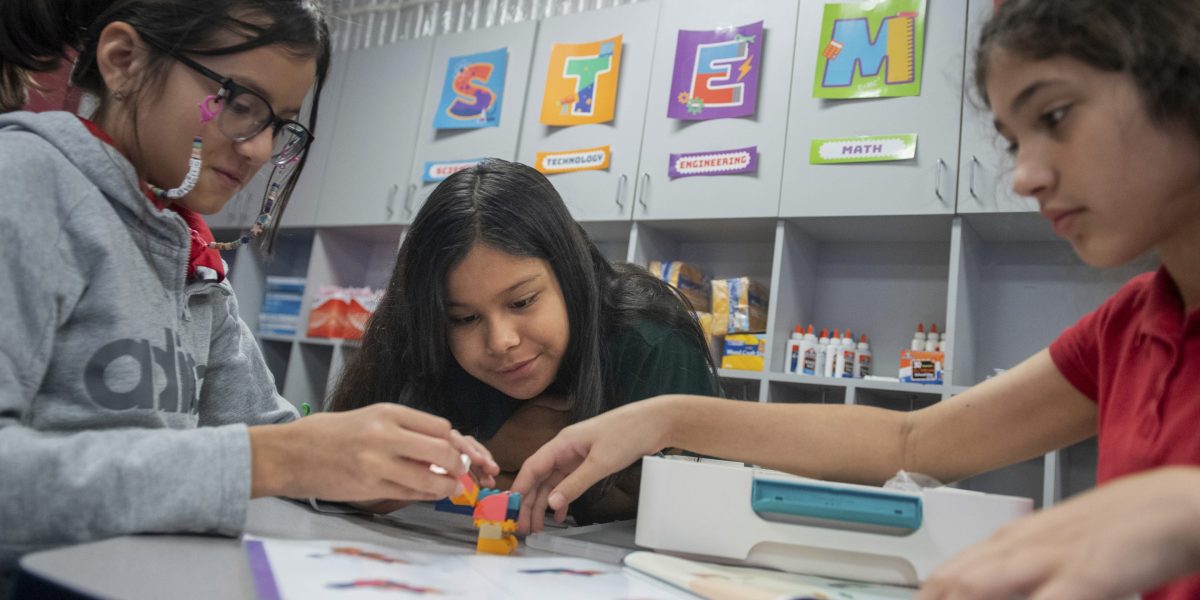
Crowded around a workshop table, four girls at de Zavala Middle School puzzled over a Lego machine they had built. As they flashed a purple card in front of a light sensor, nothing happened.

The teacher at the Dallas-area school had emphasized that in the building process, there is no such thing as mistakes. Only iterations. So the girls dug back into the box of blocks and pulled out an orange card. They held it over the sensor and the machine kicked into motion.

“Oh! Oh, it reacts differently to different colors,” said sixth grader Sofia Cruz.

In de Zavala’s first year as a choice school focused on science, technology, engineering and math, the school recruited a sixth grade class that’s half girls. School leaders are hoping the girls will stick with STEM fields. In de Zavala’s higher grades — whose students joined before it was a STEM school — some elective STEM classes have just one girl enrolled.

Efforts to close the gap between boys and girls in STEM classes are picking up after losing steam nationwide during the chaos of the COVID-19 pandemic. Schools have extensive work ahead to make up for the ground girls lost, in both interest and performance.

In the years leading up to the pandemic, the gender gap nearly closed. But within a few years, girls lost all the ground they had gained in math test scores over the previous decade, according to an Associated Press analysis. While boys’ scores also suffered during COVID, they have recovered faster than girls, widening the gender gap.

As learning went online, special programs to engage girls lapsed — and schools were slow to restart them. Zoom school also emphasized rote learning, a technique based on repetition that some experts believe may favor boys, instead of teaching students to solve problems in different ways, which may benefit girls.

Old practices and biases likely reemerged during the pandemic, said Michelle Stie, a vice president at the National Math and Science Initiative.

“Let’s just call it what it is,” Stie said. “When society is disrupted, you fall back into bad patterns.”

The pandemic upended progress toward closing the gender gap

In most school districts in the 2008-2009 school year, boys had higher average math scores on standardized tests than girls, according to AP’s analysis, which looked at scores across 15 years in over 5,000 school districts. It was based on average test scores for third through eighth graders in 33 states, compiled by the Educational Opportunity Project at Stanford University.

A decade later, girls had not only caught up, they were ahead: Slightly more than half of districts had higher math averages for girls.

Within a few years of the pandemic, the parity disappeared. In 2023-2024, boys on average outscored girls in math in nearly nine out of 10 districts.

A separate study by NWEA, an education research company, found gaps between boys and girls in science and math on national assessments went from being practically non-existent in 2019 to favoring boys around 2022.

Studies have indicated girls reported higher levels of anxiety and depression during the pandemic, plus more caretaking burdens than boys, but the dip in academic performance did not appear outside STEM. Girls outperformed boys in reading in nearly every district nationwide before the pandemic and continued to do so afterward.

“It wasn’t something like COVID happened and girls just fell apart,” said Megan Kuhfeld, one of the authors of the NWEA study.

Initiatives to boost girls’ confidence in STEM lost traction

In the years leading up to the pandemic, teaching practices shifted to deemphasize speed, competition and rote memorization. Through new curriculum standards, schools moved toward research-backed methods that emphasized how to think flexibly to solve problems and how to tackle numeric problems conceptually.

Educators also promoted participation in STEM subjects and programs that boosted girls’ confidence, including extracurriculars that emphasized hands-on learning and connected abstract concepts to real-life applications.

When STEM courses had large male enrollment, Superintendent Kenny Rodrequez noticed girls losing interest as boys dominated classroom discussions at his schools in Grandview C-4 District outside Kansas City. Girls were significantly more engaged after the district moved some of its introductory hands-on STEM curriculum to the lower grade levels and balanced classes by gender, he said.

When schools closed for the pandemic, the district had to focus on making remote learning work. When in-person classes resumed, some of the teachers had left, and new ones had to be trained in the curriculum, Rodrequez said.

“Whenever there’s crisis, we go back to what we knew,” Rodrequez said.

Bias against girls in STEM persists

Despite shifts in societal perceptions, a bias against girls persists in science and math subjects, according to teachers, administrators and advocates. It becomes a message girls can internalize about their own abilities, they say, even at a very young age.

In his third grade classroom in Washington, D.C., teacher Raphael Bonhomme starts the year with an exercise where students break down what makes up their identity. Rarely do the girls describe themselves as good at math. Already, some say they are “not a math person.”

“I’m like, you’re 8 years old,” he said. “What are you talking about, ‘I’m not a math person?’”

Girls also may have been more sensitive to changes in instructional methods spurred by the pandemic, said Janine Remillard, a math education professor at the University of Pennsylvania. Research has found girls tend to prefer learning things that are connected to real-life examples, while boys generally do better in a competitive environment.

“What teachers told me during COVID is the first thing to go were all of these sense-making processes,” she said.

A school district renews its commitment

At de Zavala Middle School in Irving, the STEM program is part of a push that aims to build curiosity, resilience and problem-solving across subjects.

Coming out of the pandemic, Irving schools had to make a renewed investment in training for teachers, said Erin O’Connor, a STEM and innovation specialist there.

The district last year also piloted a new science curriculum from Lego Education. The lesson involving the machine at de Zavala, for example, had students learn about kinetic energy. Fifth graders learned about genetics by building dinosaurs and their offspring with Lego blocks, identifying shared traits.

“It is just rebuilding the culture of, we want to build critical thinkers and problem solvers,” O’Connor said.

Teacher Tenisha Willis recently led second graders at Irving’s Townley Elementary School through building a machine that would push blocks into a container. She knelt next to three girls who were struggling.

They tried to add a plank to the wheeled body of the machine, but the blocks didn’t move enough. One girl grew frustrated, but Willis was patient. She asked what else they could try, whether they could flip some parts around. The girls ran the machine again. This time, it worked.

“Sometimes we can’t give up,” Willis said. “Sometimes we already have a solution. We just have to adjust it a little bit.”

___

Lurye reported from Philadelphia. Todd Feathers contributed reporting from New York.

___

The Associated Press’ education coverage receives financial support from multiple private foundations. AP is solely responsible for all content. Find AP’s standards for working with philanthropies, a list of supporters and funded coverage areas at AP.org.


Source link

Continue Reading

Business

Miss Universe co-owner gets bank accounts frozen as part of probe into drugs, fuel and arms trafficking

Published

on


Mexico’s anti-money laundering office has frozen the bank accounts of the Mexican co-owner of Miss Universe as part of an investigation into drugs, fuel and arms trafficking, an official said Friday.

The country’s Financial Intelligence Unit, which oversees the fight against money laundering, froze Mexican businessman Raúl Rocha Cantú’s bank accounts in Mexico, a federal official told The Associated Press on condition of anonymity because he was not authorized to comment on the investigation.

The action against Rocha Cantú adds to mounting controversies for the Miss Universe organization. Last week, a court in Thailand issued an arrest warrant for the Thai co-owner of the Miss Universe Organization in connection with a fraud case and this year’s competition — won by Miss Mexico Fatima Bosch — faced allegations of rigging.

The Miss Universe organization did not immediately respond to an email from The Associated Press seeking comment about the allegations against Rocha Cantú.

Mexico’s federal prosecutors said last week that Rocha Cantú has been under investigation since November 2024 for alleged organized crime activity, including drug and arms trafficking, as well as fuel theft. Last month, a federal judge issued 13 arrest warrants for some of those involved in the case, including the Mexican businessman, whose company Legacy Holding Group USA owns 50% of the Miss Universe shares.

The organization’s other 50% belongs to JKN Global Group Public Co. Ltd., a company owned by Jakkaphong “Anne” Jakrajutatip.

A Thai court last week issued an arrest warrant for Jakrajutatip who was released on bail in 2023 on the fraud case. She failed to appear as required in a Bangkok court on Nov. 25. Since she did not notify the court about her absence, she was deemed to be a flight risk, according to a statement from the Bangkok South District Court.

The court rescheduled her hearing for Dec. 26.

Rocha Cantú was also a part owner of the Casino Royale in the northern Mexican city of Monterrey, when it was attacked in 2011 by a group of gunmen who entered it, doused gasoline and set it on fire, killing 52 people.

Baltazar Saucedo Estrada, who was charged with planning the attack, was sentenced in July to 135 years in prison.


Source link

Continue Reading

Business

Elon Musk’s X fined $140 million by EU for breaching digital regulations

Published

on


European Union regulators on Friday fined X, Elon Musk’s social media platform, 120 million euros ($140 million) for breaches of the bloc’s digital regulations, in a move that risks rekindling tensions with Washington over free speech.

The European Commission issued its decision following an investigation it opened two years ago into X under the 27-nation bloc’s Digital Services Act, also known as the DSA.

It’s the first time that the EU has issued a so-called non-compliance decision since rolling out the DSA. The sweeping rulebook requires platforms to take more responsibility for protecting European users and cleaning up harmful or illegal content and products on their sites, under threat of hefty fines.

The Commission, the bloc’s executive arm, said it was punishing X because of three different breaches of the DSA’s transparency requirements. The decision could rile President Donald Trump, whose administration has lashed out at digital regulations, complained that Brussels was targeting U.S. tech companies and vowed to retaliate.

U.S. Secretary of State Marco Rubio posted on his X account that the Commission’s fine was akin to an attack on the American people. Musk later agreed with Rubio’s sentiment.

“The European Commission’s $140 million fine isn’t just an attack on @X, it’s an attack on all American tech platforms and the American people by foreign governments,” Rubio wrote. “The days of censoring Americans online are over.”

Vice President JD Vance, posting on X ahead of the decision, accused the Commission of seeking to fine X “for not engaging in censorship.”

“The EU should be supporting free speech not attacking American companies over garbage,” he wrote.

Officials denied the rules were intended to muzzle Big Tech companies. The Commission is “not targeting anyone, not targeting any company, not targeting any jurisdictions based on their color or their country of origin,” spokesman Thomas Regnier told a regular briefing in Brussels. “Absolutely not. This is based on a process, democratic process.”

X did not respond immediately to an email request for comment.

EU regulators had already outlined their accusations in mid-2024 when they released preliminary findings of their investigation into X.

Regulators said X’s blue checkmarks broke the rules because on “deceptive design practices” and could expose users to scams and manipulation.

Before Musk acquired X, when it was previously known as Twitter, the checkmarks mirrored verification badges common on social media and were largely reserved for celebrities, politicians and other influential accounts, such as Beyonce, Pope Francis, writer Neil Gaiman and rapper Lil Nas X.

After he bought it in 2022, the site started issuing the badges to anyone who wanted to pay $8 per month.

That means X does not meaningfully verify who’s behind the account, “making it difficult for users to judge the authenticity of accounts and content they engage with,” the Commission said in its announcement.

X also fell short of the transparency requirements for its ad database, regulators said.

Platforms in the EU are required to provide a database of all the digital advertisements they have carried, with details such as who paid for them and the intended audience, to help researches detect scams, fake ads and coordinated influence campaigns. But X’s database, the Commission said, is undermined by design features and access barriers such as “excessive delays in processing.”

Regulators also said X also puts up “unnecessary barriers” for researchers trying to access public data, which stymies research into systemic risks that European users face.

“Deceiving users with blue checkmarks, obscuring information on ads and shutting out researchers have no place online in the EU. The DSA protects users,” Henna Virkkunen, the EU’s executive vice-president for tech sovereignty, security and democracy, said in a prepared statement.

The Commission also wrapped up a separate DSA case Friday involving TikTok’s ad database after the video-sharing platform promised to make changes to ensure full transparency.

___

AP Writer Lorne Cook in Brussels contributed to this report.


Source link

Continue Reading

Business

Nvidia CEO says U.S. data centers take 3 years, but China ‘can build a hospital in a weekend’

Published

on


Nvidia CEO Jensen Huang said China has an AI infrastructure advantage over the U.S., namely in construction and energy.

While the U.S. retains an edge on AI chips, he warned China can build large projects at staggering speeds.

“If you want to build a data center here in the United States from breaking ground to standing up a AI supercomputer is probably about three years,” Huang told Center for Strategic and International Studies President John Hamre in late November. “They can build a hospital in a weekend.”

The speed at which China can build infrastructure is just one of his concerns. He also worries about the countries’ comparative energy capacity to support the AI boom.

China has “twice as much energy as we have as a nation, and our economy is larger than theirs. Makes no sense to me,” Huang said.

He added that China’s energy capacity continues to grow “straight up”, while the U.S.’s remains relatively flat.

Still, Huang maintained that Nvidia is “generations ahead” of China on AI chip technology to support the demand for the tech and semiconductor manufacturing process.

But he warned against complacency on this front, adding that “anybody who thinks China can’t manufacture is missing a big idea.”

Yet Huang is hopeful about Nvidia’s future, noting President Donald Trump’s push to reshore manufacturing jobs and spur AI investments.

‘Insatiable AI demand’

Early last month, Huang made headlines by predicting China would win the AI race—a message he amended soon thereafter, saying the country was “nanoseconds behind America” in the race in a statement shared to his company’s X account.

Nvidia is just one of the big tech companies pouring billions of dollars into a data center buildout in the U.S., which experts tell Fortune could amount to over $100 billion in the next year alone.

Raul Martynek, the CEO of DataBank, a company that contracts with tech giants to construct data centers, said the average cost of a data center is $10 million to $15 million per megawatt (MW), and a typical data centers on the smaller side requires 40 MW.

“In the U.S., we think there will be 5 to 7 gigawatts brought online in the coming year to support this seemingly insatiable AI demand,” Martynek said.

This shakes out to $50 billion on the low end, and $105 billion on the high end.


Source link

Continue Reading

Trending

Copyright © Miami Select.