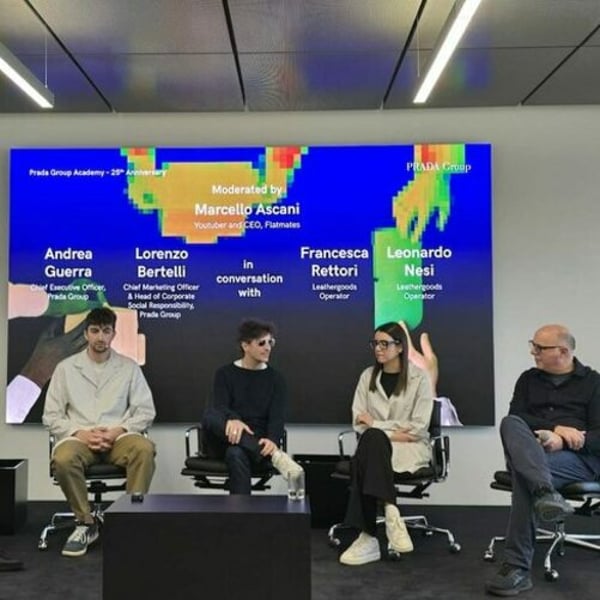
At a time when the fashion and luxury industry is facing numerous challenges—not least concern over generational renewal in a sector that stands as a flagship of Italian craftsmanship—the Prada Group has reaffirmed its commitment to training new talent.
Prada Group opens the doors of its Academy in Scandicci
To mark the 25th anniversary of the Prada Group Academy, the company opened the doors of its Scandicci site to show guests in attendance, including FashionNetwork.com, the activities carried out at the training centre. It was an opportunity to explore, together with the group’s CEO, Andrea Guerra, and Lorenzo Bertelli, the importance of attracting younger generations to craftsmanship in order to preserve the savoir-faire behind Italian excellence.
The meeting was opened by a speech from Claudia Sereni, Mayor of Scandicci, underscoring the importance of the bond between institutions and companies in the area.
“Scandicci is not only a city that is home to big brands, but also to subcontractors—the hands that make the products. We are witnessing a severe industrial crisis; we know that markets naturally go through cycles, but right now it is difficult for the entire supply chain to understand how to regenerate. In a context like this, training becomes even more crucial: we need young people who can interpret the emerging needs of companies and give shape to your projects,” Sereni said.
“We hope to forge ever-stronger relationships with brands, collaborating with their training initiatives. For our part, we are looking for ways to bring out the cultural value of leather goods, sharing it with citizens and tourists. We have an ambitious project: to create a Museum of Accessories, which can convey the value of craftsmanship, and which could be built in a roof garden located above an underpass of the A1 motorway—a unique place in Europe that could act as a meeting point between the city and manufacturing.”
Turning to the hot topic of the day—generational turnover—the figures speak for themselves, and they are not reassuring: more than 270,000 specialised professionals in manufacturing will be needed by 2028, 75,000 of them in luxury alone, and it is estimated that the current supply meets only 50 per cent of demand.
These numbers do not worry Guerra: “In the world of manufacturing people often think that work is made up of assembly lines, components, repetitive actions, but this is absolutely not true. What we do is industrial craftsmanship—80 per cent hands, mind and heart. Here in Scandicci we work with leather, which by definition is a living element; no two pieces of leather in the world are the same. There are countless small, almost imperceptible aspects in its processing that must be overseen by expert eyes and hands; otherwise, we would not be able to create the products we make,” the CEO stressed. “Another very important aspect, which should always be remembered, is that in luxury there can be no rush. It is a job that requires great patience, to be learned over years of practice; it is a long yet fundamental journey—otherwise we would do something else.”
“I’m not worried about generational change because, especially since Covid, I see in young people the desire for a different life, for balance, for less alienation. Of course salary is important, but it is not the only thing they value. We need to create a business environment where people enjoy being, investing in training so that they continually learn and do more, but also in welfare—for example, with policies to promote women’s employment, a very important issue for us because we have a great many female employees,” Guerra added.
On how to attract young people to manual jobs, which are sometimes undervalued, Bertelli commented: “I think that today the myth of ‘white-collar workers’ is fading, also because many of the activities carried out in an office can now be done by technology, which is capable of supplanting people in this type of task. One thing, however, that technology can never replace is the craftsperson’s ability to work with their hands—their know-how, their skills developed over years of work; this is what we need to convey to young people. For this reason, those who learn a craft should not be afraid of new technologies such as artificial intelligence, which will probably cause some initial ‘shock’, but for those who have the ability to innovate they will become tools that further elevate people’s work, especially in manufacturing,” the entrepreneur stressed.
“It is of paramount importance how we communicate all this to young people, helping them see that this work has nothing to do with an assembly line—making it feel current and modern. I think the most exciting thing for a person is knowing that with their own hands they can create something that no technology will ever be able to do.”
In her remarks during the conference, Rosa Santamaria Maurizio, chief people officer of the Prada Group, emphasised how important it is for the company to “put people at the centre and focus on emotions.”
“We embed these principles at the heart of the company and bring those who will come to work with us into our production sites and our stores, so that they can see first-hand how we work. We are training the group’s people leaders on these pillars,” the manager explained.
“Then, of course, diversity and inclusion—therefore equal opportunities for all—are fundamental for us, and we are about to obtain gender equality certification. A project that Lorenzo Bertelli strongly wanted to activate is also ‘Drivers of Change’, through which employees propose initiatives they believe in, which the company then tries to implement, including bringing their family members into the company so that they can see the work environments and experience the atmosphere. In our work, the Academy is a strategic asset because it creates an exchange between generations, between master artisans and students, which is working very well in both directions.”
Also present at the conference were two Academy students, Leonardo and Francesca, whom Guerra addressed—as he did all young people—in his closing remarks: “I give you the same advice I give my children about the world of work: be humble but challenging. Humble in the sense of not backing down if you need to arrive an hour earlier, go the extra mile or work an extra hour. But challenging because your future is also in our hands, so feel free to ask questions and someone will have to give you real answers. This can make your future rich,” the CEO said. “To our master artisans, however, I want to say thank you, for still having the ability and the desire to pass on their knowledge and skills to you.”
Prada Group Academy: the numbers
Prada Group Academy—which has dedicated spaces in Tuscany, Marche, Veneto and Umbria—trains around twenty young people in each session, 70 per cent of whom subsequently find employment within the group’s companies. Between 2021 (the year courses resumed after Covid) and 2024, 29 courses were run in the categories of Leather Goods, Footwear and Apparel, increasing progressively (from 3 in 2021 to 11 in 2024).
Since 2021, a total of 571 trainees—of 18 nationalities; 69.7 per cent women and 30.3 per cent men—have been trained; in 2024, of the 120 young people who completed their training, 82 were hired by the group.
This year, seven training programmes were launched across the three categories, with 78 trainees trained (as at November 2025) and three Academy programmes currently under way in the Leather Goods and Apparel areas, for a total of 152 participants enrolled and confirmed (up 28 per cent on 2024). In September, a new edition of the men’s footwear course began in Montegranaro, while last October in Torgiano training began for technical roles dedicated to knitwear.
This article is an automatic translation. Click here to read the original article.