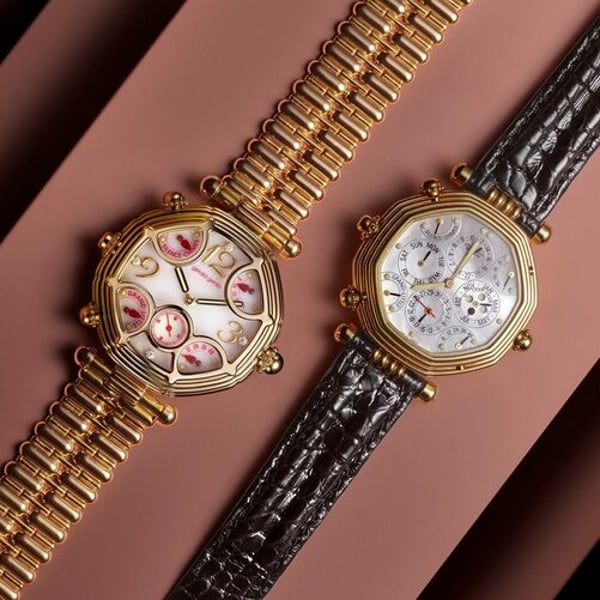
Looking back on a long year of trips to Switzerland, tours of manufactures and museums and trade shows, and interviews with watchmakers around the world, I think it’s fair to say 2025 was an excellent year for watches.
LVMH watch brand Gérald Genta – Gérald Genta
There were major debuts, including the Vacheron Constantin clock and automaton that was installed at the Louvre, as well as the totally new Rolex Land-Dweller line that premiered in March. There were innovations such as Audemars Piguet’s Royal Oak RD#5, with its thin case, tourbillon, and ultra-easy chronograph pushers, plus Breguet’s magnetic escapement in its avant-garde Expérimentale 1.
Cartier, Bremont, Maen, Fears, and others kick-started a trend of funky jumping-hour watches I expect we’ll see continue for some time. Urban Jürgensen debuted and immediately inflamed the passion of high-net-worth collectors with its movements by Kari Voutilainen and its prices in the hundreds of thousands of dollars.
But my favourite thing this year was that brands at every price point began to embrace bold colour and shapes. The rapidly expanding trend of stone dials is a big part of this, as is a desire among collectors to find design-forward watches inspired by the cool case forms of the 1960s, ’70s, and ’80s. It’s one thing to wear a complicated watch that only enthusiasts will know is significant. It’s another to wear something rad that’s so plainly beautiful, anyone will stop you to ask about it.
As such, here are some graphic watches from 2025, in order of price.
Studi0 Underd0g Av0cado
If you missed your chance to scoop up this particular fruit-themed timepiece from the quirky, UK-based brand Studi0 Underd0g, never fear. There will be others to come. The colour combo on the front is of course delightful, and was actually inspired by a copycat avocado watch spotted by brand founder Richard Benc. But as always with SU’s watches, the excellent finishing on the chronograph movement is just as fun to admire through the transparent case-back. Price: $675
Baltic is a great entry-level brand that always has fun with styling. If you can’t manage to chase down a candy-pink Rolex Oyster Perpetual (spoiler: you can’t), this is a fun alternative you don’t have to be too precious about. Part of Baltic’s new “prismic stone” line, this manual stunner has a bright dial of the mineral albite. The domed crystal has a nice retro feel- as does the tidy 36-millimeter size. Price: $1,590
Nomos Glashütte Club Sport Neomatic Worldtimer
These watches were on tons of “best of” lists, and for good reason: The 40mm worldtimer comes in six bright colour combos that are eye-catching and well designed. The countries around the edge of the dial move with a press of a pusher, and there’s a central 24-hour subdial you can use to always track your home time. Plus, the price tag can’t be beat. Price: $5,190
MB&F M.A.D. 2 Green
You can’t get this anymore, because it was distributed by lottery, but I just love this collaboration between the wizards at MB&F and the watch designer Eric Giroud. It has a bidirectional jumping-hour module developed by the MB&F team and is powered by a Swiss-made La Joux-Perret movement, with 64 hours of power reserve. The rotor spins behind the dial, creating a cool visual effect through the dots around the rim. Look for it on the secondary market ($6,000 more or less), or get ready for the next M.A.D. Editions raffle.
The new matte colour for Chanel’s classic ceramic watch from 2000 is elegant and understated but also bold. Just read Jack Forster’s paean to the original in Hodinkee from 2022- people are sleeping on this watch, and I hope the blue tone opens it up to a whole new crew of wearers. Price: $11,050
Cartier Tressage
The 18-karat gold gadroons are so striking and outrageous, it looks like something Cate Blanchett would have worn as part of her impeccably chic jewellery collection in the 1950s-set movie Carol. Sometimes class doesn’t bother with whispering. Price: $44,000
H. Moser & Cie. Endeavour Small Seconds Concept Pop
At Watches and Wonders in April, Moser launched a whole series of stone dials that were a step away from the striated malachite and tiger’s eye we were seeing with other brands. These were so clean, and the borders between stones so impeccable, they almost looked painted. As with many watches from this brand, a layperson wouldn’t know there’s extremely high-level horology within the case- but with this colour combo, it would turn their head anyway. Price: 39,000 Swiss francs ($49,500)
Andy Warhol used to wear a chunky, distinctive Piaget called the Black Tie- which was among seven Piaget watches he owned. In 2024 the brand began an official collaboration with the late artist’s foundation to rename the watch the Andy Warhol. This one, which is limited to 50 pieces, has an 18-karat yellow-gold case and an onyx dial that bears slivers of yellow serpentine, pink opal and green chrysoprase. At a hefty 45mm by 43mm, it’s a big ol’ thing, but on the wrist it’s impossibly chic. Price: $78,000
Gérald Genta Gentissima Oursin Fire Opal
The LVMH-owned Gérald Genta brand won the Ladies’ Watch Prize at the 2025 Grand Prix d’Horlogerie de Genève, the Oscars of watchmaking, for this fiesty “sea urchin” timepiece set with 137 fire opals and an orange carnelian dial. Price: Upon request
In addition to her timeless staples of womenswear, simple pieces such as the Breton top and ballet pumps, Brigitte Bardot’s style is also defined by silhouettes that are both sexy and emancipated- a blend of masculine and feminine, Western flair and glamour- more than ever in tune with the times.
French actress Brigitte Bardot, 29 January 1962, Paris – AFP/Archives
Ballet flats
A ballet dancer before becoming a world-famous actress and singer, Brigitte Bardot was used to wearing Repetto ballet slippers. In 1956, she asked the brand to create a ballet flat that was just as light and comfortable, but more flattering and sexy. This ballet flat, christened Cendrillon, was immortalised in carmine red in Roger Vadim’s “Et Dieu… créa la femme.” This model has been a cult Repetto shoe ever since, produced in a variety of colours and materials.
Paired with full midi skirts, cigarette trousers, or Capri trousers, the actress was rarely without these flats. Thanks to her, the ballet flat took to the streets and even to Hollywood.
Gingham print
In the 1960s, brides wore white, but B.B. broke with convention. In 1959, she married actor Jacques Charrier in a pink gingham dress with three-quarter-length sleeves trimmed with broderie anglaise. The look was crowned by a voluminous blonde mane, with no accessories.
Until then, checked prints were associated with tea towels or jam jars.
“I designed a dress that reminded me of the little shepherdesses of the 18th century,” explained the designer of the dress, Jacques Esterel, who went on to sell millions of them worldwide.
Decades later, the legend still sells: in 2010, the luxury leather goods house Lancel launched a line of “B.B.” bags with a bright pink gingham lining.
Marinière
While Chanel adapted this masculine, military garment for women, it was B.B. who made this striped T-shirt famous worldwide, wearing it either loose or close-fitting.
Bardot neckline: the actress gave her name to a neckline that bares the shoulders and upper chest, sometimes heart-shaped.
Western
In the late 1960s, B.B., in a leather micro-dress and thigh-high boots designed for her by Roger Vivier, sang that she “didn’t need anyone on a Harley-Davidson.”
In the 1970s, she embraced Cavalli‘s style, as he opened a boutique in Saint-Tropez, where the actress lived, characterised by his signature mix of denim and leather and animal prints.
Blonde volume, doe eyes
Whether worn loose and tousled, in a backcombed chignon or a beehive, the star’s ever-voluminous hair was widely copied.
It was sometimes adorned with a headband to highlight the eyes. The actress made the smoky eye fashionable, using eyeliner to accentuate her doe eyes.
This article is an automatic translation. Click here to read the original article.
The Brigitte Bardot Foundation, which she founded, announced her death in a statement, expressing its “immense sadness” at the death of the woman “who chose to abandon her prestigious career to devote her life and energy to the defence of animals.”
French actress Brigitte Bardot, on 23 January 1978, in Strasbourg. – AFP Archives
The star of “Et Dieu… créa la femme” and “Le Mépris” died in the morning, at her famous residence, La Madrague, in Saint-Tropez, the foundation told AFP.
At the scene, the dirt track through the bamboo leading to the villa was blocked by a gendarmerie vehicle, an AFP journalist noted.
“We saw her often. I’d watch her go by and, when she was in a good mood, she’d blow us kisses,” said Nathalie Dorobisze, a 50-year-old Saint-Tropez resident, in tears. “It feels strange that she’s no longer here, because she’s always been here.”
La Madrague was a BB touchstone, and it was also the name of the fashion label she launched.
On the same social network, Marine Le Pen, leader of the Rassemblement National, with whom Brigitte Bardot made no secret of her affinity, paid tribute to an “incredibly French” woman: “free, indomitable, uncompromising.”
In recent years, Brigitte Bardot, who embodied the liberalisation of social mores in 1950s France, was known above all for her statements on politics, immigration, feminism, hunters… some of which resulted in convictions for racist insults.
“Freedom means being oneself, even when it’s inconvenient,” she proclaimed defiantly, as the epigraph to a book titled “Mon BBcédaire”, published in early October.
Before making headlines for her stances, the woman known by her initials B.B. was nothing short of a myth.
That of a woman liberated from moral, sartorial, romantic and sexual codes—and from what was expected of her. A woman who “didn’t need anyone,” as Serge Gainsbourg had her sing in 1967, as familiar in Cannes as on Brazilian beaches.
Brigitte Bardot, the first celebrity to lend her features to the bust of Marianne, was a kind of French Marilyn Monroe- likewise blonde, with an explosive beauty and a tumultuous private life, hounded by the paparazzi.
B.B., Marilyn, “I’m sure their two stars form the most beautiful duo in the sky,” Francis Huster, who worked with Bardot in 1973, told AFP.
Marilyn was “a woman who was exploited, whom nobody understood, and who died as a result,” recalled Bardot, who had met her in 1956.
It was a mistake she would not repeat, bowing out at 39, leaving behind around 50 films and two scenes that have entered the pantheon of the Seventh Art: a feverish mambo in a Saint-Tropez restaurant (“Et Dieu… créa la femme”, 1956) and a monologue in which she, nude, listed the different parts of her body, at the opening of “Le Mépris” (1963).
“Nobody has described Bardot better than the writer François Nourissier,” former Cannes Film Festival president Gilles Jacob told AFP: “‘an unstable balance between caprice and damnation’.” Pierre Lescure, another ex-president of the festival, paid tribute to her “crazy, somehow new beauty- absolute and brazen.”
Nothing foretold such a destiny for the young Brigitte: born into a bourgeois Parisian family in 1934, she developed a passion for dance and tried her hand at modelling. At just 18, she married her first love, Roger Vadim, who gave her the role of Juliette in “Et Dieu… créa la femme,” a film that shook up the established order and branded her a sex symbol. With the film’s success, she shot film after film, stirred passions, and got burnt by the limelight.
In 1960, at the height of her fame, she gave birth to a boy, Nicolas, her only child, under the prying eye of the press. Declaring herself devoid of maternal instinct, the actress let her husband Jacques Charrier raise their son.
She later married German millionaire Gunter Sachs, then industrialist Bernard d’Ormale, who was close to the Front National.
Baby seals
She then became another Bardot, a figurehead for animal welfare. The turning point came on the set of her last film, “L’histoire très bonne et très joyeuse de Colinot trousse-chemise” (1973), opposite a goat that she bought and installed in her hotel room.
Defending elephants, opposing ritual slaughter, bullfighting, and the consumption of horsemeat… the fight was only just beginning.
In 1977, she travelled to the ice floes to raise awareness of the plight of baby seals, a highly publicised sequence that made the front page of Paris Match and left her with bitter memories.
Most of her second life unfolded out of the public eye, in the south of France, between La Madrague and a second, more discreet residence, La Garrigue. There she took in animals in distress and ran the foundation that bears her name, founded in 1986.
An organisation that continued to benefit from the glamorous image of her beginnings. The fashion label that bears her name, Brigitte Bardot Paris, offers modern collections inspired by the silhouettes of the 60s and 70s. The company that develops the brand donates a share of its revenue to Family Trademark TLM, which holds the exclusive worldwide rights to the Brigitte Bardot brand and funds the Brigitte Bardot Foundation. The former actress also has a lingerie brand in her name, Brigitte Bardot Lingerie.
In an interview with BFMTV in May, she confided that she longed for “peace, nature” and to live “like a farmer.” This autumn, she was hospitalised for an operation, the nature of which was not disclosed.
Evoking her death, she warned that she wanted to avoid the presence of “a crowd of arseholes” at her funeral.
FashionNetwork.com with AFP
This article is an automatic translation. Click here to read the original article.
Reading “A Career in Fashion,” the autobiography of the celebrated Bill Cunningham (published in Spanish by Editorial Superflua), fills the reader with a healthy envy. There are figures who trace astonishing character arcs with their lives and seem to live more than one life. Cunningham was a milliner, a young salesman in a New York department store, a columnist for Women’s Wear Daily and, in the final stage of his life- the one that launched him to stardom on social media- a street-style photographer famed for criss-crossing the Big Apple on his bicycle in his blue jacket. The life of Fernando Rius, who founded the agency Area Comunicación Global in 1995, has something of the same quality.
A conversation with Rius and a simple question (“how did you get started in this?”) is enough to realise that he has also lived many lives. He was involved in the launch and development of Cabás, which could be described as Madrid’s first “concept store,” stocking pieces by Issey Miyake, Azzedine Alaïa, Francis Montesinos, and Adolfo Domínguez. He was buying director at Loewe, working alongside Enrique Loewe, and, in Vogue Spain’s early years, he wrote runway reports and designer interviews for the title.
Fernando Rius, founder of AREA Comunicación Global – AREA CG
Three decades ago, Fernando Rius shaped a communications agency which, without abandoning its family character and boutique spirit, has established itself beyond Spain’s borders, with a team of fifty people and offices in Mexico City and Lisbon, in addition to Madrid. As the agency marks its 30th anniversary, having specialised in the luxury segment since its inception, FashionNetwork.com talks to its founder about the past, present, and future of the sector.
FNW: How did you come up with the idea of creating a communications agency at a time when this concept hardly existed in Spain?
Fernando Rius: When I found myself in need of reinvention, I realised that I had very comprehensive experience, from dressing a window to heading a brand’s buying, doing trunk shows, writing for a magazine, producing fashion shoots… I knew the whole process, from the conception of a fabric to its sale, including the creation of desire through a publication. That had been my experience for 18 years and the logical next step was to set up a consultancy. All this has taken shape over 30 years to create what Area is today. In the early days, I didn’t have the clarity or vision I have now.
FNW: And how did your first clients come?
F. R.: Someone spoke about me in Italy. I had excellent contacts from my time at Condé Nast, and a team in Italy asked whether I would handle communications for their brand. At the time, I wasn’t entirely sure what they were asking of me, but I said yes. That brand was Tod’s, and it was my first client, along with Calvin Klein, which was entering a new chapter. They asked me to organise an event in Madrid for the opening of their boutique on Ortega y Gasset, with Kate Moss as the special guest.
I launched the agency with those two clients, plus consultancy for Loewe and for Zegna. I worked with a Spanish designer named Roberto Verino, and with another—Roberto Torretta—who had not yet launched his brand; I began advising him, and two years later he took to the Cibeles runway. Then came the CityTime group, Ralph Lauren, Gucci, and Burberry. Over the years, the agency has grown around the fashion sector, and also lifestyle.
FNW: How have you managed to stay focused amid this growth?
F. R.: We have had fascinating clients, from 30-year-old premium spirits to music boxes that take a year to make and cost as much as a plane. We’ve handled brands, products and projects that have given us a unique inside view of luxury. We have worked with major houses, but always in very close, almost family-like settings, where we have been able to engage in very direct dialogue with the brands and their creators.
This has given us a very privileged insight because we have experienced true luxury. Luxury is not buying something expensive; it is understanding the culture, the history, the time that lies behind each product.
FNW: In the last 30 years the world of communication has changed a lot, largely thanks to (or because of) technology. How do you get along with it?
F. R.: We have always tried to be very consistent with the principles that led me to create the agency. We go hand in hand with technology, but we don’t let it dominate us. We embrace the new: we have had an office in the metaverse for three years; we did a “press day” with augmented reality in the middle of the pandemic because we wanted to allow journalists, who were at home, to take a virtual- but almost physical- trip to our offices and to the world that had shut down at that time: the catwalk shows, the showrooms, and travel. Now, of course, we use artificial intelligence, but with an internal code of ethics that the team has to respect. What we cannot do is allow artificial intelligence to supplant the human brain and our ability to think- and to make mistakes.
FNW: Historically, Spain has not been a big market for luxury. What is it like to work in the sector in this country?
F. R.: Spain is now far more interesting than before due to geographic, social, cultural, and economic shifts. There are people coming to invest, but Spain has never been a country that has contributed in any radical way to the growth of the big brands. We do our bit, but we are not China, the United Kingdom or the United States. That gives you a very special perspective because you learn to live with your reality: we have to hold our own against the United States and all the big European- and, of course, Asian- capitals when it comes to results or delivering what is asked of us. But we work for a market that represents a very small percentage of the revenues of the big firms. That teaches you to be tremendously dynamic, efficient, and competitive with lean structures. And it forces you to learn to survive, but above all to be creative in a state of, shall we say, permanent crisis.
FNW: If we talk about crises, in the last three decades the sector and the economy have gone through a few. How have you navigated them?
F. R.: Area has so far survived the September 11 attacks, the fall of Lehman Brothers, and Covid, which doesn’t mean there couldn’t be a crash tomorrow that wipes us out. I mean we have survived all that by adapting and being enormously flexible. It is true that, in 2014, I began to seriously consider that Area needed to diversify risk and I realised that I couldn’t expand either into the United States or further within Europe because my clients were all European or North American. I could see that some of our clients already wanted to enter Latin America, so in 2014 I went to Mexico, began exploring the market and, after various twists and turns, we opened a subsidiary that has now been operating for 11 years.
Mexico is a very dynamic market. And Mexico keeps you humble: when you think you have achieved something, you go back to square one and have to start all over again. It has been an absolutely fascinating experience and, to be very honest, it is what allowed us to survive times as hard as the Covid pandemic in 2020. We also have a small office in Portugal that we use to triangulate Iberia with Latin America.
FNW: With your experience and expert eye, how do you see the current situation of fashion and its near future?
F. R.: The future of fashion lies in restoring primacy to those who have the talent and in accepting that the mass market is a battlefield, but it must once again be nourished by the creative ideas of those who really take the risk, day in and day out, of putting a wild idea on the table. I think fashion has to go back to dressing “immense minorities.” I think the sector is going to experience an interesting catharsis in the coming years; the big groups will find themselves needing to start divesting not of loss-making brands, but of brands they cannot, or do not know how to, manage. And we have to give the power back to the creator, to the person who really has the ideas, and let them develop those ideas.
FNW: How do you envisage the next decades for Area?
F. R.: Growing steadily, seeking synergies, but always keeping two things: the family environment and a small structure. My motto is “think small” because, if you think small, you’ll create on a grand scale. I see Area, more than ever, as a human, humanist project, where technology can only be at the service of creativity and not the other way round. Obviously, I hope Area will outlive me, and that is the future I would like it to have.
This article is an automatic translation. Click here to read the original article.