Sports
The Modern NFL Began In The Bronx On December 28 1958
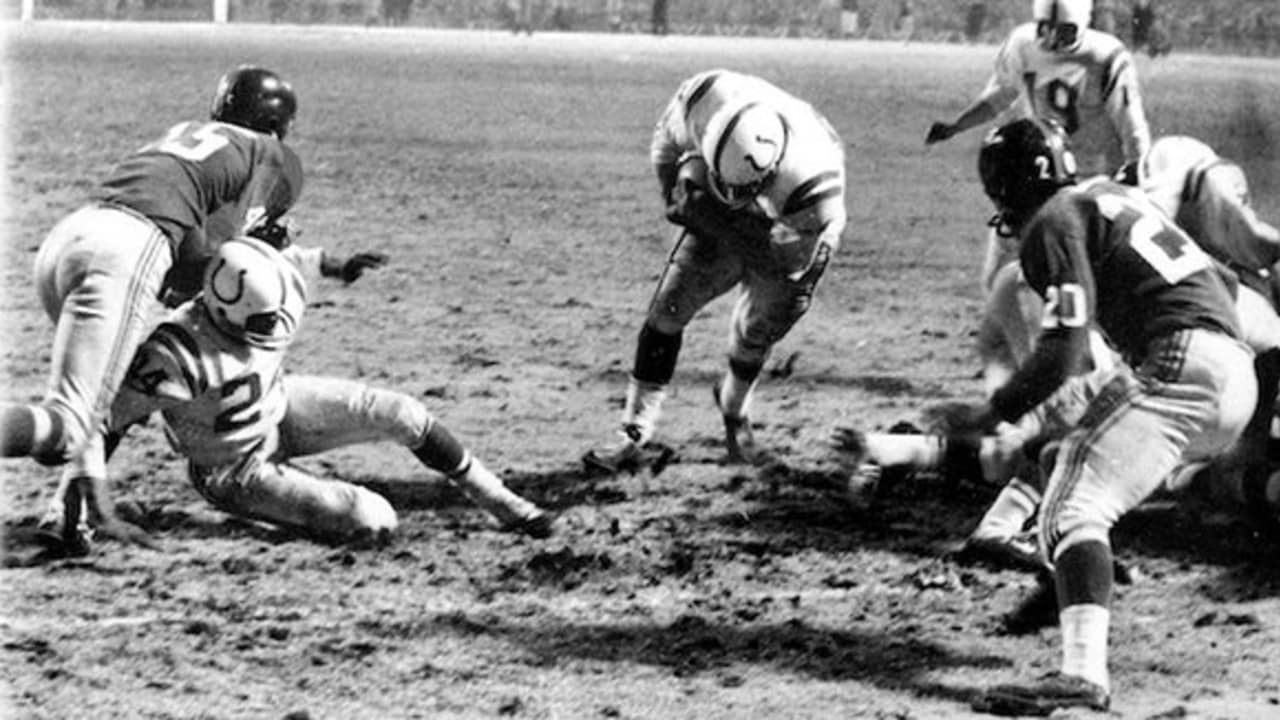
The Colts-Giants NFL Championship Game was not well played but it left an indubitable on the industry.
On December 28th, 1958, the modern National Football League was born at New York’s Yankee Stadium. It was the National Football League championship game and there was an expectation that the New York Giants would easily defeat the Baltimore Colts. Both teams would pack up the equipment and the NFL would shut down until training camp in July 1959. The NFL was just a mom-and-pop part time operation. Chicago Bears owner George Halas ran a sporting goods store in the off season. Players worked jobs in the off season as did coaches. The NFL was just a step above semi-pro status.
In 1958, the National Football League was just another struggling sports entity. The league had 12 franchises with varying degrees of success.
Two events changed the league. The Baltimore Colts-Giants 1958 Championship Game and the problems the Chicago Cardinals were having at the gate. In 1958, as pro football began to stabilize economically, two Texas business men, Lamar Hunt and Bud Adams applied for expansion franchises in Dallas and Houston respectively. NFL owners said no. Both had also tried to buy the Chicago Cardinals with the idea of moving them to Texas. Both bids were turned down.
On the field, the New York Giants were becoming the glamour boys of Madison Avenue led by the handsome Frank Gifford. The Giants were the NFL champions in 1956 and finished the 1958 season in a tie with Cleveland on top of the NFL Eastern Conference. They beat the Browns 10-0 in a playoff game and faced the Baltimore Colts in the championship contest.
The Giants had Gifford, Charley Conerly, Kyle Rote and Sam Huff. Highly recognizable names. The Colts history traced back to the New York Yankees brief fling in the NFL in 1951. Unitas, Raymond Berry, Lenny Moore, Gino Marchetti and Artie Donovan were fine players but the New York media had convinced the sporting public that simply the Giants were better.
“I was very fortunate to have been part of two great games,” said Weeb Ewbank who led the Colts in 1958. “The 1958 game was supposed to have been the greatest game ever played and Super Bowl was the biggest upset.
“Our theme for that day was that we thought we were a good football team. Everybody else was supposed to be the better football team. Our theme for that game was known your football, play it well and execute it”
The Colts and Giants finished regulation tied at 17-17. The Colts tied it on a Steve Myhra field goal with just seven seconds remaining. The Colts won it in overtime– after Unitas led the team downfield capped by Alan Ameche’s one yard touchdown run with 8:15 gone in the overtime.
The on-field drama had viewers tied to their TV sets and convinced both TV executives and Lamar Hunt that football had arrived.
Hunt decided if he couldn’t join the NFL, he might as well compete with them and by 1959; the American Football League was organized with franchises in Dallas, Houston, Los Angeles, Minneapolis, Denver and New York. Eventually Boston and Buffalo would join the league, but Minneapolis owner Max Winter dropped out when the NFL awarded him an expansion franchise to the Twin Cities in 1961 and eventually that franchise ended up in Oakland.
“The first organizational meeting of the AFL was in mid-August of 1959 in Chicago,” recalled Hunt. “I think there was an opportunity, the sport needed to grow. It had gone through a consolidation period and we had seen the 1958 great championship game between the Giants and Colts.
“There was great national interest in the game and there were a lot of cities frankly that were growing, not all of them had great stadium facilities. But it was beginning to happen. The public was beginning to perceive that this game had a national appeal.”
While Hunt thought the 1958 championship game was proof that the public had accepted pro football, Johnny Unitas didn’t realize that his performance along with his teammates and the Giants would change the course of pro football’s history.
“No, it was just another ballgame, that’s all it was. You never think of those things going into them. It just happened to be the one that was a championship game that happened to be in overtime, the first overtime game ever and it happened to be the one that was watched by more people than any other sporting event in the world at that time,” he said.
“It was not an outstanding football game for us. The reason why people remember is the overtime and the way we tied it up. It put football over the top and into the prominence it holds.”
Hunt’s first move after he decided to go ahead with the American Football League was to meet with Adams in Houston. Hunt felt a Dallas-Houston rivalry would be important for the new league. Hunt also noted that NFL attendance had grown from nearly two million in 1950 to more three million in 1958.
The NFL signed a TV deal with CBS in 1956 and further pushed pro football into a nation’s consciousness.
“The others came from really from names that were interested in getting the Chicago Cardinals to move to their city,” he explained. “Harry Wismer was not in that group. He was a stockholder, interestingly in two NFL teams, Detroit and Washington and I don’t know how that came about, but he came in a little later with the New York Titans.
“Ralph Wilson and Buffalo also came in October and his franchise became the seventh and then the Boston Patriots with Bill Sullivan became the eighth franchise and then we went through another consolidation and lost one team and then added the Oakland Raiders as the eighth team,” he remembered.
Sullivan was interested in bringing an NFL team to Boston and was one among the first people to conceive the idea of putting luxury boxes into a stadium in 1958.
He went to NFL Commissioner Bert Bell with architectural plans for a stadium in Norwood near the airport. The stadium had a roof and executive boxes and the idea was to have the Boston Red Sox move out of Fenway Park as a co-tenant.
The plan died when word leaked out and the Red Sox walked away from the stadium idea. Sullivan entered the AFL without a home field and jumped from stadium to stadium within the Boston area.
“In 1958, it was kind of the golden age of the NFL,” said Jack Kemp who was a backup quarterback with the New York Giants that year. “You had Conerly, Tittle, all the great quarterbacks, Gifford. When the AFL started, admittedly it was a new league and everybody thought it would fold immediately.
NFL Commissioner Bert Bell died of a heart attack suffered at Franklin Field in Philadelphia during a Stealers-Eagles game on October 11th, 1959. It was under Bell’s tenure that the Chicago Cardinals began their quest to move. The NFL had concluded the Cardinals and Bears could not share the then second biggest market in the country. The two had reached an agreement in the 1930s whereby the Bears would play all of their games north of Madison Street and the Cardinals would stay on the south side.
The Cardinals wanted out of Comiskey Park and looked to move north of Madison Street to play their games. In 1959, the Cardinals played four of their home games at Soldier Field and two in Minneapolis. The only time the Cardinals drew a large crowd for a home game in the 1950s was against the Bears.
George Halas asked Bell to come up with a decision on the Cardinals planned move north. Bell turned down the Cardinals request. Bud Adams met with the Cardinal ownership in an attempt to buy the team and move them to Houston. Adams even staged a preseason game between the Bears and Stealers to convince NFL officials that moving to Houston would be profitable. The NFL had no expansion plans and was forced to deal with Cardinals Chicago problem.
The same day that Hunt was elected AFL President, January 26th, 1960, Alvin Ray “Pete” Rozelle was elected as the NFL Commissioner as a compromise candidate on the thirty-third ballot.
Two days later, on January 28th, 1960, the National Football League awarded a franchise to Clint Murchinson to operate the Texas Rangers franchise in Dallas. The Rangers would become the Dallas Cowboys and go head-to-head with Hunt, the AFL and the Dallas Texans. Even though NFL owners were trying to throw Hunt a roadblock in his efforts to establish both the AFL and his Dallas franchise, the owners did not go out of their way to make the team very competitive. The Cowboys finished the 1960 season at 0-11-1.
CBS, which was televising NFL games, needed a solution to the Bears Cardinals two market setup. Since the teams never played head-to-head unless they played one another, and the league was blacking out home games, CBS never showed games in Chicago.
On March 13th, 1960 the Cardinals moved to St. Louis after receiving $500,000 for “improvements” at Soldier Field. Some of that money came from CBS. In truth, it wasn’t just that the NFL “allowed” the Cardinals to move to St. Louis, the league and the George Halas Chicago Bears paid the Cardinals and the Bidwill family to move. In the NFL, money talks. The Cardinals took their Chicago grandstand with them to St. Louis.
But what if there was no Lamar Hunt, no Bud Adams? No Ralph Wilson, Bill Sullivan, Barron Hilton or the rest of what the media dubbed “The Foolish Club?”
“Probably the game would have taken a different course. Certainly the league would have expanded. I would hate to hazard a guess how many teams it might be. But the AFL jerked the game of pro football forward rapidly into an era where were all of a sudden instead of there being 12 teams, in one year’s time there were 21 teams. Before 1960, you had two West Coast cities in the NFL and the rest concentrated in the Northeast. The AFL changed all of that.
Suddenly you had pro football in cities that didn’t have it before, Dallas, Denver, Houston and Buffalo.
‘That was remarkable addition and of course signaled other expansion,” said the Kansas City Chiefs owner. “There was a need for a second football league.
The argument could be made you have to fill a need. But there was a need, a natural opening for it.
“The AFL was very fortuitous. It had perfect timing.”
The two leagues merged in 1966. The NFL ascendancy can all be traced to two things, the 1958 NFL Championship Game featuring the Colts and Giants and CBS wanting the Chicago Cardinals to move out of the south side of the city.
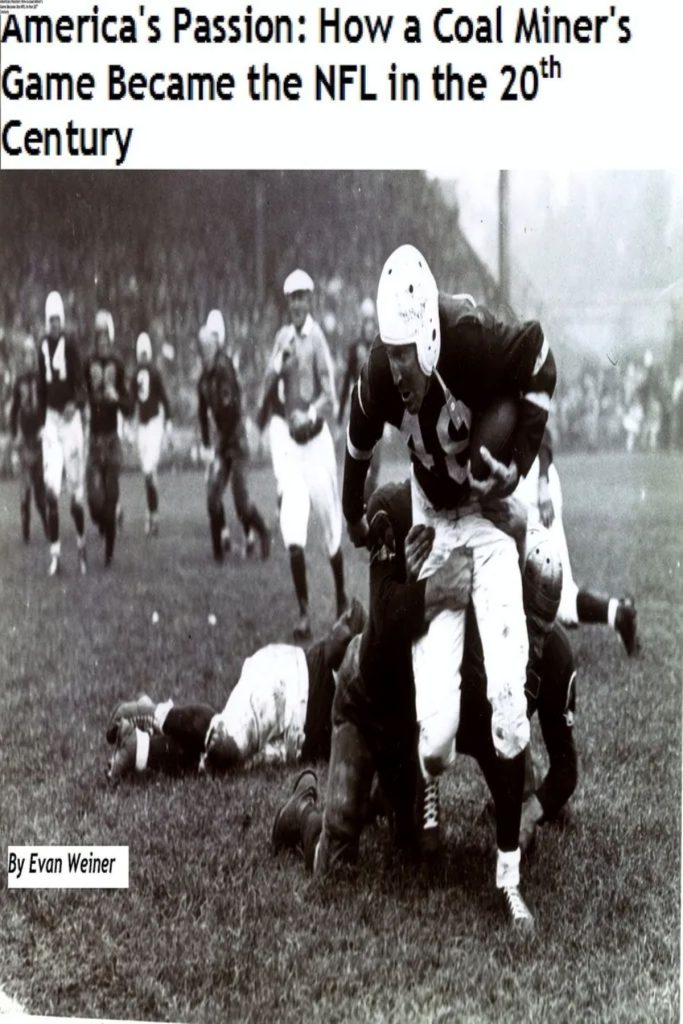
(From the book, America’s Passion: How a Coal Miner’s Game Became the NFL in the 20th Century by Evan Weiner)
Evan Weiner’s books are available at iTunes – https://books.apple.com/us/author/evan-weiner/id595575191
Evan can be reached at evan_weiner@hotmail.com