Connect with us

Politics

The House gives final approval to Donald Trump’s big tax bill and sends it to him to sign
Published

on


House Republicans propelled President Donald Trump’s $4.5 trillion tax breaks and spending cuts bill to final congressional passage Thursday, overcoming multiple setbacks to approve his signature second-term policy package before a Fourth of July deadline.

The tight roll call, 218-214, came at a potentially high political cost, with two Republicans joining all Democrats opposed. GOP leaders worked overnight and the President himself leaned on a handful of skeptics to drop their opposition and send the bill to him to sign into law. Democratic leader Hakeem Jeffries of New York delayed voting by holding the floor for more than eight hours with a record-breaking speech against the bill.

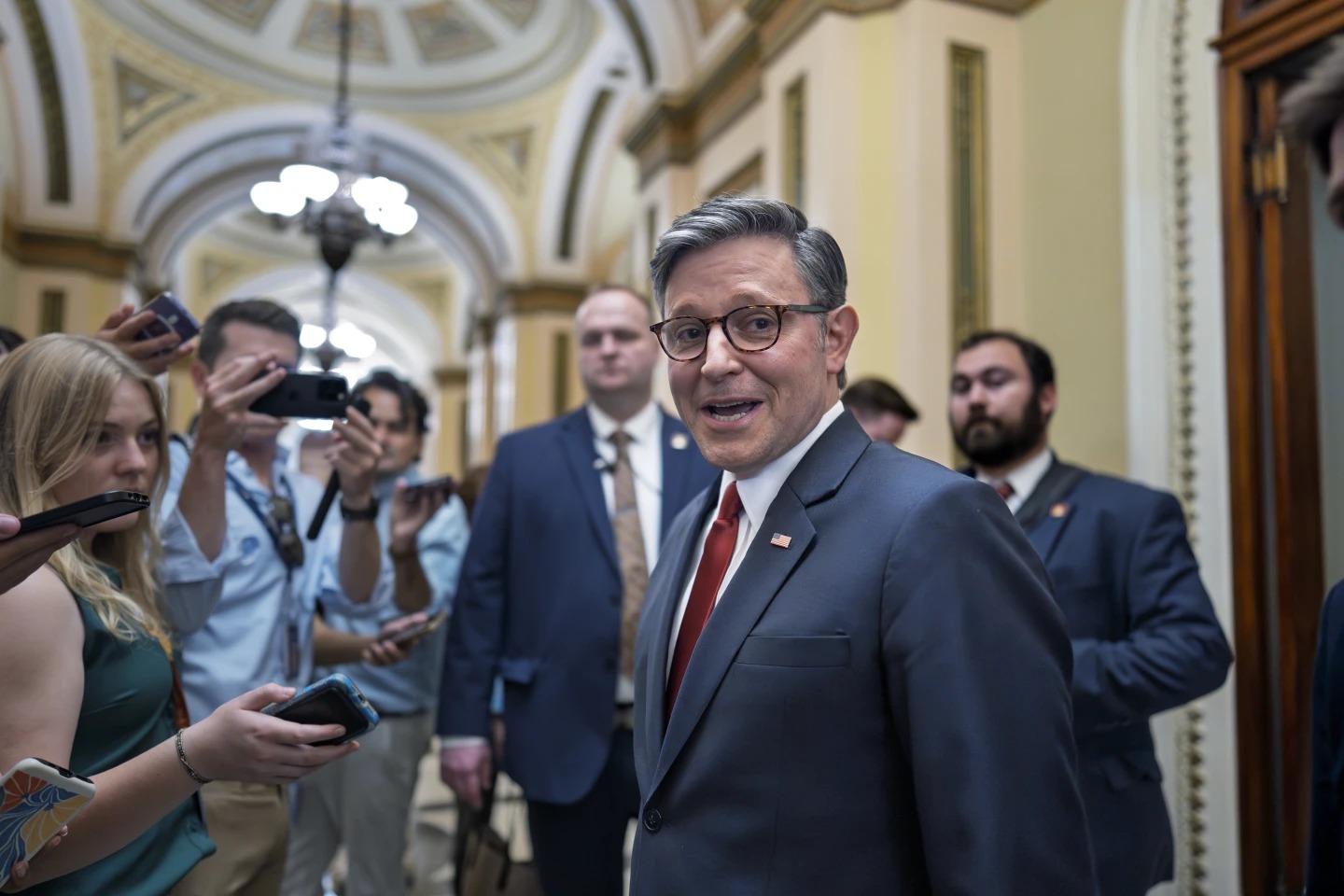
“We have a big job to finish,” said House Speaker Mike Johnson, a Louisiana Republican. “With one big beautiful bill we are going to make this country stronger, safer and more prosperous than ever before.”

The outcome delivers a milestone for the President, by his Friday goal, and for his party,. It was a long-shot effort to compile a lengthy list of GOP priorities into what they called his “One Big Beautiful Bill,” an 800-plus page measure. With Democrats unified in opposition, the bill will become a defining measure of Trump’s return to the White House, aided by Republican control of Congress.

Tax breaks and safety net cuts

At its core, the package’s priority is $4.5 trillion in tax breaks enacted in 2017 during Trump’s first term that would expire if Congress failed to act, along with new ones. This includes allowing workers to deduct tips and overtime pay, and a $6,000 deduction for most older adults earning less than $75,000 a year.

There’s also a hefty investment, some $350 billion, in national security and Trump’s deportation agenda and to help develop the Golden Dome defensive system over the U.S.

To help offset the lost tax revenue, the package includes $1.2 trillion in cutbacks to the Medicaid health care and food stamps, largely by imposing new work requirements, including for some parents and older people, and a major rollback of green energy tax credits.

The nonpartisan Congressional Budget Office estimates the package will add $3.3 trillion to the deficit over the decade and 11.8 million more people will go without health coverage.

“This was a generational opportunity to deliver the most comprehensive and consequential set of conservative reforms in modern history, and that’s exactly what we’re doing,” said Republican U.S. Rep. Jodey Arrington of Texas, the House Budget Committee Chair.

Democrats united against ‘ugly bill’

Democrats unified against the bill as a tax giveaway to the rich paid for on the backs of the working class and most vulnerable in society, what they called “trickle down cruelty.” Tensions ran high in the chamber.

Jeffries began the speech at 4:53 a.m. EDT and finished at 1:37 p.m. EDT, 8 hours, 44 minutes later, a record, as he argued against what he called Trump’s “big ugly bill.”

“We’re better than this,” Jeffries said, who used a leader’s prerogative for unlimited debate and read letter after letter from Americans writing about their reliance of the health care programs.

“I never thought that I’d be on the House floor saying that this is a crime scene,” Jeffries said.

“It’s a crime scene, going after the health, and the safety, and the well-being of the American people.”

And as Democrats, he said, “We want no part of it.”

Hauling the package through the Congress has been difficult from the start. Republicans have struggled mightily with the bill nearly every step of the way quarreling in the House and Senate, and often succeeding only by the narrowest of margins: just one vote.

The Senate passed the package days earlier with Vice President JD Vance breaking the tie vote. The slim majority in the House left Republicans little room for defections.

Political costs of saying no

Despite their discomfort with various aspects of the sprawling package, in some ways it became too big to fail — in part because Republicans found it difficult to buck Trump.

As Wednesday’s stalled floor action dragged overnight Trump railed against the delays.

“What are the Republicans waiting for???” the President said in a midnight post. “What are you trying to prove???”

Johnson relied heavily on White House Cabinet Secretaries, lawyers and others to satisfy skeptical GOP holdouts. Moderate Republicans worried about the severity of cuts while conservatives pressed for steeper reductions. Lawmakers said they were being told the administration could provide executive actions, projects or other provisions in their districts back home.

The alternative was clear. Republicans who staked out opposition to the bill, including U.S. Rep. Thomas Massie of Kentucky, and U.S. Sen. Thom Tillis of North Carolina, were being warned by Trump’s well-funded political operation. Tillis soon after announced he would not seek re-election.

Rollback of past presidential agendas

In many ways, the package is a repudiation of the agendas of the last two Democratic Presidents, a chiseling away at the Medicaid expansion from Barack Obama’s Affordable Care Act, and a pullback of Joe Biden’s climate change strategies in the Inflation Reduction Act.

Democrats have described the bill in dire terms, warning that cuts to Medicaid, which some 80 million Americans rely on, would result in lives lost. Food stamps that help feed more than 40 million people would “rip food from the mouths of hungry children, hungry veterans and hungry seniors,” Jeffries said.

Republicans say the tax breaks will prevent a tax hike on households and grow the economy. They maintain they are trying to rightsize the safety net programs for the population they were initially designed to serve, mainly pregnant women, the disabled and children, and root out what they describe as waste, fraud and abuse.

The Tax Policy Center, which provides nonpartisan analysis of tax and budget policy, projected the bill would result next year in a $150 tax break for the lowest quintile of Americans, a $1,750 tax cut for the middle quintile and a $10,950 tax cut for the top quintile. That’s compared with what they would face if the 2017 tax cuts expired.

___

Republished with permission of The Associated Press.


Post Views: 0


Source link

Continue Reading

Politics

Last Call for 1.19.26 – A prime-time read of what’s going down in Florida

Published

on


Last Call – A prime-time read of what’s going down in Florida politics.

First Shot

Did Christina Pushaw break the law by asking gubernatorial candidate James Fishback to delete text messages the two exchanged in recent months?

Maybe.

Pushaw, who earns a $179,000 tax-funded salary as a senior management analyst for Gov. Ron DeSantis, all but confirmed the authenticity of texts between her and Fishback in which she appears to have written, “I need you to confirm that you deleted everything with my name on it.”

The exchange has raised questions about whether she solicited the destruction of public records, which would be illegal if the messages involved her government duties, but likely not if they were strictly campaign-related, as she says.

Fishback posted a screenshot of the exchange following a public blowup between the two after they, according to Pushaw, spoke “frequently” since October about Fishback’s campaign.

On X, Pushaw accused Fishback of deception, writing: “Thanks for proving my point that you have no qualms about lying and revealing private messages. I truly believed that we were friends, and I feel sickened and violated by this betrayal.”

Pushaw, who has worked for DeSantis as both a campaign and government staffer, says she was never paid for advising Fishback and never told the Governor about her communications with Fishback.

In a brief phone interview on Monday, she said none of her messages with Fishback touched her state job.

“I never talked to him about government business,” she said. She declined to explicitly confirm the authenticity of Fishback’s screenshots, including one that referenced her government position.

Read more on Florida Politics.

Evening Reads

—“Donald Trump ties Greenland takeover bid to Nobel Prize in text to Norway leader” via Ellen Francis and Steve Hendrix of The Washington Post

—”Trump’s letter to Norway should be the last straw” via Anne Applebaum of The Atlantic

—”Trump’s Greenland move is one of the dumbest political decisions I have ever seen” via Chris Cillizza of So What

—”The race to build the DeepSeek of Europe is on” via Joel Khalili of WIRED

—”Three maps tell a tale of the 2026 Midterms.” via Ashley Cai and Shane Goldmacher of The New York Times

—”Orlando Sentinel 150: Remembering MLK’s only visit to Orlando in 1964” via the Orlando Sentinel

—“Jeff Brandes: Six ideas Legislature can’t afford to ignore in 2026” via Jeff Brandes for Florida Politics

—”The Indiana-Miami CFP game is the Hollywood tangle we didn’t know we needed” via Steven Zeitchik of The Hollywood Reporter

—”‘It shaped my DNA’: The very Miami story of Mario Cristobal” via Andrea Adelson of ESPN

—”Two other Hoosiers from Miami are coming home, too — and could play a big role” via David J. Neal and Jordan McPherson of the Miami Herald

Quote of the Day

“I didn’t vote for this weather.”

Marc Caputo on a frigid morning in Miami.

Put it on the Tab

Look to your left, then look to your right. If you see one of these people at your happy hour haunt, flag down the bartender and put one of these on your tab. Recipes included, just in case the Cocktail Codex fell into the well.

Even though it’s booze-free, the Duval delegation could use a Cortisol Cocktail to calm their nerves after a bomb threat landed in their inboxes.

Disney and Universal are getting an Investigators Rite, courtesy of Central Florida Democrats, who are requesting they look into a company that operates independent restaurants on their properties.

Someone should’ve sent an Out of Office for Attorney General James Uthmeier, because he picked an odd day to drop his latest opinion.

Breakthrough Insights

Tune In

Miami plays for national title at home

The Miami Hurricanes try for the program’s first national championship since 2001 when they face top-seeded Indiana at Hard Rock Stadium tonight (7:30 p.m. ET, ESPN).

Miami entered the College Football Playoff as the 10th seed and knocked off Texas A&M, Ohio State, and Ole Miss to reach the finals. The Hurricanes (13-2) have benefitted from a defense that has limited opponents to 14 points per game this season. Defensive end Rueben Bain Jr. was named the ACC defensive player of the year and is a likely Top 10 pick in the NFL Draft.

Indiana (15-0) has enjoyed the greatest season in program history. In the second season under Curt Cignetti, the Hoosiers have not only won more games than they ever have in a season, but also more than the program ever did in two consecutive seasons combined before Cignetti’s arrival.

The Hoosiers are led by Heisman Trophy-winning quarterback Fernando Mendoza.

The two programs have met twice in history, with Indiana winning the first meeting in 1964 and the Hurricanes taking the return match in 1966. The two programs have not met since.

The last time a college football team won the national championship by winning a game on its home field was the Hurricanes, who won the Orange Bowl following the 1987 season to win the program’s second of five national championships.

___

Last Call is published by Peter Schorsch, assembled and edited by Phil Ammann and Drew Wilson, with contributions from the staff of Florida Politics.


Source link

Continue Reading

Politics

James Fishback ordered to turn over Azoria stock, luxury items to pay $229K court judgment

Published

on


Gubernatorial candidate James Fishback’s legal woes are deepening.

A federal magistrate Judge has ordered Fishback, the founder and CEO of Azoria Capital, to turn over company stock certificates and a slate of luxury purchases to the U.S. Marshals Service by the end of the month as payment on a $229,000 judgment to his former employer, Greenlight Capital.

U.S. Magistrate Judge Martin Fitzpatrick of the Northern District of Florida granted two unopposed motions by Greenlight after Fishback failed to respond by a court-ordered deadline.

It’s the latest escalation in a dispute between Greenlight and Fishback, a former analyst for the hedge fund who has made more headlines recently for his race-baiting rhetoric in the Governor’s race, allegations of grooming, multistate voter registration and public blowup with Gov. Ron DeSantis adviser Christina Pushaw.

Greenlight told the court that Fishback still owes it money under a June 2025 court order. The firm asked the court in late November to compel Fishback to surrender his stock or share certificates in Azoria Capital, Inc., a Delaware corporation Greenlight described as founded by Fishback and controlled by him at “75% or more.”

Because Fishback did not oppose the request, the court granted it and directed him to “locate, obtain, and turn over” all Azoria stock and/or share certificates to the U.S. Marshals Service by Jan. 30.

The Marshals Service, in turn, is ordered to sell the stock for the benefit of Greenlight as the judgment creditor. Fitzpatrick warned Fishback that federal courts have inherent authority to enforce orders and cautioned that ignoring the directive could place him “in danger of being held in contempt of court.”

Fitzpatrick also granted a second motion by Greenlight seeking the turnover of personal property belonging to Fishback. The firm alleged that Fishback claimed he lacked means to pay the $229,000 judgment while making more than $37,000 in debit card purchases over 16 months through a previously undisclosed JPMorgan Chase account.

The court summarized transactions at retailers including eBay, Nordstrom, Burberry, Bucherer and others, but noted it did not know what exactly Fishback purchased. Still, Fitzpatrick described the spending as “extravagant” and found that Fishback, by not responding by the deadline, waived his chance to argue the items were exempt or not personal property.

Under the order, Fishback must turn over 43 items listed in the motion paper, along with a list, to the Marshals Service by Jan. 30. The Marshals must hold the items for 30 days, allowing Greenlight’s lawyers to retrieve and sell them as partial satisfaction of the judgment.

Fishback worked at Greenlight from 2021 to 2023, after which he and the company became embroiled in a very public dispute over how he described his role there. He said he was “head of macro” for Greenlight, while the New York hedge fund insisted no such title ever existed and that the loftiest role Fishback held was as a research analyst.

Greenlight alleged that Fishback misrepresented his position to boost credibility and attract investors for Azoria. Fishback, meanwhile, argued Greenlight’s denial harmed him with potential backers and pointed to internal communications he says support his version of events.

He did, however, admit to sharing confidential Greenlight portfolio information and agreed to pay costs to resolve a separate lawsuit.

Trustees of a white-label exchange-traded fund (ETF) under Tidal Financial Group also voted in October to liquidate two Azoria ETFs — SPXM and TSLV, which together held about $40 million in assets — after Fishback admitted to sharing the information.

Between when he launched his campaign on Nov. 24 and Dec. 31, when fourth-quarter bookkeeping closed, Fishback reported raising less than $19,000 through his campaign account and nothing through an affiliated political committee.

Fishback is seeking the Republican nomination for Governor. The race’s poll-tested front-runner, U.S. Rep. Byron Donalds, amassed $45 million last quarter.


Source link

Continue Reading

Politics

Anna Eskamani hits $1M fundraising milestone for Orlando Mayor race

Published

on


Rep. Anna Eskamani says she has raised more than $1 million so far as she tries to become the next Orlando Mayor.

The Orlando Democrat says she hit the milestone last week as lawmakers returned to Tallahassee for the start of the 2026 Legislative Session.

Term-limited in the House, Eskamani is running in 2027 to replace Orlando Mayor Buddy Dyer, who is not running for re-election.

“This campaign is powered by everyday Orlandoans who believe our city can be more affordable, more connected, and safer for everyone,” Eskamani said in a statement.

“Raising over one million dollars from thousands of grassroots donors sends a clear message: people are ready for leadership that listens, leads with integrity, solves problems, and puts community first. Together, we’re building a movement that reflects the heart of Orlando and delivers real results for working families.”

Her campaign has given out 900 yard signs and knocked on more than 33,000 doors in the city, according to a press release.

So far, no other established candidates have filed to run against Eskamani, although she has drawn her first competitor on the ballot: Abdelnasser Lutfi.

Lutfi, who filed to run for Mayor in late December, was not immediately available when reached for comment Monday afternoon.

Eskamani and Lutfi are running to replace Dyer, the longest-serving Mayor in Orlando’s history. Dyer was first elected in 2003.

Eskamani also said she is launching a podcast called “Twinning with Anna and Ida” with her twin sister. 

Every episode will unpack economic public policy issues that are critically important to everyone, but aren’t always well understood by the vast majority of people — often because they have been made intentionally opaque by politicians and the corporations who fund them to benefit from the complex system,” a press release said.

“But they will also have some fun along the way, from exposing a ‘grift of the month’ in Florida politics to exploring the punk rock scene in Orlando.”


Source link

Continue Reading

Trending

Copyright © Miami Select.