Connect with us

Business

The first American Pope found a way to indirectly celebrate Thanksgiving: by making his first foreign visit a trip to Turkey

Published

on


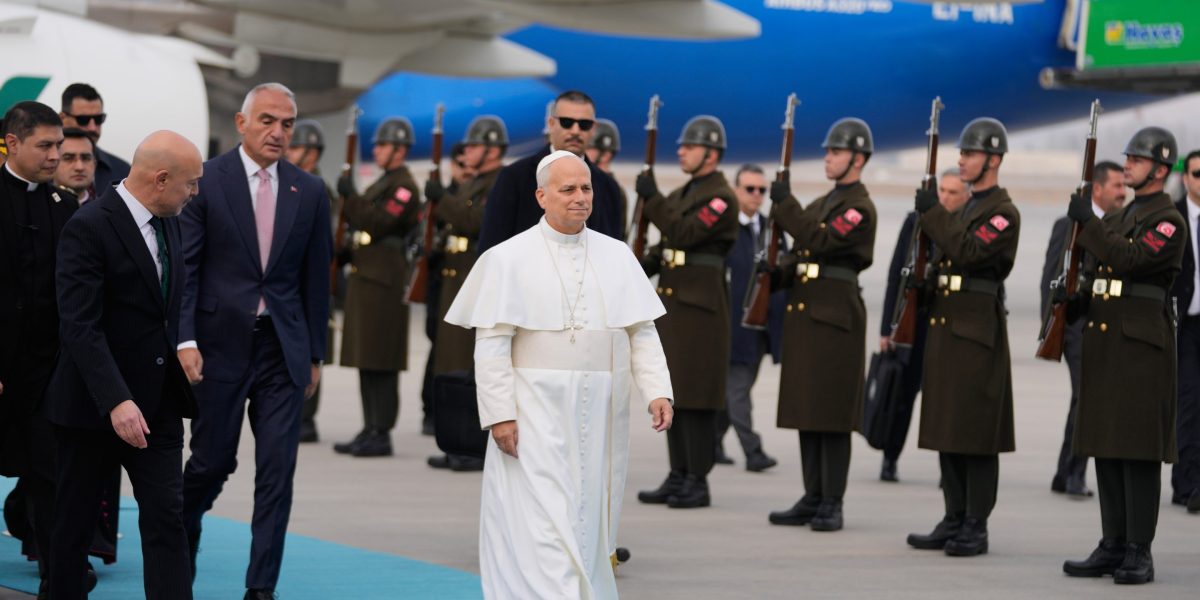
ANKARA (AP) — Pope Leo XIV arrived in Turkey on Thursday on his first foreign trip, fulfilling Pope Francis’ plans to mark an important Christian anniversary and bring a message of peace to the region at a crucial time in efforts to end the war in Ukraine and ease Mideast tensions.

Leo was welcomed on the tarmac of Ankara’s Esenboga Airport by a military guard of honor. Strolling along a turquoise carpet, he shook hands with Culture and Tourism Minister Mehmet Nuri Ersoy, other officials and senior church figures from Turkey.

Later, he had a meeting planned with President Recep Tayyip Erdogan and a speech to the country’s diplomatic corps. He’ll then move late Thursday on to Istanbul for three days of ecumenical and interfaith meetings that will be followed by the Lebanese leg of his trip.

Speaking to reporters on board his plane, Leo acknowledged the historic nature of his first foreign trip and said he has been looking forward to it because of what it means for Christians and for peace in the world.

Leo said he knows the visit to commemorate a key ecumenical anniversary was important for Christians. But he said he hoped his broader message of peace would resonate worldwide.

“We hope to also announce, transmit and proclaim how important peace is throughout the world. And to invite all people to come together to search for greater unity, greater harmony, and to look for the ways that all men and women can truly be brothers and sisters in spite of differences, in spite of different religions, in spite of different beliefs.”

Leo’s visit comes as Turkey, a country of more than 85 million predominantly Sunni Muslims, has cast itself as a key intermediary in peace negotiations for the conflicts in Ukraine and Gaza.

Ankara has hosted rounds of low-level talks between Russia and Ukraine and has offered to take part in the stabilization force in Gaza to help uphold the fragile ceasefire, engagements Leo may applaud in his arrival speech.

Reaction in Turkey

Turkey’s growing military weight, as NATO’s largest army after the U.S., has been drawing Western leaders closer to Erdogan even as critics warn of his crackdown on the country’s main opposition party.

Though support for Palestinians and an end to the war in Ukraine is widespread in Turkey, for Turks who face an ongoing cost-of-living crisis, owing to market turmoil induced by shake-ups in domestic politics, international politics is a secondary concern.

That could explain why Leo’s visit has largely escaped the attention of many in Turkey, at least outside the country’s small Christian community.

“I didn’t know he was coming. He is welcome,” said Sukran Celebi. “It would be good if he called for peace in the world, but I don’t think it will change anything.”

Some said they thought the visit by history’s first American pope was about advancing the interests of the United States, or perhaps to press for the reopening of a Greek Orthodox religious seminary that has become a focal point in the push for religious freedoms in Turkey.

“If the pope is visiting, that means America wants something from Turkey,” said Metin Erdem, a musical instruments shop owner in the touristic Galata district of Istanbul.

Historic anniversary

The main impetus for Leo to travel to Turkey is to mark the 1,700th anniversary of the Council of Nicaea, Christianity’s first ecumenical council.

Leo will pray with Ecumenical Patriarch Bartholomew, spiritual leader of the world’s Orthodox Christians, at the site of the A.D. 325 gathering in today’s Iznik in northwestern Turkey, and sign a joint declaration in a visible sign of Christian unity.

Eastern and Western churches were united until the Great Schism of 1054, a divide precipitated largely by disagreements over the primacy of the pope.

While the visit is timed for the important Catholic-Orthodox anniversary, it will also allow Leo to reinforce the church’s relations with Muslims. Leo is due to visit the Blue Mosque and preside over an interfaith meeting in Istanbul.

Asgın Tunca, a Blue Mosque imam who will be receiving the pope, said the visit would help advance Christian-Muslim ties and dispel popular prejudices about Islam.

“We want to reflect that image by showing the beauty of our religion through our hospitality — that is God’s command,” Tunca said.

Religious freedom in Turkey

Since coming to power in 2002, Erdogan’s government has enacted reforms to improve the rights of religious groups, including opening places of worship and returning property that were confiscated.

Still, some Christian groups face legal and bureaucratic problems when trying to register churches, according to a U.S. State Department report on religious freedoms.

The Catholic Church, which counts around 33,000 members in Turkey, has no formal legal recognition in the country “and this is the source of many problems,” said the Rev. Paolo Pugliese, superior of the Capuchin Catholic friars in Turkey.

“But the Catholic Church enjoys a rather notable importance because we have an international profile … and we have the pope holding our backs,” he said.

Possible tensions

One of the more delicate moments of Leo’s visit will come Sunday, when he visits the Armenian Apostolic Cathedral in Istanbul. The cathedral has hosted all popes who have visited Turkey since Paul VI, with the exception of Francis who visited Turkey in 2014 when its patriarch was sick.

Francis visited him at the hospital, and a few months later he greatly angered Turkey in 2015 when he declared that the slaughter of Armenians by Ottoman Turks was “the first genocide of the 20th century.” Turkey, which has long denied a genocide took place, recalled its ambassador to the Holy See in protest.

Leo has tended to be far more prudent than Francis in his public comments, and using such terms on Turkish soil would spark a diplomatic incident. But the Vatican is also navigating a difficult moment in its ties with Armenia, after its interfaith overtures to Azerbaijan have been criticized.


Source link

Continue Reading

Business

What a Walmart CEO contender’s exit reveals about when to move on

Published

on


There’s no such thing as a silver medal in a CEO succession race.

In November, Walmart named U.S. chief John Furner as its next CEO, crowning him the sixth leader in the history of the world’s largest retailer. The decision also quietly closed the door on another highly regarded contender for the corner office: Kath McLay, Walmart International’s CEO and a decade-long veteran of the company. On Thursday, Walmart disclosed that McLay would depart, staying on briefly to ensure a smooth transition.

The sequence was swift, orderly, and entirely unsurprising to those who study corporate succession. Boards rarely say it out loud, but experienced executives understand intuitively that once a CEO is chosen, the long-term prospects for previously whispered-about internal candidates dim almost immediately as power consolidates around the new chief executive. 

That’s why many of the most ambitious leaders in American business don’t linger after a succession decision. They move deliberately, and often quickly, because the moment immediately after a board makes its choice is paradoxically when a near-CEO executive’s market value is at its peak. The executive has just been validated at the highest level—close enough to be seriously considered for the top job—without yet absorbing the reputational drag that can follow prolonged proximity to a decision that didn’t go their way.

In that narrow window, the story is still about capability. Search firms and directors see a leader who was trusted with scale, complexity, and board scrutiny, not someone who failed to clear the final hurdle. 

When Jeff Immelt was named CEO of General Electric in 2001, the decision concluded one of the most closely watched succession contests in modern corporate history. Among the executives developed as credible successors was Bob Nardelli, then president and CEO of GE Power Systems. Nardelli didn’t stay to see how it might play out. Within months, he left GE to become Home Depot’s CEO.

A decade later, a different scenario unfolded at Apple, but with a similar outcome. Retail chief Ron Johnson had transformed Apple’s stores into an industry-defining, highly profitable global business and was widely viewed internally as CEO-caliber. Apple’s board had long centered its succession plans on Tim Cook, and when Cook was formally named successor to Steve Jobs, it effectively closed the door on a CEO path for Johnson. He left soon after to take the top job at J.C. Penney.

The executives who leave quickly aren’t being disloyal; they’re being realistic. Remaining too long after a succession decision can quietly erode an executive’s standing, both internally and externally, as the narrative shifts from “next in line” to “still waiting.”

At Ford Motor Co., president Joe Hinrichs was widely viewed as a leading CEO contender. When the board selected Jim Hackett in 2017, Hinrichs left not long afterward. Five years later, he resurfaced as CEO of transportation company CSX. Similarly, several senior Disney executives left or were sidelined after Bob Chapek was chosen as CEO in 2020. Most notably, Kevin Mayer, Disney’s head of direct-to-consumer and international, and a widely assumed CEO contender, departed within months to briefly become CEO of TikTok.

There are exceptions. But they tend to follow a different arc.

Although longtime Nike insider Elliott Hill was not passed over in a formal succession contest, he was widely viewed as CEO-ready when the board opted for an external hire in 2020. Hill stayed on for several years and later retired. Only after performance pressures mounted and the company embarked on a strategic reset did Nike’s board reverse course, asking Hill to return as CEO in 2024. Even then, such boomerangs remain exceedingly rare.

McLay’s departure from Walmart fits the dominant pattern. By exiting promptly while remaining to support a defined transition, she preserves both her reputation and her leverage. She leaves as an executive who was close enough to be seriously considered—not one who stayed long enough to be diminished by the process.

Join us at the Fortune Workplace Innovation Summit May 19–20, 2026, in Atlanta. The next era of workplace innovation is here—and the old playbook is being rewritten. At this exclusive, high-energy event, the world’s most innovative leaders will convene to explore how AI, humanity, and strategy converge to redefine, again, the future of work. Register now.


Source link

Continue Reading

Business

Crypto market reels in face of tariff turmoil, Bitcoin falls below $90,000 as key legislation stalls

Published

on


If you don’t like the price of Bitcoin, wait five minutes, and it will change. The major cryptocurrency’s volatility has been on full display to start the year, this time dipping about 7% since last week to its current price of just under $90,000 as of mid-day Tuesday.

Other cryptocurrencies have also slid. Ethereum is down 11% in the last six days to its current price of about $3,000, and Solana is down about 14% during that time to its price of about $127. 

The dip comes as President Donald Trump threatened European nations with tariffs as they pushed back against his plans to take over Greenland, causing markets to scramble. Meanwhile, crypto markets faced an additional headwind as key legislation for the industry, known as the Clarity Act, became stalled after industry giant Coinbase unexpectedly withdrew its support late last week. 

“President Trump’s threat to impose tariffs on Europe has put Bitcoin under pressure,” said Russell Thompson, chief investment officer at Hilbert Group. “The postponement of the Clarity Act in the Senate committee mainly due to concerns from Coinbase eliminated a large amount of positive sentiment in the market.”

Coinbase CEO Brian Armstrong objected to the Clarity Act primarily on grounds that crypto owners would not be able to earn yield from stablecoins. The new uncertainty over the bill, which many assumed was on a smooth path towards a Presidential signature, has shaken the price not just of crypto assets but also the share price of companies exposed to digital assets. 

It’s uncertain whether the current headwinds will fade anytime soon. Trump has made his intentions of taking control of Greenland clear. When a group of European nations expressed solidarity with the Danish, he threatened those countries with tariffs, saying he would not back down until Greenland was purchased. Bitcoin and other risk assets subsequently fell, along with major stock indices, while the price of gold rose.

It’s not all gloom and doom for crypto, at least according to some analysts, who view Bitcoin’s correlation with macroeconomic forces as confirmation that digital assets have finally gone mainstream. 

“Bitcoin’s reactivity is another sign of its increasing integration with broader macroeconomic forces, signaling maturation rather than fragility, even as short-term volatility continues,” said Beto Aparicio, senior manager of strategic finance at Offchain Labs.

Join us at the Fortune Workplace Innovation Summit May 19–20, 2026, in Atlanta. The next era of workplace innovation is here—and the old playbook is being rewritten. At this exclusive, high-energy event, the world’s most innovative leaders will convene to explore how AI, humanity, and strategy converge to redefine, again, the future of work. Register now.


Source link

Continue Reading

Business

The 9 most disruptive deals of Trump’s first year back in the White House

Published

on


President Trump lives on deals: “That’s what I do—I do deals,” he once told Bob Woodward. On the one-year anniversary of his second presidency, he’s pushing hard to make his biggest, most disruptive deal ever, one that would bring Greenland under the control of the U.S.—and the global business community is still scrambling to adapt to his approach. Here are nine of Trump’s most unorthodox deals from the past year.

Nine deals that shook the business world

April 2, 2025: Reciprocal tariffs

Trump imposes “reciprocal tariffs” on 57 countries, with each tariff understood as an opening bid in a negotiation. Several countries have since made deals. The one-on-one negotiations, unlike the multilateral system of the past 80 years, can be chaotic for companies and economies

June 13: U.S. Steel “Golden Share”

In return for allowing Nippon Steel to buy U.S. Steel, Trump requires that the U.S. receive several powers over the company, including total power over all the board’s independent directors and vetoes over locations of offices and factories. 

July 10: MP Materials

The U.S. pays $400 million for a large equity share in MP and signs a contract to buy all of MP’s rare earth magnets for 10 years. The reason for the equity stake was not disclosed.

July 14: Nvidia, Part 1

JADE GAO—AFP/Getty Images

Trump reverses the U.S. ban on selling Nvidia H20 chips to China in exchange for Nvidia paying the U.S. 15% of the revenue.

July 23: Columbia University

LYA CATTEL/Getty Images

The Trump administration restores $400 million of canceled federal research funding for the university under an unprecedented multipoint deal. For example, Columbia must supply data to the federal government for all applicants, broken down by race, “color,” GPA, and standardized test performance. A few other schools later make similar deals.

August 6: Apple

Bonnie Cash—UPI/Bloomberg/Getty Images

At a public appearance with Trump, CEO Tim Cook announces Apple will invest an additional $100 billion in the U.S. over four years; Trump announces Apple will be exempt from a planned tariff on imported chips that would have doubled the price of iPhones in the U.S.

August 22: Intel

Justin Sullivan—Getty Images

Intel trades the U.S. government a 9.9% equity stake in exchange for $8.9 billion that might already be owed to Intel under the CHIPS and Science Act. The deal is unusual because the company was not in immediate danger or significantly affecting the economy.

December 8: Nvidia, Part 2:

Trump reverses the U.S. ban on selling powerful Nvidia H200 chips in exchange for Nvidia paying the U.S. 25% of the revenue. Both Nvidia deals are unusual because the payments to the U.S., based on exports, appear to be forbidden by the Constitution. 

December 19: Pharma

Alex Wong—Getty Images

Nine pharmaceutical companies make deals with Trump that are intended to lower drug prices. This is unusual because Trump negotiated separate deals with each company, and the terms have not been released.

All eyes this week will be watching President Trump at the World Economic Forum in Davos, where the president has hinted he’ll announce some high-stakes agreements. Expect the unexpected.

A version of this piece appears in the February/March 2026 issue of Fortune.


Source link

Continue Reading

Trending

Copyright © Miami Select.