Connect with us

Business

The Fed’s architects wanted glass in the HQ renovation, but Trump appointees to a local commission pushed for marble

Published

on


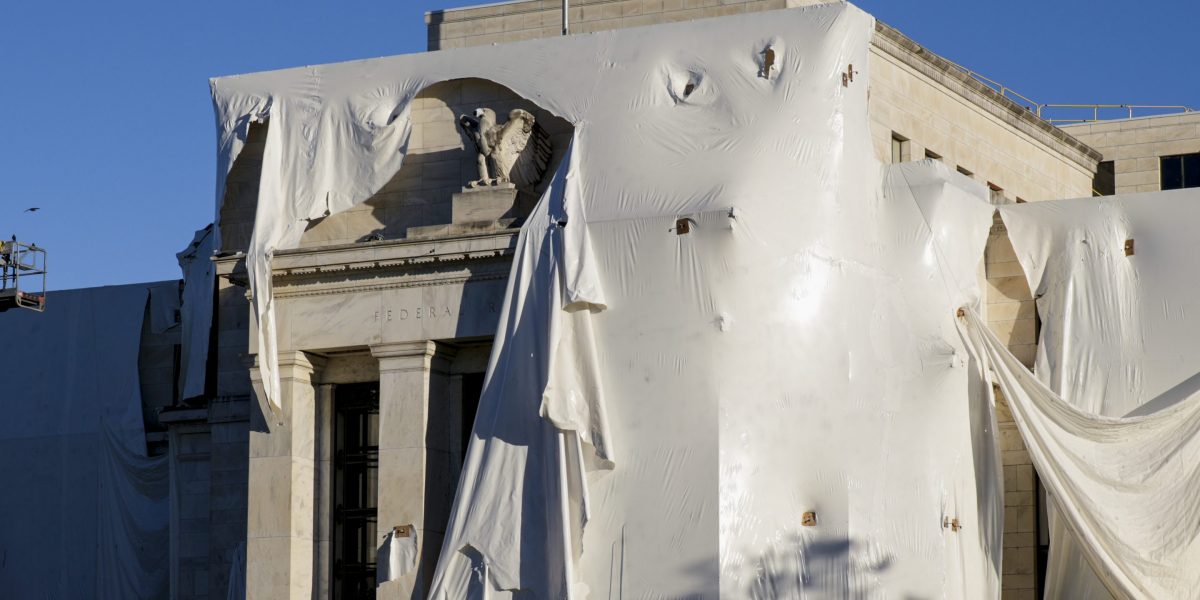
President Donald Trump has looked to the marble finishes and hefty price tag of the Federal Reserve headquarters to claim grounds to fire Chair Jerome Powell, with whom he has tussled for years over interest rates. But the extensive use of marble in the building is, at least in part, the result of policies backed by Trump himself.

As the Fed moved forward with plans to renovate its Great Depression-era headquarters in Washington during Trump’s first term, it faced concerns in 2020 during a vetting process involving Trump appointees, who called for more “white Georgia marble” for the facade of the building.

The Fed’s architects said the central bank wanted glass walls, to reflect the Fed as a transparent institution, but three Trump appointees to a local commission felt marble best fit the building’s historic character. While most of the proposed glass exterior was kept, some marble was added as a result, according to the minutes of the Commission of Fine Arts, which advises the federal government on architecture.

The marble does not explain the roughly $600 million in cost overruns for the project, now budgeted to cost $2.5 billion, which also includes the addition of an underground parking garage and new glass atria in the building’s courtyards. But the roots of its extensive use further muddies the White House’s attempts to use the renovation to paint the central banker as a profligate spender as a possible pretext to removing him.

“I wouldn’t be surprised if the result costs more” because of the added marble, said Alex Krieger, a Harvard University emeritus professor who was a member of the commission and participated in hearings on the Fed’s proposal.

Russ Vought, Trump’s top budget adviser, cited “premium marble” in a letter to Powell last week as an example of the “ostentatious overhaul.”

In a response late Thursday, Powell wrote that the project would “use new domestic marble” for several reasons, including “to address concerns raised by external review agencies.”

The National Capital Planning Commission, which also reviewed and approved the Fed renovation project, has started an inquiry into how Powell oversaw the updates.

“The Federal Reserve’s extravagant multi-billion dollar renovation happened on the watch of the Fed’s leadership, and the Fed’s leadership needs to own up for this mismanagement of taxpayer dollars – as well as its botched coverup job,” said White House spokesman Kush Desai. A Fed spokesperson declined to comment.

There is an uncomfortable possibility that the fate of the U.S. central bank and its foundational role in the economy hinges on a dispute about renovation costs and architecture, one that could lead a broader legal battle as to whether Trump can dismiss a Fed chair he dislikes after the Supreme Court in May described the institution as having protections against an abrupt firing.

Trump White House investigating renovation

Trump, who has redecorated the Oval Office in gold leaf, has argued that inflation is not a concern, so the Fed can dramatically slash its rate to encourage more borrowing. But Powell and other Fed committee members are waiting to see whether Trump’s tariffs lift inflation, which higher interest rates could help blunt.

The Fed chair pushed back against criticism during a June congressional hearing that the renovation was lavish by saying some features were removed due to cost, leading the White House to speculate as to whether Powell deceived lawmakers or made changes to the renovation plans without getting additional approvals. At that hearing, Sen. Tim Scott, R-S.C., also cited “white marble” as an example of extravagance.

James Blair, a White House deputy chief of staff who was recently added to the planning commission, said Wednesday that he would send a letter to the Fed requesting any revisions to the project. His goal is to see whether Powell was accurate in his congressional testimony.

“He’s either telling the truth or he isn’t,” Blair told The Associated Press. “If he’s telling the truth, he can prove it by just submitting all the plans and revisions.”

Blair told reporters Friday that the Fed offered to let them inspect the construction site at 7 p.m. that evening, but the timing didn’t work and officials would like to tour the area next week.

Trump said Wednesday that he’s “highly unlikely” to try to fire Powell unless there was what he deemed as “fraud.”

The attempt to remove Powell before his May 2026 term as chair ends could unleash a devastating financial blowback, as financial markets expect the Fed, with its mission of stabilizing prices and maximizing employment, to be free of White House politicking.The perception that the central bank would use its powers to serve Trump’s political ends could lead to higher interest rates on the U.S. debt and mortgages, instead of the declines being promised by the president.

Trump appointees push for more marble

The 115-year old Commission of Fine Arts reviewed the plans for the renovation three times in 2020.

Duncan Stroik, who was appointed to the commission in 2019 during Trump’s first term, “proposed an amendment requesting that the next submission include an alternative design in white Georgia marble, the same material used for the five existing buildings along the north side of Constitution Avenue,” the minutes of a Jan. 16, 2020, meeting said.

Stroik “does not think the proposed additions defer to the historic buildings as great marble edifices on an important street,” the minutes added.

Stroik’s amendment was voted down, but the commission didn’t fully endorse the Fed’s plans. The architects presented new plans in May 2020, though those didn’t appear to satisfy Trump’s appointees.

Some commissioners “continued to object to the addition as a glass box that is reminiscent of a commercial office building, glowing at night, that would present an unacceptable contrast to the solid masonry architecture of the historic building in its monumental context,” the commission wrote in a May 2020 letter to a Fed official.

By July 2020, however, the Fed’s architects came back with a new proposal, which included “panels of white Georgia marble” which would be used for the “base, cornice, and other details, consistent with the historic building,” the commission’s minutes said.

Neoclassical vs. modern designs

Stroik, now a professor of architecture at the University of Notre Dame, said in an interview that “stone buildings don’t necessarily have to cost a fortune.” But he acknowledged that the commission had not discussed expenses, which has not been part of its mission.

“If they wanted to play the cost game, you do a marble facade and you do the glass facade and you compare the cost,” Stroik said. “And you know, they never did that.”

Krieger, the former commission member, noted that the body’s discussions became much more contentious after the Trump administration removed several members and replaced them with Stroik and James McCrery, a professor at Catholic University, whom he said often echoed the sentiments in a then- draft executive order from Trump that extolled classical architecture.

“At the time, it was a fierce battle over how literal to the original design should the renovations be,” Krieger said. “Normally, that attitude does add costs to the construction project.” McCrery declined to comment.

Trump issued the executive order in December 2020, which criticized modernist architecture and expressed a preference for “beautiful” classical buildings with more traditional designs. Biden revoked the order, and Trump reissued it the first day of his second term.

The commission did not fully approve the Fed’s project until September 2021, after McCrery and another Trump appointee, Justin Shubow, had been removed by then President Joe Biden.


Source link

Continue Reading

Business

Epstein grand jury documents from Florida can be released by DOJ, judge rules

Published

on


A federal judge on Friday gave the Justice Department permission to release transcripts of a grand jury investigation into Jeffrey Epstein’s abuse of underage girls in Florida — a case that ultimately ended without any federal charges being filed against the millionaire sex offender.

U.S. District Judge Rodney Smith said a recently passed federal law ordering the release of records related to Epstein overrode the usual rules about grand jury secrecy.

The law signed in November by President Donald Trump compels the Justice Department, FBI and federal prosecutors to release later this month the vast troves of material they have amassed during investigations into Epstein that date back at least two decades.

Friday’s court ruling dealt with the earliest known federal inquiry.

In 2005, police in Palm Beach, Florida, where Epstein had a mansion, began interviewing teenage girls who told of being hired to give the financier sexualized massages. The FBI later joined the investigation.

Federal prosecutors in Florida prepared an indictment in 2007, but Epstein’s lawyers attacked the credibility of his accusers publicly while secretly negotiating a plea bargain that would let him avoid serious jail time.

In 2008, Epstein pleaded guilty to relatively minor state charges of soliciting prostitution from someone under age 18. He served most of his 18-month sentence in a work release program that let him spend his days in his office.

The U.S. attorney in Miami at the time, Alex Acosta, agreed not to prosecute Epstein on federal charges — a decision that outraged Epstein’s accusers. After the Miami Herald reexamined the unusual plea bargain in a series of stories in 2018, public outrage over Epstein’s light sentence led to Acosta’s resignation as Trump’s labor secretary.

A Justice Department report in 2020 found that Acosta exercised “poor judgment” in handling the investigation, but it also said he did not engage in professional misconduct.

A different federal prosecutor, in New York, brought a sex trafficking indictment against Epstein in 2019, mirroring some of the same allegations involving underage girls that had been the subject of the aborted investigation. Epstein killed himself while awaiting trial. His longtime confidant and ex-girlfriend, Ghislaine Maxwell, was then tried on similar charges, convicted and sentenced in 2022 to 20 years in prison.

Transcripts of the grand jury proceedings from the aborted federal case in Florida could shed more light on federal prosecutors’ decision not to go forward with it. Records related to state grand jury proceedings have already been made public.

When the documents will be released is unknown. The Justice Department asked the court to unseal them so they could be released with other records required to be disclosed under the Epstein Files Transparency Act. The Justice Department hasn’t set a timetable for when it plans to start releasing information, but the law set a deadline of Dec. 19.

The law also allows the Justice Department to withhold files that it says could jeopardize an active federal investigation. Files can also be withheld if they’re found to be classified or if they pertain to national defense or foreign policy.

One of the federal prosecutors on the Florida case did not answer a phone call Friday and the other declined to answer questions.

A judge had previously declined to release the grand jury records, citing the usual rules about grand jury secrecy, but Smith said the new federal law allowed public disclosure.

The Justice Department has separate requests pending for the release of grand jury records related to the sex trafficking cases against Epstein and Maxwell in New York. The judges in those matters have said they plan to rule expeditiously.

___

Sisak reported from New York.


Source link

Continue Reading

Business

Miss Universe co-owner gets bank accounts frozen as part of probe into drugs, fuel and arms trafficking

Published

on


Mexico’s anti-money laundering office has frozen the bank accounts of the Mexican co-owner of Miss Universe as part of an investigation into drugs, fuel and arms trafficking, an official said Friday.

The country’s Financial Intelligence Unit, which oversees the fight against money laundering, froze Mexican businessman Raúl Rocha Cantú’s bank accounts in Mexico, a federal official told The Associated Press on condition of anonymity because he was not authorized to comment on the investigation.

The action against Rocha Cantú adds to mounting controversies for the Miss Universe organization. Last week, a court in Thailand issued an arrest warrant for the Thai co-owner of the Miss Universe Organization in connection with a fraud case and this year’s competition — won by Miss Mexico Fatima Bosch — faced allegations of rigging.

The Miss Universe organization did not immediately respond to an email from The Associated Press seeking comment about the allegations against Rocha Cantú.

Mexico’s federal prosecutors said last week that Rocha Cantú has been under investigation since November 2024 for alleged organized crime activity, including drug and arms trafficking, as well as fuel theft. Last month, a federal judge issued 13 arrest warrants for some of those involved in the case, including the Mexican businessman, whose company Legacy Holding Group USA owns 50% of the Miss Universe shares.

The organization’s other 50% belongs to JKN Global Group Public Co. Ltd., a company owned by Jakkaphong “Anne” Jakrajutatip.

A Thai court last week issued an arrest warrant for Jakrajutatip who was released on bail in 2023 on the fraud case. She failed to appear as required in a Bangkok court on Nov. 25. Since she did not notify the court about her absence, she was deemed to be a flight risk, according to a statement from the Bangkok South District Court.

The court rescheduled her hearing for Dec. 26.

Rocha Cantú was also a part owner of the Casino Royale in the northern Mexican city of Monterrey, when it was attacked in 2011 by a group of gunmen who entered it, doused gasoline and set it on fire, killing 52 people.

Baltazar Saucedo Estrada, who was charged with planning the attack, was sentenced in July to 135 years in prison.


Source link

Continue Reading

Business

Elon Musk’s X fined $140 million by EU for breaching digital regulations

Published

on


European Union regulators on Friday fined X, Elon Musk’s social media platform, 120 million euros ($140 million) for breaches of the bloc’s digital regulations, in a move that risks rekindling tensions with Washington over free speech.

The European Commission issued its decision following an investigation it opened two years ago into X under the 27-nation bloc’s Digital Services Act, also known as the DSA.

It’s the first time that the EU has issued a so-called non-compliance decision since rolling out the DSA. The sweeping rulebook requires platforms to take more responsibility for protecting European users and cleaning up harmful or illegal content and products on their sites, under threat of hefty fines.

The Commission, the bloc’s executive arm, said it was punishing X because of three different breaches of the DSA’s transparency requirements. The decision could rile President Donald Trump, whose administration has lashed out at digital regulations, complained that Brussels was targeting U.S. tech companies and vowed to retaliate.

U.S. Secretary of State Marco Rubio posted on his X account that the Commission’s fine was akin to an attack on the American people. Musk later agreed with Rubio’s sentiment.

“The European Commission’s $140 million fine isn’t just an attack on @X, it’s an attack on all American tech platforms and the American people by foreign governments,” Rubio wrote. “The days of censoring Americans online are over.”

Vice President JD Vance, posting on X ahead of the decision, accused the Commission of seeking to fine X “for not engaging in censorship.”

“The EU should be supporting free speech not attacking American companies over garbage,” he wrote.

Officials denied the rules were intended to muzzle Big Tech companies. The Commission is “not targeting anyone, not targeting any company, not targeting any jurisdictions based on their color or their country of origin,” spokesman Thomas Regnier told a regular briefing in Brussels. “Absolutely not. This is based on a process, democratic process.”

X did not respond immediately to an email request for comment.

EU regulators had already outlined their accusations in mid-2024 when they released preliminary findings of their investigation into X.

Regulators said X’s blue checkmarks broke the rules because on “deceptive design practices” and could expose users to scams and manipulation.

Before Musk acquired X, when it was previously known as Twitter, the checkmarks mirrored verification badges common on social media and were largely reserved for celebrities, politicians and other influential accounts, such as Beyonce, Pope Francis, writer Neil Gaiman and rapper Lil Nas X.

After he bought it in 2022, the site started issuing the badges to anyone who wanted to pay $8 per month.

That means X does not meaningfully verify who’s behind the account, “making it difficult for users to judge the authenticity of accounts and content they engage with,” the Commission said in its announcement.

X also fell short of the transparency requirements for its ad database, regulators said.

Platforms in the EU are required to provide a database of all the digital advertisements they have carried, with details such as who paid for them and the intended audience, to help researches detect scams, fake ads and coordinated influence campaigns. But X’s database, the Commission said, is undermined by design features and access barriers such as “excessive delays in processing.”

Regulators also said X also puts up “unnecessary barriers” for researchers trying to access public data, which stymies research into systemic risks that European users face.

“Deceiving users with blue checkmarks, obscuring information on ads and shutting out researchers have no place online in the EU. The DSA protects users,” Henna Virkkunen, the EU’s executive vice-president for tech sovereignty, security and democracy, said in a prepared statement.

The Commission also wrapped up a separate DSA case Friday involving TikTok’s ad database after the video-sharing platform promised to make changes to ensure full transparency.

___

AP Writer Lorne Cook in Brussels contributed to this report.


Source link

Continue Reading

Trending

Copyright © Miami Select.