Connect with us

Business

The Fed doesn’t have a ‘dual’ mandate—Jerome Powell and Stephen Miran are talking about the third

Published

on


If you asked the majority of Americans what the mandate of the Federal Open Market Committee (FOMC) was, few would know and even less would care. Ask economists, Wall Street analysts, and even the Fed itself, they would likely recite the “dual mandate”: Price stability and maximum employment.

Indeed, in virtually every one of his speeches this year Fed chairman Jerome Powell has mentioned the dual mandate. Members of the FOMC have written entire speeches on the matter.

Only problem is, the Fed doesn’t have a dual mandate. It has a triple mandate.

This was pointed out by Trump’s appointee to the FOMC, Stephen Miran, during his confirmation with the Senate Banking Committee this week. Miran recalled the Federal Reserve Act of the 1970s, that “Congress wisely tasked the Fed with pursuing price stability, maximum employment, and moderate long-term interest rates.”

Economists and Wall Street analysts had mixed reactions to the mention of the Fed’s often-unmentioned third task. Some experts told Fortune that even they had forgotten entirely about the long-term interest rate rule, while others said its fulfillment was implied by the commitment to price stability and employment. Some argued the subject is kept on the back burner by the Fed deliberately, and for good reason.

Indeed, the very definition of moderate long-term rates is open to interpretation. Does it refer to 10-year Treasury yields, perhaps 30-year bonds? Or, is it a proxy for financial stability more widely?

One thing’s for sure, while there may be a range of motivations for the Fed and its periphery to focus on the dual instead of the triple mandate, no one wants to see the third item dropped from the agenda. To do so, experts warn, would be to place both the central bank and the U.S. budget in jeopardy.

Why focus on ‘dual’?

In a time of increased focus on the Fed and its credibility, critics of the central bank may argue that by omitting mention of moderate long-term rates, the Fed is letting itself off the hook.

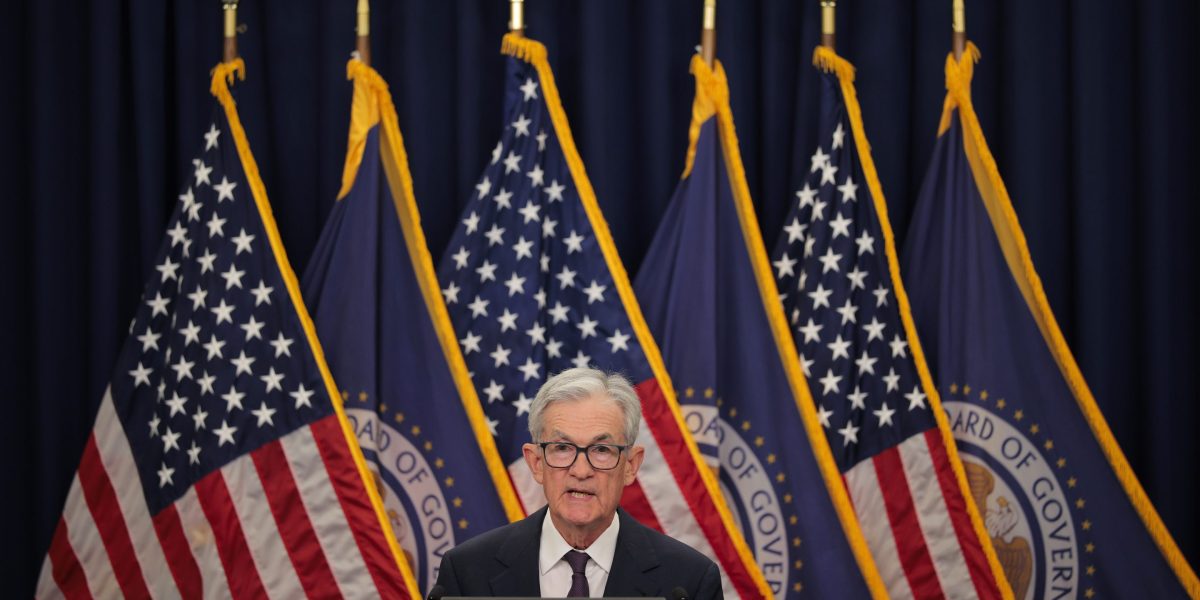
However, Powell addressed the long-rates aspect directly in his press conference this week. He told reporters: “We always think of it as the dual mandate, maximum employment and price stability … because we think moderate, long-term interest rates are something that will result from stable inflation—low and stable inflation and maximum employment.”

“So we we haven’t thought about that for a very long time as a third mandate that requires independent action. So that’s where that is. There’s no thought of—as far as I’m concerned—there’s no thought of considering that we somehow incorporate that in as something in a different way.”

Economists also argue that the Fed has little to no control over long-term rates: Its lever is the short-term base rate which, historically, has had varying impact on the longer-term interest level. They would also point to the context of the mandate: It was written in the 1970s, before the Fed was effectively targeting the funds rate.

Economists like Dr Steve Kamin, a senior fellow at the American Enterprise Institute and a former director at the Fed, therefore argue that on a day-to-day basis the third aspect is little more than “vestigial remnants of the congressional legislation.”

Likewise, RSM U.S.’s chief economist Joe Brusuelas argues the stipulation was met a matter of years after it was laid out: In the 1980s the Fed went back to effectively targeting the Fed Funds Rate, rendering the long-term mandate defunct. He explained to Fortune: “When this was written, the federal funds rate was not the policy tool. So one of the reasons why the policy innovation with the Fed fulfills that mandate—all three parts of it—is that the utilization of the federal fund’s policy rate at the front end of the curve profoundly influences financial conditions.”

“And so by using the federal funds rate to influence financial conditions, the third part, it then creates the context in which it can achieve price stability that allows the Fed to achieve maximum sustainable employment under conditions in any given business cycle.”

Professor Kent Smetters, of the Wharton Business School at the University of Pennsylvania, echoed that the Fed has little control over the long-term rate—though added this doesn’t make it an unimportant factor. He told Fortune: “The long rates, if anything, are the most important for the economy itself. It’s the benchmark against what you are making investment decisions over—if I’m putting up a new building I better be looking at alternatives of similar risk and … I would probably be looking at a 30-year rate, adding the risk premium to that and then saying: ‘OK, do I think my rental income of my buildings could at least cover that?’”

But more notably, Professor Smetters points out that a key influence over the long-term rate is government debt. To fully stay in control of this aspect of the mandate would entail “finger-wagging” to Congress over spending, he added: “The resistance to that is that the Federal Reserve is so concerned about its independence, especially nowadays, that anything where it looks like they could be encroaching in Congress, invites maybe the opposite. So I think they’re probably hesitant about doing that as well.”

If it ain’t broke, don’t fix it

The consensus across the range of experts Fortune spoke to was clear: Even if the Fed isn’t talking about long-term interest rates, the third element should not be removed from its mandate.

Professor Smetters is of the opinion that if the Fed were to lose its long-term policy task, markets would view it as the U.S. effectively taking its hands off the wheel when it comes to national debt. After all, if no one is monitoring the long-end of the curve and the sustainability of America’s bond market as a result, the asset becomes too risky to invest in.

Another concern is that of the market at large at present: That Congress altering the mandate may suggest further interference into the central bank. “I’m not sure that we are at a place where we need to move to change the Fed’s mandate,” Elyse Ausenbaugh, Head of Investment Strategy at J.P. Morgan Wealth Management, tells Fortune, “And indeed … that could fan the flames of this idea that there is political influence over what it is the Fed is striving to do and how they do it.”

Potentially more alarming still is the notion that if the Fed were relinquished of this responsibility, the government itself may try and intervene. The bond market is unique in its appreciation for competition: Investors want other buyers to be in the market because it means they are also confident in the returns on the asset—likewise if other investors are fleeing, it means they should too. For that equilibrium of buy-in to be falsely set (or lowered by a government in order for it to borrow more cheaply, and hence deliver lower returns to investors) buyers would likely sell up.

“Anytime these days that Congress would touch … the Fed constitution and stuff, that’s probably a bad thing,” echoed Dr Kamin. “This thing isn’t broke, and any attempts by Congress to meddle with it would probably make it worse, not better.”

Success despite the quiet

While Jerome Powell doesn’t have to search far for critics, the experts Fortune spoke to were generally of the opinion that the Fed had by and large achieved all three parts of its mandate.

While Powell may not be rattling off every part of the mandate in every press conferences, Ausenbaugh felt the Fed was still adequately indicating to investors that it was mindful of the issue, saying they are “willing to acknowledge this piece of the mandate.”

She added: “It is not rare for [Powell] to field questions around the fiscal trajectory of the United States, and I think the measured way with which he addresses those questions and the distinction he draws between what he and the FOMC are able to do versus what is the responsibility of Congress is hopeful, and to me a signal that they’re mindful of the elements that they can control when it comes to this picture.”

Likewise, if Powell stood up in his press conferences and began making predictions or promises about longer-term rates he would be “laughed out of the room” added Dr Kamin and Brusuelas.

“I don’t believe just because we don’t talk about the third leg of the mandate doesn’t mean it’s not being tended to or obtained,” added Brusuelas. “In fact, I would argue it’s being tended to and maintained all day every day.”


Source link

Continue Reading

Business

Trump slams Fed’s third-straight rate cut as ‘too small,’ saying he wishes it was twice as large

Published

on


The Federal Reserve reduced its key interest rate by a quarter-point for the third time in a row Wednesday but signaled that it may leave rates unchanged in the coming months.

The cut decreased the Fed’s rate to about 3.6%, the lowest it has been in nearly three years. Lower rates from the Fed can bring down borrowing costs for mortgages, auto loans, and credit cards over time, though market forces can also affect those rates.

Chair Jerome Powell suggested at a news conference that after six rate cuts in the past two years, the central bank can step back and see how hiring and inflation develop. In a set of quarterly economic projections, Fed officials signaled they expect to lower rates just once next year.

Fed officials “will carefully evaluate the incoming data,” Powell said, adding that the Fed is “well positioned to wait to see how the economy evolves.”

The chair also said that the Fed’s key rate was close to a level that neither restricts nor stimulates the economy, a significant shift from earlier this year, when he described the rate as high enough to slow the economy and quell inflation. With rates closer to a more neutral level, the bar for further rate cuts is likely higher that it was this fall.

“We believe the labor market will have to noticeably weaken to warrant another rate cut soon,” Ryan Sweet, global chief economist at Oxford Economics, said.

Three Fed officials dissented from the move, the most dissents in six years and a sign of deep divisions on a committee that traditionally works by consensus. Two officials voted to keep the Fed’s rate unchanged: Jeffrey Schmid, president of the Kansas City Fed, and Austan Goolsbee, president of the Chicago Fed. Stephen Miran, whom Trump appointed in September, voted for a half point cut.

December’s meeting could usher in a more contentious period for the Fed. Officials are split between those who support reducing rates to bolster hiring and those who’d prefer to keep rates unchanged because inflation remains above the central bank’s 2% target. Unless inflation shows clear signs of coming fully under control, or unemployment worsens, those divisions will likely remain.

“What you see is some people feel we should stop here and we’re in the right place and should wait, and some people think we should cut more next year,” Powell said.

A stark sign of the Fed’s divisions was the wide range of cuts that the 19 members of the Fed’s rate-setting committee penciled in for 2026. Seven projected no cuts next year, while eight forecast that the central bank would implement two or more reductions. Four supported just one. Only 12 out of 19 members vote on rate decisions.

President Donald Trump on Wednesday criticized the cut as too small, and said he would have preferred “at least double.” Trump could name a new Fed chair as soon as later this month to replace Powell when his term ends in May. Trump’s new chair is likely to push for sharper rate cuts than many officials will support.

Stocks jumped in response to the Fed’s move, in part because some Wall Street investors expected Powell to be more forceful in shutting down the possibility of future cuts. The broad S&P 500 stock index rose 0.7% and closed near an all-time high reached in October.

Powell was also optimistic about the economy’s growth next year, and said that consumer spending remains resilient while companies are still investing in artificial intelligence infrastructure. He also suggested growing worker efficiency could contribute to faster growth without more inflation.

Still, Powell said the committee reduced borrowing costs out of concern that the job market is even weaker than it appears. While government data shows that the economy has added just 40,000 jobs a month since April, Powell said that figure could be revised lower by as much as 60,000, which would mean employers have actually been shedding an average of 20,000 jobs a month since the spring.

“It’s a labor market that seems to have significant downside risks,” Powell told reporters. “People care about that. That’s their jobs.”

The Fed met against the backdrop of elevated inflation that has frustrated many Americans, with prices higher for groceries, rents, and utilities. Consumer prices have jumped 25% in the five years since COVID.

“We hear loud and clear how people are experiencing really high costs,” Powell said Wednesday. “A lot of that isn’t the current rate of inflation, a lot of that is e mbedded high costs due to higher inflations in 2022-2023.”

Powell said inflation could move higher early next year, as more companies pass tariff costs to consumers as they reset prices to start the year. Inflation should decline after that, he added, but it’s not guaranteed.

“We just came off an experience where inflation turned out to be much more persistent than anyone expected,” he said, referring to the spike in 2022. “Is that going to happen now? That’s the risk.”

The Fed’s policy meeting took place as the Trump administration moves toward picking a new Fed chair to replace Powell when his term finishes in May. Trump’s nominee is likely to push for sharper rate cuts than many officials may support.

Trump has hinted that he will likely pick Kevin Hassett, his top economic adviser. But on Wednesday, Trump said he would meet with Kevin Warsh, a former Fed governor who has also been on the short list to replace Powell.

Trump added that he wants someone who will lower interest rates. “Our rates should be the lowest rates in the world,” he said.

A government report last week showed that overall and core prices rose 2.8% in September from a year earlier, according to the Fed’s preferred measure. That is far below the spikes in inflation three years ago but still painful for many households after the big run-up since 2020.

Adding to the Fed’s challenges, job gains have slowed sharply this year and the unemployment rate has risen for three straight months to 4.4%. While that is still a low rate historically, it is the highest in four years. Layoffs are also muted, so far, as part of what many economists call a “low hire, low fire” job market.

The Fed typically keeps its key rate elevated to combat inflation, while it often reduces borrowing costs when unemployment worsens to spur more spending and hiring.

Powell will preside over only three more Fed meetings before he steps down. On Wednesday, he was asked about his legacy.

“I really want to turn this job over to whoever replaces me with the economy in really good shape,” he said. “I want inflation to be under control, coming back down to 2%, and I want the labor market to be strong.”

___

Associated Press Writers Collin Binkley and Alex Veiga in Los Angeles contributed to this report.


Source link

Continue Reading

Business

Coca-Cola names 30-year veteran Henrique Braun as new CEO

Published

on


Coca-Cola said Wednesday that its chief operating officer will become its next CEO in the first quarter of 2026.

The Atlanta beverage giant said its board elected Henrique Braun as CEO effective March 31. James Quincey, Coke’s current chairman and CEO, will transition to executive chairman of the company.

Braun, 57, has worked at Coca-Cola for three decades. Prior to assuming the COO role earlier this year, he led operations in Brazil, Latin America, Greater China and South Korea. He has held positions overseeing Coke’s supply chain, new business development, marketing, innovation, general management and bottling operations.

Braun was born in California and raised in Brazil. He holds a bachelor’s degree in agricultural engineering from the University Federal of Rio de Janeiro, a master of science degree from Michigan State University and an MBA from Georgia State University.

David Weinberg, Coca-Cola’s lead independent director, called Quincey, 60, a “transformative leader” who will continue to remain active in the business.

During Quincey’s nine years as CEO, Coke added more than 10 additional billion-dollar brands, including BodyArmor and Fairlife. He also brought Coke into the alcoholic drink market with Topo Chico Hard Seltzer, which went on sale in 2021.

In 2020, Quincey led a restructuring that reduced Coke’s brands by half and laid off thousands of employees. Quincey said Coke wanted to streamline its structure and focus its investments on fast-growing products like its Simply and Minute Maid juices.

But as Quincey steps down as CEO, Coke is facing numerous challenges, including tepid demand for its products in the U.S. and Europe and increasing customer scrutiny of its ingredients. This summer, after a nudge from President Donald Trump, Coke said it would release a version of its trademark Cola with cane sugar instead of high-fructose corn syrup.

Weinberg said the board is confident that Braun will build on the company’s strengths and seek out growth opportunities globally.

Coke shares were flat in after-market trading.


Source link

Continue Reading

Business

Warner Bros. merger fight draws fire across U.S. political divide

Published

on


The battle for Warner Bros. Discovery Inc. has already lit a fire in Hollywood, with unions decrying the potential job losses, theaters sounding an alarm about the future of film releases and actors worrying about free speech. 

Now, the debate over which company will end up owning Warner Bros. — Netflix Inc. or Paramount Skydance Corp. — is carving up the country along political lines.

In Republican circles, it’s become fashionable to root against Netflix. Paramount is run by David Ellison, who has close ties to the White House and whose bid for Warner Bros. is backed by Jared Kushner, son-in-law of President Donald Trump. Some prominent Democrats, on the other hand, are voicing objections to the Paramount bid, crying foul over the $24 billion that’s coming from Middle East sources.

President Trump added drama on Wednesday when he said that any deal for Warner Bros. should include the sale of its CNN cable news network.

“It should be guaranteed that CNN is part of it or sold separately,” he said. The network is run by “a very dishonest group of people.”

Warner Bros. and Paramount declined to comment. Netflix didn’t respond to requests for comment.

Few mergers in recent memory have been as polarizing at the battle for Warner Bros., which combines the glamour of Hollywood, the influence of TV news, foreign intrigue tied to Middle Eastern funds and the specter of White House favoritism.

Trump’s comment triggered even more uncertainty. He had previously raised antitrust concerns about Netflix buying Warner Bros.

After a months-long auction, Warner Bros. agreed last week to sell its studios and streaming business, including HBO, to Netflix for $27.75 a share. Under the Netflix deal, Warner Bros. would move forward with its plan to spin off its cable networks, including CNN and TNT, into a separate company called Discovery Global.

Paramount, which kicked off the sale process by making several unsolicited offers for the company, responded on Dec. 8 by launching a $30-a-share hostile tender offer for all of Warner Bros., including the cable networks.

Paramount released a letter to shareholders on Wednesday reiterating that its offer is superior and more likely to win approval in Washington. 

Ellison has spoken publicly about having a good relationship with the Trump administration. His father Larry Ellison, the cofounder of Oracle Corp. and world’s second-richest person, is a Trump ally. 

Still, Trump hasn’t fully endorsed Paramount’s bid. He bashed the company on Monday over a 60 Minutes interview with Republican Congresswoman Marjorie Taylor Greene, who has become a vocal critic of the president. He also said that neither Netflix nor Paramount “are particularly great friends of mine.” 

Other politicians have been much clearer about who they’re rooting against in the bidding war.

In November, Republican Congressman Darrell Issa of California wrote a letter to Attorney General Pam Bondi asking whether a Netflix deal with Warner Bros. would give the streaming leader too much market power.

“Netflix is already the dominant streaming platform in the United States and permitting it to absorb a major competitor raises antitrust concerns that could result in a harm to consumers,” Issa wrote.

Democratic Representatives Sam Liccardo of California and Ayanna Pressley of Massachusetts sent a letter to Warner Bros. CEO David Zaslav on Wednesday raising concerns about the participation of foreign investors in Paramount’s bid, which includes backing from sovereign wealth funds in Saudi Arabia, Qatar and Abu Dhabi. 

“These investors, by virtue of their financial position or contractual rights, could obtain influence — direct or indirect — over business decisions that bear upon editorial independence, content moderation, distribution priorities, or the stewardship of Americans’ private data,” the lawmakers wrote. 

Like many in Hollywood, Democratic Senator Elizabeth Warren of Massachusetts would prefer no sale at all. She called Paramount’s offer a “five-alarm antitrust fire” on Monday after previously branding Netflix’s bid as an “anti-monopoly nightmare.”

Within the pro-Trump MAGA-verse, influencers and media commentators called on Trump to block a Netflix-Warner Bros. deal. Conservative commentator Laura Loomer zeroed in on Netflix’s ties to former President Barack Obama and his wife Michelle. They signed a deal with the company in 2018.

“If Netflix is allowed to buy Warner Bros. and Trump’s administration doesn’t kill off the merger, CNN will be transformed into the Obama News Network, featuring shows hosted by Michelle Obama @MichelleObama where she lectures Americans about how racist and sexist we are,” Loomer wrote on X

Right-wing podcaster Benny Johnson said combining Netflix with Warner Bros.’ streaming and studios asset would be “the most dangerous media consolidation in American history” and deliver “a monopoly on children’s entertainment” to “the Democrat super-donors that run Netflix.”

Former US Representative Matt Gaetz, who was previously nominated for attorney general by Trump before withdrawing, wrote “TRUMP MUST STOP THIS!” in a post on X shortly after the Netflix deal was announced.

“The most massive content distributor lashing to a massive content producer / catalog will create a homogenized, woke nightmare for the media landscape,” he wrote.

For Hollywood, much of the focus has been on how each deal would impact an industry already facing job losses, production cuts and the threat of artificial intelligence. 

With Netflix co-CEO Ted Sarandos previously deeming the experience of going to a movie theater to be “outdated,” some in the industry are concerned his company’s takeover of Warner Bros.’s streaming business would spell disaster for theater chains and film production. 

Michael O’Leary, CEO of movie theater trade group Cinema United, said in a statement last week that the Netflix deal “poses an unprecedented threat to the global exhibition business.”

“Netflix’s stated business model does not support theatrical exhibition,” he wrote. “In fact, it is the opposite.”

The Producer’s Guild of America urged protection for producers’ livelihoods and theatrical distribution. 

“Our legacy studios are more than content libraries – within their vaults are the character and culture of our nation,” the guild said.

Actress Jane Fonda spoke out against the Netflix deal last week calling it “an alarming escalation of the consolidation that threatens the entire entertainment industry, the democratic public it serves and the First Amendment itself.”

Other creatives commented on how the consolidation might affect consumers. In a skit from Morning Brew’s YouTube Channel Good Work, a movie viewer starts to stream a film at home, only to be barraged by a series of studio logos that include Netflix, Warner Bros., Paramount, HBO, Pixar and the Saudi Arabia Public Investment Fund. The viewer quickly gets bored before grabbing the remote.

“Let’s turn this off,” he says. 


Source link

Continue Reading

Trending

Copyright © Miami Select.