
Business
The emperor strikes back—but Trump’s revenge and deflection aren’t public protection
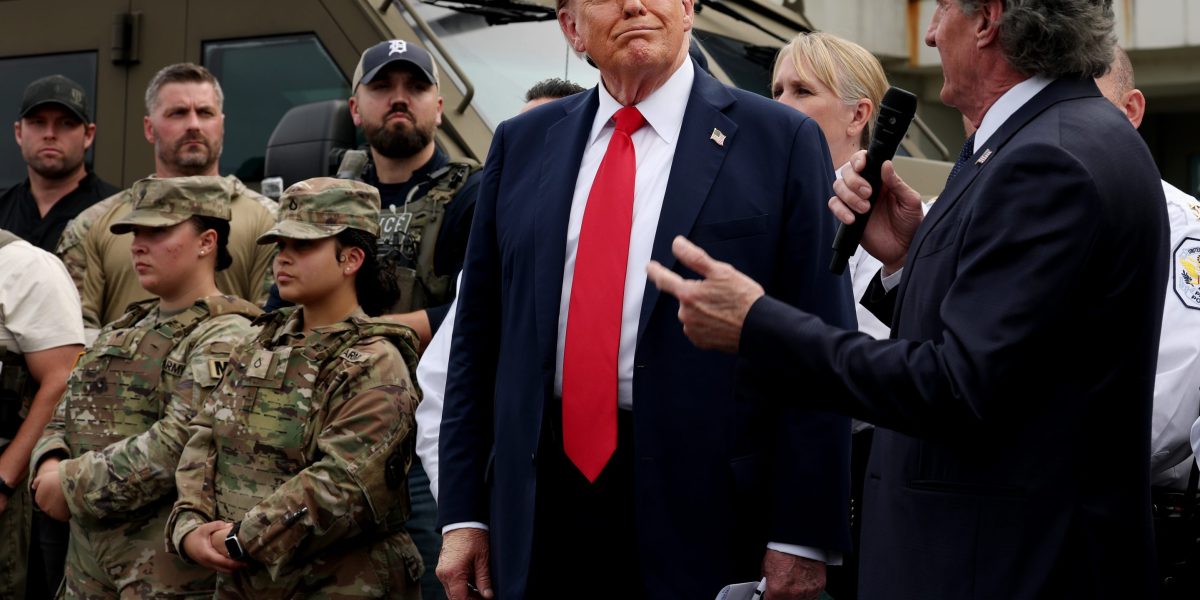
Deflection is not protection, unless you are President Donald Trump, desperate to divert national attention away from your own self-inflicted crises, failures, and ongoing legal problems. Sounding false alarms over public safety despite falling crime rates, Trump is manufacturing misinformation to lead a dangerous military war on his own American cities as a dodge from accountability while, paradoxically, degrading public safety.
Despite Trump’s bravado, his firing of non-political career economists, prosecutors, and military leaders, and his attacks on former Trump administration officials and critical media commentators, he cannot hide the evidence—of rising inflation and wide-ranging national security failures, such as threats of nuclear war from North Korea, the ongoing bloodshed in Gaza, or the continued Russian mass slaughter of Ukrainian civilians. He cannot hide the public outrage over maneuvers intended to evade the release of the full Epstein sex-trafficking files, and cutbacks to Medicaid and disaster relief. Targeting critics for unwarranted criminal investigations and deploying thousands of National Guardsmen have sidetracked media attention from his own setbacks, but they have made the nation less safe.
As experts on leadership, governance, community policing, counterterrorism, and military training, we condemn Trump’s dangerous erosion of public safety and outline how to fortify law enforcement. Trump’s grandiose displays of brute force—the massing of weapons of war and platoons of masked, unidentified combat fighters targeting the very civilian populations they are commissioned to protect—does not bring reassurance.
Trump invades Los Angeles, then Washington, D.C.
In June, Trump invoked Title 10 of the U.S. Code to send about 700 active-duty Marines and 4,000 National Guard troops to Los Angeles over the objection of California Democratic Gov. Gavin Newsom, citing the urgent need to combat rebellions and to repel foreign invasions.
Trump has now expanded this massive federal invasion into Washington, D.C., and he’s been widely reported to be planning the military occupation of other Democratic-led cities—Chicago, Baltimore, Philadelphia, New York City, Boston, New Orleans, Chicago, Seattle, and Detroit—despite the reality of crime already significantly dropping in all these cities. Such moves conjure up images of the suppression tactics of feared secret police forces, from Russia’s FSB (formerly known as the KGB) to China’s MSS to the former Savak and Gestapo agencies of Iran and Germany, respectively.
The president has an uncanny ability to reframe national attention by taking the focus off his failures with distractions based on the repetition of distorted statistics, fortified by large ceremonial events. In the recent past, he invented false charges of President Obama’s non-American birth, untrue charges of New Jersey Muslims cheering the collapse of the twin towers of 9/11, and antivax conspiracies insisting COVID-19 was a Democratic hoax. He incited a riot at the U.S. Capitol as he falsely declared massive election fraud, amassed thousands of troops along the southern border to repel mysterious caravans of illegal immigrants, and made false allegations of Haitian immigrants eating their neighbors’ pets.
Trump’s crime data as empty as his military parade
Earlier this summer, on his 79th birthday, overlapping with the Army’s 250th anniversary, Trump imported 6,600 soldiers along with tanks, armored personnel carriers and aircraft, supported by roughly 150 vehicles, including Strykers, M1 Abrams tanks and Humvees. (Trump was rebuffed when he tried to pull off such a grandiose parade during his first term.) Despite the cost of up to $45 million, only several thousand civilians came to watch the event, with photos showing the bleachers largely empty, while the anti-Trump “No Kings” counter rallies drew up to six million Americans nationwide.
As a counter to this failed show of military force to divert public attention, Trump has now weaponized the military against America, seizing the false pretext of crime when a DOGE staffer who called himself “Big Balls” was assaulted during an attempted carjacking. Trump inaccurately proclaimed “We have a capital that’s very unsafe,” adding, “We have to run D.C.”
Trump announced a virulent crime epidemic, but his own Justice Department (DOJ) numbers show this to be false. Trump’s move on D.C. came just months after the DOJ announced that violent crime in the city had hit a 30-year low, and it was down 35% in 2024 from the year before. According to recent data released by the Metropolitan Police Department (MPD), homicides are down 11% year-to-date in comparison to the same period in 2024 and violent crime is down 26%. Although violent crime rates in Washington, D.C., are higher than the national average, the Council on Criminal Justice announced last week “there is an unmistakable and large drop in reported violence in the District since the summer of 2023 … consistent with what’s being reported in other large cities across the country.”
City leaders also insist the crackdown is unnecessary and destabilizing, pointing to data showing violent crime is already declining. Mayor Muriel Bowser has pushed back on Trump’s characterization of the city, calling his actions both a photo op and a gross militarization of the nation’s capital. She tweeted that “American soldiers and airmen policing American citizens on American soil is #UnAmerican.”
Cities under siege
Trump has since ordered thousands of soldiers from the National Reserves and federalized law enforcement officers to converge on Washington, with exaggerated assertions of crime, to divert the public narrative away from his own legal challenges and on public safety instead.
Washington is like a city under siege, with armed combat troops establishing federal checkpoints, with individuals being asked questions about their immigration status and then being arrested, with no evidence of a criminal violation and no evident crimes committed. His false public safety emergency invoked Section 740 of the District of Columbia Home Rule Act, which gives the President of the United States the authority to seize control of DC’s Police Department in “conditions of an emergency nature.” (Attorney General Pam Bondi was initially placed in charge of the MPD, but the DOJ agreed to withdraw that power grab following negotiations required by a federal judge.)
Section 740 provides the president only limited and temporary powers to direct the mayor to provide the services of MPD for federal purposes after the president determines that “special conditions of an emergency nature exist. Authority over the MPD lapses after just 48 hours unless they obtain a joint resolution from Congress to extend the authority for beyond 30 days. The legal time limit and required congressional approvals should act as an important limit on such abuse of presidential power; however, Rep. Anna Paulina Luna (R-FL) has already introduced a resolution to extend it beyond the 30-day period.
In June, one of us ran 20 of Trump’s most prominent pronouncements through all five of the top AI platforms (Chat GPT, Google Gemini, Anthropic, Perplexity; and X AI’s Grok) and found agreement that every single one of them was false, as we wrote in The Washington Post. Our new original review of all five leading AI platforms, drawing on scores of different independent databases, contradict Trump and indicate Trump’s pretext of out-of-control crime to be a lie — all federal and state law enforcement statistics reveal plunging crime rates in all of these cities.
Accordingly, some GOP governors have declined Trump’s request for National Guard troops, such as Vermont Governor Phil Scott, who issued a bold statement defying Trump: “While public safety is a legitimate concern in cities across the country and certainly in the nation’s capital, in the absence of an immediate emergency or disaster that local and regional first responders are unable to handle, the governor just does not support utilizing the guard for this purpose, and does not view the enforcement of domestic law as a proper use of the National Guard.”
Humiliation, then anger
The public reaction has been a humiliating blend of outrage and mockery rather than the intended adulation. A recent Pew Research Poll found most Americans believe Trump has made the federal government worse. Even in Washington, the federal military crackdown has destroyed business, with people hiding at home and independent restaurant booking data showing business plummeting by a stunning 31%.
Such rejection of his efforts to reflect has angered Trump even more, as he called the federal and local crime statistics false and demanded criminal investigations of the data collection. Army, Air Force, and Marine generals and admirals have decried this attack on our cities as a “political stunt with his very dangerous for our country” creating dangerous crowd situations.
General Mark Hertling has said “in this case, I can’t see what the mission is right now.” Former Trump Defense Secretary Mark Esper has warned that Trump asked him to shoot peaceful protestors demonstrating after the George Floyd murder.
Soldiers are not trained to be police
One of us who has trained the nation’s military forces for decades at West Point warns that people who are trained to kill in battle are not trained in assisting distressed citizens in emergency healthcare or aiding those in mental distress, let alone handling traffic stops, routine arrests, domestic violence, or peacefully calming neighborhood disputes. Military reservists are civilians who jump back into uniforms to assist heroically in natural disaster recovery, provide humanitarian assistance, or to fortify regular combat divisions in battles around the world. Wearing them out in the wrong jobs makes them less available for such national priorities.
Defense Secretary Pete Hegseth has armed the deployed troops with M17 pistols—controversial weapons that have been known to fire if dropped or even when holstered. The manufacturer has made repairs to many of them, but claims of unintentional discharges, including in upgraded models, have continued, leading to ongoing debate and lawsuits about the pistol’s safety.
More importantly, most of the Guardsmen are not Military Police or Special Ops, meaning they are not well-trained to carry or shoot the handguns they have been armed with. Thus, the probability of innocents being killed or wounded in these deployments is high.
Militaries are designed to win wars: They are trained in Rules of Engagement (ROE), which define the parameters of the use of force on a battlefield. These are governed by the laws of armed conflict (LOC), and provide a framework for identifying appropriate military targets; once identified, they can be eliminated. By contrast, law enforcement are trained in rules on the use of deadly force. Under this paradigm, deadly force is appropriate only when the officer has a reasonable belief that the subject poses an imminent threat to the officer or another person. Their actions are governed by the Constitution of the United States: The goal is to “neutralize the threat,” not “shoot to kill.”
These are very different mindsets. Having individuals who view American streets as a military battlefield, rather than a community whose overall well-being they are trained to protect, is a recipe for disaster.
A distraction from genuine terrorism
Another of us who has led counterterrorism initiatives at the FBI similarly is concerned about the distraction from genuine protection against foreign terrorist plots and international gangs and domestic mass shootings and kidnappings. Instead, soldiers have been needlessly assigned to stand around train stations and monuments, like statues themselves.
Meanwhile, she has called out Trump’s efforts to delegitimize proper FBI investigation of misuse of classified information and other reviews of possible illegal conduct of public officials, punishing them for doing their jobs beforehand, while using them now to silence critics of his administration. There are also concerns about the misuse of needed expertise and resources of ATF agents who need to be targeting the cartels who are smuggling firearms, improving forensic tools for criminal investigations. and assisting in thousands of federal weapons convictions. Meanwhile, the draining of ICE agents from the borders, where the US is now understaffed, comes as Trump urgently seeks to recruit 10,000 more agents.
Another of us who led the Capitol Police has warned the collaboration across agencies will work only if the MPD leads the effort as they know the turf. It already has 3,500 police, with unique experience in managing peaceful demonstrations and legal protests. He has confirmed the statistics about the increased safety in Washington and warned that local leadership has the expertise to prevent crowding and overlap of law enforcement.
William Bratton, who has successfully led crime-fighting efforts in such major cities as Boston, Los Angeles, and New York, provided the track record and data to prove that militarizing municipal law enforcement is the exact wrong way to partner with communities for public safety. As the architect of the successful model of “community policing” in American cities, he advocated for engaging with neighborhoods for beat police officers to be known as resources and not distant, feared soldiers in tanks, operating under central command. He advocated combined crime prevention initiatives with a willingness to listen to community concerns through a system of decentralized management where precinct commanders were held accountable for addressing locally defined problems. His double-digit drops in violent crime across these cities fortifies the credulity of his approach over Trump’s military assault on American cities.
A lust for empire
Finally, one co-author, a leadership scholar, has worked with Trump personally and notes that the drive for grandiosity that motivates this misuse of law enforcement, intertwined with military warriors, could have been foreseen years earlier in Trump’s character. His goal is not public safety but rather imperial power. In a 2004 Wall Street Journal essay, entitled “Last Emperor Trump,” he predicted Trump might run for the presidency a decade before he actually did so, warning, “Our curiosity over the tortured logic behind his mysterious choices has a magnetic draw as does the raw power to change the fate of someone else’s life at your pleasure. Roman crowds packed the Colosseum to watch the gladiators battle each other and loved the Emperor’s glance to the onlookers before condemning the loser to death.”
Over 2,000 years ago, the vainglorious emperors and conquering generals of the ancient Roman Empire would arrange massive public salutes to themselves in famous Roman Triumphs where they would surround themselves with armed, uniformed soldiers and cheering crowds to celebrate and sanctify their victories with divine-like imagery. While President Trump may not have been a classics scholar, he certainly tried to model the tradition of such grandiose fanfare. But his classics lesson is backfiring.
As Benjamin Franklin advised 270 years ago, “They who would give up essential Liberty, to purchase a little temporary Safety, deserve neither Liberty nor Safety.”
The authors would like to thank Steven Tian from the Yale Chief Executive Leadership Institute for their research.
The opinions expressed in Fortune.com commentary pieces are solely the views of their authors and do not necessarily reflect the opinions and beliefs of Fortune.