Connect with us

Business

The curious case of the ICE pastor as Minnesota protesters disrupt church services and DOJ launches investigation


Published

on


The U.S. Department of Justice said Sunday it is investigating a group of protesters in Minnesota who disrupted services at a church where a local official with U.S. Immigration and Customs Enforcement apparently serves as a pastor.

A livestreamed video posted on the Facebook page of Black Lives Matter Minnesota, one of the protest’s organizers, shows a group of people interrupting services at the Cities Church in St. Paul by chanting “ICE out” and “Justice for Renee Good.” The 37-year-old mother of three was fatally shot by an ICE agent in Minneapolis earlier this month amid a surge in federal immigration enforcement activities.

The protesters allege that one of the church’s pastors — David Easterwood — also leads the local ICE field office overseeing the operations that have involved violent tactics and illegal arrests.

U.S. Department of Justice Assistant Attorney General Harmeet Dhillon said her agency is investigating federal civil rights violations “by these people desecrating a house of worship and interfering with Christian worshippers.”

“A house of worship is not a public forum for your protest! It is a space protected from exactly such acts by federal criminal and civil laws!” she said on social media.

Attorney General Pam Bondi also weighed in on social media, saying that any violations of federal law would be prosecuted.

Nekima Levy Armstrong, who participated in the protest and leads the local grassroots civil rights organization Racial Justice Network, dismissed the potential DOJ investigation as a sham and a distraction from federal agents’ actions in Minneapolis-St. Paul.

“When you think about the federal government unleashing barbaric ICE agents upon our community and all the harm that they have caused, to have someone serving as a pastor who oversees these ICE agents, is almost unfathomable to me,” said Armstrong, who added she is an ordained reverend. “If people are more concerned about someone coming to a church on a Sunday and disrupting business as usual than they are about the atrocities that we are experiencing in our community, then they need to check their theology and the need to check their hearts.”

The website of St. Paul-based Cities Church lists David Easterwood as a pastor, and his personal information appears to match that of the David Easterwood identified in court filings as the acting director of the ICE St. Paul field office. Easterwood appeared alongside DHS Secretary Kristi Noem at a Minneapolis press conference last October.

Cities Church did not respond to a phone call or emailed request for comment Sunday evening, and Easterwood’s personal contact information could not immediately be located.

Easterwood did not lead the part of the service that was livestreamed, and it was unclear if he was present at the church Sunday.

In a Jan. 5 court filing, Easterwood defended ICE’s tactics in Minnesota such as swapping license plates and spraying protesters with chemical irritants. He wrote that federal agents were experiencing increased threats and aggression and crowd control devices like flash-bang grenades were important to protect against violent attacks. He testified that he was unaware of agents “knowingly targeting or retaliating against peaceful protesters or legal observers with less lethal munitions and/or crowd control devices.”

“Agitators aren’t just targeting our officers. Now they’re targeting churches, too,” the U.S. Immigration and Customs Enforcement agency stated. “They’re going from hotel to hotel, church to church, hunting for federal law enforcement who are risking their lives to protect Americans.”

Black Lives Matter Minnesota co-founder Monique Cullars-Doty said that the DOJ’s prosecution was misguided.

“If you got a head — a leader in a church — that is leading and orchestrating ICE raids, my God, what has the world come to?” Cullars-Doty said. “We can’t sit back idly and watch people go and be led astray.”


Source link

Continue Reading

Business

Trump says he wants Greenland because he was rejected for a Nobel Peace Prize last year

Published

on


U.S. President Donald Trump linked his aggressive stance on Greenland to last year’s decision not to award him the Nobel Peace Prize, telling Norway’s prime minister that he no longer felt “an obligation to think purely of Peace,” two European officials said Monday.

Trump’s message to Jonas Gahr Støre appears to ratchet up a standoff between Washington and its closest allies over his threats to take over Greenland, a self-governing territory of NATO member Denmark. On Saturday, Trump announced a 10% import tax starting in February on goods from eight nations that have rallied around Denmark and Greenland, including Norway.

Those countries issued a forceful rebuke. But British Prime Minister Keir Starmer sought to de-escalate tensions on Monday. While the White House has not ruled taking control of the strategic Arctic island by force, Starmer said he did not believe military action would occur.

“I think this can be resolved and should be resolved through calm discussion,” he said.

Still, the American leader’s message to Gahr Støre could further fracture a U.S.-European relationship already strained by differences over how to end the nearly four-year war in Ukraine, previous rounds of tariffs, military spending and migration policy.

In a sign of how tensions have increased in recent days, thousands of Greenlanders marched over the weekend in protest of any effort to take over their island. Greenland Prime Minister Jens-Frederik Nielsen said in a Facebook post Monday that the tariff threats would not change the their stance.

“We will not be pressured,” he wrote.

Meanwhile, Naaja Nathanielsen, Greenland’s minister for business, minerals, energy, justice and equality, told The Associated Press that she was moved by the quick response of allies to the tariff threat and said it showed that countries realize “this is about more than Greenland.”

“I think a lot of countries are afraid that if they let Greenland go, what would be next?”

Trump sends a message to the Norwegian leader

According to two European officials, Trump’s message to Gahr Støre read in part: “Considering your Country decided not to give me the Nobel Peace Prize for having stopped 8 Wars PLUS, I no longer feel an obligation to think purely of Peace, although it will always be predominant, but can now think about what is good and proper for the United States of America.”

It concluded: “The World is not secure unless we have Complete and Total Control of Greenland.”

The officials, who were not authorized to comment publicly and spoke on condition of anonymity, said it had been forwarded to multiple European ambassadors in Washington. PBS first reported on the content of Trump’s note.

U.S. Treasury Secretary Scott Bessent defended the president’s approach in Greenland during a brief Q&A with reporters in Davos, Switzerland, which is hosting the World Economic Forum meeting this week.

“I think it’s a complete canard that the president would be doing this because of the Nobel,” Bessent said, immediately after saying he did not “know anything about the president’s letter to Norway.”

Bessent insisted Trump “is looking at Greenland as a strategic asset for the United States,” adding that “we are not going to outsource our hemispheric security to anyone else.”

The White House did not respond to questions about the message or the context for Trump sending it.

Gahr Støre confirmed Monday that he had received a text message the day before from Trump but did not release its contents.

The Norwegian leader said Trump’s message was a reply to an earlier missive sent on behalf of himself and Finnish President Alexander Stubb, in which they conveyed their opposition to the tariff announcement, pointed to a need to de-escalate, and proposed a telephone conversation among the three leaders.

“Norway’s position on Greenland is clear. Greenland is a part of the Kingdom of Denmark, and Norway fully supports the Kingdom of Denmark on this matter,” the Norwegian leader said in a statement. “As regards the Nobel Peace Prize, I have clearly explained, including to president Trump what is well known, the prize is awarded by an independent Nobel Committee and not the Norwegian Government.”

He told TV2 Norway that he hadn’t responded to the message, but “I still believe it’s wise to talk,” and he hopes to talk with Trump in Davos this week.

The Norwegian Nobel Committee is an independent body whose five members are appointed by the Norwegian Parliament.

Trump has openly coveted the peace prize, which the committee awarded to Venezuelan opposition leader María Corina Machado last year. Last week, Machado presented her Nobel medal to Trump, who said he planned to keep it though the committee said the prize can’t be revoked, transferred or shared with others.

Starmer says a trade war is in no one’s interest

In his latest threat of tariffs, Trump indicated they would be retaliation for last week’s deployment of symbolic numbers of troops from the European countries to Greenland — though he also suggested that he was using the tariffs as leverage to negotiate with Denmark.

European governments said that the troops traveled to the island to assess Arctic security, part of a response to Trump’s own concerns about interference from Russia and China.

Starmer on Monday called Trump’s threat of tariffs “completely wrong” and said that a trade war is in no one’s interest.

He added that “being pragmatic does not mean being passive and partnership does not mean abandoning principles.”

Six of the eight countries targeted are part of the 27-member European Union, which operates as a single economic zone in terms of trade. European Council President Antonio Costa said Sunday that the bloc’s leaders expressed “readiness to defend ourselves against any form of coercion.” He announced a summit for Thursday evening.

Starmer indicated that Britain, which is not part of the EU, is not planning to consider retaliatory tariffs.

“My focus is on making sure we don’t get to that stage,” he said.

Denmark’s defense minister and Greenland’s foreign minister are expected to meet NATO Secretary-General Mark Rutte in Brussels on Monday, a meeting that was planned before the latest escalation.

___

Associated Press writers Josh Boak in West Palm Beach, Florida; Emma Burrows in Nuuk, Greenland; and Bill Barrow in Atlanta contributed to this report.


Source link

Continue Reading

Business

Down Arrow Button Icon

Published

on


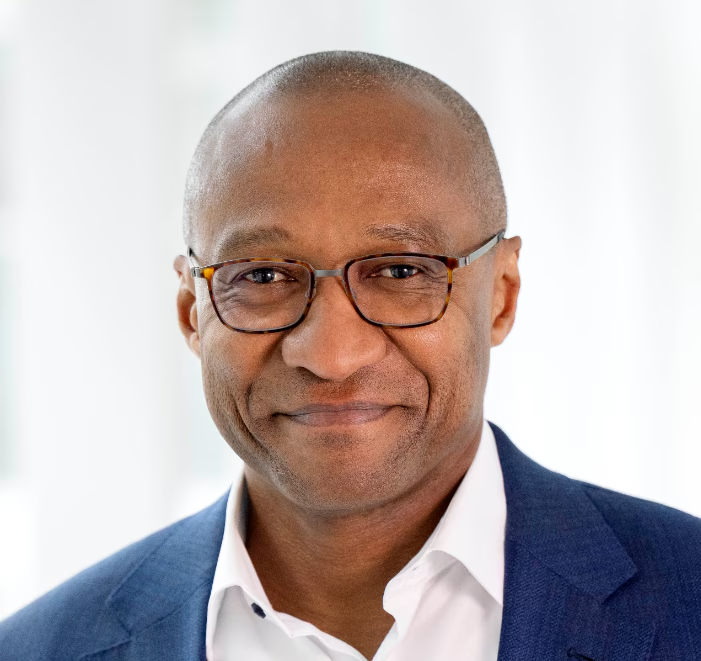
For the past two-and-a-half decades, the mandate for global business leaders was relatively straightforward: grow the existing business, allocate capital efficiently, and implement technology to drive productivity. But Mohamed Kande, global chairman of PwC, speaking to Fortune in Davos, Switzerland, ahead of the World Economic Forum’s annual meeting, insisted that era is over. Kande argued that the CEO job has changed more in the past year than anything he’s seen over the last quarter-century.

“This is one of the most testing moments for leaders,” Kande told Fortune‘s Diane Brady, describing a new “tri-modal” mandate that requires executives to simultaneously run their current business, transform it in real time, and also build entirely new business models for the future. “I’ve not seen that in 25 years,” he said.

Despite this pressure, Kande’s message to the global business community is rooted in historical optimism. “Do not fear the future. It is unsettling. It is true. Every day something changes, but do not fear it,” he said, noting that all the uncertainty so stressful to executives has happened before, from tariffs, roughly 100 years ago, to the industrial revolution, even further back. “Eventually, something good will happen.” Kande allowed that he’s an optimist by nature, but he insisted that top leaders can adjust to this business climate.

The AI Execution Gap

Of course, a primary driver of this unsettling change is the rapid adoption of artificial intelligence (AI), as revealed in PwC’s 29th global CEO survey, “Leading Through Uncertainty in the Age of AI,” released at the onset of the annual meeting in Davos. Based on responses from 4,454 CEOs across 95 countries and territories, the survey reveals a stark disconnect between ambition and reality. Kande said the business community made huge strides from 2024 to 2025, going from asking themselves whether they can or should adopt AI to a point where “nobody is asking that question anymore. Everybody’s going for it.”

PwC’s survey finds, however, that only 10% to 12% of companies report seeing benefits on the revenue or cost side, while a staggering 56% say they are getting “nothing out of it.” This echoes the MIT study that shook markets in August with the finding that 95% of generative AI pilots were failing across the corporate sector.

Kande attributed this tension not to the technology itself, but to a lack of foundational rigor. “Somehow AI moves so fast … that people forgot that the adoption of technology, you have to go to the basics,” he explained, citing the need for clean data, solid business processes, and governance. PwC is finding that the companies that are seeing benefits from AI are “putting the foundations in place.” It’s about execution, not technology, he argued, and that comes down to good management and leadership.

The Confidence Paradox and U.S. Dominance

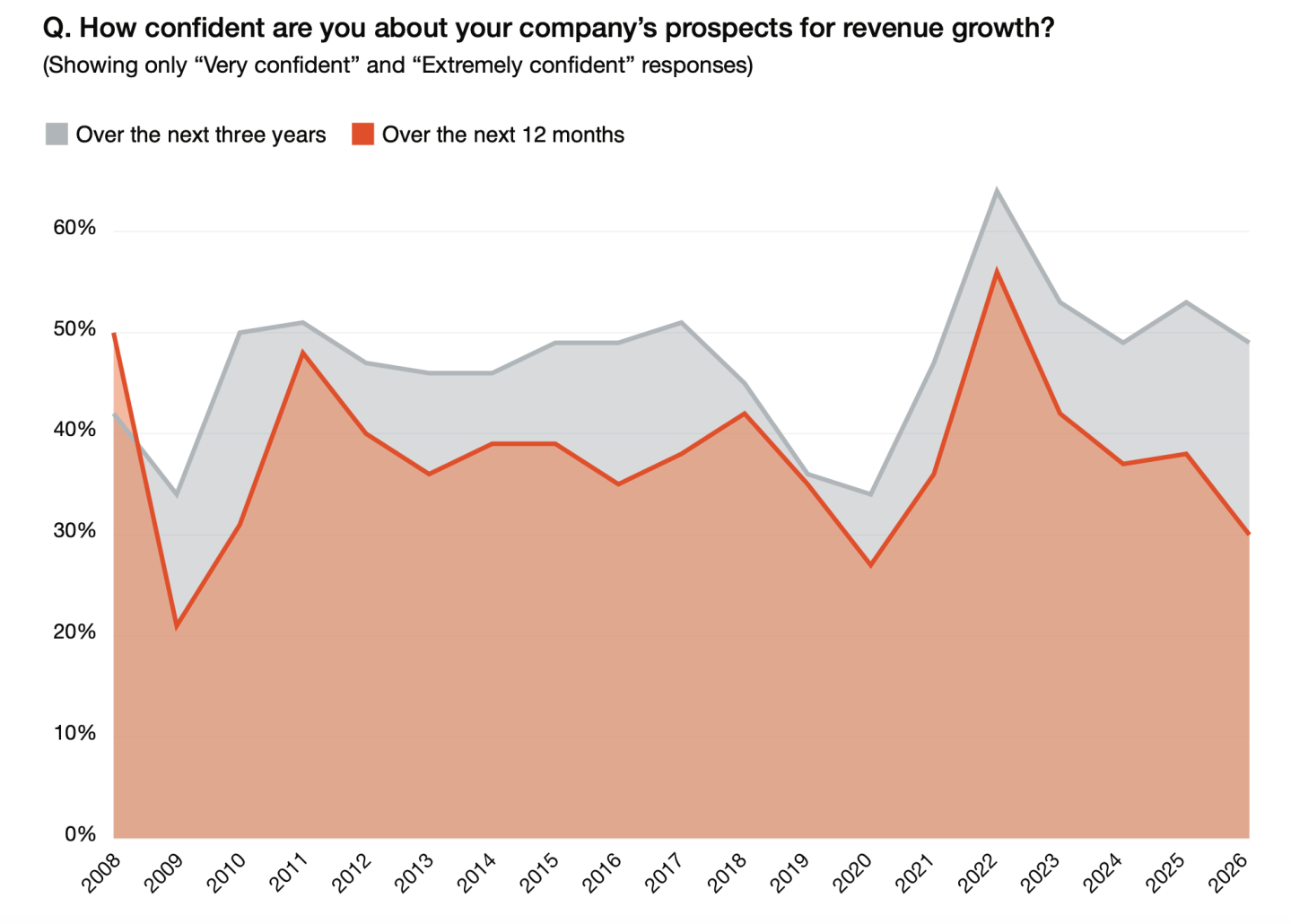
The uncertain environment has also created a paradox in business sentiment, Kande told Fortune. While CEOs express confidence in the global economy, only 30% have confidence that they can grow their own businesses. Kande questioned whether this hesitation stems from geopolitics, tariffs, technology, or a lack of leadership agility. The last 15 years, he noted, have been ones of solid growth and stable business models, making this time a real test for the C-suite. “This is one of the most testing moment for leaders, what we have today,” he said, because it requires the ability to change fast and adapt quickly without getting bogged down in day-to-day, tactical combat.

Only three in 10 CEOs were confident in PwC’s 29th survey about revenue growth over the next 12 months, down from 38% in 2025 and 56% in 2022, marking a five-year low in CEO confidence in their own revenue outlook. Another survey question may be more revealing, about CEO confidence in their company’s 12‑month revenue growth: this has fallen sharply over recent years, even as many leaders continue to pursue multiyear opportunities to reinvent their businesses through AI, innovation, and cross-sector expansion. 
The transformation of the CEO role is trickling down to the workforce, necessitating a reimagining of career paths. Kande warned that the traditional “apprenticeship model”—where entry-level employees learn by doing basic tasks—is being disrupted by AI. That classic career ladder, starting at the entry level, taught lots of expertise through hands-on learning, but this will have to be redesigned, going forward, to teach “system thinking” rather than task execution, as AI increasingly handles the latter.

Ultimately, Kande urges executives to look at the last 50 to 100 years rather than the last five to understand the current moment. Citing the infrastructure booms of the railroad era and the early internet, he said he believes the current wave of investment will birth the next age of innovation. The CEO survey’s framing of a coming “decade of innovation and industry reconfiguration” supports this long-term view, highlighting that companies generating more revenue from new sectors tend to enjoy higher profit margins and higher CEO confidence in future growth.

“I’m an optimist,” Kande concluded. Rather than being afraid of all of the changes that are happening now, he urged leaders to remember that people fear what they don’t understand, and the best remedy for that is to seek understanding. “That’s why I spend so much time learning now and traveling a lot, just to understand what’s happening and thinking about what can be done differently. That’s why I don’t fear AI.”

“I’ve seen change,” Kande said. “You’ve got to embrace it.”


Source link

Continue Reading

Business

Trump’s Gaza ‘Board of Peace’ extends invitations to Russia, Belarus and Thailand along with EU
Published

on


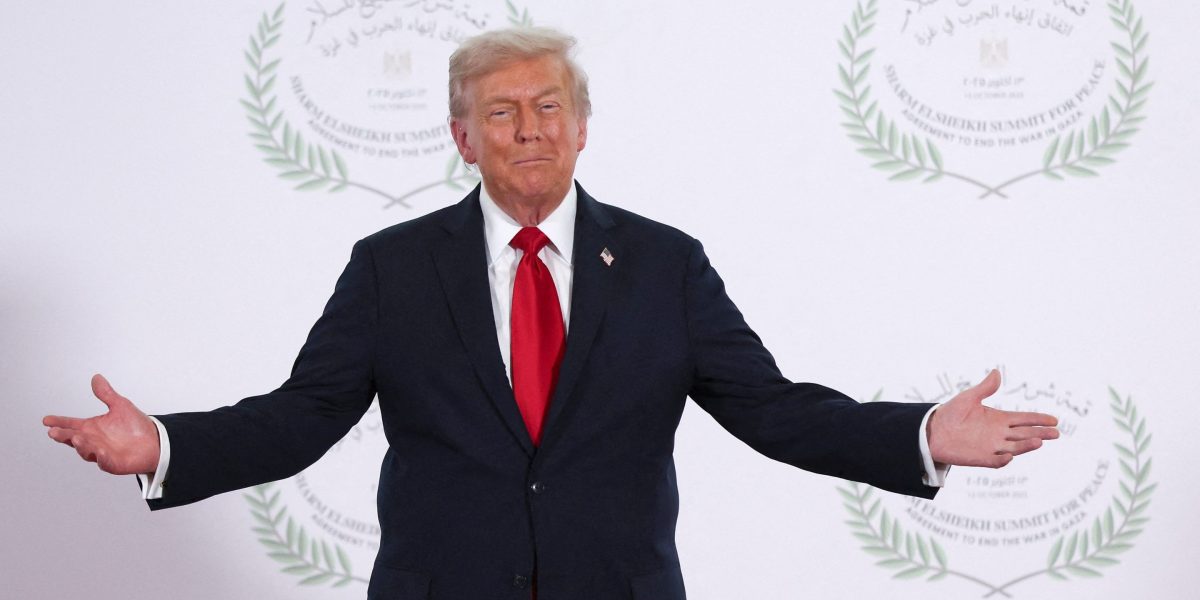
The European Union’s executive arm, Russia, Belarus and Thailand on Monday were the latest to be asked to join U.S. President Donald Trump’s new Board of Peace that will supervise the next phase of the Gaza peace plan, as a top Israeli official said the initiative is “bad for Israel” and should be scrapped.

Kremlin spokesman Dmitry Peskov said Russian President Vladimir Putin received the invitation and that the Kremlin is now “studying the details” and would seek clarity of “all the nuances” in contacts with the U.S. The Thai Foreign Ministry said it was also invited and that it was reviewing the details.

Belarus President Alexander Lukashenko has been invited and is ready to take part, according to the country’s Foreign Ministry.

European Commission spokesperson Olof Gill confirmed that Ursula von der Leyen, the president of the commission, received an invitation and would be speaking to other EU leaders about Gaza. Gill didn’t say whether the invitation had been accepted, but that the commission wants “to contribute to a comprehensive plan to end the Gaza conflict.”

It’s unclear how many leaders have been invited to join the board. But a Trump reference in the invitation letters that the body would “embark on a bold new approach to resolving global conflict” suggested it could act as a rival to the U.N. Security Council, the most powerful body of the global organization created in the wake of World War II.

According to the World Bank’s Gaza and West Bank Interim Rapid Damage and Needs Assessment (IRDNA) report released last year, it’ll take $53 billion to rebuild the strip.

Israel’s objections

to the board

Israeli far-right Finance Minister Bezalel Smotrich on Monday dismissed the Board of Peace as a raw deal for Israel and called for its dissolution.

“It is time to explain to the president that his plan is bad for the State of Israel and to cancel it,” Smotrich said at a ceremony inaugurating the new Yatziv settlement in the occupied West Bank. “Gaza is ours, its future will affect our future more than anyone else’s. We will take responsibility for what happens there, impose military administration, and complete the mission.”

Smotrich, a hardliner who opposed the Gaza ceasefire, even suggested that Israel renew a full-scale offensive on the territory to destroy Hamas if it doesn’t abide by a “short ultimatum for real disarmament and exile.”

On Saturday, the office of Israeli Prime Minister Benjamin Netanyahu said the formation of the committee wasn’t coordinated with the Israeli government and “is contrary to its policy” without clarifying what its objections were. Israel hasn’t been invited to join the committee, unlike Turkey, a key regional rival.

The final list

The U.S. is expected to announce its official list of members in the coming days, likely during the World Economic Forum meeting in Davos, Switzerland.

Board members will oversee an executive committee that will be in charge of implementing the tough second phase of the Gaza peace plan that includes the deployment of an international security force, disarmament of Hamas and reconstruction of the war-devastated territory.

A $1 billion contribution secures permanent membership on the board, with the money going to rebuild Gaza, according to a U.S. official who spoke on condition of anonymity about the charter as he wasn’t permitted to speak publicly about details of the board, which hasn’t been made public. A three-year appointment has no contribution requirement.

But details of how this will also work remain murky. British Prime Minister Keir Starmer said Monday the United Kingdom is talking to allies about the Board of Peace. Although the U.K. hasn’t said whether Starmer has been formally invited to join, he said it’s necessary to proceed with the Gaza peace plan’s second phase and that his country has “indicated willingness to play our part, and we will.”

Running Gaza

Egypt’s top diplomat on Monday met with the leader of the newly appointed committee of Palestinian technocrats who will be running Gaza’s day-to-day affairs during the second phase of the peace plan.

Foreign Minister Bader Abdelatty met with Ali Shaath, a Palestinian engineer and former official with the Western-backed Palestinian Authority, who was named last week as chief commissioner of the National Committee for the Administration of Gaza

Abdelatty expressed the Egyptian government’s “complete support” to the committee and affirmed its role in running Gaza’s daily affairs until the Palestinian Authority takes over the territory, a statement from the Egyptian ministry said following the meeting.

He also underscored “the importance of preserving the unity of the Palestinian territories, ensuring geographical and administrative continuity between the Gaza Strip and the West Bank.”

Gaza humanitarian situation still fragile

The U.N. World Food Program on Monday said it has “significantly expanded” its operations across Gaza 100 days into the ceasefire, reaching more than a million people each month with hot meals, bread bundles and food parcels. But it warned the situation remains “extremely fragile” even as critical progress has been made in pushing back famine.

It noted that malnutrition has been prevented for 200,000 pregnant and breastfeeding women, as well as children under 5, while school snacks are reaching 235,000 children in 250 temporary schools.

Still, the most recent Integrated Food Security Phase Classification (IPC) analysis in December indicates that 77% the population is facing crisis-level food insecurity, with over 100,000 people experiencing catastrophic levels of hunger.

The WFP said access to nutritious food such as fresh fruit, vegetables and dairy is limited, with most families still can’t afford more commercial goods entering Gaza.

Israeli forces move into Hebron

Israeli military and security forces launched what they called a large-scale counterterrorism operation in the West Bank city of Hebron to dismantle “terrorist infrastructure, eliminating illegal weapons possession and strengthening security.”

The Israeli military said Monday the operation is expected to continue for several days. Israeli armored vehicles and soldiers patrolled city streets and put up barriers where operations were being conducted.

Hebron Mayor Khaled Dudin said Israeli forces targeted the area that’s home to 80,000 people because it obstructs the construction of additional Israeli settlements.

The West Bank has seen a surge in Israeli military activity since the Oct. 7, 2023, Hamas-led attack into Israel that triggered the war in Gaza.

Three Palestinians killed

Israeli forces on Monday killed three Palestinians, including a teenager, in southern Gaza, hospital authorities said.

Two men crossed into Israeli-controlled areas east of Khan Younis before being shot dead, while 17-year-old Hussein Tawfiq Abu Sabalah was shot and killed in the Muwasi area of Rafah, according to the Nasser hospital. It wasn’t immediately clear whether the teen had crossed into or came close to the Israeli-controlled area.

More than 460 people were killed by Israeli fire and their bodies brought to hospitals since the ceasefire went into effect just over three months ago, according to the Gaza Health Ministry.

The ministry, which is part of the Hamas-led government, maintains detailed casualty records that are seen as generally reliable by U.N. agencies and independent experts

___

Associated Press writers Jill Lawless in London, Vladimir Isachenkov in Moscow and Grant Peck in Bangkok, Thailand contributed to this report.


Source link

Continue Reading

Trending

Copyright © Miami Select.