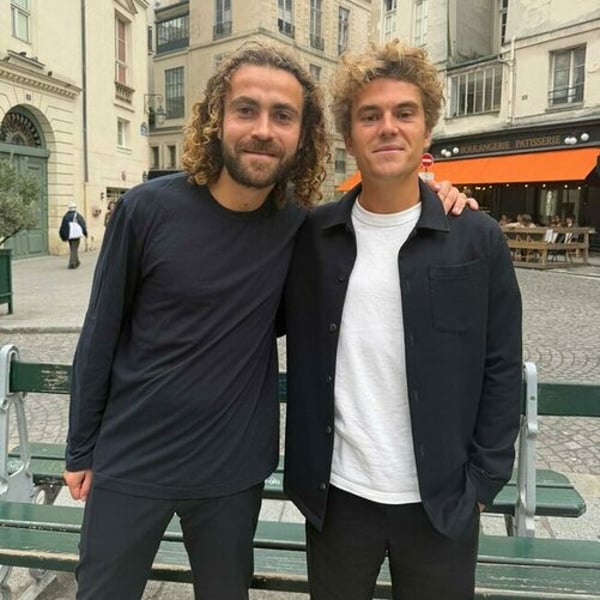
The Bradery has returned to independence. After three years within the Showroomprivé group, the private-sales platform for premium brands and experiences has been reacquired in full by its founders, Edouard Caraco and Timothée Linyer. On December 22, Showroomprivé announced it had sold its 52.75% stake in the company for €19 million, a deal accompanied by additional terms and performance-related earn-outs for the Parisian gem. This brings fresh performance pressure for The Bradery. Edouard Caraco shares with FashionNetwork.com the background to this takeover, his vision for the company’s development- underpinned by the app’s performance- and the founding duo’s plans in the luxury sector.
Edouard Caraco (left) and Timothée Linyer, co-founders and 100% owners of The Bradery – The Bradery
FashionNetwork.com: Showroomprivé has officially confirmed that it has sold its majority stake in The Bradery to you. When did you start negotiating this takeover, given that the group’s initial plan was to acquire 100% of the capital? What were the main points of discussion, given the group’s financial challenges?
Edouard Caraco: The takeover stemmed from several factors. For me, the key was that Tim (co-founder Timothée Linyer) and I were convinced of the market’s potential. We spent a great deal of time over the past year preparing the project, and that really drove the discussions. We felt as though we were letting go of our baby, even though we were only at the beginning of what we were capable of achieving. Reacquiring The Bradery is about taking a long-term view. I think that when we ceded the majority stake, we were also less mature. We were in a rush about everything. I still like to move fast, but I now see that continuity is a very positive virtue in an economic environment that can be unstable. That’s what we offer our partner brands, our customers, and our team.
FNW: Yes, but why did you give up the majority stake when Showroomprivé came in?
EC: When Showroomprivé came in, it was the end of the Covid period. We had experienced a very strong surge after our launch, and we didn’t really know whether we had been propelled by the online consumption boom of that period or whether we had the opportunity to build a longer-term business. And, as I said, we were young and in a hurry. Since then, the company has continued to grow strongly. Tim and I have been friends since we were 10. We feel incredibly fortunate to have a company that performs, that’s growing, with an amazing team, and where we both enjoy coming to work every day.
FNW: How are you financing this share buyback? It’s a substantial sum, so did you bring in new partners?
EC: We wanted to take back 100% of the company. We had no desire to change shareholders, either now or in the medium term. For us, the deal was clear: either we regained 100% of the capital by financing the acquisition with debt, or we saw through the initial agreement and sold 100% of our shares. Our banks supported us- they were brilliant on the project- so it was possible.
FNW: The agreement also includes a vendor loan of three million euros. Between your repayments and the commitments to the Showroomprivé group, doesn’t this put a lot of pressure on the company’s profitability over the next few years?
EC: The Bradery is a fast-growing company. And of course we must maintain the level of profitability that stems from the teams’ work. But we based our plan on the level we have today.
FNW: In your results filed for 2024, you mention a net profit of over €4 million on turnover of €62 million. What are your 2025 results?
EC: Showroomprivé is a consolidated, listed group, so I’m not going to comment on the figures. What I can say is that we recorded strong double-digit growth in 2025. And if we maintain our profitability for 10 years, we’ll have no problem repaying the debt.
FNW: That’s the financial part. But leaving a group also implies adjustments. What reorganisation and process changes are you going to have to implement?
EC: This was really the point that prompted us to pursue the buyback. We have kept our team- even as we grew from 40 to 70 people- our model, our premises and our processes. And Tim and I have remained very hands-on at The Bradery. I look after sales and Tim handles marketing. We knew there would be no friction. And honestly, if it had taken six months to transform the company, I don’t think we would have wanted to go for it. I believe this also influenced Showroomprivé’s management in their decision. In our absence, it would have required a significant implementation effort. We use Shopify for our CMS and we hadn’t migrated to Showroomprivé’s internal processes. The only area where we benefited from their clout was logistics. But we have strong relationships with our carriers.
An app at the heart of the model
FNW: Since 2022, you’ve significantly increased the number of The Bradery’s operations and opened new verticals such as travel- as Showroomprivé also did.
EC: We have grown very independently. Historically, The Bradery is a private-sales player in premium ready-to-wear. But today we’ve built an offering that very much meets the expectations of the audience we want to appeal to: young women aged 25–35 who are looking for premium offers. She wants to find fashion on the platform, but she also wants experiences. That’s why we’ve developed offers for gyms, travel, and concerts. We want to become the shopping destination for this generation. In this respect, we have developed our own processes. What Showroomprivé clearly gave us is ambition. They taught us to plan ahead. We’re much smaller, more niche and more selective in our offering.
FNW: What growth drivers are you considering?
EC: We have several important priorities. Internationalising the business is one of them. We only generate 5% of our sales from exports, concentrated in the Benelux countries and Spain- and mainly in Belgium. So we need to develop a real strategy for our presence in neighbouring countries. We’re going to organise ourselves to reach the Benelux countries, Spain, and Italy. This means proposing an offer that appeals to local customers, with a relevant offer for each country. If you think you’ll succeed just by translating the site, you’re deluding yourself. Entrepreneurial success is about the people you manage to bring together.
FNW: You’ve diversified your offering, but what share does fashion still represent?
EC: It’s not the fastest-growing vertical; we’ve seen particularly strong growth in beauty and home. But it remains the largest part of our business.
FNW: And how have you maintained its attractiveness as you’ve expanded your offer, given that initially exclusivity also came from a limited number of operations?
EC: It’s a topic we’ve worked on extensively to improve the customer experience. To that end, we’ve moved from an online strategy to an app-first strategy. Of course, we still have a website, with a new version going live in the first half of this year. But we’ve invested heavily in the app, with the aim of building daily habits for our customers. They log on every morning to discover the latest offers. And we now generate 70% of our sales via the app.
FNW: Successful app launches are rare. What’s your formula?
EC: The data show that customers using the app are more engaged than site visitors. They come back more often and purchase more frequently. We’ve hired specialists to improve the experience and encourage repeat visits by personalising the journey as much as possible and making the purchasing process as easy as possible. Buying via the app is as simple as ordering an Uber. And as we’ve grown, we’ve reworked customer service and logistics… We’ve raised our game.
FNW: And how do you manage to generate profitable growth at a time when consumer spending is struggling and digital performance has been more challenging in recent seasons?
EC: Across all operations, we work with brands, but we take a prudent, common-sense approach to generating profitability. We’re still very modest in size and very humble about the global context. I look at what Veepee and Showroomprivé have achieved with a lot of admiration, and I hope we’ll be their size one day. Simply maintaining their level of activity at such scale already seems a success to me. Beyond that, I believe that, in the current context, our size gives us the agility to be responsive and opportunistic, and to set up operations very quickly- with brands- in 48–72 hours. I see that as a competitive advantage. Incidentally, another growth lever for The Bradery is physical sales.
FNW: Why, when your expertise is online?
EC: We started in December and it worked very well. We’ve worked with Maison Kitsuné, Levi’s, Drôle de Monsieur… I think a lot of brands understand that digital and physical complement each other. And there’s a shift back to physical retail, particularly among customers looking for premium offers. Our customers expect it. But it’s also important to remember that we’re obsessed with profitability. We’re always balancing the provision of solutions for partners with keeping the books in order. So for physical operations, we’re taking a pop-up approach to control our investments. And we’re going to continue like this in 2026, managing it on a variable-cost basis, with two to three operations per month.
Luxury as a growth driver
FNW: Are you planning to launch other verticals?
EC: With Tim, the takeover project has taken up 25% to 30% of our time for months now. We’re going to devote that time to developing the business. We have big ambitions for The Bradery. The major focus for us is luxury. To address this, we’ve launched a platform called Première for luxury brands, enabling them to run white-label operations.
FNW: What does that mean?
EC: It means they don’t appear on The Bradery. We organise discreet digital or physical operations for the houses so they can sell down their stock while benefiting from tightly controlled exposure. Brands select, from their customer base and ours, the clients they want to target according to very precise criteria. Those customers receive a personal invitation. For our part, we create a site in the brand’s colours specifically for the occasion.
FNW: And what can this new activity represent?
EC: Given the very positive response from brands to the four operations carried out at the end of the year, we’re very ambitious. It’s highly selective, but conversion rates are strong and, inevitably, average order values are very attractive.
FNW: With these various projects, what is your five-year roadmap?
EC: The plan is to continue accelerating growth, with double-digit increases every year. But we don’t want to set any limits. We really feel we’re at the beginning of the journey.
This article is an automatic translation. Click here to read the original article.
There’s a new executive at the helm of North Sails Apparel. Frenchman Cédric Georges has been appointed CEO of the Italian sportswear brand inspired by the world of sailing. It’s an additional top executive role for Georges, formerly the boss of outdoor apparel brand Odlo, who joined North Technology Group in 2024 and is currently also the CEO of Netherlands-based North Actionsports Group, a leader in kiteboarding, windsurfing and wakeboarding equipment.
North Sails’s ready-to-wear division has appointed a new CEO – North Sails
Georges has already moved to Milan to take up his new role. He replaced Victor Duran (formerly with McKinsey, Amer Sports and Intersport), who left the company in December 2025 after a two-year tenure.
“I am honoured to step into my new role as president and CEO of North Sails Apparel and North Actionsports Group,” Georges recently posted on his LinkedIn account. “Leading two companies of the North Technology Group, based in two different countries and operating in two distinct industries, will certainly be challenging – and that’s exactly what makes this journey so motivating. On a more personal note, we’ve recently relocated to Milan with my family, embracing this new chapter both professionally and personally. I am grateful for the trust placed in me and truly excited to work alongside our amazing teams to build what’s coming next,” he added.
It’s a crucial challenge for North Sails Apparel, which is distributed via several hundred stores, with Italy as its main market, and is active within as embattled a segment as ready-to-wear. Georges has the opportunity to rebuild on shared principles the two divisions he is in charge of, which together generate a revenue of nearly €150 million.
Their results were consolidated in H1 2025, and they are both subsidiaries of sailmaking giant North Sails, a company founded in California in 1957 by Lowell North. North Sails launched into the ready-to-wear business in 1989, signing a licence deal in Italy. US investment firm Oakley Capital Investments (OCI) bought North Sails in 2014, and subsequently took over the whole North Technology Group business, which in 2022 bought the apparel division operated by Italian sailing specialist Tomasoni Topsail. OCI has indicated that the revenue of the North Sails group grew by 7% in H1 2025, with EBITDA up 11%.
Meta Platforms Inc. and EssilorLuxottica SA are discussing potentially doubling production capacity for AI-powered smart glasses by the end of this year, in a bid to capture growing demand and head off rivals, according to people familiar with the matter.
The Ray-Ban Meta smart glasses – Meta Platforms, Inc
With sales of Ray-Ban Meta frames taking hold, Facebook-owner Meta has suggested increasing annual capacity to 20 million units or more by the end of 2026, said the people, asking not to be named because the deliberations are private.
The partners have also discussed going further to establish the capability of producing more than 30 million units, should demand justify such a move, the people said. They cautioned that no decisions have been made.
The talks underscore Meta’s desire to extend its artificial-intelligence strategy into hardware it can control end-to-end, reducing the tech giant’s reliance on smartphones produced by competitors. A step-up in output would signal confidence that smart glasses can move beyond early adopters and reach mass-market scale.
EssilorLuxottica, which is responsible for manufacturing, is already near its current capacity target of 10 million pairs by the end of 2026, one of the people said. The world’s largest eyewear maker, with brands such as Ray-Ban and Oakley and retailers Sunglass Hut and LensCrafters, has a production footprint and customer reach giving Meta a large-scale platform to expand its smart-glasses lead.
Representatives for Meta and EssilorLuxottica declined to comment.
The talks on production reflect a deepening relationship as Meta pivots toward the augmented reality of smart glasses and lowers its commitment to fully immersive VR headsets. The tech company last year bought about a 3% stake in EssilorLuxottica, giving Meta closer access to EssilorLuxottica’s manufacturing know-how and retail network.
The two companies began working together in 2019 and launched their first Ray-Ban branded smart glasses in 2021. They have reported growing momentum in recent months, with EssilorLuxottica saying in October that Meta smart glasses helped spur revenue growth in the third quarter.
In September, Meta unveiled the latest $799 Meta Ray-Ban Display in the US, incorporating for the first time text that appears directly on the right-hand lens. At the CES expo in Las Vegas last week, Meta said it had paused an international expansion of the new frames to the UK, France, Italy, and Canada because of “unprecedented demand and limited inventory.”
The news gave EssilorLuxottica shares a 5.2% boost on January 6, after a 15% rise last year. After Bloomberg’s report on Tuesday, shares of Paris-based EssilorLuxottica reversed losses, advancing as much as 2%. Meta slipped 1% in the US.
The smart-glasses market has drawn interest from global technology groups as advances in AI, battery life and components make lighter, non-immersive wearables more practical.
Meta has the early lead with an estimated 73% global market share in the first half of 2025, according to Counterpoint. The researcher forecasts over 60% compound annual growth for the category through 2029. Yet competition is rising.
Last May, Alphabet Inc.’s Google formed a smart-glasses partnership with the eyewear division of Gucci owner Kering SA, while Apple Inc. has redirected resources toward AI-powered glasses after scaling back work on its Vision Pro headset. Chinese groups including Xiaomi Corp. and Huawei Technologies have also rolled out smart glasses as companies test consumer demand for AI-enabled wearables.
Meta sees smart glasses as a key way to deliver its AI services as it races with tech heavyweights like Alphabet and OpenAI to dominate the next generation of technology.
The tech industry’s push into smart glasses dovetails with EssilorLuxottica Chief Executive Officer Francesco Milleri’s strategy to expand in wearables and medical technology while preserving its dominance in traditional eyewear, he said in an interview in October. He foresees smart glasses potentially replacing smartphones over time.
Yet a steeper production ramp would also create challenges for EssilorLuxottica, as it balances growth with the cost of preparing its factories for the push.
Ray-Ban Meta smart glasses are expected to generate substantially lower gross margins than EssilorLuxottica’s broader product line, according to analysts at RBC Capital Markets. Higher revenue and improved component costs will likely mitigate some of these strains as volume rises, they said.
Analysts are expected to ask EssilorLuxottica about its output plans with Meta when the French-Italian group reports annual results in the first half of February.
The companies have closely guarded specific figures on Ray-Ban Meta sales- EssilorLuxottica executives said in February 2025 that they had delivered about 2 million units of the Ray-Ban Meta frames since late 2023.
Chief financial officer Stefano Grassi said in an October conference call that he expected to reach the capacity goal of 10 million units earlier than the original end-of-2026 target, without specifying further. He added that EssilorLuxottica has “the capability to do it in-house or outsource.”
Premium and luxury second-hand platform Vestiaire Collective has parted ways with co-founder and president Fanny Moizant. Of the leadership trio assembled in 2019 with managing director Maximilian Bittner and fashion director Sophie Hersan, only the latter remains- the last co-founder still in post at the company. This changing of the guard raises questions about the strategy of Bernard Osta, who recently took the helm and plans to harness AI and marketing to strengthen the platform’s position.
Fanny Moizant, Sophie Hersan and Maximilian Bittner, the management trio that operated from 2019 to 2025 – Vestiaire Collective
Vestiaire Collective does not publish its figures. Its revenue was estimated at around €414 million for 2024. Operating in more than 70 countries, the platform claims 30,000 new listings per day and around 23 million members.
This shift in governance comes as the clothing sector undergoes a transition of its own. With demand slowing as consumers redirect spending to other categories, industry players are seeking to adapt. Vestiaire Collective must also contend with an online sales model which, after years of strong growth in the West, is no longer insulated from fluctuations in consumer spending.
Consumer spending, after a health crisis, an energy crisis, the invasion of Ukraine, and worsening geopolitical tensions, is now showing its limits even in the luxury market. This is a segment in which Vestiaire Collective has historically built a strong position against other second-hand fashion players, but where the ubiquitous Vinted is now seeking to compete with dedicated features.
“Vestiaire Collective has established itself as the benchmark marketplace in the highly attractive second-hand luxury fashion sector,” said Bernard Osta upon his appointment. “Together, we will continue to transform fashion by giving a second life to the most coveted pieces, in the service of a more sustainable model.”
A study by the French Federation of Circular Fashion (FMC) estimated last year that the European second-hand fashion market would grow by 8.5% per year to reach €26 billion in 2030, compared with €15.9 billion in 2024. These gains will, more than ever, have to be captured from the new-goods market, underpinned by significant investment in technology and communications.
AI and marketing
Like many marketplaces, the French company is betting heavily on artificial intelligence, both to rationalise costs- at a time when investors are closely scrutinising return on investment (ROI)- and to streamline its processes, as AI tools are now capable of purchasing on third-party sites on behalf of customers.
Bernard Osta, Managing Director of Vestiaire Collective – Vestiaire Collective
It is a pivot to AI that Vestiaire Collective has already been preparing. At the end of 2024, the company announced its first two AI-powered features, focused on search and recommendations.
But the move towards AI was marked above all by the hiring of Stacia Carr, previously vice president of Fashion Customer Experience at Zalando, where she led engineering and applied sciences. Another heavyweight, Jim Freeman, a US tech figure with stints at Amazon and Zalando, has also joined the board.
“With the rise of AI, we have an extraordinary opportunity to accelerate our product roadmap, offer a more engaging customer experience and gain market share,” says Bernard Osta, whose company now sets out a “vast product roadmap powered by AI to improve the experience of buyers and sellers at an accelerated pace.”
International campaigns
The company also intends to boost its profile, and address a relative lack of brand awareness versus other second-hand players such as Lithuania’s Vinted and France’s Leboncoin. To this end, campaigns have been announced targeting Europe and the US as well as Asia-Pacific (APAC), under the leadership of Samina Virk, who took over as marketing director last July.
On the financial side, the company last raised €178 million in 2021, followed by a €75 million debt refinancing subsequently. Around €3.5 million was also raised via crowdfunding in 2024.
Against its Lithuanian competitor, Vestiaire Collective fully intends to defend its premium and luxury positioning. And perhaps revive an IPO project which, despite the support of minority shareholder Kering, has yet to come to fruition.
This article is an automatic translation. Click here to read the original article.