
Business
The billionaires and CEOs panicking about Zohran Mamdani are wrong about Gen Z
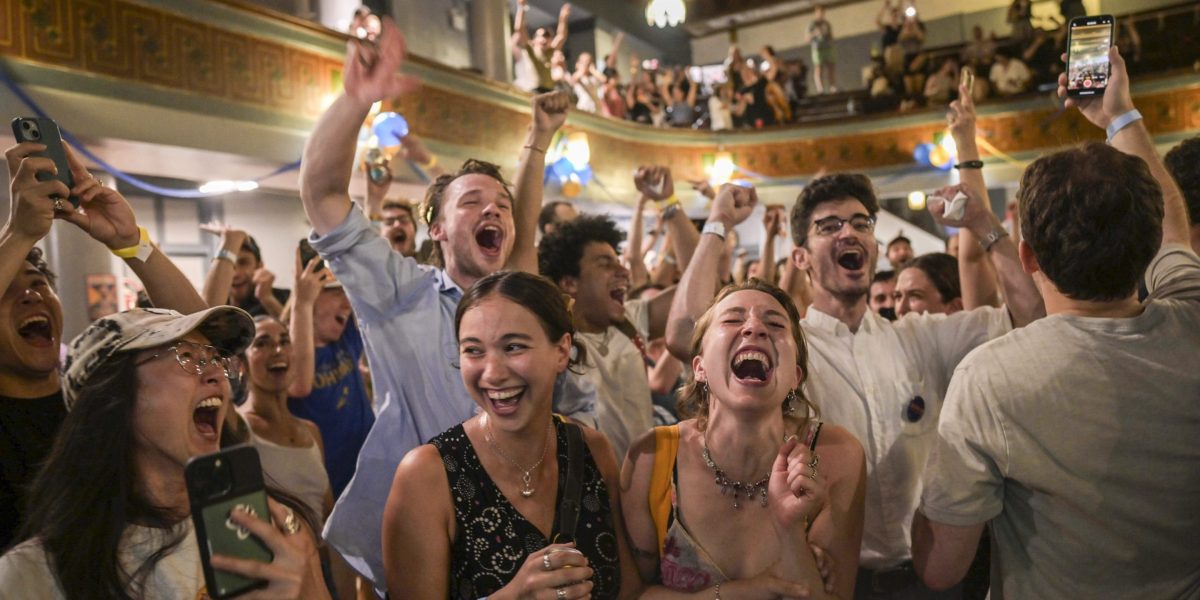
Sebastian Leon Martinez had pounded the pavement for New York City mayoral candidate Zohran Mamdani from frigid 23-degree cold snaps in January to the 100-degree day in June when the young democratic socialist stunned the political establishment by winning the primary for the Democratic nomination.
That night, Martinez, a 20-year-old NYU student, found himself “sweaty, laughing, incredibly tired” at Mamdani’s victory party in Queens. It was a “monumental” moment, Martinez told me a week later. “A lot of people around me were crying and laughing,” he recalled. “Talking about how we’ve changed the political system, not only in New York City, but probably for the entire Democratic Party in the country.”
But as the 33-year-old candidate’s supporters cheered Mamdani’s win, business titans from Wall Street to Silicon Valley slid into panic mode at the thought of a socialist running New York City. Hedge fund billionaire Daniel Loeb warned of a “hot commie summer” in a post on X. Fellow billionaire hedge fund manager Bill Ackman pledged to bankroll any New York City mayoral candidate capable of defeating Mamdani.
Is Gen Z rejecting capitalism outright, some wondered, as their millennial counterparts tried to do with the Occupy Wall Street movement in 2011? Could Mamdani’s win spark a full embrace of socialism by the next generation, fulfilling dire predictions about the imminent demise of “late capitalism”?
In a word: no. That’s what I heard in a series of conversations with members of Gen Z and those who study them in the business and political spheres. Most scoffed at the notion that young people are rejecting capitalism on a large scale, or planning any kind of a revolution.
“We’re not seeing young people go live on communes,” said Shana Gadarian, a professor of political science at Syracuse University. “They’re working at banks, they’re starting gig economies, they’re working in high tech. If that’s not capitalism, I’m not clear what would be.”
If there’s a message for political and business leaders to glean from the youth movement buoying Mamdani, it’s perhaps a simpler one: Stop bullshitting us.
“What Gen Z is asking for is honesty,” explained Ziad Ahmed, the 26-year-old head of United Talent Agency’s Gen Z–focused marketing advisory practice, Next Gen. “If the world is on fire, tell me the world is on fire. Don’t tell me that actually, you might like the heat.”
I heard over and over that young people are deeply “discontented” or “disillusioned” with the status quo. Saad Amer, a New York–based climate activist and founder of the sustainability consultancy Justice Environment, said the next generation has been told a “fable” of how to succeed in America.
“What Gen Z is asking for is honesty. If the world is on fire, tell me the world is on fire. Don’t tell me that actually, you might like the heat.”
Ziad Ahmed, Head of Next Gen at United Talent Agency
“Young people are sold the story of, ‘Go to school, get good grades, go to college, and then you’ll get a great job, and you’ll own a home, and you’ll have a family,’” Amer said. “I look around at my peers, and that’s not true for any single one of them.” Instead, he said, he sees people “stuck in careers that they find unfulfilling—and that are also having disastrous impacts on their mental health and the planet at large. It’s clear that what we’re being told isn’t true.”
It’s not just liberal Gen Zers who feel this way. Rachel Janfaza, the 27-year-old founder of youth political culture newsletter The Up and Up, regularly holds listening sessions with young voters across the country. She has seen similar frustrations on the Republican side of the aisle, she said.
“I’ve certainly heard young people on the right who are very anti-billionaire and antiestablishment talk in the same way that we hear young people on the left,” she said. “This type of rhetoric exists on both sides. And I think there are a lot of similarities in why Trump resonates with young people and why perhaps Mamdani resonated with young people.”
Janfaza boils it down to one key issue: economic anxiety. And it’s not just in their heads. The average age of first-time U.S. homebuyers hit a record high last year at 38. In the country’s 30 largest metros, more than half of Gen Z renters are rent-burdened, spending more than 30% of their income on rent, Zillow found. And nearly a quarter of millennials and Gen Zers without children do not plan to become parents, primarily owing to financial stress, according to a recent report from MassMutual.
It’s no wonder, then, that instead of career politicians, Gen Zers are embracing outsider candidates who speak bluntly to this economic anxiety—a strength of Mamdani’s, and arguably Trump’s too. They’re done with dated rhetoric, PR talking points, and leaders “siloing themselves in boardrooms” instead of meeting Gen Zers where they are, Ahmed told me.
Business leaders, take note. Members of Gen Z aren’t just craving real talk—and action—from politicians; they’re also demanding it of their CEOs. Younger workers want the same things previous generations wanted: fair pay, rewarding work, mentorship, job security, a clear and fair path to advancement—and they’re not going to be content with kombucha-filled fridges or other office perks. This is a generation that has grown up with school shootings so frequent they’ve become normalized, with massive student debt, and in the shadow of a looming climate crisis. Of course they are demanding change—both from their politicians and their employers.
Charlene Li, an author who advises companies on digital transformation, told me that the two key value for Gen Z workers are honesty and fairness. Both require transparency: Leaders need to clearly state how success is measured and offer concrete opportunities and financial rewards to employees who meet these measures, she says.
Bleak outlook
Gen Z can’t take for granted the life milestones older generations expected to hit.
38
The record-high average age of first-time U.S. homebuyers in 2024
23%
Percentage of childless Millennials and Gen Zers who don’t plan to become parents, primarily for financial reasons
Sources: National Association of Realtors; MassMutual
The word “purpose” is frequently used by consultancies and business advisors to describe what Gen Z truly wants in a workplace. But what does that look like in practice? At the Fortune Workplace Innovation Summit in May, Ahmed told me that workers should understand the “why” behind every business decision. Managers must clearly articulate their reasoning—to both their workers and customers, he said. “I don’t think it has to be as lofty as changing the world, because Gen Z also has a huge bullshit filter, and doesn’t want you to say that you stand for everything if you don’t,” Ahmed said. “Authenticity is everything.”
A good starting point would be a more straightforward discussion of diversity and equity, Li says. Instead of relying upon box-checking or acronyms such as DEI, she advises business leaders to take a hard look at the demographics of who is getting promotions and raises, and to think critically about company—and C-suite—makeup: “That’s what people are looking for, not just Gen Z,” she said. “We’re looking for some authenticity between what you have on your walls and on your websites and how you actually show up.”
Business leaders also need to listen to younger workers—their complaints, thoughts, and opinions about the business and the world. That doesn’t mean you need to hold a town hall tomorrow on the merits of Marxism, but it does require a certain level of respect and thoughtfulness, even for views that leaders disagree with.
“For Gen Z, politics are very personal,” Li said. “Work is going to be deeply personal to them.
This is not something where they want to go in and just check off the list. So will you be ready to take that energy and bottle it and direct it?”
Mamdani’s win seems to have brought to the surface generational tensions and anxieties that had been simmering long before he became a political celebrity.
Elizabeth Spiers, a progressive digital strategist and journalist, said political and business leaders tend to conflate younger generations’ criticism of economic systems with political extremism. “They sort of treat capitalism like it’s a sacred cow that can never be spoken of in anything less than glowing terms,” Spiers said. But the precarities that young people face are real, she said: “They’ve grown up in an economic environment where a lot of those myths have sort of fallen apart in front of them.”
Addressing the disillusionment of young people who see corporate hierarchies as fundamentally unfair will take more than just better workplace communication; young people are also demanding real action to improve their economic prospects, both from politicians and from the business world.
Amer, who advises Fortune 500 C-suite executives on climate impact, said he has been “seeing the fear” in business leaders’ eyes when talking about how to work with and engage a young workforce.
“These corporations do have a role that they should be playing, and I think they are actively trying to figure out the role,” he said. “But to the younger generation, the role seems obvious: Do better.”
This article appears in the August/September issue of Fortune with the headline “Gen Z’s wake-up call to corporate America.”