Connect with us

Business

The attacks on Tim Cook are half-baked—despite Apple stumbling over AI 

Published

on


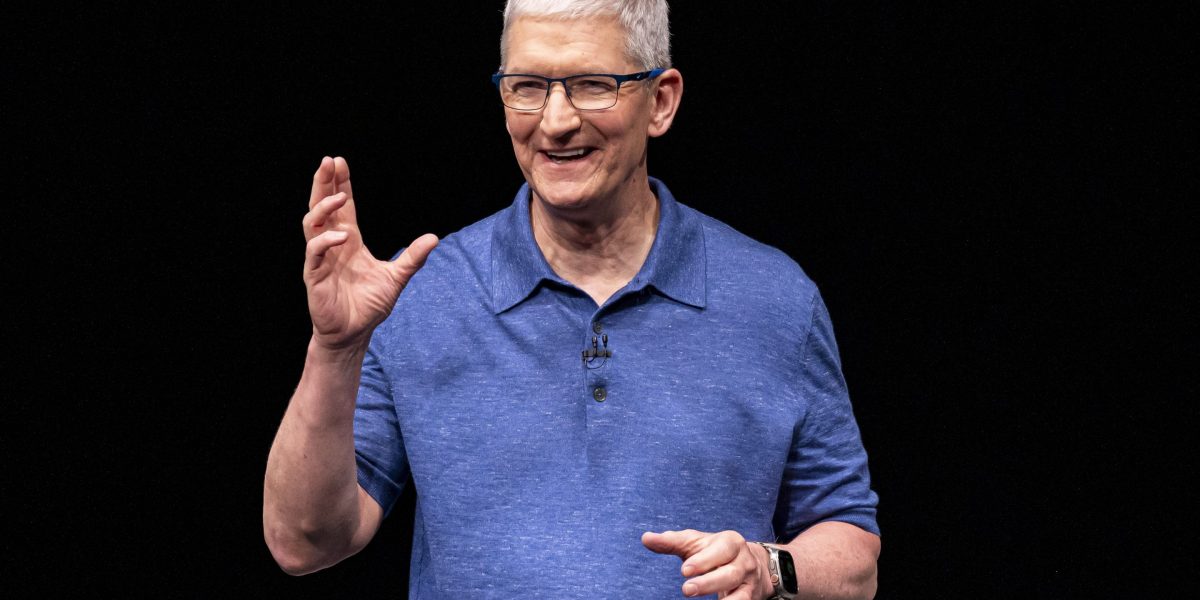
Apple received an unwanted spotlight last week when President Trump’s trade advisor, Peter Navarro, attacked CEO Tim Cook for not moving manufacturing out of China fast enough. In fact, having received similar pressure during Trump’s first term, Apple, in terms of what it sells in the U.S., now makes most iPhones in India and most laptops, AirPods, and other devices in Vietnam. Furthermore, Cook has committed over $500 billion to new U.S. manufacturing facilities and design centers that will employ about 20,000 Americans.

Nevertheless, by late last week attention had quickly shifted to Cook’s tenure as CEO.

Part of this may be seasonal. There is often debate during the hot midsummer months—after annual shareholder meetings—over whether CEO is turnover increasing or decreasing. CNBC anchor Carl Quintanilla has said that one factor behind this is an effort to create headlines during the “tape slump” of major business news. He suggested this behavior was behind a recent report by respected analysts Walter Piecyk and Joe Galone at Lightshed calling for Apple to consider replacing Cook amidst Apple’s struggles with artificial intelligence

We believe that such short-sighted attacks on an icon of American industry could not be more misguided. Cook’s leadership is still critically needed at Apple.

Apple and AI

While Apple hasn’t been a first mover in AI, it doesn’t need to be. In fact, it might benefit the company to not get sucked into the AI arms race amidst counterproductive and desperate moves from competitors—consider Meta offering cash bonuses of up to $100 million to poach AI engineers from rivals.

At our Yale CEO Summit last month, nearly 50% of CEOs polled believe that AI hype has already led to significant overinvestment within their companies. An equal proportion think that AI investments have been allocated inefficiently and profess disappointment with the return on investment.

While nobody doubts the importance of AI to Apple’s future, a critical management skill is finding the right balance on the make vs. buy tradeoff. Developing products in-house is not the only way to go. Despite Apple’s setbacks with Apple Intelligence, a potential partnership or outright acquisition of Perplexity could transform Apple into an AI leader practically overnight, as noted by many savvy analysts, including Wedbush’s Dan Ives.

There are many examples of companies successfully buying or partnering their way into new products or business lines: IBM’s visionary acquisition of RedHat in 2019 gave it a foothold in cloud computing—now a core business. Pfizer’s partnership with BioNTech during the pandemic allowed for the rapid production of the COVID vaccine. Merck’s acquisition of Schering-Plough brought in the blockbuster cancer drug Keytruda, which now powers about half of its sales.

Transforming Apple

Despite Apple’s AI stumbles, Cook deserves a long leash as one of the most revered chief executives of our time, with an unparalleled track record of accomplishment. A genuine tech visionary, he faced the daunting and unenviable task of succeeding the larger-than-life Steve Jobs. He assumed the reins with a rare blend of energy and humility, inspiring others to innovate without any personal grandiosity, transforming Apple into the world’s most valuable company.

Under Cook’s stewardship, Apple’s market value has soared from $350 billion in 2011 to more than $3 trillion today. Apple became the first U.S. company to achieve a $1 trillion market capitalization in 2018, doubling that figure in 2020 and tripling it just three years later.

Despite the echo-chamber accusations that Cook is nothing more than a supply chain guru and not a true product visionary, the truth is that Cook’s tenure has seen Apple revolutionize its product lineup, driving profound advancements for the iPhone, Mac, and iPad and introducing industry-leading devices such as the Apple Watch, AirPods, and Apple Vision Pro. His leadership has also expanded the Apple ecosystem, launching services like Apple Pay, which is growing every year, as well as Apple Music and Apple TV+.

Despite this unparalleled record of achievement, even supporters of Cook wonder if he may have lost his touch or his creativity. Though strongly supporting Cook, CNBC anchor David Faber wondered aloud, “sometimes, as people get older, they may not be taking in as much information, or their expertise may be in an area that is no longer as specific to needs of their business, and I’m curious as to whether there is somebody else out there who might be in a better position to do that.”  

Long leadership

The first author of this essay has closely studied age and work—once called industrial gerontology—since the founding of the field decades ago, and my book The Hero’s Farewell: What Happens when CEOs Retire provided the first empirical studies of leaders in late career. There is no correspondence between age and invention, or age and leadership.

Over 45 years of research on age and work, I have closely documented the effects of age and found potentially surprising results. Older workers tend to have greater sales skills and interpersonal savvy, with only modest declines in physical dexterity. Research on age and risk in engineering found that older managers were only mildly less willing to take risks. They took longer to make decisions, but they were better able to appreciate the value of new information.

Consider some of the startling examples through history. Benjamin Franklin helped draft the Declaration of Independence at 70, invented bifocal glasses in his late 70s, and negotiated an agreement to salvage the Constitutional Convention at 81. France relied upon Charles De Gaulle to unify the nation while he was in his late sixties and seventies. Averell Harriman, after leading Union Pacific and Brown Brothers Harriman, served as one of America’s greatest diplomats, unofficially advising presidents until his nineties.

Compared to these examples, at age 64, Cook is just getting started.

Of course, that doesn’t mean there aren’t some steps Cook can take to strengthen Apple’s positioning, even beyond doubling down on AI development. As CNBC’s Jim Cramer pointed out, it would not hurt with the Trump administration if Apple accelerated some of its $500 billion commitment for domestic manufacturing. Moving some spending forward and accelerating that planned four-year timeline would be a tangible political and patriotic signal to rectify Trump’s fears that he is being played via delays and long timeframes. Similarly, it may not hurt Apple to add a respected technologist with AI, software, or hardware expertise to its board.

But clearly, Apple has stayed ripe for growth and product innovation under Cook, and the attacks on him and the company are half-baked.

The opinions expressed in Fortune.com commentary pieces are solely the views of their authors and do not necessarily reflect the opinions and beliefs of Fortune.

Read more:


Source link

Continue Reading

Business

‘Its own research shows they encourage addiction’: Highest court in Mass. hears case about Instagram, Facebook effect on kids

Published

on


Massachusetts’ highest court heard oral arguments Friday in the state’s lawsuit arguing that Meta designed features on Facebook and Instagram to make them addictive to young users.

The lawsuit, filed in 2024 by Attorney General Andrea Campbell, alleges that Meta did this to make a profit and that its actions affected hundreds of thousands of teenagers in Massachusetts who use the social media platforms.

“We are making claims based only on the tools that Meta has developed because its own research shows they encourage addiction to the platform in a variety of ways,” said State Solicitor David Kravitz, adding that the state’s claim has nothing to do the company’s algorithms or failure to moderate content.

Meta said Friday that it strongly disagrees with the allegations and is “confident the evidence will show our longstanding commitment to supporting young people.” Its attorney, Mark Mosier, argued in court that the lawsuit “would impose liabilities for performing traditional publishing functions” and that its actions are protected by the First Amendment.

“The Commonwealth would have a better chance of getting around the First Amendment if they alleged that the speech was false or fraudulent,” Mosier said. “But when they acknowledge that its truthful that brings it in the heart of the First Amendment.”

Several of the judges, though, seem to more concerned about Meta’s functions such as notifications than the content on its platforms.

“I didn’t understand the claims to be that Meta is relaying false information vis-a-vis the notifications but that it has created an algorithm of incessant notifications … designed so as to feed into the fear of missing out, fomo, that teenagers generally have,” Justice Dalila Wendland said. “That is the basis of the claim.”

Justice Scott Kafker challenged the notion that this was all about a choose to publish certain information by Meta.

“It’s not how to publish but how to attract you to the information,” he said. “It’s about how to attract the eyeballs. It’s indifferent the content, right. It doesn’t care if it’s Thomas Paine’s ‘Common Sense’ or nonsense. It’s totally focused on getting you to look at it.”

Meta is facing federal and state lawsuits claiming it knowingly designed features — such as constant notifications and the ability to scroll endlessly — that addict children.

In 2023, 33 states filed a joint lawsuit against the Menlo Park, California-based tech giant claiming that Meta routinely collects data on children under 13 without their parents’ consent, in violation of federal law. In addition, states including Massachusetts filed their own lawsuits in state courts over addictive features and other harms to children.

Newspaper reports, first by The Wall Street Journal in the fall of 2021, found that the company knew about the harms Instagram can cause teenagers — especially teen girls — when it comes to mental health and body image issues. One internal study cited 13.5% of teen girls saying Instagram makes thoughts of suicide worse and 17% of teen girls saying it makes eating disorders worse.

Critics say Meta hasn’t done enough to address concerns about teen safety and mental health on its platforms. A report from former employee and whistleblower Arturo Bejar and four nonprofit groups this year said Meta has chosen not to take “real steps” to address safety concerns, “opting instead for splashy headlines about new tools for parents and Instagram Teen Accounts for underage users.”

Meta said the report misrepresented its efforts on teen safety.

___

Associated Press reporter Barbara Ortutay in Oakland, California, contributed to this report.


Source link

Continue Reading

Business

Quant who said passive era is ‘worse than Marxism’ doubles down

Published

on


Inigo Fraser Jenkins once warned that passive investing was worse for society than Marxism. Now he says even that provocative framing may prove too generous.

In his latest note, the AllianceBernstein strategist argues that the trillions of dollars pouring into index funds aren’t just tracking markets — they are distorting them. Big Tech’s dominance, he says, has been amplified by passive flows that reward size over substance. Investors are funding incumbents by default, steering more capital to the biggest names simply because they already dominate benchmarks.

He calls it a “dystopian symbiosis”: a feedback loop between index funds and platform giants like Apple Inc., Microsoft Corp. and Nvidia Corp. that concentrates power, stifles competition, and gives the illusion of safety. Unlike earlier market cycles driven by fundamentals or active conviction, today’s flows are automatic, often indifferent to risk.

Fraser Jenkins is hardly alone in sounding the alarm. But his latest critique has reignited a debate that’s grown harder to ignore. Just 10 companies now account for more than a third of the S&P 500’s value, with tech names driving an outsize share of 2025’s gains.

“Platform companies and a lack of active capital allocation both imply a less effective form of capitalism with diminished competition,” he wrote in a Friday note. “A concentrated market and high proportion of flows into cap weighted ‘passive’ indices leads to greater risks should recent trends reverse.” 

While the emergence of behemoth companies might be reflective of more effective uses of technology, it could also be the result of failures of anti-trust policies, among other things, he argues. Artificial intelligence might intensify these issues and could lead to even greater concentrations of power among firms. 

His note, titled “The Dystopian Symbiosis: Passive Investing and Platform Capitalism,” is formatted as a fictional dialog between three people who debate the topic. One of the characters goes as far as to argue that the present situation requires an active policy intervention — drawing comparisons to the breakup of Standard Oil at the start of the 20th century — to restore competition.

data-srcyload

In a provocative note titled “The Silent Road to Serfdom: Why Passive Investing is Worse Than Marxism” and written nearly a decade ago, Fraser Jenkins argued that the rise of index-tracking investing would lead to greater stock correlations, which would impede “the efficient allocation of capital.” His employer, AllianceBernstein, has continued to launch ETFs since the famous research was published, though its launches have been actively managed. 

Other active managers have presented similar viewpoints — managers at Apollo Global Management last year said the hidden costs of the passive-investing juggernaut included higher volatility and lower liquidity. 

There have been strong rebuttals to the critique: a Goldman Sachs Group Inc. study showed the role of fundamentals remains an all-powerful driver for stock valuations; Citigroup Inc. found that active managers themselves exert a far bigger influence than their passive rivals on a stock’s performance relative to its industry.

“ETFs don’t ruin capitalism, they exemplify it,” said Eric Balchunas, Bloomberg Intelligence’s senior ETF analyst. “The competition and innovation are through the roof. That is capitalism in its finest form and the winner in that is the investor.”

Since Fraser Jenkins’s “Marxism” note, the passive juggernaut has only grown. Index-tracking ETFs, which have grown in popularity thanks to their ease of trading and relatively cheaper management fees, are often cited as one of the primary culprits in this debate. The segment has raked in $842 billion so far this year, compared with the $438 billion hauled in by actively managed funds, even as there are more active products than there are passive ones, data compiled by Bloomberg show. Of the more than $13 trillion that’s in ETFs overall, $11.8 trillion is parked in passive vehicles. The majority of ETF ownership is concentrated in low-cost index funds that have significantly reduced the cost for investors to access financial markets. 

In Fraser Jenkins’s new note, one of his fictitious characters ask another what the “dystopian symbiosis” implies for investors. 

“The passive index is riskier than it has been in the past,” the character answers. “The scale of the flows that have been disproportionately into passive cap-weighted funds with a high exposure to the mega cap companies implies the risk of a significant negative wealth effect if there is an upset to expectations for those large companies.”


Source link

Continue Reading

Business

Why the timing was right for Salesforce’s $8 billion acquisition of Informatica — and for the opportunities ahead

Published

on


The must-haves for building a market-leading business include vision, talent, culture, product innovation and customer focus. But what’s the secret to success with a merger or acquisition? 

I was asked about this in the wake of Salesforce’s recently completed $8 billion acquisition of Informatica. In part, I believe that people are paying attention because deal-making is up in 2025. M&A volume reached $2.2 trillion in the first half of the year, a 27% increase compared to a year ago, according to JP Morgan. Notably, 72% of that volume involved deals greater than $1 billion. 

There will be thousands of mergers and acquisitions in the United States this year across industries and involving companies of all sizes. It’s not unusual for startups to position themselves to be snapped up. But Informatica, founded in 1993, didn’t fit that mold. We have been building, delivering, supporting and partnering for many years. Much of the value we bring to Salesforce and its customers is our long-earned experience and expertise in enterprise data management. 

Although, in other respects, a “legacy” software company like ours — founded well before cloud computing was mainstream — and early-stage startups aren’t so different. We all must move fast and differentiate. And established vendors and growth-oriented startups have a few things in common when it comes to M&A, as well. 

First and foremost is a need to ensure that the strategies of the two companies involved are in alignment. That seems obvious, but it’s easier said than done. Are their tech stacks based on open protocols and standards? Are they cloud-native by design? And, now more than ever, are they both AI-powered and AI-enabling? All of these came together in the case of Salesforce and Informatica, including our shared belief in agentic AI as the next major breakthrough in business technology.

Don’t take your foot off the gas

In the days after the acquisition was completed, I was asked during a media interview if good luck was a factor in bringing together these two tech industry stalwarts. Replace good luck with good timing, and the answer is a resounding, “Yes!”

As more businesses pursue the productivity and other benefits of agentic AI, they require high-quality data to be successful. These are two areas where Salesforce and Informatica excel, respectively. And the agentic AI opportunity — estimated to grow to $155 billion by 2030 — is here and now. So the timing of the acquisition was perfect. 

Tremendous effort goes into keeping an organization on track, leading up to an acquisition and then seeing it through to a smooth and successful completion. In the few months between the announcement of Salesforce’s intent to acquire Informatica and the close, we announced new partnerships and customer engagements and a fall product release that included autonomous AI agents, MCP servers and more. 

In other words, there’s no easing into the new future. We must maintain the pace of business because the competitive environment and our customers require it. That’s true whether you’re a small, venture-funded organization or, like us, an established firm with thousands of employees and customers. Going forward we plan to keep doing what we do best: help organizations connect, manage and unify their AI data. 

Out with the old, in with the new

It’s wrong to think of an acquisition as an end game. It’s a new chapter. 

Business leaders and employees in many organizations have demonstrated time and again that they are quite good at adapting to an ever-changing competitive landscape. A few years ago, we undertook a company-wide shift from on-premises software to cloud-first. There was short-term disruption but long-term advantage. It’s important to develop an organizational mindset that thrives on change and transformation, so when the time comes, you’re ready for these big steps. 

So, even as we take pride in all that we accomplished to get to this point, we now begin to take on a fresh identity as part of a larger whole. It’s an opportunity to engage new colleagues and flourish professionally. And importantly, customers will be the beneficiaries of these new collaborations and synergies. On the day Informatica was welcomed into the Salesforce family and ecosystem, I shared my feeling that “the best is yet to come.” That’s my North Star and one I recommend to every business leader forging ahead into an M&A evolution — because the truest measure of success ultimately will be what we accomplish next.

The opinions expressed in Fortune.com commentary pieces are solely the views of their authors and do not necessarily reflect the opinions and beliefs of Fortune.


Source link

Continue Reading

Trending

Copyright © Miami Select.