Last week, Louis Vuitton unveiled a significant new space in Shanghai, “The Louis,” which seamlessly integrates retail, Le Café Louis Vuitton, and the “Louis Vuitton Visionary Journeys” exhibition within a magnificent boat-like facade.
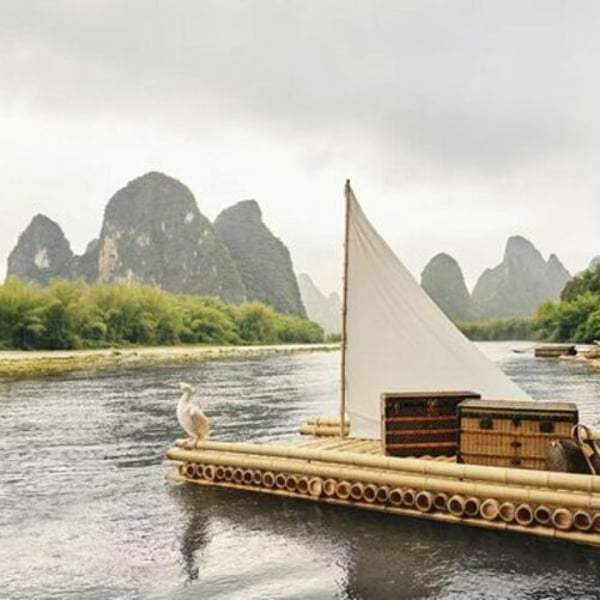
Louis Vuitton’s new travel campaign captures the serene beauty of the Lijiang River, blending iconic trunks and the Soft Keepall with traditional bamboo rafts to reflect a harmonious dialogue between heritage and nature. – Credit by LV
Since the opening of the brand’s first store in Beijing’s Palace Hotel in 1992, Louis Vuitton embarked on its journey into the Chinese market with its iconic Monogram symbol. It wasn’t until the “Louis Vuitton: Voyages” exhibition at the National Museum of China in Beijing in 2009 that the brand’s design philosophy and historical heritage were systematically communicated to Chinese consumers for the first time, marking the completion of Louis Vuitton’s journey of cultural integration with the East.
Later, Louis Vuitton’s “City Guides” series—featuring 32 themed editions—blended its travel philosophy with urban cultural heritage, creating “portable city memories.” In 2022, the Louis Vuitton show in Anaya and the House of Louis Vuitton in Chengdu each became recognized cultural landmarks.
Luxury groups in China are increasingly embracing “cultural long-termism.” LVMH, Louis Vuitton’s parent company, outlined its 2024 China strategy as a shift from short-term traffic tactics to a long-term cultural approach. During the Q1 2025 earnings call, CFO Jean-Jacques Guiony reinforced this direction, emphasizing that sustainable growth in China relies on deeply understanding cultural consumption cycles—not merely reacting to technological trends.
Now, more than three decades later, the brand exemplifies the core principles of Chinese business wisdom through three major events.
Right time (天时 Tiānshí)
At the beginning of June, Louis Vuitton, in collaboration with China Post and DeepSeek AI, launched a pop-up store at the Shanghai Post Museum. This initiative transforms the brand’s travel philosophy into digital art and co-branded stamps, aiming to revitalize traditional letter culture amidst the resurgence of cultural tourism and the digital “Guócháo(国潮)” trend.
From June 7 to 15, 2025, Louis Vuitton opened a pop-up space at the Shanghai Postal Museum, showcasing its book series and stationery collections. – Credit by LV
Since its inception, “The Art of Travel” has been central to Louis Vuitton’s identity. Through publications such as the “City Guide,” which explores urban landscapes, the “Fashion Eye” series featuring evocative photography, and the “Travel Book” with its artistic reflections on destinations, the brand has crafted a narrative universe centered on exploration. These works embody the belief that “Life is a Journey,” inviting readers to embark on inspiring odysseys through each page. This collaboration has opened new channels of dialogue with the brand’s next generation of target consumers.
Right place (地利 Dìlì)
At the end of June, “The Louis” was completed at Taikoo Hui on Wujiang Road. This ship-shaped structure pays homage to Louis Vuitton’s nautical heritage and Shanghai’s port culture. Inside, a 1,200 sq. m. exhibition, a collaboration with OMA, and localized dining options—including Monogram dumplings—deeply integrate the spatial narrative with the city’s spirit. This integration of “spiritual symbols” demonstrates Louis Vuitton’s profound understanding of local culture, signifying that a fragmented, symbolic approach is obsolete in favor of a cohesive cultural interpretation.
Right people (人和 Rénhé)
Starting from July, the new travel campaign—beginning along the legendary Lijiang River landscape, captured by American photographer Alec Soth—showcases the Soft Keepall bag on a bamboo raft and Monogram Horizon suitcases with a convoy. Through an international lens, this campaign sheds the “Western gaze” and aims to evoke widespread emotional resonance with Eastern natural aesthetics.
Following Guilin, the travel campaign will continue to explore China’s diverse landscapes. Together with the other two major events, this initiative aims to seize timely opportunities, deepen urban connections, and cultivate cultural empathy.
More than a journey, Louis Vuitton’s new travel campaign captures the contemplative essence while travel becomes a transformative odyssey, and an invitation to uncover hidden beauty. – Credit by LV
As Louis Vuitton’s presence in the Chinese market quietly extends beyond three decades, it has transcended its origins as a Western luxury symbol to become a cultural and commercial touchstone—growing in tandem with China’s ’90s-born generation of consumers.
This intergenerational brand evolution can be understood through the dimensions of time, place, and people—navigating market cycles, integrating into the local market, and solidifying consumer perception. This strategic progression, mirroring the ancient Chinese wisdom of “Right Time, Right Place, and Right People,” has propelled Louis Vuitton’s transformation from a mere “top luxury leather goods” brand to a “culturally beloved entity in China,” showcasing the brand’s enduring power of continuous evolution beneath its classic heritage.
UK footfall down in November? Blame the Budget and bad weather. Those two important factors damaged shoppers’ desire to venture out, resulting in an albeit slender 0.8% year-on-year dip in footfall last month, with all types of destinations suffering. It was also the seventh consecutive footfall decline, noted the latest British Retail Consortium (BRC)/Sensormatic report
Image: Nigel Taylor
That meant visits to high streets were down 1.2% in November and down from a 0.6% rise in October; shopping centre footfall dipped 1.3% last month, down from a 0.9% dip in October; and retail park visits were down 0.4% in November, but were better than a 0.5% dip in October.
The BRC also noted that November’s Storm Claudia prompted many consumers to search online for Black Friday deals throughout November, leading some to not visit physical stores on Black Friday.
But there was good news, with some northern UK cities – including Manchester and Sheffield – continuing to buck the trend, “recording positive footfall for the eighth consecutive month”.
So with many shoppers holding off on store visits until this month, Helen Dickinson, chief executive of the British Retail Consortium, said: “With the Golden Quarter in full swing, retailers are continuing to invest what they can to entice customers into stores over Christmas.
“However, as we approach the New Year, given the downward trend in footfall across recent years, we need a comprehensive strategy to revitalise our high streets and shopping centres, from better transport, affordable parking, to a reformed planning system to enable faster, better development.”
Andy Sumpter, Retail Consultant EMEA for Sensormatic, added: “November may have been dominated by caution, but there are glimmers of hope. The Golden Quarter isn’t over yet, and with four of our predicted Top Five shopping days still to come, the festive season could deliver the lift retailers need. A last-minute rush may top off the year, turning caution into celebration. With the right balance of value, convenience, and experience, there’s still time to make December count.”
The world’s largest fashion retailer staged a stock-market comeback this week as Inditex SA’s push to differentiate itself from fierce ultra-low-price competition shows signs of bearing fruit.
Inside a Zara store – Zara
The owner of Zara, Bershka, and Massimo Dutti has seen its shares jump 14%, putting them on track for their best week in five years. Strong third-quarter results, coupled with accelerating November sales, were seen as evidence of the company’s resilience against weaker consumer sentiment.
This week’s surge put the stock on course for an annual gain, after what had previously looked like a lacklustre 2025. Inditex- whose second-largest market is the US- had been punished for its exposure to tariffs and a weaker greenback, amid concerns about softening consumer demand and intensifying competition from Chinese fast-fashion firms.
While its 10% rise this year trails the 50% jump for UK retailer Next Plc and the 19% gain at Sweden’s Hennes & Mauritz AB, Inditex is now outperforming the broader European retail sector. Analysts have welcomed the firm’s push to steer its Zara and Massimo Dutti brands further into the premium segment as it seeks to outmuscle competitors such as Shein and Temu. “The strategy is not to chase ultra-low prices, but to deliver premium-looking products at a good-value price point,” Alphavalue analyst Jie Zhang wrote in a note.
After this week’s rally, Inditex is trading at a substantially higher valuation than peers at 26 times forward earnings- on par with luxury behemoth LVMH. The firm’s strong third-quarter earnings reinforce “the quality of the business and will make investors question whether the right peer group for this company is luxury rather than retail in our view,” said Deutsche Bank AG analyst Adam Cochrane.
Inditex’s latest trading update spurred upward earnings revisions and price target upgrades, with more bullishness among brokers likely to follow, as the current consensus 12-month forward price target doesn’t leave any room for further upside. “These growth levels should provide reassurance of the continued opportunity for outperformance, including into 2026,” said JPMorgan & Chase Co. analyst Georgina Johanan.
A partnership between Agromethod Labs and CITEVE is advancing hydroponic cotton cultivation, a project that could make Portugal the only country in Europe to host the entire cotton value chain, from fibre to clothing.
Agromethod Labs was founded earlier this year with the mission of developing more sustainable, future-oriented agricultural solutions. Its founder, Raquel Maria, a chemist by training with a long track record in academic research, explains that the impetus to create thestart-upstemmed from a personal concern.
“Academia allows us to change the world on a small scale. I felt it was time to bring that knowledge into the real world and have a greater impact on future generations,” she told Portugal Têxtil.
Although Agromethod Labs works across several fields, cotton quickly stood out, building on previous research, notably by researcher Filipe Natálio, currently at the Applied Biomolecular Sciences Unit (UCIBIO) of the School of Science and Technology at Universidade Nova de Lisboa (NOVA FCT). “But we want to continue working on other types of crops and other seeds. Agromethod Labs is bigger than cotton,” she says.
Approaching CITEVE marked a turning point. According to the founder, the hydroponic cotton project “was very much on paper” and required initial investment and a solid technological partner. “CITEVE was decisive. It came along at the right time and finally gave us the opportunity to get started with something that we had already thought about extensively, but which was not yet in a position to move forward,” she says.
The collaboration has made it possible to implement a functional mini pilot, already with measurable results, and to prepare the next phase: a larger-scale pilot that will incorporate vertical farming to maximise the production area.
Advantages and challenges
Hydroponic cultivation offers significant advantages, notes Raquel Maria. “We can grow anywhere in the world, without reliance on sunlight and without geographical limitations,” she explains. It also enables continuous production. “We are no longer limited to a single annual harvest. We can get three or four harvests a year,” she says.
Early results also show improvements in the fibre. “We have obtained cotton with better mechanical properties and greater whiteness, which can reduce some stages in textile processing,” says Raquel Maria.
Even so, the founder of Agromethod Labs recognises that there are challenges, particularly in terms of costs, since this cultivation technique is more expensive. However, incorporating vertical farming in the new pilot could help. “If we double the production area, we can get closer to the economic viability we want,” she believes. Considering the higher costs and added value of the fibre, the raw material produced “in the initial phase will be directed to specialised markets,” she says.
The small-scale production carried out in a room at CITEVE has already made it possible to produce yarn from hydroponic cotton. The next symbolic goal will be “to make a T-shirt and be able to say that it was made with cotton produced in Portugal would be wonderful,” confesses Raquel Maria.
With expansion planned for the next six months, the aim will be to significantly increase production and take an important step closer to the market. According to the founder of Agromethod Labs, the Portuguese textile industry has already started to show enthusiasm. “There have been several expressions of interest. We are completely open to collaborating with Portuguese companies,” she says.
However, the ambition goes beyond fibre production. “Portugal could be the only country in Europe to have the entire value chain- from raw material to end product- in a single territory. That would be a milestone for the country,” concludes Raquel Maria.
This article is an automatic translation. Click here to read the original article.