Connect with us

Business

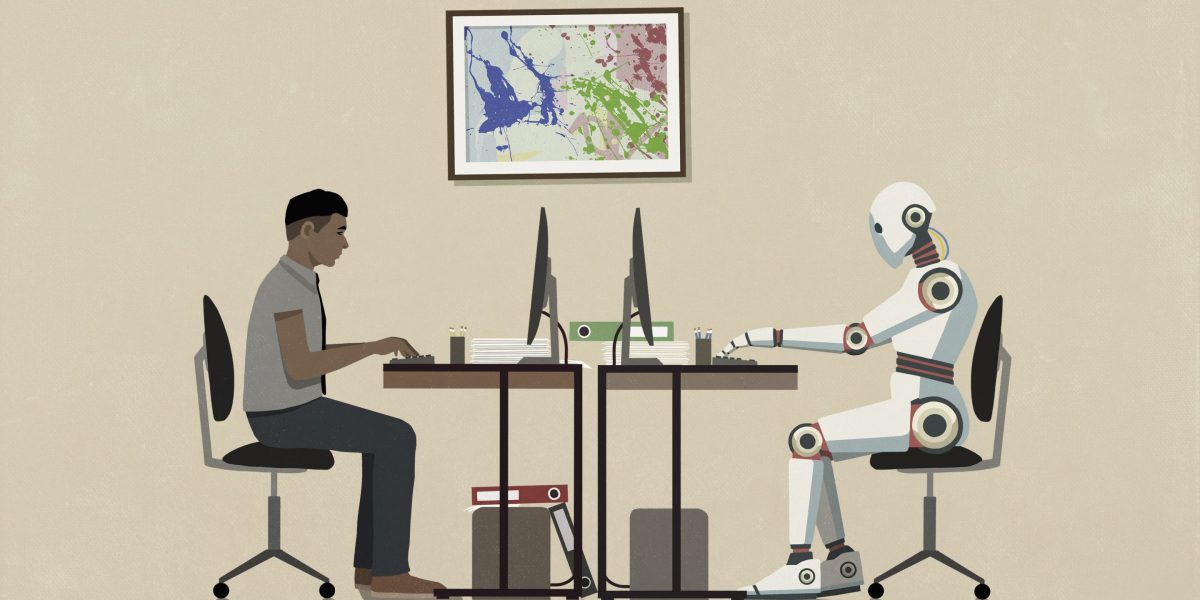
The AI jobs apocalypse isn’t upon us, according to new data
Published

on


Hello and welcome to Eye on AI. In this edition: No AI Jobpocalypse, plus early signs of life for entry-level jobs…OpenAI launches Sora 2Meta plans to use AI chatbot conversations to personalize ads…and more companies are disclosing AI-related risks.

Hi, Beatrice Nolan here, filling in for AI reporter Sharon Goldman, who is out today. For all the corporate hype and Silicon Valley hand-wringing, new research suggests that the U.S. jobs market hasn’t yet experienced the AI apocalypse some have warned about.

In a new report, researchers from Yale’s Budget Lab and the Brookings Institution said they had found no evidence of any “discernible disruption” to jobs since the launch of OpenAI’s ChatGPT in November 2022. The study found that most of the ongoing shifts in the U.S. occupational mix, a measure of the types of jobs people hold, were already underway in 2021, and recent changes don’t appear any more dramatic.

“While the occupational mix is changing more quickly than it has in the past, it is not a large difference and predates the widespread introduction of AI in the workforce,” the researchers wrote in the report. “Currently, measures of exposure, automation, and augmentation show no sign of being related to changes in employment or unemployment.”

Industries with higher AI exposure, such as Information, Financial Activities, and Professional and Business Services, have seen some downward shifts, but these trends largely began before ChatGPT’s launch.

The conclusion isn’t altogether shocking, although it flies in the face of some of the AI doomsayers’ more dramatic claims. Historically, major workplace disruptions have unfolded over decades, not months or years. Computers, for example, didn’t become common in offices until nearly 10 years after their debut, and it was even longer before they reshaped workflows. If AI ends up transforming the labor market as dramatically as computers did—or more so—it’s reasonable to expect that broad effects will take longer than three years to appear.

Some executives have also told me they are taking a “wait and see” approach to hiring while they assess whether the tech can really deliver on its productivity promises. This approach can slow hiring and make the labor market feel sluggish, but it doesn’t necessarily mean workers are being automated out of their jobs.

While anxiety over the effects of AI on today’s labor market may be widespread, the new data suggests that this anxiety is still largely speculative. 

Entry-level hiring woes

The real hiring pain has been felt by college grads and entry-level workers.

There’s no denying that AI is better at tasks typically done by this class of workers, and companies have increasingly been saying the quiet part out loud when it comes to junior roles. But claims that AI is keeping recent graduates out of work aren’t entirely supported by the new data. When researchers compared jobless rates for recent graduates to those with more experience, new grads seemed to be having a slightly tougher time landing roles, but the gap wasn’t big enough to suggest technology is the main factor.

The researchers found a small increase in occupational dissimilarity compared to older graduates, which could reflect early AI effects but also could just as easily be attributed to labor market trends, including employers’ and job-seekers’ reactions to noise about AI replacing workers. The report suggests that entry-level struggles are more likely to be part of broader labor market dynamics rather than a direct result of AI adoption.

Recently, there have also been anecdotal but promising signs of life in the entry-level job market. For example, Shopify and Cloudflare are both increasing their intern intake this year, with Cloudflare calling AI tools a way “to multiply how new hires can contribute to a team” rather than a replacement for the new hires themselves. Younger workers are typically more receptive, more eager to experiment, and more creative when it comes to using emerging technology, which could give companies that hire them an edge. As U.K.-based programmer Simon Willison put it: “An intern armed with AI tools can produce value a whole lot faster than interns in previous years.”

The researchers cautioned that the analysis isn’t predictive, and they plan to keep updating their findings. They also warned that the sample size is small.

Just because AI hasn’t significantly impacted the labor market yet doesn’t mean it won’t in the future. Some recent assessments, such as OpenAI’s new GDPval benchmark, show that leading AI models are getting better at performing professional tasks at or above human expert level on roughly half of cases, depending on the sector. As AI tools improve and companies get better at integrating them, the tech could have a more direct impact on the workforce.

But should we be thinking of AI as just the next computer, or as a new industrial revolution? At least for now, the jury’s still out.

With that, here’s the rest of the AI news.

Beatrice Nolan
bea.nolan@fortune.com
@beafreyanolan

FORTUNE ON AI

We’re not in an ‘AI winter’—but here’s how to survive a cold snap —by Sharon Goldman

California governor signs landmark AI safety law, forcing major tech companies to disclose protocols and protect whistleblowers —Beatrice Nolan

How OpenAI and Stripe’s latest move could blow up online shopping as we know it —by Sharon Goldman

Meta is exploiting the ‘illusion of privacy’ to sell you ads based on chatbot conversations, top AI ethics expert says—and you can’t opt out —Eva Roytburg

AI IN THE NEWS

Meta plans to use AI chatbot conversations to personalize ads. Meta will begin using chats with its AI assistant to shape ads and content recommendations across Facebook and Instagram. The company announced the update to its recommendation system on Wednesday, adding it will take effect on Dec. 16, with user notifications beginning Oct. 7. The company told the Wall Street Journal that it will not use conversations about religion, politics, sexual orientation, health, or race and ethnicity to personalize ads or content. The move will tie Meta’s massive investments in generative AI into its core ad business. Users can’t opt out, but those who don’t use Meta AI won’t be affected, according to the Journal.

Mira Murati’s Thinking Machines Lab launches its first product. Thinking Machines, an AI lab lead by former OpenAI CTO Mira Murati, has launched a tool that automates the creation of custom frontier AI models. Murati told Wired the tool, called Tinker, “will help empower researchers and developers to experiment with models and will make frontier capabilities much more accessible to all people.” The team believes that giving users the tools to fine-tune frontier models will demystify the process of model tuning, make advanced AI accessible beyond big labs, and help to unlock specialized capabilities in areas like math, law, or medicine. The startup raised $2 billion in seed funding in July 2025, before releasing any products, and is made up of a team of top researchers including John Schulman, who cofounded OpenAI and led the creation of ChatGPT. Read more from Wired.

OpenAI launches a new version of Sora. OpenAI has launched Sora 2, its next-generation AI video and audio model, along with a companion app that lets users create, share, and remix AI-generated videos. The new model improves photorealistic motion, generates speech, and introduces “cameos,” allowing users to insert themselves into videos via a short verification recording. However, according to the Wall Street Journal, the new video generator requires copyright holders to opt out. This means that movie studios and other IP owners must actively request that OpenAI exclude their copyrighted material from videos generated by the new version of Sora. A later report from 404 Media found that users are able to generate strange and often offensive content featuring copyrighted characters like Pikachu, SpongeBob SquarePants, and figures from The Simpsons. Read more from 404 Media here.

A new startup is scooping up top AI researchers. Periodic Labs, a new San Francisco startup founded by ChatGPT co-creator Liam Fedus and former DeepMind scientist Ekin Dogus Cubuk, has recruited a string of top AI researchers from OpenAI, Google DeepMind, and Meta, according to the New York Times. More than 20 researchers, including Rishabh Agarwal, who was poached by Meta from DeepMind just a few months ago, have left their work at major AI companies to join the startup focused on building AI that accelerates real-world scientific discovery in physics, chemistry, and materials science. It’s backed by $300 million in funding and plans to use robots to run large-scale lab experiments. Read more from the New York Times.

AI CALENDAR

Oct. 6-10: World AI Week, Amsterdam.

Oct. 21-22: TedAI San Francisco.

Nov. 10-13: Web Summit, Lisbon. 

Nov. 26-27: World AI Congress, London.

Dec. 2-7: NeurIPS, San Diego.

Dec. 8-9: Fortune Brainstorm AI San Francisco. Apply to attend here.

EYE ON AI NUMBERS

72% 

That’s the percentage of S&P 500 companies that have disclosed an AI-related risk this year, according to The Conference Board, a nonprofit think tank and business membership organization, and ESGAUGE, a data analytics firm. Public company disclosure of AI as a material risk has surged in the past two years, with the share of  S&P 500 companies citing an AI-related risk jumping from 12% in 2023 to 72% this year.

Reputational risk is the most frequently cited concern around AI, disclosed by 38% of companies in 2025. Cybersecurity was a close second, cited by 20% of firms in both 2024 and 2025. While all sectors are disclosing risks, financial, health care, and industrials have seen the sharpest rise. This may be because financial and health care companies face regulatory risks tied to sensitive data and fairness, while industrials are largely scaling automation and robotics.

“The rise in AI-related risk disclosures reflects the rapid mainstreaming of AI across corporate functions in recent years, as companies embed it more deeply into areas such as supply chains, customer engagement, and product development,” Andrew Jones, principal researcher at The Conference Board, told Fortune. “With adoption expanding, firms have increased their internal focus on governance, compliance, and operational considerations, with boards, risk committees, and legal teams evaluating potential challenges from data privacy and bias to regulatory uncertainty and liability.” 

The dramatic surge in disclosures does signal that more companies are seeing AI integration as a material risk that needs to be actively managed and communicated to investors. The findings were based on Form 10-K filings from S&P 500 companies available through Aug. 15, 2025.


Source link

Continue Reading

Business

U.S. consumers are so strained they put more than $1B on BNPL during Black Friday and Cyber Monday

Published

on


Financially strained and cautious customers leaned heavily on buy now, pay later (BNPL) services over the holiday weekend.

Cyber Monday alone generated $1.03 billion (a 4.2% increase YoY) in online BNPL sales with most transactions happening on mobile devices, per Adobe Analytics. Overall, consumers spent $14.25 billion online on Cyber Monday. To put that into perspective, BNPL made up for more than 7.2% of total online sales on that day.

As for Black Friday, eMarketer reported $747.5 million in online sales using BNPL services with platforms like PayPal finding a 23% uptick in BNPL transactions.

Likewise, digital financial services company Zip reported 1.6 million transactions throughout 280,000 of its locations over the Black Friday and Cyber Monday weekend. Millennials (51%) accounted for a chunk of the sizable BNPL purchases, followed by Gen Z, Gen X, and baby boomers, per Zip.

The Adobe data showed that people using BNPL were most likely to spend on categories such as electronics, apparel, toys, and furniture, which is consistent with previous years. This trend also tracks with Zip’s findings that shoppers were primarily investing in tech, electronics, and fashion when using its services.

And while some may be surprised that shoppers are taking on more debt via BNPL (in this economy?!), analysts had already projected a strong shopping weekend. A Deloitte survey forecast that consumers would spend about $650 million over the Black Friday–Cyber Monday stretch—a 15% jump from 2023.

“US retailers leaned heavily on discounts this holiday season to drive online demand,” Vivek Pandya, lead analyst at Adobe Digital Insights, said in a statement. “Competitive and persistent deals throughout Cyber Week pushed consumers to shop earlier, creating an environment where Black Friday now challenges the dominance of Cyber Monday.”

This report was originally published by Retail Brew.


Source link

Continue Reading

Business

AI labs like Meta, Deepseek, and Xai earned worst grades possible on an existential safety index

Published

on


A recent report card from an AI safety watchdog isn’t one that tech companies will want to stick on the fridge.

The Future of Life Institute’s latest AI safety index found that major AI labs fell short on most measures of AI responsibility, with few letter grades rising above a C. The org graded eight companies across categories like safety frameworks, risk assessment, and current harms.

Perhaps most glaring was the “existential safety” line, where companies scored Ds and Fs across the board. While many of these companies are explicitly chasing superintelligence, they lack a plan for safely managing it, according to Max Tegmark, MIT professor and president of the Future of Life Institute.

“Reviewers found this kind of jarring,” Tegmark told us.

The reviewers in question were a panel of AI academics and governance experts who examined publicly available material as well as survey responses submitted by five of the eight companies.

Anthropic, OpenAI, and GoogleDeepMind took the top three spots with an overall grade of C+ or C. Then came, in order, Elon Musk’s Xai, Z.ai, Meta, DeepSeek, and Alibaba, all of which got Ds or a D-.

Tegmark blames a lack of regulation that has meant the cutthroat competition of the AI race trumps safety precautions. California recently passed the first law that requires frontier AI companies to disclose safety information around catastrophic risks, and New York is currently within spitting distance as well. Hopes for federal legislation are dim, however.

“Companies have an incentive, even if they have the best intentions, to always rush out new products before the competitor does, as opposed to necessarily putting in a lot of time to make it safe,” Tegmark said.

In lieu of government-mandated standards, Tegmark said the industry has begun to take the group’s regularly released safety indexes more seriously; four of the five American companies now respond to its survey (Meta is the only holdout.) And companies have made some improvements over time, Tegmark said, mentioning Google’s transparency around its whistleblower policy as an example.

But real-life harms reported around issues like teen suicides that chatbots allegedly encouraged, inappropriate interactions with minors, and major cyberattacks have also raised the stakes of the discussion, he said.

“[They] have really made a lot of people realize that this isn’t the future we’re talking about—it’s now,” Tegmark said.

The Future of Life Institute recently enlisted public figures as diverse as Prince Harry and Meghan Markle, former Trump aide Steve Bannon, Apple co-founder Steve Wozniak, and rapper Will.i.am to sign a statement opposing work that could lead to superintelligence.

Tegmark said he would like to see something like “an FDA for AI where companies first have to convince experts that their models are safe before they can sell them.

“The AI industry is quite unique in that it’s the only industry in the US making powerful technology that’s less regulated than sandwiches—basically not regulated at all,” Tegmark said. “If someone says, ‘I want to open a new sandwich shop near Times Square,’ before you can sell the first sandwich, you need a health inspector to check your kitchen and make sure it’s not full of rats…If you instead say, ‘Oh no, I’m not going to sell any sandwiches. I’m just going to release superintelligence.’ OK! No need for any inspectors, no need to get any approvals for anything.”

“So the solution to this is very obvious,” Tegmark added. “You just stop this corporate welfare of giving AI companies exemptions that no other companies get.”

This report was originally published by Tech Brew.


Source link

Continue Reading

Business

Hollywood writers say Warner takeover ‘must be blocked’

Published

on


Hollywood writers, producers, directors and theater owners voiced skepticism over Netflix Inc.’s proposed $82.7 billion takeover of Warner Bros. Discovery Inc.’s studio and streaming businesses, saying it threatens to undermine their interests.

The Writers Guild of America, which announced in October it would oppose any sale of Warner Bros., reiterated that view on Friday, saying the purchase by Netflix “must be blocked.”

“The world’s largest streaming company swallowing one of its biggest competitors is what antitrust laws were designed to prevent,” the guild said in an emailed statement. “The outcome would eliminate jobs, push down wages, worsen conditions for all entertainment workers, raise prices for consumers, and reduce the volume and diversity of content for all viewers.”

The worries raised by the movie and TV industry’s biggest trade groups come against the backdrop of falling movie and TV production, slack ticket sales and steep job cuts in Hollywood. Another legacy studio, Paramount, was sold earlier this year.

Warner Bros. accounts for about a fourth of North American ticket sales — roughly $2 billion — and is being acquired by a company that has long shunned theatrical releases for its feature films. As part of the deal, Netflix co-CEO Ted Sarandos has promised Warner Bros. will continue to release moves in theaters.

“The proposed acquisition of Warner Bros. by Netflix poses an unprecedented threat to the global exhibition business,” Michael O’Leary, chief executive officer of the theatrical trade group Cinema United, said in en emailed statement Friday. “The negative impact of this acquisition will impact theaters from the biggest circuits to one-screen independents.”

The buyout of Warner Bros. by Netflix “would be a disaster,” James Cameron, the director of some of Hollywood’s highest-grossing films in history including Titanic and Avatar, said in late November on The Town, an industry-focused podcast. “Sorry Ted, but jeez. Sarandos has gone on record saying theatrical films are dead.”

On a conference call with investors Friday, Sarandos said that his company’s resistance to releasing films in cinemas was mostly tied to “the long exclusive windows, which we don’t really think are that consumer friendly.”

The company said Friday it would “maintain Warner Bros.’ current operations and build on its strengths, including theatrical releases for films.”

On the call, Sarandos reiterated that view, saying that, “right now, you should count on everything that is planned on going to the theater through Warner Bros. will continue to go to the theaters through Warner Bros.” 

Competition from online outfits like YouTube and Netflix has forced a reckoning in Hollywood, opening the door for takeovers like the Warner Bros. deal announced Friday. Media giants including Comcast Corp., parent of NBCUniversal, are unloading cable-TV networks like MS Now and USA, and steering resources into streaming. 

In an emailed note to Warner Bros. employees on Friday, Chief Executive Officer David Zaslav said the board’s decision to sell the company “reflects the realities of an industry undergoing generational change in how stories are financed, produced, distributed, and discovered.”

The Producers Guild of America said Friday its members are “rightfully concerned about Netflix’s intended acquisition of one of our industry’s most storied and meaningful studios,” while a spokesperson for the Directors Guild of America raised concerns about future pay at Warner Bros.

“We will be meeting with Netflix to outline our concerns and better understand their vision for the future of the company,” the Directors Guild said.

In September, the DGA appointed director Christopher Nolan as its president. Nolan has previously criticized Netflix’s model of releasing films exclusively online, or simultaneously in a small number of cinemas, and has said he won’t make movies for the company.

The Screen Actors Guild said Friday that the transaction “raises many serious questions about its impact on the future of the entertainment industry, and especially the human creative talent whose livelihoods and careers depend on it.”

Oscar winner Jane Fonda spoke out on Thursday before the deal was announced. 

“Consolidation at this scale would be catastrophic for an industry built on free expression, for the creative workers who power it, and for consumers who depend on a free, independent media ecosystem to understand the world,” the star of the Netflix series Grace and Frankie wrote on the Ankler industry news website.

Netflix and Warner Bros. obviously don’t see it that way. In his statement to employees, Zaslav said “the proposed combination of Warner Bros. and Netflix reflects complementary strengths, more choice and value for consumers, a stronger entertainment industry, increased opportunity for creative talent, and long-term value creation for shareholders.”


Source link

Continue Reading

Trending

Copyright © Miami Select.