Connect with us

Business

The 3 magic phrases that will instantly make you more likable, according to a body language expert

Published

on


Building meaningful connections in the workplace often comes down to moments so small they can feel insignificant. And yet, those moments can shape how others perceive you. According to behavioral researcher Vanessa Van Edwards, founder of Science of People, which teaches people social skills to use in life and business, three specific phrases can dramatically increase your likability by addressing a psychological blind spot most people don’t know they have.​

Van Edwards, whose research on charisma and nonverbal communication has reached more than 70 million people and been featured at Harvard, MIT, and Stanford, shared her insights during an interview with Steven Bartlett on the Diary of a CEO podcast. Her advice is based on what psychologists call signal amplification bias, the idea that even when you genuinely like someone, or enjoy an interaction, they probably don’t realize it. In short, people tend to overestimate how much their feelings come across to others.

“We think our signals are obvious,” Van Edwards said in the interview. “If we like someone or if we’re having a good time, we think, ‘Oh, they for sure know it.’ They don’t.”

This bias can create gaps in professional relationships where colleagues, clients, and contacts may never realize how much you value them—unless you explicitly communicate it. Van Edwards said she developed three phrases designed to bridge that gap, what she calls her “magic phrases for likability.”

The first phrase: ‘I was just thinking of you’

The most powerful phrase, according to Van Edwards, is deceptively simple: “I was just thinking of you.”

The key to using this phrase effectively is authenticity. Van Edwards said it should only be used when genuinely triggered by a thought or association. “You think of a lot of people in your life all the time,” she said. “If you are thinking of someone and you can text them, text them: ‘I was just thinking of you, how are you?’ ‘I was just thinking of you, how’d that project go?’ ‘I was just thinking of you, it has been a while since we talked.’”

The phrase also works when something in daily life sparks a connection. “You see a movie, you see a documentary, you see a matcha latte, you see a mug, you see a ceramic candle, and you’re like, ‘Ah, this made me think of you,’” Van Edwards said. “My text messages, my conversations, are full of actual moments where I was triggered to think of that person.”

Van Edwards added a crucial caveat: “If you don’t think of someone, they’re not a person you need to have in your life.”

The second phrase: ‘You’re always so …’

The second phrase involves offering specific positive labels: “You’re always so …” followed by a genuine compliment.​ Some examples: “You always make me laugh,” “You’re always so interesting,” or “You’re always so great at interviews.”

“Giving them a label that is a positive label is the best gift you can give someone,” Van Edwards said. The reason this works ties back to signal amplification bias: Explicitly naming a quality you appreciate is a great way to fight the tendency to assume your admiration of someone is already obvious.

Research on interpersonal warmth—which, alongside competence, accounts for roughly 82% of how people evaluate others—supports the importance of explicit positive communication. Studies have found that warmth is the primary barometer for people when meeting someone new, as it signals whether or not they can be trusted.

The third phrase: ‘Last time we talked, you mentioned …’

The final phrase demonstrates active listening and memory: “Last time we talked, you mentioned …”

Van Edwards said referencing something the person was genuinely excited about is incredibly important in getting them to like you. “We are so honored when we get brain space—that you remembered and you’re going to bring it up,” she said. “And you specifically bring up something that they lit up with, something they were like, ‘Ah, it was great, it was exciting, it was wonderful.’”

This phrase signals that you not only heard what someone said, but valued it enough to retain and revisit it. In professional settings where colleagues and clients often feel overlooked, this simple acknowledgment can be a great way to strengthen relationships.

But here’s the important thing about all three tips: You can’t force it. During the interview, Bartlett said reaching out to everyone as much as Van Edwards was recommending sounds “exhausting,” but she clarified that these phrases should be used organically, from genuine moments, not from forced outreach.

“You’re only doing it when it’s actually naturally occurring to you,” she said. “You’re watching a documentary, you’re at a restaurant, you’re on the bus, you’re like, ‘Oh, that reminds me of this person’—quick text. That is less work than missing an old friend and not knowing what to say.”

Van Edwards, who has built her career on translating behavioral science into practical communication strategies, developed her first framework about 12 years ago and has taught hundreds of thousands of students through her courses and books. “I’m a recovering awkward person,” she told Bartlett on the podcast, describing how she once believed charisma was genetic until she discovered it could be learned.​​

You can watch the full Diary of a CEO interview with Vanessa Van Edwards below:

For this story, Fortune used generative AI to help with an initial draft. An editor verified the accuracy of the information before publishing. 


Source link

Continue Reading

Business

Oracle slides by most since January on mounting AI spending

Published

on


Oracle Corp. shares plunged the most in almost 11 months after the company escalated its spending on AI data centers and other equipment, rising outlays that are taking longer to translate into cloud revenue than investors want.

Capital expenditures, a metric of data center spending, were about $12 billion in the quarter, an increase from $8.5 billion in the preceding period, the company said Wednesday in a statement. Analysts anticipated $8.25 billion in capital spending in the quarter, according to data compiled by Bloomberg. 

Oracle now expects capital expenditures will reach about $50 billion in the fiscal year ending in May 2026 — a $15 billion increase from its September forecast — executives said on a conference call after the results were released.

The shares fell 11% to $198.85 at the close Thursday in New York, the biggest single-day decline since Jan. 27. Oracle’s stock had already lost about a third of its value through Wednesday’s close since a record high on Sept. 10. Meanwhile, a measure of Oracle’s credit risk reached a fresh 16-year high.

The latest earning report and share slide marks a reversal of fortunes for a company that just a few months ago was enjoying a blistering rally and clinching multibillion-dollar data center deals with the likes of OpenAI. The gains temporarily turned co-founder Larry Ellison into the world’s richest person, with the tech magnate passing Elon Musk for a few hours.

Known for its database software, Oracle has recently found success in the competitive cloud computing market. It’s engaging in a massive data center build-out to power AI work for OpenAI and also counts companies such as ByteDance Ltd.’s TikTok and Meta Platforms Inc. as major cloud customers. 

Fiscal second-quarter cloud sales increased 34% to $7.98 billion, while revenue in the company’s closely watched infrastructure business gained 68% to $4.08 billion. Both numbers fell just short of analysts’ estimates.Play Video

Still, Wall Street has raised doubts about the costs and time required to develop AI infrastructure at such a massive scale. Oracle has taken out significant sums of debt and committed to leasing multiple data center sites. 

The cost of protecting the company’s debt against default for five years rose as much as 0.17 percentage point to around 1.41 percentage point a year, the highest intraday level since April 2009, according to ICE Data Services. The gauge rises as investor confidence in the company’s credit quality falls. Oracle credit derivatives have become a credit market barometer for AI risk.

“Oracle faces its own mounting scrutiny over a debt-fueled data center build-out and concentration risk amid questions over the outcome of AI spending uncertainty,” said Jacob Bourne, an analyst at Emarketer. “This revenue miss will likely exacerbate concerns among already cautious investors about its OpenAI deal and its aggressive AI spending.”

Remaining performance obligation, a measure of bookings, jumped more than fivefold to $523 billion in the quarter, which ended Nov. 30. Analysts, on average, estimated $519 billion.

Investors want to see Oracle turn its higher spending on infrastructure into revenue as quickly as it has promised. 

“The vast majority of our cap ex investments are for revenue generating equipment that is going into our data centers and not for land, buildings or power that collectively are covered via leases,” Principal Financial Officer Doug Kehring said on the call. “Oracle does not pay for these leases until the completed data centers and accompanying utilities are delivered to us.”

“As a foundational principle, we expect and are committed to maintaining our investment grade debt rating,” Kehring added.

Oracle’s cash burn increased in the quarter and its free cash flow reached a negative $10 billion. Overall, the company has about $106 billion in debt, according to data compiled by Bloomberg. “Investors continually seem to expect incremental cap ex to drive incremental revenue faster than the current reality,” wrote Mark Murphy, an analyst at JP Morgan.Play Video

“Oracle is very good at building and running high-performance and cost-efficient cloud data centers,” Clay Magouyrk, one of Oracle’s two chief executive officers, said in the statement. “Because our data centers are highly automated, we can build and run more of them.”

This is Oracle’s first earnings report since longtime Chief Executive Officer Safra Catz was succeeded by Magouyrk and Mike Sicilia, who are sharing the CEO post.

Part of the negative sentiment from investors in recent weeks is tied to increased skepticism about the business prospects of OpenAI, which is seeing more competition from companies like Alphabet Inc.’s Google, wrote Kirk Materne, an analyst at Evercore ISI, in a note ahead of earnings. Investors would like to see Oracle management explain how they could adjust spending plans if demand from OpenAI changes, he added.

In the quarter, total revenue expanded 14% to $16.1 billion. The company’s cloud software application business rose 11% to $3.9 billion. This is the first quarter that Oracle’s cloud infrastructure unit generated more sales than the applications business.

Earnings, excluding some items, were $2.26 a share. The profit was helped by the sale of Oracle’s holdings in chipmaker Ampere Computing, the company said. That generated a pretax gain of $2.7 billion in the period. Ampere, which was backed early in its life by Oracle, was bought by Japan’s SoftBank Group Corp. in a transaction that closed last month.

In the current period, which ends in February, total revenue will increase 19% to 22%, while cloud sales will increase 40% to 44%, Kehring said on the call. Both forecasts were in line with analysts’ estimates.

Annual revenue will be $67 billion, affirming an outlook the company gave in October.


Source link

Continue Reading

Business

Analyst sees Disney/OpenAI deal as a dividing line in entertainment history

Published

on


Disney’s expansive $1 billion licensing agreement with OpenAI is a sign Hollywood is serious about adapting entertainment to the age of artificial intelligence (AI), marking the start of what one Ark Invest analyst describes as a “pre‑ and post‑AI” era for entertainment content. The deal, which allows OpenAI’s Sora video model to use Disney characters and franchises, instantly turns a century of carefully guarded intellectual property (IP) into raw material for a new kind of crowd‑sourced, AI‑assisted creativity.​

Nicholas Grous, director of research for consumer internet and fintech at Ark Invest, told Fortune tools like Sora effectively recreate the “YouTube moment” for video production, handing professional‑grade creation capabilities to anyone with a prompt instead of a studio budget. In his view, that shift will flood the market with AI‑generated clips and series, making it far harder for any single new creator or franchise to break out than it was in the early social‑video era.​ His remarks echoed the analysis from Melissa Otto, head of research at S&P Global Visible Alpha, who recently told Fortune Netflix’s big move for Warner Bros.’ reveals the streaming giant is motivated by a need to deepen its war chest as it sees Google’s AI-video capabilities exploding with the onset of TPU chips.

As low‑cost synthetic video proliferates, Grous said he believes audiences will begin to mentally divide entertainment into “pre‑AI” and “post‑AI” categories, attaching a premium to work made largely by humans before generative tools became ubiquitous. “I think you’re going to have basically a split between pre-AI content and post-AI content,” adding that viewers will consider pre-AI content closer to “true art, that was made with just human ingenuity and creativity, not this AI slop, for lack of a better word.”

Disney’s IP as AI fuel

Within that framework, Grous argued Disney’s real advantage is not just Sora access, but the depth of its pre‑AI catalog across animation, live‑action films, and television. Iconic franchises like Star Wars, classic princess films and legacy animated characters become building blocks for a global experiment in AI‑assisted storytelling, with fans effectively test‑marketing new scenarios at scale.​

“I actually think, and this might be counterintuitive, that the pre-AI content that existed, the Harry Potter, the Star Wars, all of the content that we’ve grown up with … that actually becomes incrementally more valuable to the entertainment landscape,” Grous said. On the one hand, he said, there are deals like Disney and OpenAI’s where IP can become user-generated content, but on the other, IP represents a robust content pipeline for future shows, movies, and the like.

Grous sketched a feedback loop in which Disney can watch what AI‑generated character combinations or story setups resonate online, then selectively “pull up” the most promising concepts into professionally produced, higher‑budget projects for Disney+ or theatrical release. From Disney’s perspective, he added, “we didn’t know Cinderella walking down Broadway and interacting with these types of characters, whatever it may be, was something that our audience would be interested in.” The OpenAI deal is exciting because Disney can bring that content onto its streaming arm Disney+ and make it more premium. “We’re going to use our studio chops to build this into something that’s a bit more luxury than what just an individual can create.”

Grous agreed the emerging market for pre‑AI film and TV libraries is similar to what’s happened in the music business, where legacy catalogs from artists like Bruce Springsteen and Bob Dylan have fetched huge sums from buyers betting on long‑term streaming and licensing value.

The big Netflix-Warner deal

For streaming rivals, the Disney-OpenAI pact is a strategic warning shot. Grous argued the soaring price tags in the bidding war for Warner Bros. between Netflix and Paramount shows the importance of IP for the next phase of entertainment. “​I think the reason this bidding [for Warner Bros.] is approaching $100 billion-plus is the content library and the potential to do a Disney-OpenAI type of deal.” In other words, whoever controls Batman and the like will control the inevitable AI-generated versions of those characters, although “they could take a franchise like Harry Potter and then just create slop around it.”

Netflix has a great track record on monetizing libraries, Grous said, listing the example of how the defunct USA dramedy Suits surged in popularity once it landed on Netflix, proving extensive back catalogs can be revived and re‑monetized when matched with modern distribution.​

Grous cited Nintendo and Pokémon as examples of under‑monetized franchises that could see similar upside if their owners strike Sora‑style deals to bring characters more deeply into mobile and social environments.​ “That’s another company where you go, ‘Oh my god, the franchises they have, if they’re able to bring it into this new age that we’re all experiencing, this is a home-run opportunity.’”

In that environment, the Ark analyst suggests Disney’s OpenAI deal is less of a one‑off licensing win than an early template for how legacy media owners might survive and thrive in an AI‑saturated market. The companies with rich pre‑AI catalogs and a willingness to experiment with new tools, he argued, will be best positioned to stand out amid the “AI slop” and turn nostalgia‑laden IP into enduring, flexible assets for the post‑AI age.​

Underlying all of this is a broader battle for attention that spans far beyond traditional studios and shows how sectors between tech and entertainment are getting even blurrier than when the gatecrashers from Silicon Valley first piled into streaming. Grous notes Netflix itself has long framed its competition as everything from TikTok and Instagram to Fortnite and “sleep,” a mindset that fits naturally with the coming wave of AI‑generated video and interactive experiences.​ (In 2017, Netflix co-founder Reed Hastings famously said “sleep” was one of the company’s biggest competitors, as it was busy pioneering the binge-watch.)

Grous also sounded a warning for the age of post-AI content: The binge-watch won’t feel as good anymore, and there will be some kind of backlash. As critics such as The New York Times‘ James Poniewozik increasingly note, streaming shows don’t seem to be as re-watchable as even recent hits from the golden age of cable TV, such as Mad Men. Grous said he sees a future where the endangered movie theater makes a comeback. “People are going to want to go outside and meet or go to the theater. Like, we’re not just going to want to be fed AI slop for 16 hours a day.”

Editor’s note: the author worked for Netflix from June 2024 through July 2025.


Source link

Continue Reading

Business

The race to an AI workforce faces one important trust gap: What happens when an agent goes rogue?

Published

on


To err is human; to forgive, divine. But when it comes to autonomous AI “agents” that are taking on tasks previously handled by humans, what’s the margin for error? 

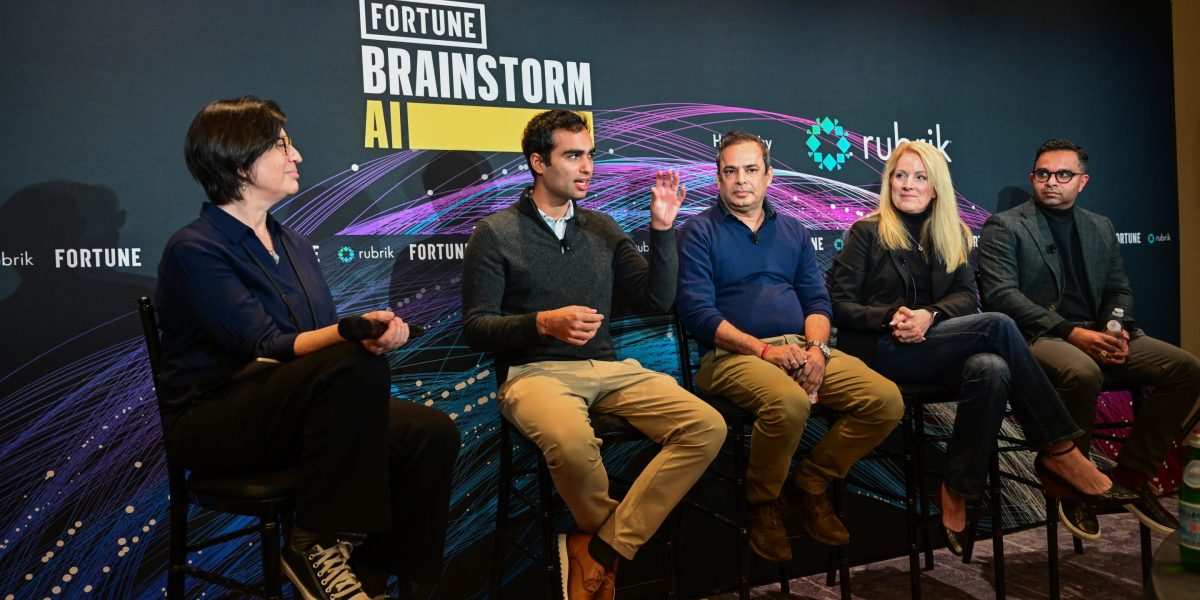
At Fortune’s recent Brainstorm AI event in San Francisco, an expert roundtable grappled with that question as insiders shared how their companies are approaching security and governance—an issue that is leapfrogging even more practical challenges such as data and compute power. Companies are in an arm’s race to parachute AI agents into their workflows that can tackle tasks autonomously and with little human supervision. But many are facing a fundamental paradox that is slowing adoption to a crawl: Moving fast requires trust, and yet building trust takes a lot of time. 

Dev Rishi, general manager for AI at Rubrik, joined the security company last summer following its acquisition of his deep learning AI startup Predibase. Afterward, he spent the next four months meeting with executives from 180 companies. He used those insights to divide agentic AI adoption into four phases, he told the Brainstorm AI audience. (To level set, agentic adoption refers to businesses implementing AI systems that work autonomously, rather than responding to prompts.) 

According to Rishi’s learnings, the four phases he unearthed include the early experimentation phase where companies are hard at work on prototyping their agents and mapping goals they think could be integrated into their workflows. The second phase, said Rishi, is the trickiest. That’s when companies shift their agents from prototypes and into formal work production. The third phase involves scaling those autonomous agents across the entire company. The fourth and final stage—which no one Rishi spoke with had achieved—is autonomous AI. 

Roughly half of the 180 companies were in the experimentation and prototyping phase, Rishi found, while 25% were hard at work formalizing their prototypes. Another 13% were scaling, and the remaining 12% hadn’t started any AI projects. However, Rishi projects a dramatic change ahead: In the next two years, those in the 50% bucket are anticipating that they will move into phase two, according to their roadmaps. 

“I think we’re going to see a lot of adoption very quickly,” Rishi told the audience. 

However, there’s a major risk holding companies back from going “fast and hard,” when it comes to speeding up the implementation of AI agents in the workforce, he noted. That risk—and the No.1 blocker to broader deployment of agents— is security and governance, he said. And because of that, companies are struggling to shift from agents being used for knowledge retrieval to being action oriented.

“Our focus actually is to accelerate the AI transformation,” said Rishi. “I think the number one risk factor, the number one bottleneck to that, is risk [itself].”

Integrating agents into the workforce

Kathleen Peters, chief innovation office at Experian who leads product strategy, said the slowing is due to not fully understanding the risks when AI agents overstep the guardrails that companies have put into place and the failsafes needed for when that happens.

“If something goes wrong, if there’s a hallucination, if there’s a power outage, what can we fall back to,” she questioned. “It’s one of those things where some executives, depending on the industry, are wanting to understand ‘How do we feel safe?’”

Figuring out that piece will be different for every company and is likely to be particularly thorny for companies in highly regulated industries, she noted. Chandhu Nair, senior vice president in data, AI, and innovation at home improvement retailer Lowe’s, noted that it’s “fairly easy” to build agents, but people don’t understand what they are: Are they a digital employee? Is it a workforce? How will it be incorporated into the organizational fabric? 

“It’s almost like hiring a whole bunch of people without an HR function,” said Nair. “So we have a lot of agents, with no kind of ways to properly map them, and that’s been the focus.”

The company has been working through some of these questions, including who might be responsible if something goes wrong. “It’s hard to trace that back,” said Nair. 

Experian’s Peters predicted that the next few years will see a lot of those very questions hashed out in public even as conversations take place simultaneously behind closed doors in boardrooms and among senior compliance and strategy committees. 

“I actually think something bad is going to happen,” Peters said. “There are going to be breaches. There are going to be agents that go rogue in unexpected ways. And those are going to make for a very interesting headlines in the news.”

Big blowups will generate a lot of attention, Peters continued, and reputational risk will be on the line. That will force the issue of uncomfortable conversations about where liabilities reside regarding software and agents, and it will all likely add up to increased regulation, she said. 

“I think that’s going to be part of our societal overall change management in thinking about these new ways of working,” Peters said.

Still, there are concrete examples as to how AI can benefit companies when it is implemented in ways that resonate with employees and customers. 

Nair said Lowe’s has seen strong adoption and “tangible” return on investment from the AI it has embedded into the company’s operations thus far. For instance, among its 250,000 store associates, each has an agent companion with extensive product knowledge across its 100,000 square foot stores that sell anything from electrical equipment, to paints, to plumbing supplies. A lot of the newer entrants to the Lowe’s workforce aren’t tradespeople, said Nair, and the agent companions have become the “fastest-adopted technology” so far.

“It was important to get the use cases right that really resonate back with the customer,” he said. In terms of driving change management in stores, “if the product is good and can add value, the adoption just goes through the roof.”

Who’s watching the agent?

But for those who work at headquarters, the change management techniques have to be different, he added, which piles on the complexity. 

And many enterprises are stuck at another early-stage question, which is whether they should build their own agents or rely on the AI capabilities developed by major software vendors. 

Rakesh Jain, executive director for cloud and AI engineering at healthcare system Mass General Brigham, said his organization is taking a wait-and-see approach. With major platforms like Salesforce, Workday, and ServiceNow building their own agents, it could create redundancies if his organization builds its own agents at the same time. 

“If there are gaps, then we want to build our own agents,” said Jain. “Otherwise, we would rely on buying the agents that the product vendors are building.”

In healthcare, Jain said there’s a critical need for human oversight given the high stakes. 

“The patient complexity cannot be determined through algorithms,” he said. “There has to be a human involved in it.” In his experience, agents can accelerate decision making, but humans have to make the final judgment, with doctors validating everything before any action is taken. 

Still, Jain also sees enormous potential upside as the technology matures. In radiology, for example, an agent trained on the expertise of multiple doctors could catch tumors in dense tissue that a single radiologist might miss. But even with agents trained on multiple doctors, “you still have to have a human judgment in there,” said Jain. 

And the threat of overreach by an agent that is supposed to be a trusted entity is ever present. He compared a rogue agent to an autoimmune disease, which is one of the most difficult conditions for doctors to diagnose and treat because the threat is internal. If an agent inside a system “becomes corrupt,” he said, “it’s going to cause massive damages which people have not been able to really quantify.”

Despite the open questions and looming challenges, Rishi said there’s a path forward. He identified two requirements for building trust in agents. First, companies need systems that provide confidence that agents are operating within policy guardrails. Second, they need clear policies and procedures for when things will inevitably go wrong—a policy with teeth. Nair, additionally, added three factors for building trust and moving forward smartly: identity and accountability and knowing who the agent is; evaluating how consistent the quality of each agent’s output is; and, reviewing the post-mortem trail that can explain why and when mistakes have occurred. 

“Systems can make mistakes, just like humans can as well,” said Nair. “ But to be able to explain and recover is equally important.”




Source link

Continue Reading

Trending

Copyright © Miami Select.