Connect with us

Business

Tesla self driving cars are being tested in Boring Co. tunnels in Las Vegas, but full autonomy is still ‘a ways off,’ Convention Center exec says

Published

on


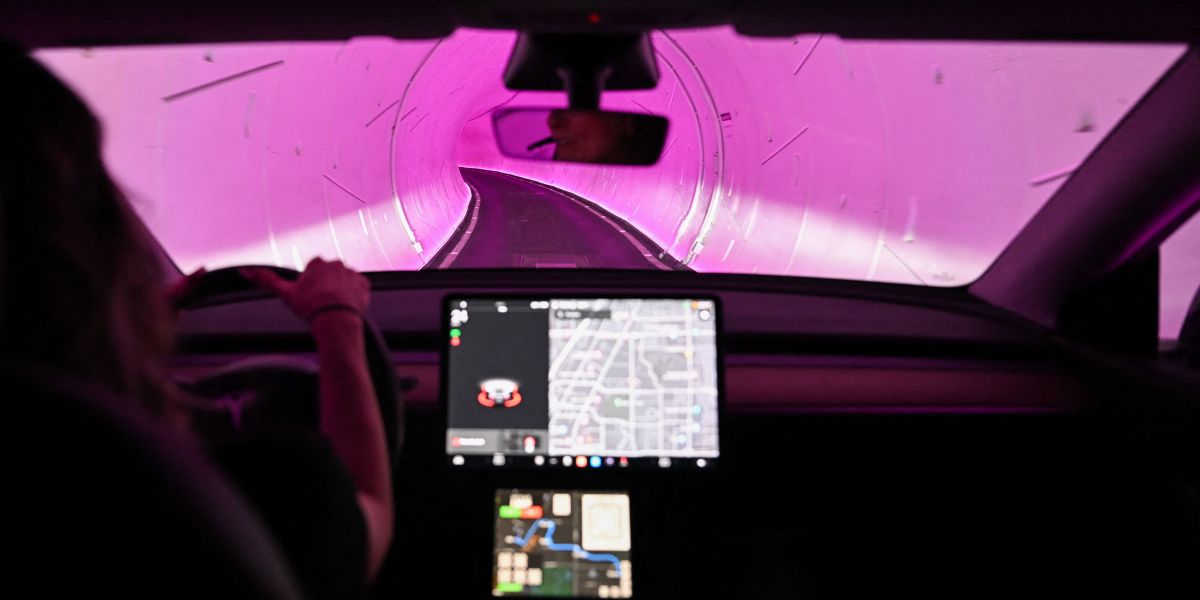
Autonomous testing of Tesla cars has begun in the 3.5-mile tunnel system that Elon Musk’s Boring Company operates below the Las Vegas Convention Center.

“We’ve started to test,” Steve Hill, CEO of city marketing organization the Las Vegas Convention and Visitors Authority (LVCVA), told Fortune in an interview in his office earlier this month. Hill specified that the autonomous testing had begun prior to Tesla’s robotaxi launch in June—at the end of 2024—and that no passengers have been in vehicles during the testing. 

Thus far, all of the initial testing has been done with the standard Full Self-Driving (FSD) software that consumers can get in their personal Tesla vehicles, and with a Boring Company safety operator in the driver’s seat, according to Hill, who awarded the Boring Company its first transportation contract and who has overseen all of Boring’s initial construction and tunneling in the broader County thus far. Hill said that Boring Company is operating the vehicles, but was unsure of Tesla’s exact role in the testing apart from furnishing the vehicles and the self-driving software. There have been no scrapes or accidents thus far, though safety drivers have “periodically” had to intervene and take control of the vehicles, Hill said.

The Boring Company and Elon Musk have repeatedly suggested that the Teslas driving below Las Vegas will eventually drive themselves, but until now, there has been no firm timeline for when that process would formally begin. Boring Company, which received initial approvals to construct a 68-mile underground taxi system below Las Vegas, still has not received the necessary permits to dig within city limits, a Las Vegas spokesman confirmed (the Las Vegas Convention Center tunnel is technically in Clark County). Tesla and the Boring Company did not respond to requests for comment.

In the future, Boring Company will remove safety drivers from the front seat during testing, Hill said, but there is no telling when that will take place, as it will depend on when Tesla, where Musk is CEO, and the Boring Company can demonstrate to the LVCVA that it is safe to do so. Convention Center attendees will also need to become comfortable with the idea of it before testing with riders begins, according to Hill. “I think it’s a ways off,” Hill says, noting it is crucial that the system will “work exceptionally well and instill and earn confidence” with the people who ride in it. 

The current Boring Company tunnel system is comprised of two adjacent one-way single-lane tunnels connecting passengers to different ends of the Las Vegas Convention Center as well as to Resorts World and the Westgate Hotel and Casino.

Hill said that the vehicles are currently being tested in self-driving mode inside the tunnels, “experiencing the environment,” as “they find spots that are difficult for them.” The rock walls of the tunnels, Hill said, combined with the bright, colorful lights in the passageways create some “interesting but odd lighting” for Tesla’s self-driving system, which uses video cameras only and does not rely on the radar and LiDAR sensors that most of its competitors use to help the cars “see” the world around them.

The tunnels should make for a “much easier environment” for autonomous vehicles than the open roads of Austin—where Tesla has begun a limited, small-scale robotaxi operation with employees in the passenger seat—because, in the tunnels, Boring Company has complete control over what and who enters, Hill said. In theory, that means less unexpected “edge” cases for the autonomous cars to contend with, whether it be cyclists, pedestrians, or animals getting in the way (though the tunnel has had its share of trespassers). So far, Hill said there have not been any scrapes or accidents. Still, Hill said, Boring Company is “going to have to show us that and make us comfortable that [they] can take the next step. The LVCVA will likely also bring in a consultant before the safety driver is removed, according to Hill. 

“Sooner or later, this is going to be autonomous,” Hill said.

For now, Boring Company is in the process of expanding its tunnel system and fleet of human drivers—currently working on an underground road to the Las Vegas airport. That tunnel will emerge on a property nearby, and human-driven Teslas will drive the rest of the way to and from the airport on the main roads, “like Uber and Lyft,” Hill says. Boring has been awaiting permits from the City to run a tunnel below Las Vegas Boulevard. The company has announced plans to start digging below another city, too: Nashville. 

Fortune reported last year that there had been trespassing in the Las Vegas tunnels, as well as a series of safety episodes, including Boring Company workers getting burned with chemicals in the tunnels, Boring employees digging too close to the Las Vegas monorail, and an enormous concrete bin that had collapsed in front of the Convention Center. OSHA issued several “serious” violations to Boring Company last year, which the Musk-owned company is appealing. That appellate hearing, which was scheduled for mid-August, has been postponed until later this year. 

After Fortune’s reporting, Hill said that his agency would take a more hands-on role with safety, and he appointed an LVCVA employee to oversee Boring Company’s work. Hill said he is not aware of any other serious safety incidents since that appointment.

“I think it’s been really helpful,” Hill said, noting that Boring Company has been “completely welcoming” of the LVCVA’s safety oversight.

While the current iteration of Boring Company’s underground network is a far cry from the high-speed hyperloop system Musk initially talked about, where customers would blast around in autonomous electric pods at more than 600 miles per hour, Hill says he’s proud of the system in its current form, saying it is “the highest rated feature we have” at the Convention Center. “People love it,” he said, noting that the only reason Boring isn’t digging any faster is because of holdups with getting permits issued.

“We’re holding them back. They’re not holding us back,” Hill said.

Introducing the 2025 Fortune Global 500, the definitive ranking of the biggest companies in the world. Explore this year’s list.


Source link

Continue Reading

Business

Miss Universe co-owner gets bank accounts frozen as part of probe into drugs, fuel and arms trafficking

Published

on


Mexico’s anti-money laundering office has frozen the bank accounts of the Mexican co-owner of Miss Universe as part of an investigation into drugs, fuel and arms trafficking, an official said Friday.

The country’s Financial Intelligence Unit, which oversees the fight against money laundering, froze Mexican businessman Raúl Rocha Cantú’s bank accounts in Mexico, a federal official told The Associated Press on condition of anonymity because he was not authorized to comment on the investigation.

The action against Rocha Cantú adds to mounting controversies for the Miss Universe organization. Last week, a court in Thailand issued an arrest warrant for the Thai co-owner of the Miss Universe Organization in connection with a fraud case and this year’s competition — won by Miss Mexico Fatima Bosch — faced allegations of rigging.

The Miss Universe organization did not immediately respond to an email from The Associated Press seeking comment about the allegations against Rocha Cantú.

Mexico’s federal prosecutors said last week that Rocha Cantú has been under investigation since November 2024 for alleged organized crime activity, including drug and arms trafficking, as well as fuel theft. Last month, a federal judge issued 13 arrest warrants for some of those involved in the case, including the Mexican businessman, whose company Legacy Holding Group USA owns 50% of the Miss Universe shares.

The organization’s other 50% belongs to JKN Global Group Public Co. Ltd., a company owned by Jakkaphong “Anne” Jakrajutatip.

A Thai court last week issued an arrest warrant for Jakrajutatip who was released on bail in 2023 on the fraud case. She failed to appear as required in a Bangkok court on Nov. 25. Since she did not notify the court about her absence, she was deemed to be a flight risk, according to a statement from the Bangkok South District Court.

The court rescheduled her hearing for Dec. 26.

Rocha Cantú was also a part owner of the Casino Royale in the northern Mexican city of Monterrey, when it was attacked in 2011 by a group of gunmen who entered it, doused gasoline and set it on fire, killing 52 people.

Baltazar Saucedo Estrada, who was charged with planning the attack, was sentenced in July to 135 years in prison.


Source link

Continue Reading

Business

Elon Musk’s X fined $140 million by EU for breaching digital regulations

Published

on


European Union regulators on Friday fined X, Elon Musk’s social media platform, 120 million euros ($140 million) for breaches of the bloc’s digital regulations, in a move that risks rekindling tensions with Washington over free speech.

The European Commission issued its decision following an investigation it opened two years ago into X under the 27-nation bloc’s Digital Services Act, also known as the DSA.

It’s the first time that the EU has issued a so-called non-compliance decision since rolling out the DSA. The sweeping rulebook requires platforms to take more responsibility for protecting European users and cleaning up harmful or illegal content and products on their sites, under threat of hefty fines.

The Commission, the bloc’s executive arm, said it was punishing X because of three different breaches of the DSA’s transparency requirements. The decision could rile President Donald Trump, whose administration has lashed out at digital regulations, complained that Brussels was targeting U.S. tech companies and vowed to retaliate.

U.S. Secretary of State Marco Rubio posted on his X account that the Commission’s fine was akin to an attack on the American people. Musk later agreed with Rubio’s sentiment.

“The European Commission’s $140 million fine isn’t just an attack on @X, it’s an attack on all American tech platforms and the American people by foreign governments,” Rubio wrote. “The days of censoring Americans online are over.”

Vice President JD Vance, posting on X ahead of the decision, accused the Commission of seeking to fine X “for not engaging in censorship.”

“The EU should be supporting free speech not attacking American companies over garbage,” he wrote.

Officials denied the rules were intended to muzzle Big Tech companies. The Commission is “not targeting anyone, not targeting any company, not targeting any jurisdictions based on their color or their country of origin,” spokesman Thomas Regnier told a regular briefing in Brussels. “Absolutely not. This is based on a process, democratic process.”

X did not respond immediately to an email request for comment.

EU regulators had already outlined their accusations in mid-2024 when they released preliminary findings of their investigation into X.

Regulators said X’s blue checkmarks broke the rules because on “deceptive design practices” and could expose users to scams and manipulation.

Before Musk acquired X, when it was previously known as Twitter, the checkmarks mirrored verification badges common on social media and were largely reserved for celebrities, politicians and other influential accounts, such as Beyonce, Pope Francis, writer Neil Gaiman and rapper Lil Nas X.

After he bought it in 2022, the site started issuing the badges to anyone who wanted to pay $8 per month.

That means X does not meaningfully verify who’s behind the account, “making it difficult for users to judge the authenticity of accounts and content they engage with,” the Commission said in its announcement.

X also fell short of the transparency requirements for its ad database, regulators said.

Platforms in the EU are required to provide a database of all the digital advertisements they have carried, with details such as who paid for them and the intended audience, to help researches detect scams, fake ads and coordinated influence campaigns. But X’s database, the Commission said, is undermined by design features and access barriers such as “excessive delays in processing.”

Regulators also said X also puts up “unnecessary barriers” for researchers trying to access public data, which stymies research into systemic risks that European users face.

“Deceiving users with blue checkmarks, obscuring information on ads and shutting out researchers have no place online in the EU. The DSA protects users,” Henna Virkkunen, the EU’s executive vice-president for tech sovereignty, security and democracy, said in a prepared statement.

The Commission also wrapped up a separate DSA case Friday involving TikTok’s ad database after the video-sharing platform promised to make changes to ensure full transparency.

___

AP Writer Lorne Cook in Brussels contributed to this report.


Source link

Continue Reading

Business

Nvidia CEO says U.S. data centers take 3 years, but China ‘can build a hospital in a weekend’

Published

on


Nvidia CEO Jensen Huang said China has an AI infrastructure advantage over the U.S., namely in construction and energy.

While the U.S. retains an edge on AI chips, he warned China can build large projects at staggering speeds.

“If you want to build a data center here in the United States from breaking ground to standing up a AI supercomputer is probably about three years,” Huang told Center for Strategic and International Studies President John Hamre in late November. “They can build a hospital in a weekend.”

The speed at which China can build infrastructure is just one of his concerns. He also worries about the countries’ comparative energy capacity to support the AI boom.

China has “twice as much energy as we have as a nation, and our economy is larger than theirs. Makes no sense to me,” Huang said.

He added that China’s energy capacity continues to grow “straight up”, while the U.S.’s remains relatively flat.

Still, Huang maintained that Nvidia is “generations ahead” of China on AI chip technology to support the demand for the tech and semiconductor manufacturing process.

But he warned against complacency on this front, adding that “anybody who thinks China can’t manufacture is missing a big idea.”

Yet Huang is hopeful about Nvidia’s future, noting President Donald Trump’s push to reshore manufacturing jobs and spur AI investments.

‘Insatiable AI demand’

Early last month, Huang made headlines by predicting China would win the AI race—a message he amended soon thereafter, saying the country was “nanoseconds behind America” in the race in a statement shared to his company’s X account.

Nvidia is just one of the big tech companies pouring billions of dollars into a data center buildout in the U.S., which experts tell Fortune could amount to over $100 billion in the next year alone.

Raul Martynek, the CEO of DataBank, a company that contracts with tech giants to construct data centers, said the average cost of a data center is $10 million to $15 million per megawatt (MW), and a typical data centers on the smaller side requires 40 MW.

“In the U.S., we think there will be 5 to 7 gigawatts brought online in the coming year to support this seemingly insatiable AI demand,” Martynek said.

This shakes out to $50 billion on the low end, and $105 billion on the high end.


Source link

Continue Reading

Trending

Copyright © Miami Select.