Connect with us

Business

Tariff rebate checks: Odds tracker shows odds of Trump paying $2,000 dividend at 2%

Published

on


If the White House handing out $2,000 checks to all U.S. citizens sounded too good to be true, it just might be. At least, that’s now the sentiment among bettors.

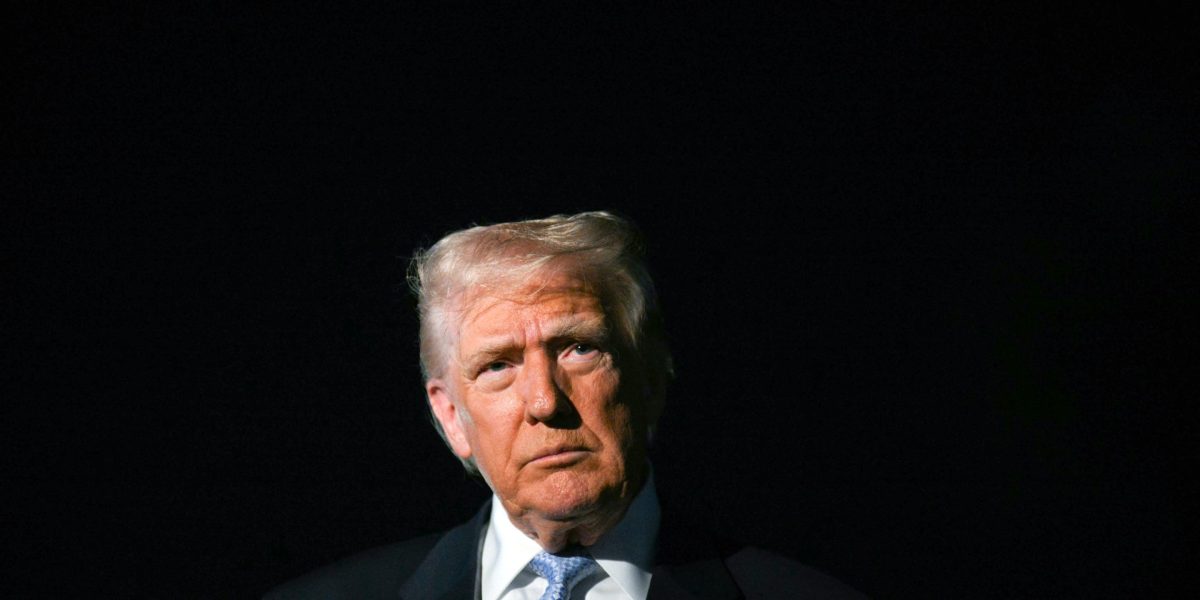
Earlier this month, President Trump made an official promise of a “dividend” payable to all Americans. Posting on Truth Social, the social media platform he owns, the president wrote that tariff opponents were “fools” and added: “record investment in the USA, plants and factories going up all over the place.” He added: “A dividend of at least $2000 a person (not including high income people!) will be paid to everyone.”

Since then, excitement around the project has dimmed. According to speculators betting on the odds market site Kalshi, there’s now just a 2% chance that Americans will receive such a check anytime soon. These odds have dropped considerably from the week following Trump’s announcement, when the market priced a more than 13% likelihood of the rebates being paid out.

Indeed, the odds tracker isn’t even assuming the promise of a $2,000 check—it’s based on the odds of a million Americans being given notice of an $1,000 check, and the verified details being reported (not the payouts completed) by January 1.

Over at Polymarket, the crypto-based probability trading platform, the odds of Americans receiving a check before December 31 have fallen to just 1%, down from 50% on November 15.

In the days since President Trump made the pledge, members of his cabinet have poured cold water on the plans. On ABC’s This Week with George Stephanopoulos on Novmber 9, shortly after the post from Trump, Treasury Secretary Scott Bessent admitted he hadn’t yet talked to the president about the dividend plan, adding it would require Congress to pass legislation.

Bessent also attempted to unpick the form the tariff stimulus would take, perhaps not a check but in relief already signed into law: “The $2,000 dividend could come in lots of forms … it could be just the tax decreases that we are seeing on the president’s agenda. No tax on tips, no tax on overtime, no tax on Social Security, deductibility of auto loans. Those are substantial deductions that are being financed in the tax bill.”

Doing the math

Bessent’s caution may be justified, as the president has also stated that some tariff revenue will also go toward paying down America’s “enormous” $38 trillion national debt burden. While tariffs are bringing in a significant sum—approximately $30 billion a month by September 2025—that revenue is minor compared even to the interest the U.S. government is paying to service its debt.

Treasury data shows the interest paid on national debt for FY2025 is $1.22 trillion, and rising every year. Even if President Trump’s tariff collection continues to rake in $30 billion a month and $360 billion a year, this still amounts to a little over a third of the interest payments on the debt—it doesn’t touch the debt itself.

Trump’s $2,000 plan is also eye-wateringly costly. Even if the government were to pay each household—as opposed to each individual—in the bottom 50% of earners, that would still require payouts to more than 67.5 million homes, per data from the St Louis Fed. That would imply that $135 billion, nearly half of the tariff revenues, would immediately be paid out to citizens instead of being directed toward national debt.

Yet despite further caveats from Bessent in the past few days, Trump doubled down on the plan yesterday. “We’re going to be issuing dividends later on, somewhere prior to … probably the middle of next year, a little bit later than that,” Trump told reporters in the Oval Office, according to Axios. The payments, he said, would go to “individuals of moderate income, middle income.”


Source link

Continue Reading

Business

As graduates face a ‘jobpocalypse,’ Goldman Sachs exec tells Gen Z they need to know their commercial impact

Published

on


For Gen Z, the entry-level career ladder is getting steeper by the month—and there’s no sign of it letting up. Unemployment among recent grads has climbed to 5.8% (the highest since 2013, excluding the pandemic) as companies rethink hiring amid AI-driven productivity gains.

The pressure is already forcing young people to rethink what it takes to stand out—especially in fields where six-figure pay once felt like a given. But for those aiming for Wall Street, one Goldman Sachs executive has a blunt message for young professionals trying to get ahead: Know what you bring to the table.

“Think about one’s role and how that fits into the broader business environment,” David Kostin, Goldman Sachs’ chief U.S. equity strategist, said on the Goldman Sachs’ Exchanges podcast

“If you understand where you sit and your contributions to the commercial process, then you can see how that changes over time.”

As AI-powered automation replaces jobs at a fraction of the cost of human labor, understanding the value of your own skills—and whether tools like ChatGPT can outperform them—has never been more critical. Investing in the development of in-demand skills may well determine whether you remain employable in the future.

Don’t know your worth? Human skills are also in demand

Luckily for those unable to put an exact number to their job function, it’s not just commercial awareness that is key in the current market. 

Kostin’s advice reflects a broader shift inside Wall Street firms, where technical skills, like using AI tools, are increasingly expected—but no longer enough on their own. 

Judgement, context, and self-awareness are also becoming real differentiators.

Data from LinkedIn backs up Kostin’s thinking. While AI literacy tops the professional networking company’s list of the fastest-growing skills in the U.S., softer skills like conflict mitigation, adaptability, process optimization, and innovative thinking round out the top five.

AI won’t kill Wall Street jobs —but it’s ramping up competitive pressure

Goldman Sachs’ CEO David Solomon has echoed the view that for those with dreams to one day earn six figures on Wall Street, not all is lost, and AI is not expected to be an outright job killer for bankers.

“There is no question that when you put these tools in the hands of smart people, it increases their productivity,” Solomon told Axios in October. “You’re going to see changes in the way analysts, associates, and investment bankers work.”

“But if you’re looking at it and assuming an organization like Goldman Sachs…is just going to have less people, I don’t think it works that way,” he added.

Even so, the pipeline into Wall Street is tightening. At several business schools, including NYU (Stern), MIT (Sloan), and Dartmouth (Tuck), the share of graduates entering investment banking has slowly declined. At Harvard and Columbia, placements have held up better, underscoring how competitive the path has become.

And even for those who manage to break in, the ride isn’t always smooth. Layoffs remain a constant threat in an industry prone to cyclical downturns, and some junior bankers have already faced this reality.

Solomon has urged young employees not to shy away from opportunities.

“I would tell you that sometimes the best opportunities come from being asked to do something you don’t want to do, and actually taking it on and trying to do it. Because that’s when people grow the most. That’s where I grew the most,” Solomon told his company’s summer interns in July.

Looking ahead, Solomon encouraged patience in an era defined by uncertainty.

“You have no idea where your career will take you, you have no idea where your life will take you,” Solomon added. “But it’s an incredible journey and you’re at the beginning of it, and my biggest and most important message is don’t be in a hurry.”


Source link

Continue Reading

Business

Trump suggests ‘warrior dividends’ will be partly paid for by tariff revenue, $100B below goal

Published

on


President Donald Trump will dole out more than one million checks to American military personnel as the administration seeks to address Americans’ growing cost-of-living concerns. 

Trump announced in a primetime address on Wednesday a “warrior dividend” for 1.45 million U.S. military personnel to be distributed ahead of the holidays. The announcement of the checks comes as Trump grapples with diminishing approval ratings on the economy and rising concern of an affordability crisis, in part because of the inflationary consequences of his sweeping tariff policy. 

As Trump works to assuage economic anxiety—blaming the state of the economy on the Biden administration while simultaneously saying the economy has never been better—Trump alluded to lower mortgage rates and housing reform in addition to his decision to send checks to military members.

“Military service members will receive a special—we call warrior dividend—before Christmas—a warrior dividend,” Trump said. “In honor of our nation’s founding in 1776, we are sending every soldier $1,776. Think of that. And the checks are already on the way.”

The president said the administration has been able to raise a significant amount of money as a result of levies put in place earlier this year.

“We made a lot more money than anybody thought because of tariffs, and the [One Big Beautiful] Bill helped us along,” he said. “Nobody deserves it more than our military.”

A senior administration official told Fortune the one-time “warrior dividend” checks will cost $2.6 billion and act as a housing supplement to eligible service members, including 1.28 million active component military members and 174,000 reserves. Through the One Big Beautiful Bill, Congress appropriated $2.9 million to the Department of Defense for supplements for basic housing allowances.

The White House did not address Fortune’s inquiry about how tariff revenue would finance the checks.

Lagging tariff revenue

The nearly 1.5 million checks are the latest economic relief effort Trump has associated with tariff revenues, including a $12 billion aid package for tariff-roiled farmers and $2,000 rebate checks for Americans. The president also claimed the income could be used to slash the ballooning $38 trillion debt. However, despite the president touting the import taxes as a stream of government income, actual revenue brought in from the levies fall far below White House estimates.

Economists reduced projected tariff revenue after the Trump administration scrapped tariffs on grocery staples like bananas, coffee, and beef last month in an affordability scramble. Pantheon Macroeconomics analysts wrote in a recent report the custom duties are bringing in about $400 billion annually, $100 billion less than the half-a-trillion dollars Treasury Secretary Scott Bessent forecasted in August

The analysts attributed the more modest revenue in large part to plummeting Chinese imports, which fell 7.5% year-over-year in October, and 7.8% in November, according to supply-chain software company Descartes Systems Group, as U.S. companies sought products from countries like Vietnam, where tariff rates are lower. The weaker imports follow a surge in shipments earlier this year as businesses stockpiled products in an attempt to dodge the brunt of the levies.  

Indeed, tariff revenue may have already peaked, with the Treasury Department’s monthly statement released last week showing the government collected $30.75 billion in customs duties in November, down from $31.35 billion collected in October. From April, following the announcement of “Liberation Day” tariffs, until October, revenues have been increasing month-over-month.

Trump’s lofty idea of redistributing tariff revenue to Americans has previously been caveated by his own cabinet. Bessent told Fox News’ Sunday Morning Futures in mid-November “we will see” about tariff-funded rebate checks.

The Treasury secretary said earlier last month in an interview on ABC’s This Week With George Stephanopoulos the $2,000 dividends could instead take the form of tax breaks that have already been signed into law.

“Those are substantial deductions that, you know, are being financed in the tax bill,” Bessent said.


Source link

Continue Reading

Business

‘We might need more than a few grains of salt’: Top economists pan inflation report that effectively assumed housing inflation was zero

Published

on


The government’s long-delayed November inflation report appeared, at first glance, to deliver welcome news: Consumer prices rose only 2.7% from a year earlier, while core inflation cooled to 2.6%, the lowest reading in years. But for many economists, the numbers immediately raised red flags, especially on housing, the single largest component of inflation.

“This is a wacky number,” Diane Swonk, chief economist at KPMG, told Fortune. “Shelter costs basically flatlined October by carrying forward September. When housing is that large a component, that really matters.”

The culprit, several economists say, is the extended government shutdown, which disrupted the Bureau of Labor Statistics’ ability to collect price data throughout October and into November. When data collection resumed in mid-November, the agency was unable to retroactively gather missing information. Instead, it relied on statistical assumptions—often “carrying forward” previous prices—that effectively treated some categories as if inflation had stopped altogether.

Housing appears to be the most distorted category. Shelter accounts for more than 40% of core CPI, yet the November report implies rents and owners’ equivalent rent was essentially zero in October.

“We expected it to cool,” Swonk said, “For this low level, it seems a little bit too much.”

She warned those assumptions don’t simply affect one month’s data. “Because of the assumptions that were made in October, it literally anchors the index going forward,” she said. “It lingers.”

Other quirks in the report reinforced that sense of unreliability. Gasoline prices, which Swonk said declined during last month’s period, instead showed an increase on a seasonally adjusted basis. Daycare costs—long one of the fastest-rising components of services inflation—suddenly fell. 

Joseph Brusuelas, chief economist at RSM, wrote in a blog post the November CPI should be treated with exceptional caution.

“This was one flawed CPI report,” he wrote. “The November consumer price index report is full of noise and lacks the normal breadth and depth that the good folks over at the Bureau of Labor Statistics normally provide.”

Because the agency couldn’t collect October prices, Brusuelas said it is nearly impossible to pinpoint why inflation appears to have slowed. 

“A quotient of humility is in order here,” he added. “Because of the flawed report, it is better to state forthrightly that we do not have sufficient sense of price movements over the past two months.”

Markets seemed to agree. Normally, market watchers would expect a meaningful drop in inflation would spark a sharp rally in stocks—or, in these days of bad data being good and good data being bad—a selloff as markets reprice interest-rate expectations. Instead, the reaction was muted. Stocks edged higher, and futures markets barely shifted, perhaps an indication the skepticism of the report was widespread. 

On the surface, the data supports the Federal Reserve’s recent decision to cut interest rates and strengthens the case for another cut early next year. But both Swonk and Brusuelas cautioned against drawing policy conclusions from distorted numbers.

“The Fed will take this with a grain of salt too,” Swonk said, noting policymakers were similarly cautious with labor-market data affected by the shutdown. “The Fed isn’t oblivious to this. What’s hard is that we have less real-time information on inflation than we do on the labor market.”

That challenge is especially acute in housing, where affordability remains a crisis, despite signs of cooling inflation. Swonk emphasized inflation and affordability are not the same thing. Home prices may be flattening in some markets, but mortgage rates, insurance premiums, and utility costs continue to strain households, she said. Electricity and natural-gas prices, long dormant, are rising again, partly due to stresses on energy grids tied to data-center expansion, she said.

President Donald Trump said in an address to the nation Wednesday evening he would soon announce “aggressive housing reforms,” and touted his upcoming pick to replace Jerome Powell as Federal Reserve chair for someone more doveish. 

Brusuelas said the broader takeaway is  inflation right now is a wash as opposed to a victory. 

“Noise rather than signal is the major takeaway from the November CPI report,” he said. 

Or, as Swonk put it: “We knew to take the data with a grain of salt. This one, we might need more than a few grains of salt.”

This story was originally featured on Fortune.com


Source link

Continue Reading

Trending

Copyright © Miami Select.