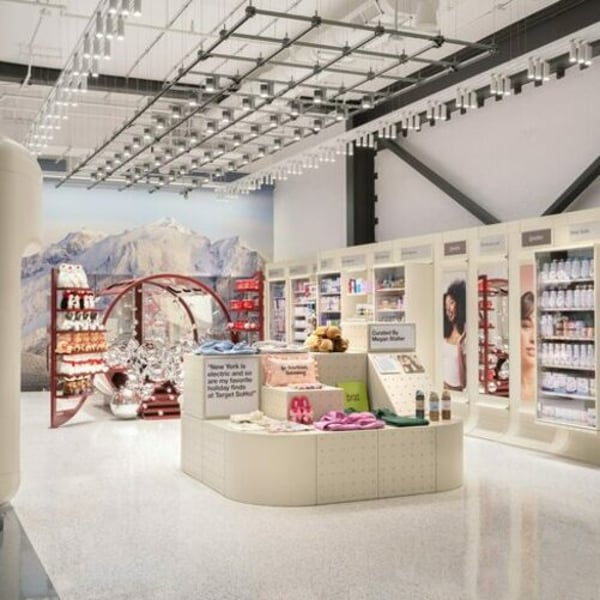
Target Corporation has opened a new concept store in New York’s SoHo district, introducing an experiential retail format.
Target opens new concept store in SoHo, New York. – Target
The location at 600 Broadway marks the debut of Target SoHo, a format the company describes as a “living, breathing style experience.”
It features curated zones built for product discovery. “Curated By”, a seasonal edit created in partnership with New York tastemakers, launches with actress and comedian Megan Stalter highlighting her Target picks across fashion, beauty and home. Meanwhile, “The Drop @ Target SoHo”, located on the first floor, will serve as a rotating showcase for monthly style collections.
The store also opens with the Broadway Beauty Bar, where celebrity makeup artist Katie Jane Hughes is curating her must-have Target beauty picks, and offering a social-driven space where guests can test products and create content.
Timed for the holiday season, Target is also introducing the “Gifting Gondola”, a photo-ready installation featuring exclusive merchandise, and a “Selfie Checkout” moment designed for social sharing.
“Style and design are part of Target’s DNA, and there’s no better place for us to showcase what’s next for our brand than in one of the style capitals of the world,” said Cara Sylvester, executive vice president and chief guest experience officer, Target.
“With Target SoHo, we’re bringing together the best of Target and the best of New York — elevated products, immersive storytelling and an experience that invites guests to explore, express and get inspired. This store is a bold reflection of our commitment to style, and it’s just one part of our larger investment in Target’s design-driven future that grows our roots even deeper in New York City.”
The company plans to continue evolving the location over the next year as part of a phased rollout. Target said the store will add new experiential zones, seasonal activations, and café and event programming through 2026.
The SoHo opening comes as Target increases its investment in New York, including a new headquarters space, partnerships tied to New York Fashion Week and now Target SoHo.
Ann Summers has filed its accounts to the end of June 2025 and it’s certainly encouraging to see that the lingerie specialist — which has struggled in recent periods — looks to be heading towards a recovery despite still posting losses.
Knickerbox.com
The company said that its 2024/25 financial year was one of “resilience and strategic adaptation”.
Turnover was “stable”, although it actually increased slightly but not enough to make up for the impact of inflation. It rose to £93.4 million from £93 million, although the cost of sales also edged up slightly.
The business remained loss-making, as mentioned, but the operating loss before tax and exceptional expenses narrowed to £5 million from £9.8 million a year earlier. The loss on ordinary activities before tax, as well as the net loss, showed an even greater decline at £3 million compared to £13 million12 months before.
So what happened in the 12-month period? Against the backdrop of persistent economic uncertainty, rising inflation and the ongoing cost of living crisis, Ann Summers said it managed to overcome major retail headwinds.
Trading conditions stayed tough with discretionary spend under pressure but it optimised its store estate while maintaining a strong presence physically with 75 locations. It also continued its expansion through third-party partnerships including its collaboration with LIWA, which has opened new opportunities in the Middle East
Its web channel remained a key part of its omnichannel strategy for both the UK and abroad. But during the year it made the strategic decision to close Connect, its direct selling channel. That ceased trading after the financial year ended, in October 2025.
A milestone was the launch of knickerbox.com in July 2024, so that came right at the start of the financial year in question. That brand is well known so should be a source of future growth.
Alongside the launch it also introduced KBX, its new in-house brand that claims to offer “stylish, effortlessly sexy, everyday lingerie”. The company said this strategic move allows it to connect with the border audience and strengthen its digital presence.
The company hasn’t posted a profit since the year to June 2021 and its losses have added up to £40 million since then. But this latest set of numbers, along with the new developments and strategic closures, suggests that the picture could change soon.
Designer Brands Inc., the Columbus, Ohio-based owner of the DSW Designer Shoe Warehouse, The Shoe Company and Shoe Warehouse retail chains, announced on Tuesday that net sales decreased 3.2% in the third quarter ended November 1.
Designer Brands Q3 sales dip 3.2%. – DSW
The company achieved net sales of $752.4 million. Comparable sales fell by 2.4%, with the U.S. retail segment down 1.5%, Canada retail down 6.6%, and the brand portfolio segment’s direct-to-consumer channel plunging 21.5%.
Reported net income attributable to the company reached $18.2 million, or $0.35 per diluted share. Adjusted net income was $19.6 million, or $0.38 per diluted share.
“Our third quarter performance represents another meaningful step forward in our transformation, as we demonstrated continued sequential improvement across multiple financial and operating metrics,” said Doug Howe, chief executive officer.
“Stronger consumer demand and improved in-store execution drove improved comparable sales in the third quarter compared to the second quarter. Our team also delivered a meaningful increase in gross profit and diligently managed expenses, which helped drive an increase in operating income over last year.”
Looking ahead, the company expects net sales to decline between 3% and 5% in fiscal 2025. Adjusted operating profit is projected in the range of $50 million to $55 million.
Howe added, “I’m encouraged that this positive momentum has extended into the early part of the fourth quarter, reinforcing the progress of our strategic initiatives and positioning us well as we close out the year. While macroeconomic pressures persist, we are confident in our ability to navigate the near-term environment and continue making progress on our long-term strategies.”
In 2025, Zalando has stepped up its pace in the Iberian Peninsula with two key moves: it entered Portugal and expanded its offering in Spain with the launch of its beauty category there. These two developments align with the German platform’s ambition to be more than a purely transactional tool; it aims to be a place of inspiration and entertainment for its customers.
Zalando takes stock of 2025 in the Iberian Peninsula – Shutterstock
One of Zalando’s milestones on a global- and, of course, Iberian- scale was its entry into Portugal last October, a launch accompanied by its suite of technological tools, such as its AI assistant, available in Portuguese, and partnerships with local brands to help them, in a two-way relationship, reach a European audience.
Portugal is the company’s 26th market, and its activities in southern Europe are grouped within the cluster led by Eloisa Siclari, which includes Portugal, Spain, and Italy. Portuguese customers have access to a catalogue of more than 200,000 items and, although it has been operating in the country for just over two months, the European giant notes Portuguese consumers’ strong propensity to shop the streetwear category.
Zalando’s arrival in Portugal also strengthens the link between the Portuguese and Spanish markets: the platform’s logistics centre in Illescas (Toledo) serves Portuguese customers, cementing the complex’s status as “a key logistics hub in southern Europe.” The same centre has expanded its operations in recent months into the beauty category, supporting the German e-tailer’s expansion into this segment.
New key partnerships in the Spanish market
Zalando describes Spain as “a fundamental market,” both for its potential and because Spanish brands are “a key growth driver” for the platform and a “valuable asset” for its customers. In 2025, the German company signed agreements with Spanish labels such as Bimba y Lola, Hoff, Aristocrazy, Tous, Brownie and, more recently, Unode50.
The company maintains that brands find in it not only another sales channel, but a “gateway” to more than 52 million customers in the continent’s key markets. It illustrates this with the performance of Singularu, a Spanish jewellery brand with 80 stores in Spain and turnover of €30 million in 2024, which is relying on the German giant for its European expansion in e-commerce. According to figures provided by Zalando, the jewellery brand grew 117% year-on-year in 2025 on the platform, with more than 10 million visits (up from 5.7 million a year earlier), and 74% of its sales via the e-tailer coming from Germany, Belgium, Poland, and Italy.
Singularu is one of the Spanish brands featured on Zalando
“6% of the audience with brand affinity interacts with Singularu; in other words, the brand already ‘resonates’ on Zalando, but there is still much to capture by expanding coverage to audiences adjacent to trend-led jewellery,” explained the business.
“On a platform it’s difficult to project what your brand is all about, but Zalando allows us to reach audiences we can’t access otherwise. And we can do that with our visual proposition and by deciding what we want to communicate. We are very happy with this relationship, which is increasingly close, and the results back it up,” said Fernando Peris, vice-president of e-commerce and marketplaces at Singularu.
“Why does Zalando choose to collaborate with local brands? In Spain, for example, consumers demand Spanish brands. It is beneficial for them, but also for us as a platform. The fact that local brands have an international clientele is also a success; there are brands with a lot of potential. And there is some national pride there,” said Eloisa Siclari, Zalando’s managing director for southern Europe.
Also in 2025, Zalando marked one year since the launch of its revamped Plus programme in the Spanish market, rolled out in summer 2024. By 2026, it plans to expand the programme and offer customer experiences, “going beyond transactional benefits”.
And beyond Iberia? Next year is shaping up to be one of expansion for the European company: it plans to enter new markets, as well as strengthen its in-house logistics and bolster its operations.
This article is an automatic translation. Click here to read the original article.