Connect with us

Business

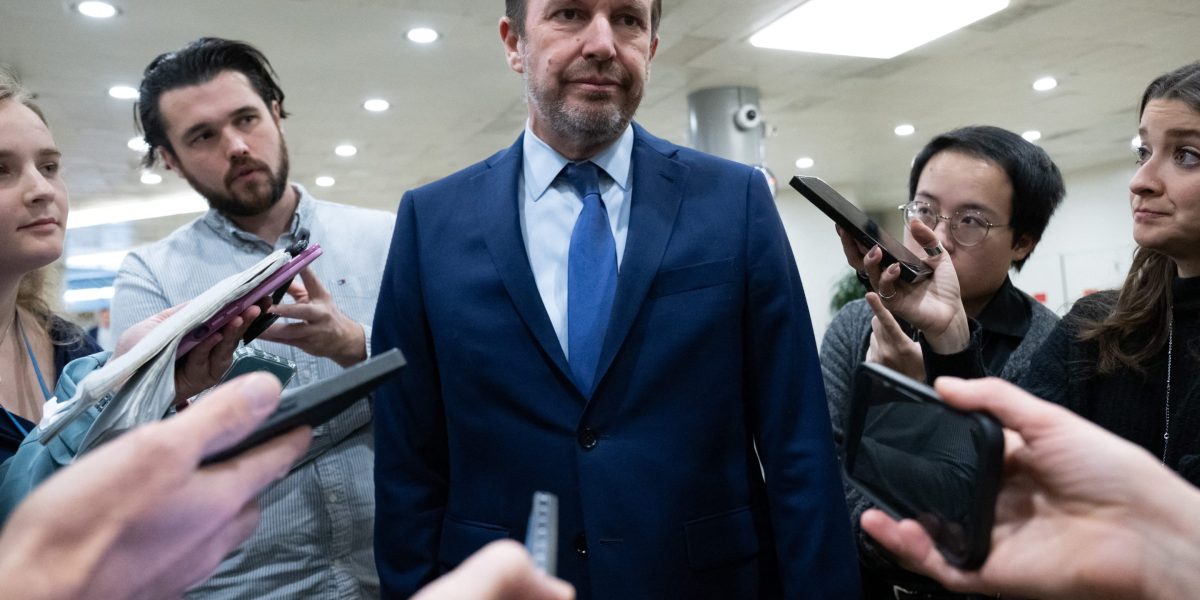
Swing-state Democrats turn on 8 centrists not facing reelection over hijacked shutdown

Published

on


The deal cut by some Senate Democrats to reopen government has refueled the party’s tussle over strategy and identity just days after sweeping election victories had raised hopes that the left’s disparate factions were pulling in the same direction heading into the 2026 midterms.

Democrats’ latest fault lines do not track perfectly along the familiar split between progressives and centrists. Instead, there’s renewed rancor over how aggressively to fight President Donald Trump and his compliant GOP majorities on Capitol Hill, with some progressives renewing their calls for Democratic Senate leader Chuck Schumer to step aside, even as he publicly opposes the latest deal.

The left flank is incensed that eight centrist senators — none of whom face reelection in 2026 — crafted a deal with Republicans that does not guarantee Democrats’ main demand to extend Affordable Care Act premium subsidies that will expire at the end of the year. They say the agreement means Schumer could not hold his caucus together.

Some moderates are frustrated, or at least caught on a political tightrope after more than a month of Democrats agreeing that the longest federal shutdown ever was the way, finally, to use their limited influence to achieve some policy and political wins in a Republican-dominated capital.

Party leaders including Schumer and House Minority Leader Hakeem Jeffries continue blaming Republicans for the looming premium spikes and other shutdown ripples, but the standoff’s sudden end underscores the difficulty of maintaining Democrats’ fragile and fractious coalition.

“The Republicans have learned they could hurt our communities, they could hurt everyday people, including their own constituents, and Democrats will fold,” said Maurice Mitchell, who leads the progressive Working Families Party.

New Jersey Gov.-elect Mikie Sherrill, who won by more than double Democrats’ 2024 margin in her state, said victories like hers showed voters “want leadership with a backbone” who “stay strong under pressure.”

Instead, she said, “The Senate is on the brink of caving.”

Democrats’ dealmakers say there was no viable alternative

The Democrats who cut a deal counter that they had little choice — that Republicans weren’t budging, and the pressure of the prolonged shutdown had become untenable as the Trump administration withheld food assistance payments to low-income Americans and mandated flight delays at airports strained by a shortage of air traffic controllers.

Democrats settled for a pledge from Senate Majority Leader John Thune, R-S.D., to hold a December vote on ACA subsidies, along with assuring back pay for federal workers who’ve missed paychecks, among other policy details.

“This was the only deal on the table,” said Sen. Jeanne Shaheen, D-N.H.

Democrats pointed to Trump, after the GOP’s electoral defeats, calling on Republican senators to end the filibuster and bypass the minority altogether. That, the centrists argued, showed Trump could not be maneuvered into negotiations — though Republican senators were pushing back to defend the filibuster.

“After 40 days, it wasn’t going to work,” Sen. Tim Kaine of Virginia said of Democrats’ demands.

Illinois Sen. Dick Durbin, Schumer’s deputy, said the shutdown “seemed to be an opportunity to lead us to a better policy. But it didn’t work.”

That did not convince many center-left and swing-state Democrats.

Senate holdouts included Michigan Sen. Elissa Slotkin, who won her seat in 2024 at the same time Trump won Michigan and other industrial Midwest battlegrounds, and Georgia Sen. Jon Ossoff, the only Democratic senator running for reelection in 2026 in a state Trump won in 2024.

“Premiums are set to double for 1.4 million Georgians and nearly half a million Georgians could lose health insurance altogether,” Ossoff said in a statement, before shifting blame to the GOP. “The President refuses to fix it and withholds SNAP benefits while the House has not even to come to work for six weeks.”

Mallory McMorrow, a Michigan state senator running for U.S. Senate, said the situation embodies a larger issue for the party, with Democrats playing by the usual set of rules while Republicans use more brazen tactics.

“It makes you wonder what was the fight for? Why the sacrifice?” McMorrow said, adding that some senators govern out of “nostalgia” without understanding a new landscape. “A refusal to evolve and recognize this is not the same Senate that it was a decade ago or even five years ago means that the party is never going to win.”

The deal highlights Democrats’ generational divides

None of the eight senators at the center of the agreement face voters in 2026, and they have an average age exceeding 65. Shaheen, 78, and Illinois Sen. Dick Durbin, 80, already have announced their retirements ahead of the midterms.

Shaheen found herself at odds with her daughter, 51-year-old Stefany Shaheen, who is running for Congress in New Hampshire. The younger Shaheen noted House Speaker Mike Johnson’s refusal thus far to schedule a House vote on the ACA insurance support.

“We need to both end this shutdown and extend the ACA tax credits,” she said in a statement. “Otherwise, no deal.”

It’s a difficult turn, especially, for Schumer. The 74-year-old New Yorker faced withering critiques for not shutting down government in the spring. The mention of his name last Friday at CrookedCon, a gathering of progressives in Washington, drew jeers and boos, even as he remained dug in for the latest shutdown fight.

The age of Democrats’ national leaders and the related assertion that they’re out of touch with the base have been defining aspects of the party dynamic for several years, with Joe Biden being the oldest president in U.S. history and having to be forced out of a reelection bid at the age of 82. But Biden and former Speaker Nancy Pelosi, who is retiring from the House at age 85, got credit for muscling through significant legislation with thin Democratic majorities.

Schumer, 74, played a key role in those accomplishments, too, leading Senate Democrats during Biden’s presidency. But he’s sometimes gotten less credit from party activists, and now he faces criticism for not keeping his caucus together in the latest shutdown fight, even with public polling and election outcomes suggesting voters were siding with Democrats.

“The best way to unify the Democratic Party and win big in 2026 is to make clear that the new generation of Democratic senators we elect will NOT be following Chuck Schumer down a losing path,” Progressive Change Campaign Committee chief Adam Green wrote to the organization’s supporters Monday, as he called for Schumer to step aside.

Senate candidate Graham Platner, who is running against Maine Gov. Janet Mills for the right to challenge Republican Sen. Susan Collins, also said Schumer should hand over caucus leadership.

“People are fed up with this,” Platner told Our Revolution activists on a Monday conference call. The deal, Platner said, “is just one more very stark piece of evidence to show that he is just completely unable to rise to this moment.”

Dems still want Republicans to own health care cuts

Durbin and others argue the six-week shutdown yielded something tangible because it elevated the healthcare issue. The promised Senate vote, they reason, will put each Republican on record and ensure Trump and his party will again have to take responsibility for any negative effects on people around the country.

“We get our day in court in December,” Durbin insisted.

Mitchell, meanwhile, said progressives already are looking ahead to 2026, starting with Democratic primary fights up and down the ballot.

“We don’t take any pride in the capitulation of our friends inside the Democratic Party,” he said. “But the story writes itself for why we need a fighting opposition party right now.”

——


Source link

Continue Reading

Business

Young people are ‘growing up fluent in AI’ and it’s helping them stand apart from older peers

Published

on


Gen Z, and younger generations, are getting a bad rap. The rise of ChatGPT and other AI tools have brought on complaints that students and young employees rely too much on AI to do everything from completing homework to writing emails. 

Yet Kiara Nirghin, a Stanford technologist and Gen Z entrepreneur, sees Gen-Z’s comfort with AI as an asset. “The younger generation isn’t adopting AI, we’re growing up fluent in AI,” she said at Fortune Brainstorm AI conference in San Francisco on Tuesday. 

Nirghin, who co-founded Chima, a U.S.-based applied AI research lab, explained that young entrepreneurs see coding as something to be done alongside AI agents, rather than done alone and from scratch. 

AI “fundamentally changes how you write, how you take tests, [and] how you apply to jobs or different applications—because it’s not from the ground up. It’s actually being able to do that with different models or agents, side by side,” Nirghin said. AI fluency sets Gen Z individuals apart from their older peers, allowing them to pioneer use cases and applications of AI that have yet to be unlocked, she explained. 

Some experts have argued that AI has eroded our critical thinking abilities. A 2025 study by researchers from MIT’s Media Lab found that users of ChatGPT “consistently underperformed at neural, linguistic, and behavioral levels.”

But Nirghin argued that this isn’t always true.“ The biggest misconception is that young people are using AI to not think things through, [but] I think that really intelligent Gen Z individuals are using it to think even deeper,” she said.

The entrepreneur pointed to how running complex research reports through AI could generate insights they may not have thought of otherwise—hence allowing users to get a fresh perspective.

Moving with the AI models

AI isn’t just for the young, however, and Nirghin stressed the technology’s ability to help workers at all levels of their careers. “We’re [only] at the beginning. It is only going to get faster, more advanced and more intelligent each and every model from here on out,” said Nirghin. 

She likened AI anxiety to climate anxiety—in that it stems from humanity’s fear of not moving fast enough to stay ahead of the game.

“In the past couple of weeks, [there’s] been two model releases that have engulfed the benchmarks in such an enormous way that pretty much everything you’ve ever used AI for can now just be 10x-ed,” Nirghin explained.

And to avoid being left behind, workers can familiarize themselves with “main model players” like ChatGPT and Gemini, and learn to use them as co-pilots and tools in everyday life. By continuously using the newest AI models, users will be more comfortable with the new technology, and thus lose their anxiety, she said. 

“The models right now are as dumb as they are ever going to be, [and] a couple months down the line, we are going to be in a very different landscape. Being able to be really comfortable with that, and having your core tools that you use and get comfortable with is really important.”


Source link

Continue Reading

Business

Mario Gabelli signals support for Paramount in Warner fight

Published

on


Money manager Mario Gabelli said it’s “highly likely” he will tender his clients’ Warner Bros. Discovery Inc. shares to Paramount Skydance Corp. in an effort to spark a bidding war for the film and TV company. 

In an interview, Gabelli said Paramount will ultimately have to increase its $30-a-share bid for Warner Bros. and that Netflix Inc. will also likely counter with a higher offer. Saying he supports the Paramount tender is a way of signaling he prefers more competition for the company.

“We’re in the early rounds,” Gabelli said. “Round five of a nine-round challenge.”

Warner Bros. shares were up 3.8% to $28.26 at the close in New York on Tuesday.

The longtime media investor attended Paramount’s presentation at a UBS conference on Tuesday and walked away impressed. Management “did a very good job” addressing potential regulatory challenges including at the state level, he said.

Gabelli’s firm and funds hold almost 5.7 million Warner Bros. shares, according to data compiled by Bloomberg, worth about $160 million based on Tuesday’s closing price. He also owns shares in Paramount and Netflix.

Warner Bros. agreed last week to sell its streaming and studios businesses, including HBO, to Netflix for $27.75 a share in cash and stock. Paramount on Monday went public with an all-cash tender offer for Warner Bros. and has been looking to convince investors its bid is better.

Gabelli plans to tender because the “terms of trade favor Paramount,” including an all-cash proposal that doesn’t rely on publicly traded stock or the spinoff of Warner Bros.’ cable networks, as Netflix’s offer does. 

Gabelli wouldn’t say which company was a better fit for Warner Bros.

“I don’t like to endorse things,” he said. “That’s why you play that card (a tender offer). It’s Texas hold ’em.”

On Tuesday, Gabelli’s company said in a regulatory filing it purchased more shares of the cinema and hotel company Marcus Corp.

Movie theater chains, which have been battered by tepid ticket sales and the threat of cutbacks in Hollywood releases, are a buy, Gabelli said. Paramount winning Warner Bros. would be “clearly better” for theaters because management believes in traditional film releases. 


Source link

Continue Reading

Business

Pluck eyebrows. Avoid surveillance cameras: Luigi Mangione’s to-do list as he tried to avoid arrest revealed in court

Published

on


Pluck eyebrows. Buy less conspicuous shoes. Take a bus or a train west toward Cincinnati and St. Louis. Move around late at night. Stay away from surveillance cameras.

A to-do list and travel plans found during Luigi Mangione’s arrest and revealed in court this week shed new light on the steps he may have taken — or planned to take — to avoid capture after UnitedHealthcare CEO Brian Thompson’s killing last year.

“Keep momentum, FBI slower overnight,” said one note. “Change hat, shoes, pluck eyebrows,” said another.

The notes, including a hand-drawn map and tactics for surviving on the lam, were shown on Monday at a pretrial hearing as Mangione’s bid to prevent prosecutors from using evidence seized during his Dec. 9, 2024, arrest at a McDonald’s in Altoona, Pennsylvania.

Excerpts of body-worn camera footage of the arrest, previously unseen by the press or the public, were released on Tuesday.

Police said they discovered the notes in Mangione’s backpack, along with a 9 mm handgun that prosecutors said matches the one used to kill Thompson five days earlier; a loaded gun magazine and silencer; and a notebook in similar handwriting which he purportedly described his intent to “wack” a health insurance executive.

Mangione’s lawyers haven’t disputed the authenticity of the notes or the provenance of the gun, pocket knife, fake ID, driver’s license, passport, credit cards, AirPods, protein bar, travel toothpaste, flash drives and other items seized from him and his backpack.

But they argue that anything found in the bag should be barred because police didn’t have a search warrant and lacked the grounds to justify a warrantless search. Prosecutors contend the search was legal — officers said they were checking for a bomb — and that police eventually obtained a warrant.

The notes, along with other evidence highlighted at the pretrial hearing, underscore that Mangione’s stop in Altoona, a city of about 44,000 people about 230 miles (370 kilometers) west of Manhattan, was only meant to be temporary.

One note said to check for “red eyes” from Pittsburgh to Columbus, Ohio or part way to Cincinnati (“get off early,” it reads). The map drawn below shows lines linking those cities, as well as other possible destinations, including Detroit, Indianapolis and St. Louis.

Thompson, 50, was killed as he walked to a Manhattan hotel for his company’s investor conference on Dec. 4, 2024. Surveillance video showed a masked gunman shooting him from behind and then fleeing the area. Over the next hours and days, police released photos of a suspect — first showing him in a mask and hooded coat and then his face and thick eyebrows.

Mangione, 27, has pleaded not guilty to state and federal murder charges. The pretrial hearing, which resumes for a sixth day on Thursday, applies only to the state case. His lawyers are making a similar push to exclude the evidence from his federal case, where prosecutors are seeking the death penalty.

Among the notes revealed this week was one with a heading “12/5” and a starred entry that said: “buy black shoes (white stripes too distinctive).”

Another, also written in to-do list style, suggested spending more than three hours away from surveillance cameras and using different modes of transportation to “Break CAM continuity” and avoid tracking. Below that, it said: “check reports for current situation,” a possible reference to news reports about the search for Thompson’s killer.

According to prosecutors, Mangione fled to Newark, New Jersey, immediately after the shooting and took a train to Philadelphia. Among the evidence shown at the pretrial hearing was a Philadelphia transit pass purchased at 1:06 p.m. — a little more than six hours after the shooting — and a ticket for a Greyhound bus, booked under the name Sam Dawson, leaving Philadelphia at 6:30 p.m. and arriving in Pittsburgh at 11:55 p.m.

A note with the heading “12/8” lists a number of tasks, including an apparent trip to Best Buy to purchase a digital camera and accessories, “hot meal + water bottles,” and “trash bag(s).” Under “12/9,” the day of Mangione’s arrest, the note lists tasks including “Sheetz,” an Altoona-based convenience store chain, “masks” and “AAA bats.” Under “Future TO DO,” it listed “intel checkin” and “survival kit.”

Mangione had a Sheetz hoagie in his backpack when he was arrested, along with a loaf of Italian bread from a local deli, according to police officers testifying Monday and Tuesday. It had been raining, and the bag and items inside it were wet, the officers said. They were heard on body-worn camera footage played in court theorizing that Mangione had gotten soaked walking from the city’s bus station.

Police responded to the McDonald’s after a manager called 911 to relay concerns from customers who thought that Mangione, eating breakfast in a back corner, resembled the man wanted for killing Thompson. On the call, played in court, the manager could be heard saying that because Mangione was wearing a medical mask, she could only see his eyebrows and that she searched online for a photo of the suspect for comparison.

Altoona Police Officer Stephen Fox testified on Tuesday that Mangione, the Ivy League-educated scion of a wealthy Maryland family, expressed concern for the 911 caller’s wellbeing. Fox said Mangione asked if police had planned on releasing her name, which they didn’t. The officer recalled him saying: “It would be bad for her” and “there would be a lot of people that would be upset.”

At another point, Fox said, a shackled Mangione stumbled while trying to keep up with the brisk-moving officer. Fox said he apologized and said, “I forgot you were shackled.”

He said Mangione responded: “It’s OK, I’m going to have to get used to it.”


Source link

Continue Reading

Trending

Copyright © Miami Select.