
Politics
Survivor-backed bill toughening domestic violence laws clears first House hurdle
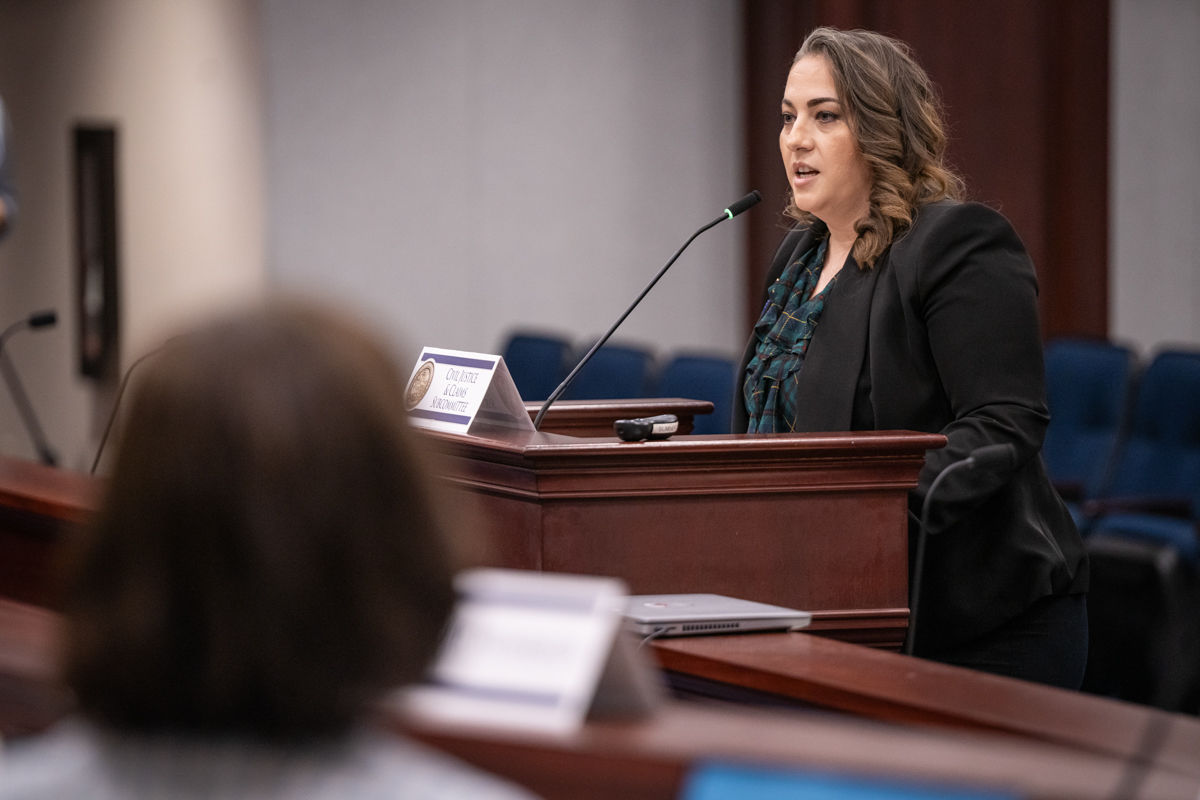
A bill that would significantly expand and strengthen Florida’s response to domestic and dating violence just cleared its first of four committee stops in the House with emphatic, cross-aisle support.
Members of the House Criminal Justice Subcommittee voted 16-0 for the measure (HB 277) by Democratic Rep. Debra Tendrich, who described the legislation as turning “pain into policy.”
Tendrich, a freshman lawmaker from Lake Worth Beach, spoke hoarsely while introducing her bill, explaining that losing her voice ahead of the committee meeting would not keep her from “speaking for the voiceless.”
And she was once among them. Tendrich detailed how she came to Florida 13 years ago to escape a “domestic violence situation” with nothing but her daughter, a suitcase with two changes of clothes, and $15.
“People often ask victims, ‘Why don’t you just leave?’ Because leaving is typically the most dangerous time for a victim,” she said Wednesday. “And for many abusers, an injunction for protection is just a piece of paper, nothing more.”
HB 277, of which Placida Republican Rep. Danny Nix is a co-prime sponsor, would give the Sunshine State’s domestic violence laws significantly sharper teeth by tightening criminal penalties, increasing monitoring and changing related emergency and law-enforcement procedures.
The bill would enhance sentences for repeat violations of protective injunctions, escalating offenses to higher-degree felonies after multiple prior convictions. It would also authorize penalty enhancements — up to a life felony — when violations occur during a declared state of emergency and mandate minimum jail terms for certain domestic violence offenses involving bodily harm.
Courts would have to order electronic monitoring in higher-risk cases, with defendants required to cover the cost.
HB 277 would also require 911 systems to flag addresses with prior domestic violence or dating violence calls, mandate domestic violence and strangulation training for paramedics and firefighters, and broaden the legal definition of domestic violence.
Further, the measure would create a supervised diversion program for first-time misdemeanor offenses and strengthen victim protections by mandating lethality assessments and body camera use during investigations.

The bill would also increase an existing state relocation allowance from $1,500 to $2,500 — a change Tendrich said would “make the difference between staying and escaping” — and add a question to injunction petitions about threats to pets.
Tendrich noted that HB 277 has military support, adding that a representative from the U.S. Department of War was supposed to attend Wednesday’s meeting but couldn’t because of the weather.
She said the Department made two recommendations for the bill, both of which were included: to limit enforcement of military protective orders to military authorities, and a requirement that local police inform a service member’s military-based law enforcement entity when there’s been a violation.
Florida continues to see high levels of domestic violence. The National Coalition Against Domestic Violence estimates that 38% of Florida women and 29% of Florida men experience intimate-partner violence in their lifetimes — among the highest rates in the country.
Citing data from the Florida Department of Law Enforcement, Tendrich said 497 domestic violence victims lost their lives between 2022 and 2024. Of them, 75% died after they tried to leave their abuser. She said Florida Clerks processed more than 78,000 protective injunction applications in 2024. Over roughly that same period, more than 603,000 emergency shelter nights were provided, 76,000 domestic violence hotline calls were answered and more than 224,000 safety plans were created in Florida alone.
Representatives from Lake Worth Beach, Palm Springs, the Florida Police Benevolent Association, Florida Council Against Sexual Violence, Florida Smart Justice Alliance and Dominic Paul Maron Ferrell Foundation all expressed support for HB 277.
The most emotionally charged testimony came from Jennie Carter, whose abusive ex-husband brutally murdered her 10-year-old son Nelson and 8-year-old daughter Crystal after she filed for divorce following a domestic violence incident.
Carter filed a restraining order, but her ex repeatedly violated it. And he still had access to the children, she said.
“When he could no longer control me, he chose to hurt me in the most unimaginable way, by hurting my children,” she said.
Carter’s ex picked up the kids, promising to take them Christmas shopping. Instead, he took them to the house the family once shared, barricaded himself and them inside, and set it on fire. When Crystal tried to escape, he stabbed her to death with a butcher knife.
The man died from smoke inhalation, as did Nelson a day later in the hospital.
“I live every day with the pain, the silence, missing hugs and the sound of my children calling me mommy or saying, ‘I love you,’” she told the panel. “Restraining orders did not protect me, nor my children. HB 277 could have.”
Hillsborough County Republican Rep. Danny Alvarez, the committee’s Chair, called Carter’s testimony “probably one of the hardest testimonies we’ve had to hear in the short career I’ve had at the House.”
“If you think beating a woman, beating a man or hatcheting your children is the way that you’re going to exhibit your control, we can’t fix you. So then, let’s take care of you. This bill is only the first step,” he said.
Alvarez added that he is committed to helping Tendrich, whom he described as “the honey badger of representatives” for her tenacity, to make fighting domestic violence a long-term project for her in the House.
“These women and children deserve it,” he said.
Alvarez signed on as a co-sponsor of HB 277, as did Republican Reps. Doug Bankson of Apopka, Webster Barnaby of Deltona, Kevin Steele of Dade City and Taylor Yarkosky of Montverde, who called the bill “legacy stuff.”
HB 277 will next go to the Civil Justice and Claims Subcommittee, after which it has two more stops before reaching a House floor vote.
Its upper-chamber companion (SB 682) by Republican Sen. Alexis Calatayud advanced through its first of three committee stops on an 8-0 vote last week. Calatayud included the bill among her 2026 legislative priorities.