Business
Stocks: Wall Street buckles in for a long war, Hormuz is closed, Trump says he has ‘plenty of time’
Oil up, everything else down
S&P 500 futures ticked upward this morning before the opening bell in New York and Bitcoin went up to $72K. That’s the good news. Everything else is down bad: The S&P closed down 1.52% yesterday. Asia, Europe, and the U.K. took another beating this morning. India’s Nifty 50 was off more than 2%. The volatile South Korean KOSPI lost 1.72%. There is no mystery as to why: Oil is up over $100 again.
TOP STORIES
IRAN
Exclusive: Binance was asleep at the wheel as its wallets funded Iran
Binance allowed a VIP account registered to a 79-year-old Chinese resident to send $439 million of digital tokens to a wallet that then forwarded the funds to others connected to sanctioned organizations linked to the Islamic Revolutionary Guard Corps, according to an investigation by Fortune’s Leo Schwartz and Ben Weiss.
“Plenty of time” — three words spooking the markets
Oil is up because it is now clear to traders that Iran has successfully closed the Strait of Hormuz, and laid sea mines within it, according to Fortune’s Eva Roytburg. Eighteen ships in the area have been struck so far. The U.S. Navy has not yet managed to provide safe passage for tankers in the Strait. Israeli intelligence suggests the regime in Tehran is not likely to fall soon, despite President Trump’s insistence that Iran is “about to surrender.” The president also said yesterday on social media, “We have unparalleled firepower, unlimited ammunition, and plenty of time.”
Those last three words seem to be the ones being taken most seriously by investors today.
“The stock market may be starting to discount the possibility that the war won’t be short and that the Strait of Hormuz may remain effectively closed for some time,” Ed Yardeni of Yardeni Research said last night. At ING, Chris Turner noted this morning: “The dollar is pushing to new highs for the month as the market struggles to see a way out of the Middle East crisis.”
U.S. stocks are down for the year—unless you are an oil producer. Shares in Exxon, Chevron, and other U.S. oil and gas producers have hit all-time-highs as the war drives up the price of their fuel. Consumers will ultimately pay the price, according to Fortune’s Jordan Blum.
Is Iran’s new leader dead or alive?
We still don’t have “proof of life” that Mojtaba Khameini, Iran’s new supreme leader, actually survived the attack that killed his father, his mother, one of his children, a sister, his wife, a brother in law and a niece, The Guardian reports. Khameini was injured in the attack but there has been no confirmation of his medical condition. He has not been seen in public since the attack. Opposition groups believe he may actually be dead or in a coma, despite the fact that Tehran has issued a robust statement in his name, vowing to continue the fight. The Guardian concludes, gloomily, “the wartime machinery can operate almost on automatic pilot without him.”
- Must-read: The FT reports that video evidence points to a U.S. Tomahawk missile striking an Iranian school, killing 168 people — mostly children.
ARTIFICIAL INTELLIGENCE
Is AI creating jobs?
Morgan Stanley, drawing on takeaways from its annual Technology, Media & Telecom Conference in San Francisco, identified three distinct areas where AI is actually creating demand for workers—even as it threatens to hollow out others, Fortune’s Nick Lichtenberg reports.
Meta’s AI “Avocado” reportedly rotting on the vine
Nine months and $14.3 billion after hiring Alexandr Wang and forming an AI super team, Meta’s AI masterplan is looking increasingly shaky, my Fortune colleague Alexei Oreskovic tells me over Slack. The company’s latest AI model, “Avocado,” is apparently being delayed until May, instead of launching this month, according to a report in the New York Times. The model fell short of those created by Google, OpenAI, and Anthropic. Even more stunning, Meta’s leadership has apparently discussed licensing Gemini from Google temporarily, until Avocado is up to snuff. “The notion of Mark Zuckerberg asking Google’s Sundar Pichai for permission to use Gemini is almost impossible to imagine,” Oreskovic says, and the fact that it was merely discussed internally at Meta is news in itself.
Anthropic “Pollution”: Defense Department CTO Emil Michael told CNBC why the Pentagon axed Anthropic from its supply chain: “We can’t have a company that has a different policy preference that is baked into the model through its constitution, its soul, its policy preferences, pollute the supply chain so our warfighters are getting ineffective weapons, ineffective body armor, ineffective protection,” he said. “That’s really where the supply chain risk designation came from.”
CHART OF THE DAY
What Americans are spending their tax refunds on

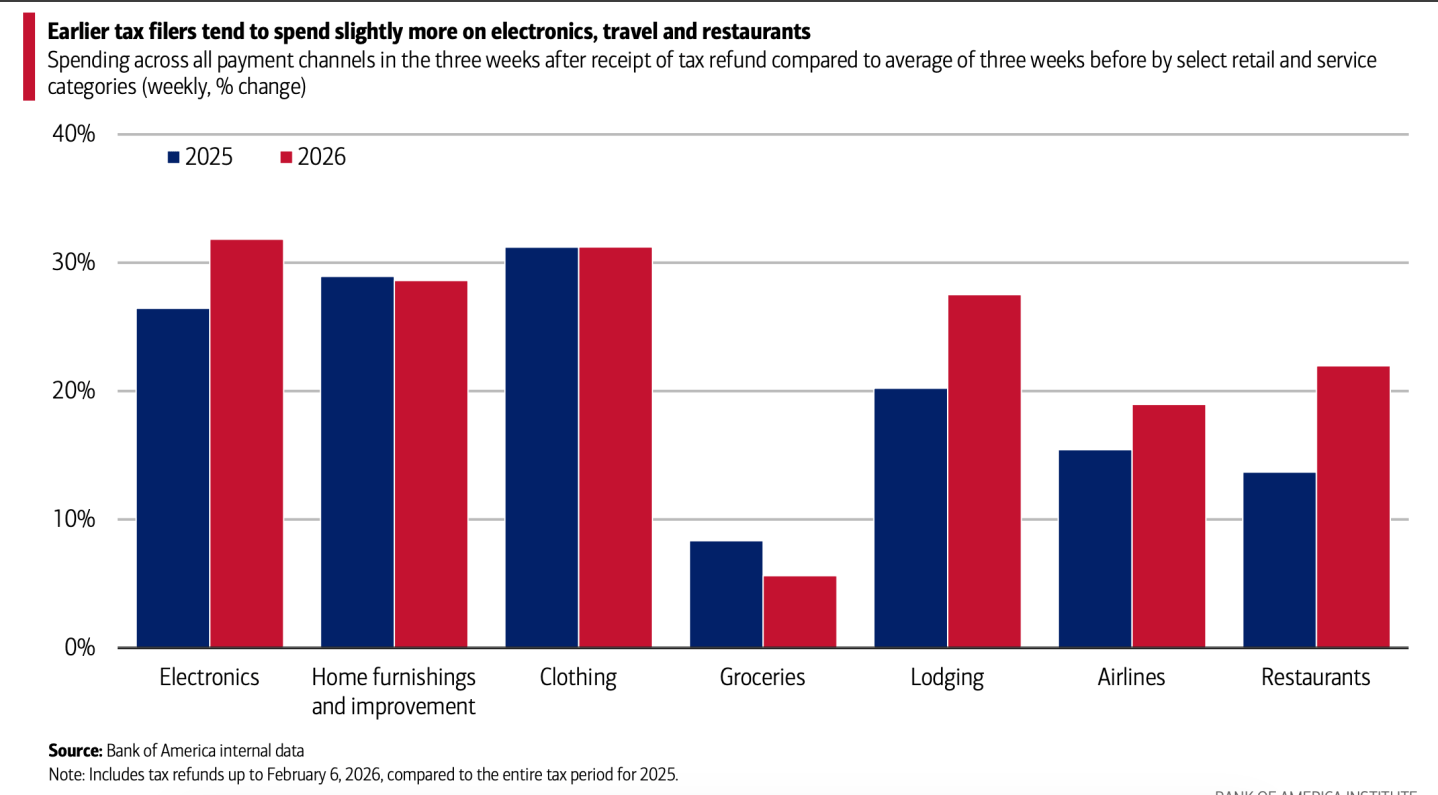
Bank of America payments data shows that early filers appear to be favoring electronics, restaurants and travel. Average refund sizes are up more than 10% year-over-year, BofA analysts Liz Everett Krisberg and David Michael Tinsley say.
NUMBER OF THE DAY
0
The number of interest rate cuts that the Fed could deliver this year, in the estimation of EY-Parthenon Chief Economist Gregory Daco. “Given our higher headline and core PCE inflation forecast, we have revised our baseline to show only one 25bps rate cut in 2026, likely in December, but it is entirely plausible that the Fed won’t deliver any rate cuts this year,” he told clients.
QUICK HITS
THE FRONT PAGES TODAY
JPMorgan, suspicious activities and Epstein – FT
Who is really footing the AI energy bill? Inside the debate about data center electricity costs – CNBC
48% of Americans blame Trump for high gas prices — more than any other factor – Axios
An Exodus of Money Endangers Wall Street’s Private-Credit Craze – WSJ
‘God, It’s Terrifying’: How the Pentagon Got Hooked on AI War Machines – Bloomberg
Embattled BuzzFeed warns end could be near as it faces major cash crunch – Reuters
ONE MORE THING
Hollywon’t: The movie industry is shrinking
Hollywood is disintegrating, according to Fortune’s Geoff Colvin. Production measured in Los Angeles shoot days is down from 36,792 in 2022 to just 19,694 in 2025. Some 41,000 of the workers who make the industry function left from 2022 to 2024. The industry’s most powerful person is not a traditional studio boss but Ted Sarandos, co-CEO of streaming giant Netflix—which is headquartered in Silicon Valley.