Connect with us

Business

Stocks rise towards more records, helped by Elon Musk’s purchase of $1 billion worth of Tesla shares

Published

on


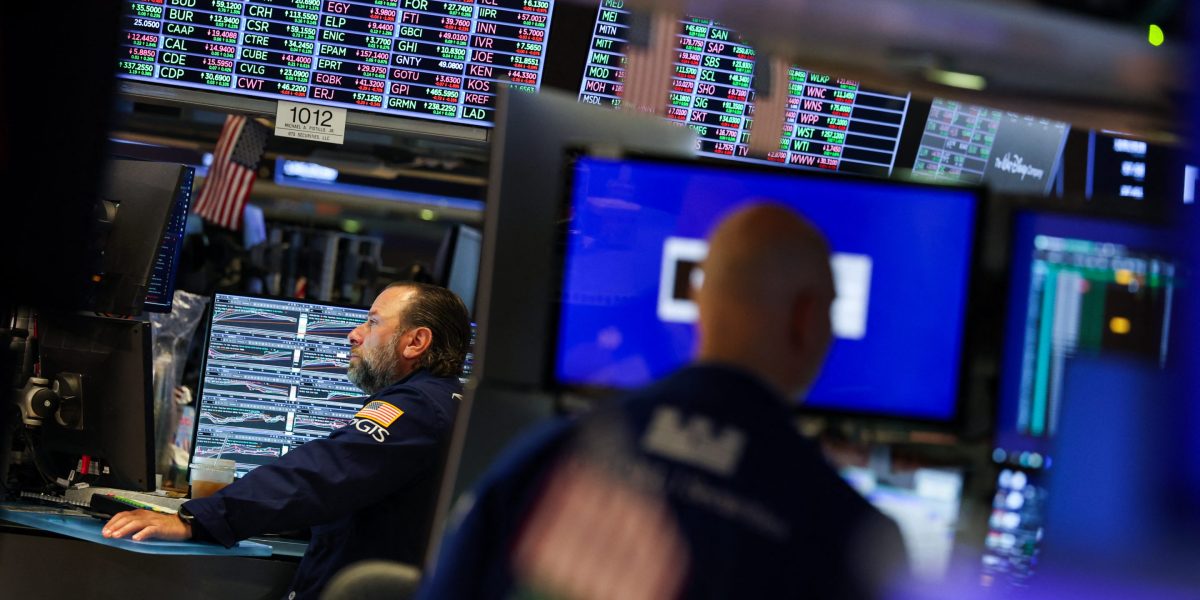
Wall Street is rising toward more records on Monday at the start of a week that could show whether the U.S. stock market’s big recent rally has been overdone or prescient.

The S&P 500 rose 0.4% and was on track to top its latest all-time high, which was set last week. The Dow Jones Industrial Average was up 33 points, or 0.1%, as of 1:54 p.m. Eastern time, and the Nasdaq composite was adding 0.8% to its own record.

Tesla helped lead the way and rose 5.3% after Elon Musk bought stock worth roughly $1 billion through a trust. The electric vehicle company’s stock price came into the day with a slight loss for the year so far, and the purchase could be a signal of Musk’s faith in it.

That helped overshadow an early dip for Nvidia after China accused the chip company of violating its antimonopoly laws. Chinese regulators did not mention a punishment for Nvidia in a one-sentence statement on the matter but did say they would carry out “further investigation.” The stock was down more than 1% in early trading, but has since recovered to near break-even.

The main event for the market will arrive on Wednesday. That’s when the Federal Reserve will announce its latest decision on interest rates, and the unanimous expectation is for its first cut of the year. Such a move could give a kickstart to the job market, which has been slowing.

Stocks have already run to records on the assumption that a cut is coming on Wednesday, though. Expectations are also high that the Fed will keep lowering rates through the end of this year and into 2026. That creates the possibility for disappointment in the market, which would mean drops for stock prices, if the Fed doesn’t end up slashing rates as aggressively as traders expect.

That’s why more attention will be on what Fed Chair Jerome Powell says in his press conference following the decision than on the decision itself. Fed officials will also release their latest projections for where they see interest rates and the economy heading in upcoming years, which could provide another potential flashpoint.

What’s keeping the Fed on guard is a possible jump in inflation because of President Donald Trump’s tariffs. That’s because lower interest rates can give inflation more fuel and send it even higher. And inflation has so far proven difficult to get under the Fed’s 2% target.

Another threat for Wall Street is if the job market slows too much. In that case, a resulting recession could create a downturn in corporate profits that’s big enough to swamp the benefits that lower interest rates bring in the near term.

Trump, meanwhile, has been pushing angrily for more cuts to interest rates. He’s often attacked Powell personally, nicknaming him “Too Late,” and is pushing for the removal of one of the Fed’s governors from its board.

“‘Too Late’ must cut interest rates now, and bigger than he had in mind,” Trump wrote on his social media network Monday, using his trademark all-caps style.

On Wall Street, TKO Group climbed 2.5% after the owner of the UFC mixed-martial arts organization and other entertainment brands announced a plan for $1 billion in purchases of its stock. Such moves send cash directly to shareholders and can boost per-share results.

Intel rose 3.4% after trimming its forecast for expenses this year. The move came after it completed the sale of a 51% stake in its Altera business to the Silver Lake investment firm.

On the losing side of Wall Street was Hain Celestial, which fell 26.5% after reporting a larger loss for its latest quarter than it did a year earlier. Interim CEO Alison Lewis said the owner of “better-for-you” brands like Terra chips is making moves to stabilize sales “as we recognize our performance has not met expectations.”

Alaska Air Group lost 5.8% after the airline said high fuel costs during the summer will likely cause its third-quarter results to come in at the low end of its forecasted range. It also cited higher expenses for overtime pay and for passengers’ compensation after bad weather and air-traffic control issues led to difficult operations, though it saw strong airfare trends thanks to demand for premium seats.

In the bond market Treasury yields eased, continuing their downward run on expectations for cuts to rates by the Fed.

The latest discouraging data on the economy came Monday from a report showing manufacturing activity in New York state is shrinking, contrary to economists’ expectations for continued growth. It’s the first month of contraction since June.

The next big economic update will arrive Tuesday, when the U.S. government will say how much shoppers spent at U.S. retailers last month.

The yield on the 10-year Treasury fell to 4.04% from 4.06% late Friday.

In stock markets abroad, France’s CAC 40 climbed 0.9%, while indexes moved more modestly across the rest of Europe and Asia.

AP Writers Yuri Kageyama, Matt Ott and Ken Moritsugu contributed.

Fortune Global Forum returns Oct. 26–27, 2025 in Riyadh. CEOs and global leaders will gather for a dynamic, invitation-only event shaping the future of business. Apply for an invitation.


Source link

Continue Reading

Business

OpenAI and Disney just ended the ‘war’ between AI and Hollywood with their $1 billion Sora deal

Published

on


Disney’s $1 billion investment in OpenAI, announced Thursday morning—and its decision to let more than 200 Disney, Pixar, Marvel, and Star Wars characters appear inside the Sora video generator—is more than a licensing deal. According to copyright and AI law expert Matthew Sag, who teaches at Emory University’s law school, the deal marks a strategic realignment that could reshape how Hollywood protects its IP in the face of AI-generated content that threatens to leech on their legally-protected magic. 

“AI companies are either in a position where they need to aggressively filter user prompts and model outputs to make sure that they don’t accidentally show Darth Vader, or strike deals with the rights holders to get permission to make videos and images of Darth Vader,” Sag told Fortune. “The licensing strategy is much more of a win-win.” 

The three-year agreement gives OpenAI the right to ingest hundreds of Disney-owned characters into Sora and ChatGPT Image. Disney will also receive equity warrants and become a major OpenAI customer, while deploying ChatGPT internally.

Sag said the deal itself will be a kind of “revenue-sharing.”

“OpenAI hasn’t figured out the revenue model,” Sag said. “So I think making this just an investment deal, in some ways, simplifies it. For Disney … [OpenAI] will figure out a way to make this profitable at some point, and [Disney will] get a cut of that.”

Why this deal matters: the ‘Snoopy problem’

For more than a year, the biggest legal threat to large-scale generative AI has centered on what Sag calls the “Snoopy problem”: It is extremely difficult to train powerful generative models without some degree of memorization, and copyrightable characters are uniquely vulnerable because copyright protects them in the abstract.

Sag was careful to outline a key distinction. AI companies aren’t licensing the right to train on copyrighted works; they’re licensing the right to create outputs that would otherwise be infringing.

That’s because the case for AI companies training their models on unlicensed content is “very strong,” Sag said. Two recent court rulings involving Anthropic and Meta have strengthened those arguments.  

The real stumbling block, Sag said, has always been outputs, not training. If a model can accidentally produce a frame that looks too much like Darth Vader, Homer Simpson, Snoopy, or Elsa, the fair use defense begins to fray.

“If you do get too much memorization, if that memorization finds its way into outputs, then your fair-use case begins to just crumble,” Sag said.

While it’s impossible to license enough text to train an LLM (“that would take a billion” deals, Sag said), it is possible to build image or video models entirely from licensed data if you have the right partners. This is why deals like Disney’s are crucial: They turn previously illegal outputs into legal ones, irrespective of whether the training process itself qualifies as fair use.

“The limiting principle is going to be essentially about whether—in their everyday operation—these models reproduce substantial portions of works from their training data,” Sag said.

The deal, Sag says, is also a hedge against Hollywood’s lawsuits. This announcement is “very bad” for Midjourney, who Disney is suing for copyright infringement, because it upholds OpenAI’s licensing deal as the “responsible” benchmark for AI firms. 

This is also a signal about the future of AI data

Beyond copyright risk, the deal exposes another trend: the drying up of high-quality, unlicensed data on the public internet.

In a blog post, Sag wrote:

“The low-hanging fruit of the public internet has been picked,” he wrote. “To get better, companies like OpenAI are going to need access to data that no one else has. Google has YouTube; OpenAI now has the Magic Kingdom.”

This is the core of what he calls the “data scarcity thesis.” OpenAI’s next leap in model quality may require exclusive content partnerships, as opposed to more scraping. 

“By entangling itself with the world’s premier IP holder, OpenAI makes itself indispensable to the very industry that threatened to sue it out of existence,” Sag wrote. 

AI and Hollywood have spent three years locked in a cold war over training data, likeness rights and infringement. With Disney’s $1 billion investment, that era appears to be ending.

“This is the template for the future,” Sag wrote. “We are moving away from total war between AI and content, toward a negotiated partition of the world.”


Source link

Continue Reading

Business

Bob Iger says Disney’s $1 billion deal with OpenAI is an ‘opportunity, not a threat’: ‘We’d rather participate than be disrupted by it’

Published

on


Disney is investing $1 billion in OpenAI and is giving the go-ahead for its iconic characters like Mickey Mouse to be used in the AI short-form video app Sora.

The two companies announced a three-year deal that would bring more than 200 characters to Sora with a period of exclusivity for part of the duration of the deal.

Disney CEO Bob Iger painted the team-up as Disney taking the next step in content with the newest technology and waived away concerns about whether the deal represents a threat to human creators.

“We’ve always viewed technological advances as opportunity, not threat,” Iger said. 

“It’s going to happen regardless, and we’d rather participate in the rather dramatic growth, rather than just watching it happen and essentially being disrupted by it,” he later added.

Iger also noted in an interview with CNBC that as part of the deal, Disney characters can be used in Sora videos, but it does not include rights to likeness or voices. 

“OpenAI is putting guardrails essentially around how these are used, so that really there’s nothing to be concerned about from a consumer perspective,” he said. “This will be a safe environment and a safe way for consumers to engage with our characters in a new way.”

Iger said the company would also feature some user-generated AI content from Sora on the Disney+ platform, which he said would be a great way to increase engagement with younger users.

Disney will receive warrants to buy additional equity in OpenAI as part of the deal and Iger said there would be future opportunities for the company to become an OpenAI customer including licensing from OpenAI. 

Starting last year, OpenAI started opening up Sora to more users and in September launched Sora 2, an upgraded version of the video generator catered more toward mobile. Controversy followed its September release because of the app’s ability to create convincing and realistic videos of people. In October, OpenAI paused AI-generated deepfake videos that featured civil rights leader Martin Luther King Jr. after his daughter, Bernice A. King complained they were being used in a “demeaning, disjointed” way.

Thursday’s deal also comes after Disney sent a cease-and-desist letter to Google for allegedly using its intellectual property to train its AI models and in its services without permission. The company has previously sent similar letters to other companies like Character.ai. Iger told CNBC that Character.ai corrected the issue shortly after and noted that with Google, “the ball is in their court,” and Disney would wait to see how they react to the claim.

Altman for his part said Sora users have longed to use Disney characters in their videos and said he hoped adding them to the platform could “unleash a sort of whole new way that people use this technology.”

“We have underestimated the amount of latent creativity in the world,” said Altman. “But if you lower the effort, skill, time required to create new things people very quickly are able to bring ideas to life.”


Source link

Continue Reading

Business

RFK Jr. and Sean Duffy had pull-up competition to announce a $1B plan for healthy airport upgrades

Published

on


As if dragging a three-wheeled carry-on across the mileage of an international airport isn’t enough, the government wants you panting before your flight. This week, Transportation Secretary Sean Duffy and Health Secretary Robert F. Kennedy Jr. had a pull-up competition in the middle of Reagan National Airport’s Terminal 2 (not a metaphor) to announce the $1 billion in grants the administration plans to allocate toward healthy airport upgrades.

  • Officials were vague about what these upgrades could include, but mentioned projects like dedicated play areas for kids, more lactation pods, and mini-gyms for travelers.
  • The funding will come from former President Biden’s 2021 Infrastructure Investment and Jobs Act and is part of the current administration’s “Make Travel Family Friendly Again” initiative.

But…over 30 major US airport hubs already have children’s play areas, and most airports have been required to provide private lactation areas since FY2021. And 68% of passengers said their top priority for air travel changes is lower prices, according to a 2025 Ipsos poll for Airlines for America.

Big picture: The administration has been pushing initiatives to make flying more pleasant. Last month, Duffy encouraged travelers to dress up for flights and act right, which some travelers responded to by…wearing pajamas to the airport to troll the secretary.—MM

This report was originally published by Morning Brew.

Join us at the Fortune Workplace Innovation Summit May 19–20, 2026, in Atlanta. The next era of workplace innovation is here—and the old playbook is being rewritten. At this exclusive, high-energy event, the world’s most innovative leaders will convene to explore how AI, humanity, and strategy converge to redefine, again, the future of work. Register now.


Source link

Continue Reading

Trending

Copyright © Miami Select.