Connect with us

Business

States are taking action as electric bills rise amid data-center boom. ‘There’s a massive outcry’

Published

on


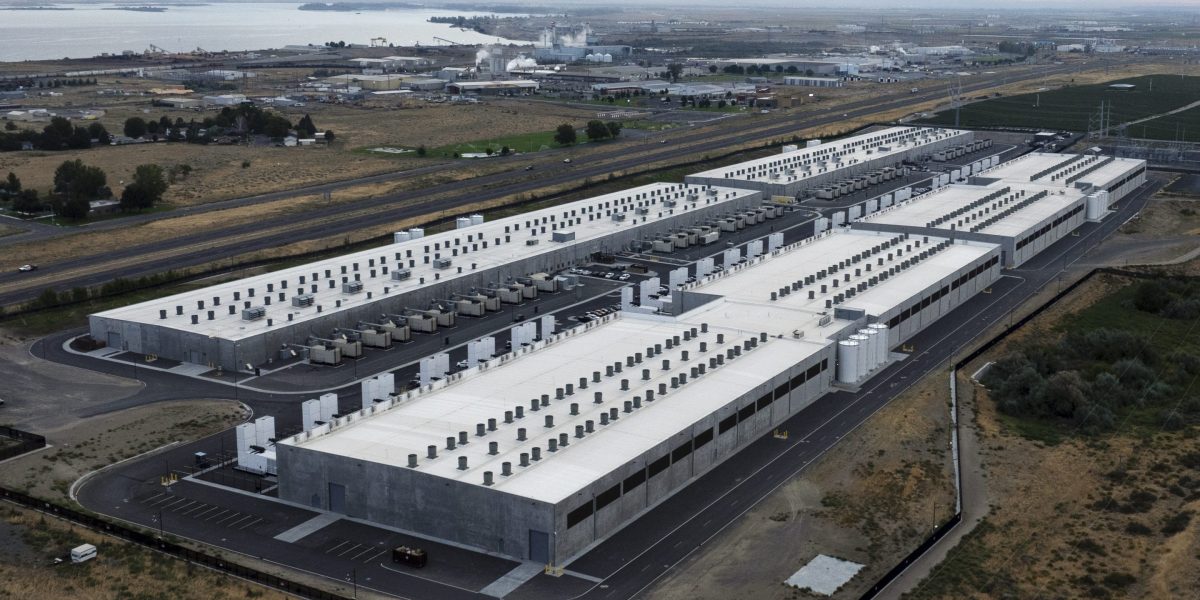
 Amid rising electric bills, states are under pressure to insulate regular household and business ratepayers from the costs of feeding Big Tech’s energy-hungrydata centers.

It’s not clear that any state has a solution and the actual effect of data centers on electricity bills is difficult to pin down. Some critics question whether states have the spine to take a hard line against tech behemoths like Microsoft, Google, Amazon and Meta.

But more than a dozen states have begun taking steps as data centers drive a rapid build-out of power plants and transmission lines.

That has meant pressuring the nation’s biggest power grid operator to clamp down on price increases, studying the effect of data centers on electricity bills or pushing data center owners to pay a larger share of local transmission costs.

Rising power bills are “something legislators have been hearing a lot about. It’s something we’ve been hearing a lot about. More people are speaking out at the public utility commission in the past year than I’ve ever seen before,” said Charlotte Shuff of the Oregon Citizens’ Utility Board, a consumer advocacy group. “There’s a massive outcry.”

Not the typical electric customer

Some data centers could require more electricity than cities the size of Pittsburgh, Cleveland or New Orleans, and make huge factories look tiny by comparison. That’s pushing policymakers to rethink a system that, historically, has spread transmission costs among classes of consumers that are proportional to electricity use.

“A lot of this infrastructure, billions of dollars of it, is being built just for a few customers and a few facilities and these happen to be the wealthiest companies in the world,” said Ari Peskoe, who directs the Electricity Law Initiative at Harvard University. “I think some of the fundamental assumptions behind all this just kind of breaks down.”

A fix, Peskoe said, is a “can of worms” that pits ratepayer classes against one another.

Some officials downplay the role of data centers in pushing up electric bills.

Tricia Pridemore, who sits on Georgia’s Public Service Commission and is president of the National Association of Regulatory Utility Commissioners, pointed to an already tightened electricity supply and increasing costs for power lines, utility poles, transformers and generators as utilities replace aging equipment or harden it against extreme weather.

The data centers needed to accommodate the artificial intelligence boom are still in the regulatory planning stages, Pridemore said, and the Data Center Coalition, which represents Big Tech firms and data center developers, has said its members are committed to paying their fair share.

But growing evidence suggests that the electricity bills of some Americans are rising to subsidize the massive energy needs of Big Tech as the U.S. competes in a race against China for artificial intelligence superiority.

Data and analytics firm Wood Mackenzie published a report in recent weeks that suggested 20 proposed or effective specialized rates for data centers in 16 states it studied aren’t nearly enough to cover the cost of a new natural gas power plant.

In other words, unless utilities negotiate higher specialized rates, other ratepayer classes — residential, commercial and industrial — are likely paying for data center power needs.

Meanwhile, Monitoring Analytics, the independent market watchdog for the mid-Atlantic grid, produced research in June showing that 70% — or $9.3 billion — of last year’s increased electricity cost was the result of data center demand.

States are responding

Last year, five governors led by Pennsylvania’s Josh Shapiro began pushing back against power prices set by the mid-Atlantic grid operator, PJM Interconnection, after that amount spiked nearly sevenfold. They warned of customers “paying billions more than is necessary.”

PJM has yet to propose ways to guarantee that data centers pay their freight, but Monitoring Analytics is floating the idea that data centers should be required to procure their own power.

In a filing last month, it said that would avoid a “massive wealth transfer” from average people to tech companies.

At least a dozen states are eyeing ways to make data centers pay higher local transmission costs.

In Oregon, a data center hot spot, lawmakers passed legislation in June ordering state utility regulators to develop new — presumably higher — power rates for data centers.

The Oregon Citizens’ Utility Board says there is clear evidence that costs to serve data centers are being spread across all customers — at a time when some electric bills there are up 50% over the past four years and utilities are disconnecting more people than ever.

New Jersey’s governor signed legislation last month commissioning state utility regulators to study whether ratepayers are being hit with “unreasonable rate increases” to connect data centers and to develop a specialized rate to charge data centers.

In some other states, like Texas and Utah, governors and lawmakers are trying to avoid a supply-and-demand crisis that leaves ratepayers on the hook — or in the dark.

Doubts about states protecting ratepayers

In Indiana, state utility regulators approved a settlement between Indiana Michigan Power Co., AmazonGoogle, Microsoft and consumer advocates that set parameters for data center payments for service.

Kerwin Olsen, of the Citizens Action Council of Indiana, a consumer advocacy group, signed the settlement and called it a “pretty good deal” that contained more consumer protections than what state lawmakers passed.

But, he said, state law doesn’t force large power users like data centers to publicly reveal their electric usage, so pinning down whether they’re paying their fair share of transmission costs “will be a challenge.”

In a March report, the Environmental and Energy Law Program at Harvard University questioned the motivation of utilities and regulators to shield ratepayers from footing the cost of electricity for data centers.

Both utilities and states have incentives to attract big customers like data centers, it said.

To do it, utilities — which must get their rates approved by regulators — can offer “special deals to favored customers” like a data center and effectively shift the costs of those discounts to regular ratepayers, the authors wrote. Many state laws can shield disclosure of those rates, they said.

In Pennsylvania, an emerging data center hot spot, the state utility commission is drafting a model rate structure for utilities to consider adopting. An overarching goal is to get data center developers to put their money where their mouth is.

“We’re talking about real transmission upgrades, potentially hundreds of millions of dollars,” commission chairman Stephen DeFrank said. “And that’s what you don’t want the ratepayer to get stuck paying for.”


Source link

Continue Reading

Business

JPMorgan CEO Jamie Dimon says Europe has a ‘real problem’

Published

on


JPMorgan Chase & Co. Chief Executive Officer Jamie Dimon called out slow bureaucracy in Europe in a warning that a “weak” continent poses a major economic risk to the US.

“Europe has a real problem,” Dimon said Saturday at the Reagan National Defense Forum. “They do some wonderful things on their safety nets. But they’ve driven business out, they’ve driven investment out, they’ve driven innovation out. It’s kind of coming back.”

While he praised some European leaders who he said were aware of the issues, he cautioned politics is “really hard.” 

Dimon, leader of the biggest US bank, has long said that the risk of a fragmented Europe is among the major challenges facing the world. In his letter to shareholders released earlier this year, he said that Europe has “some serious issues to fix.”

On Saturday, he praised the creation of the euro and Europe’s push for peace. But he warned that a reduction in military efforts and challenges trying to reach agreement within the European Union are threatening the continent.

“If they fragment, then you can say that America first will not be around anymore,” Dimon said. “It will hurt us more than anybody else because they are a major ally in every single way, including common values, which are really important.”

He said the US should help.

“We need a long-term strategy to help them become strong,” Dimon said. “A weak Europe is bad for us.”

The administration of President Donald Trump issued a new national security strategy that directed US interests toward the Western Hemisphere and protection of the homeland while dismissing Europe as a continent headed toward “civilizational erasure.”

Read More: Trump’s National Security Strategy Veers Inward in Telling Shift

JPMorgan has been ramping up its push to spur more investments in the national defense sector. In October, the bank announced that it would funnel $1.5 trillion into industries that bolster US economic security and resiliency over the next 10 years — as much as $500 billion more than what it would’ve provided anyway. 

Dimon said in the statement that it’s “painfully clear that the United States has allowed itself to become too reliant on unreliable sources of critical minerals, products and manufacturing.”

Investment banker Jay Horine oversees the effort, which Dimon called “100% commercial.” It will focus on four areas: supply chain and advanced manufacturing; defense and aerospace; energy independence and resilience; and frontier and strategic technologies. 

The bank will also invest as much as $10 billion of its own capital to help certain companies expand, innovate or accelerate strategic manufacturing.

Separately on Saturday, Dimon praised Trump for finding ways to roll back bureaucracy in the government.

“There is no question that this administration is trying to bring an axe to some of the bureaucracy that held back America,” Dimon said. “That is a good thing and we can do it and still keep the world safe, for safe food and safe banks and all the stuff like that.”


Source link

Continue Reading

Business

Hegseth likens strikes on alleged drug boats to post-9/11 war on terror

Published

on


Defense Secretary Pete Hegseth defended strikes on alleged drug cartel boats during remarks Saturday at the Ronald Reagan Presidential Library, saying President Donald Trump has the power to take military action “as he sees fit” to defend the nation.

Hegseth dismissed criticism of the strikes, which have killed more than 80 people and now face intense scrutiny over concerns that they violated international law. Saying the strikes are justified to protect Americans, Hegseth likened the fight to the war on terror following the Sept. 11, 2001 attacks.

“If you’re working for a designated terrorist organization and you bring drugs to this country in a boat, we will find you and we will sink you. Let there be no doubt about it,” Hegseth said during his keynote address at the Reagan National Defense Forum. “President Trump can and will take decisive military action as he sees fit to defend our nation’s interests. Let no country on earth doubt that for a moment.”

The most recent strike brings the death toll of the campaign to at least 87 people. Lawmakers have sought more answers about the attacks and their legal justification, and whether U.S. forces were ordered to launch a follow-up strike following a September attack even after the Pentagon knew of survivors.

Though Hegseth compared the alleged drug smugglers to Al-Qaida terrorists, experts have noted significant differences between the two foes and the efforts to combat them.

Hegseth’s remarks came after the Trump administration released its new national security strategy, one that paints European allies as weak and aims to reassert America’s dominance in the Western Hemisphere.

During the speech, Hegseth also discussed the need to check China’s rise through strength instead of conflict. He repeated Trump’s vow to resume nuclear testing on an equal basis as China and Russia — a goal that has alarmed many nuclear arms experts. China and Russia haven’t conducted explosive tests in decades, though the Kremlin said it would follow the U.S. if Trump restarted tests.

The speech was delivered at the Reagan National Defense Forum at the Ronald Reagan Presidential Foundation and Institute in California, an event which brings together top national security experts from around the country. Hegseth used the visit to argue that Trump is Reagan’s “true and rightful heir” when it comes to muscular foreign policy.

By contrast, Hegseth criticized Republican leaders in the years since Reagan for supporting wars in the Middle East and democracy-building efforts that didn’t work. He also blasted those who have argued that climate change poses serious challenges to military readiness.

“The war department will not be distracted by democracy building, interventionism, undefined wars, regime change, climate change, woke moralizing and feckless nation building,” he said.


Source link

Continue Reading

Business

US debt crisis: Most likely fix is severe austerity triggered by a fiscal calamity

Published

on


One way or another, U.S. debt will stop expanding unsustainably, but the most likely outcome is also among the most painful, according to Jeffrey Frankel, a Harvard professor and former member of President Bill Clinton’s Council of Economic Advisers.

Publicly held debt is already at 99% of GDP and is on track to hit 107% by 2029, breaking the record set after the end of World War II. Debt service alone is more than $11 billion a week, or 15% of federal spending in the current fiscal year.

In a Project Syndicate op-ed last week, Frankel went down the list of possible debt solutions: faster economic growth, lower interest rates, default, inflation, financial repression, and fiscal austerity. 

While faster growth is the most appealing option, it’s not coming to the rescue due to the shrinking labor force, he said. AI will boost productivity, but not as much as would be needed to rein in U.S. debt.

Frankel also said the previous era of low rates was a historic anomaly that’s not coming back, and default isn’t plausible given already-growing doubts about Treasury bonds as a safe asset, especially after President Donald Trump’s “Liberation Day” tariff shocker.

Relying on inflation to shrink the real value of U.S. debt would be just as bad as a default, and financial repression would require the federal government to essentially force banks to buy bonds with artificially low yields, he explained.

“There is one possibility left: severe fiscal austerity,” Frankel added.

How severe? A sustainable U.S. debt trajectory would entail elimination of nearly all defense spending or almost all non-defense discretionary outlays, he estimated.

For the foreseeable future, Democrats are unlikely to slash top programs, while Republicans are likely to use any fiscal breathing room to push for more tax cuts, Frankel said.

“Eventually, in the unforeseeable future, austerity may be the most likely of the six possible outcomes,” he warned. “Unfortunately, it will probably come only after a severe fiscal crisis. The longer it takes for that reckoning to arrive, the more radical the adjustment will need to be.”

The austerity forecast echoes an earlier note from Oxford Economics, which said the expected insolvency of the Social Security and Medicare trust funds by 2034 will serve as a catalyst for fiscal reform.

In Oxford’s view, lawmakers will seek to prevent a fiscal crisis in the form of a precipitous drop in demand for Treasury bonds, sending rates soaring.

But that’s only after lawmakers try to take the more politically expedient path by allowing Social Security and Medicare to tap general revenue that funds other parts of the federal government.

“However, unfavorable fiscal news of this sort could trigger a negative reaction in the US bond market, which would view this as a capitulation on one of the last major political openings for reforms,” Bernard Yaros, lead U.S. economist at Oxford Economics, wrote. “A sharp upward repricing of the term premium for longer-dated bonds could force Congress back into a reform mindset.”


Source link

Continue Reading

Trending

Copyright © Miami Select.