Connect with us

Politics

St. Pete Science Center’s fate in limbo as City Council prepares for discussion
Published

on


St. Petersburg City Council members will hear a report next week on a project meant to bring the St. Pete Science Center back online, providing educational programming for kids across the city.

The Science Center, shuttered in 2014, is located on the west side of the city at 7701 22nd Ave. North. The city of St. Pete currently owns the facility but has been considering selling it to St. Pete for STEAM, a group working to reactivate the Center.

Now, however, St. Pete Mayor Ken Welch is considering keeping the site under city ownership to facilitate future water storage to add capacity for the city’s water and stormwater resources. That consideration makes next Thursday’s meeting a critical next step in reactivating the long-shuttered educational facility.

Sources expect the project report to lead to a proposed resolution supporting the sale, which would then bump the issue to Welch.

The decision will be consequential.

St. Pete STEAM and the coalition behind the project have already raised more than $9 million for the project, expected to total $25 million. With pledged financial commitments, the fundraising total is about $15 million. Funding will come from a mix of private and public sources, but the city is not being asked to contribute. Instead, the coalition has agreed to pay $1.6 million to purchase the current property.

But the location has been under consideration for a new water reclamation facility, and was identified as one of two sites most feasible.

Welch said last month he is no longer considering selling the property based on feasibility report results. But a resolution from the City Council supporting the sale could sway his position.

The feasibility report at issue examined nine sites within the Northwest St. Pete geographic area to build new water storage tanks, including the Science Center.

The study included nearby Raytheon property, but that is no longer available. The existing Northwest water reclamation facility was also under consideration, but it too was eliminated from consideration after a determination that there were better uses for the space. That left the Science Center and an existing brush site as the most feasible locations for the water project.

Both sites ranked similarly, with the brush site ranking better for ease of construction.

The difference came down to demolition costs. Because the brush site amounts to basically cleared land, except for some brush and debris piles that would need to be cleared, the Science Center’s demolition costs would be about four times as expensive.

The city’s feasibility center further looked at land acquisition costs. Because it already owns the Science Center property, no cost would be associated with acquiring that property. However, if the brush site were to be used, the city would have to acquire new land to establish a new brush site. It estimated that cost at $2.9 million, far more than the $1.6 million the St. Pete STEAM has agreed on to purchase the Science Center site.

But a presentation Florida Politics obtained points to flaws in the cost estimate included in the city’s feasibility report for new land acquisition. It used a specific address — 2401 72nd St. North — as a comparison for property value. That property includes a well-maintained warehouse that includes 7,000 square feet of office space.

That, the presentation posits, is not an accurate representation of the cost to purchase vacant land. The presentation includes an alternative estimate totaling $1.3 million — less than the $1.6 million to purchase the Science Center site. That assumes a price of $650,000 per acre for land at highest and best use, for two acres to accommodate a brush site.

“The Science Center’s mission to provide quality wraparound education to the future leaders of our county dates back to 1959. Unfortunately, it has been shuttered for the better part of a decade,” said former City Council member Robert Blackmon, who has long championed the project.

“With diverse support for the project reflecting all walks of life and political party, it baffles me that negotiations have dragged on this long. If long term, theoretical relocation of a brush site is the only obstacle, let’s work together to get it done.”

Blackmon ran unsuccessfully against Welch in his first mayoral election. Reimagining and reopening the Science Center was one of his top campaign priorities.

While the City Council is likely to discuss cost and feasibility, that’s not the only factor to be considered. The City Council will also likely discuss the inherent value an education facility would bring.

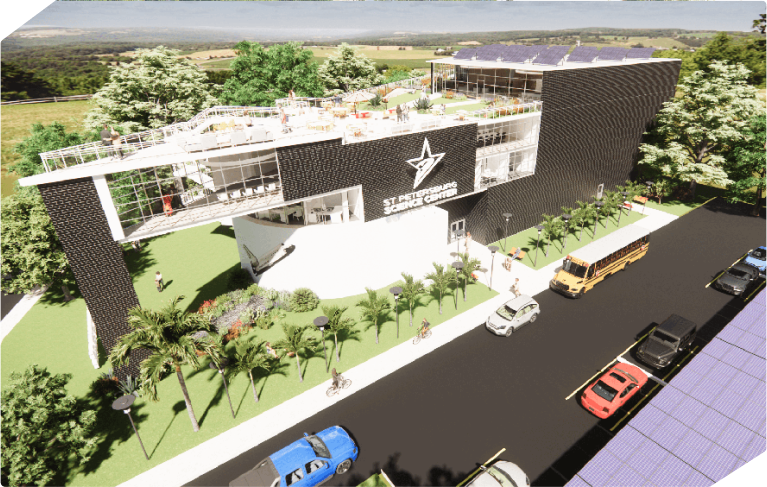
The reimagined Science Center would focus on STEAM (science, technology, engineering, arts and mathematics) education for local students, including in public, private and charter schools. It would serve as an emerging technology hub, including a focus on artificial intelligence.

The proposal includes an AI village, which would include modular stations complete with the latest breakthrough in AI technology, offering year-round programming to immerse kids in AI topics ranging from ethics to data and computer applications.

A Cityverse Hybritorium would serve as event space for up to 220 people, with room for 100 more virtually through the use of 100 screens and cameras, giving virtual participants an experience that rivals being there in person.

The original Science Center’s planetarium would be reimagined to keep pace with today’s technology, and the plan calls for robust workspace to offer amenities beyond the classroom, as well as an idea portal and a café.

There would also be a Star Garden, an outdoor rooftop event space that doubles as a stargazing opportunity.

The plan also would preserve the site’s historic mosaic trail, a centerpiece of the original Science Center that features hand-blown and hand-painted tile work celebrating the American experience.

Ironically, St. Pete STEAM was prepared to break ground on the project two years ago. But the plan was held up because the city declared the site historic eligible, causing the coalition to work through issues with the state historic preservation board. Now, the city is contemplating ripping the mosaic trail up itself, to make way for eventual water tanks.

The project also has broad community support. Letters of support have been received from various professors at the University of South Florida, the Tampa Bay Rays, Orlando Health, state Rep. Michele Rayner, Pinellas County School Board member Caprice Edmond, and more.

And local officials have worked diligently to draw down public dollars in support of the project, including former U.S. Rep. Charlie Crist, state Sen. Darryl Rouson and state Reps. Linda Chaney and Berny Jacques.

As it currently stands, the City Council is only scheduled to hear a report on the Science Center proposal, so there’s no guarantee that a resolution would be on offer, or that it would pass — though sources suggest the numbers are there. But at the very least, it will open dialogue on a community amenity that has been lost for the past 11 years.

Next week’s City Council meeting is Thursday, Sept. 25, and begins at 3 p.m. The Science Center report is so far slated as the first and only report of the meeting, which will likely draw significant attention as the City Council is also slated to issue final approval of the 2026 fiscal budget and millage rate.


Post Views: 0


Source link

Continue Reading

Politics

Paul Renner campaign launches ‘Women for Renner Coalition’ with steering committee

Published

on


Former House Speaker Paul Renner is formalizing his push for the Governor’s Mansion with a new organizing arm focused on women voters.

Renner’s campaign just announced the creation of a statewide steering committee for its “Women for Renner Coalition,” assembling dozens of conservative activists, educators, business leaders and faith-based advocates to amplify women’s voices supporting his gubernatorial bid.

The coalition, the campaign said, is designed to mobilize women across political and professional lines around issues. Among them: parental rights, public safety, faith, economic opportunity and what the campaign describes as “principled leadership.”

Renner said in a statement Tuesday that the coalition will serve as both a values-driven and operational component of his campaign.

“Women are the heart and voice of families and communities,” Renner said. “I am honored to have the growing support of strong, dedicated female leaders that will ensure their concerns remain front and center — especially when it comes to protecting faith, American exceptionalism, parental rights, a prosperous economy, and defending the principles of freedom that guide us.”

The “Women for Renner Coalition” will function as an internal organizing network, encouraging women across Florida to share personal stories, engage voters and advocate on key campaign issues. The campaign said the group will also work to elevate women’s perspectives in policymaking and community engagement.

Adriana Renner, the candidate’s wife, said she has seen her husband’s commitment to families and praised the coalition as a vehicle for advancing what the campaign calls a “Florida First agenda.”

“I know his heart and his dedication to serving Florida’s families runs deep,” she said in a statement.

Several conservative activists and former officials offered endorsements through the announcement, praising Renner’s record on parental rights, medical freedom and opposition to federal overreach.

Nancy Peek McGowan, who held prominent roles in past campaigns of Gov. Ron DeSantis and Secretary of State Marco Rubio, highlighted Renner’s background as a U.S. Navy veteran, former state prosecutor and University of Florida law graduate.

“As the former State Chairwoman for ‘Women for DeSantis,” she said, “I can say with certainty, Paul Renner is the only authentic conservative running for Governor with a lifetime record to prove it.”

Mary Flynn O’Neill, Executive Director of America’s Future, said Renner has exhibited “steadfast leadership to protect the ideals that matter most to Floridians.”

“Paul Renner has consistently championed the principles that define our nation — faith, freedom, and the enduring strength of the American family,” she said. “His leadership reflects a deep respect for the values that unite our communities and guide Florida forward.

The steering committee itself includes more than 40 members from across the state, ranging from local school board officials and former legislators to nonprofit executives, physicians and student activists.

They include Wendy Biddle, educator and activist; Regina Brown, Realtor and President of Transforming Florida; Lourdes Castillo, businesswoman and conservative activist; Virginia Cortes, nonprofit executive; Ann Dugger, former Executive Director of the Justice Coalition; Maureen France, conservative activist and former Chair of Citizens Against Legalizing Marijuana Florida; Mara Frazier, educator and conservative activist; Christi Griner, patient advocate and former state leader for Concerned Women of America; Jenna Hague, business leader and political activist; Mary Lou Hendry, pro-life advocate; Stephanie Jacobson, pro-life advocate; Charlotte Joyce, Duval County School Board member; Debbie Joyce, business leader and conservative activist; Jill Kiley, health freedom advocate; Bailey Kuykendoll, health freedom advocate; Lori Long, business leader and Central Florida community activist; Zarai Maza, CEO of Guardians of Human Rights Foundation; Aimee Villela-McBride, Executive Director of Global Wellness Forum; Aislynn Thomas-McDonald, lawyer and conservative advocate; Nancy Peek McGowan, former co-Chair of the DeSantis gubernatorial campaign and Rubio campaign grassroots leader; Kate Morales, student activist; Karyn Morton, leader of the Republican Liberty Caucus, co-founder of the Duval Trump Club, and former Duval County GOP Chair and Committeewoman; Andrea Marconi Nasteli, physician and grassroots advocate; Becky Nathanson, education activist; Mary Flynn O’Neill, Executive Director of America’s Future; Lindsay Randall, education leader and advocate; Adriana Renner; Miriam Ramirez, physician and former state Senator of Puerto Rico; Isabelle Sala, educator; Ginger Soud, former Jacksonville City Council Chair and Duval County co-Chair of Trump for President; Cyndi Stevenson, former state Representative; Patti Sullivan, parental rights advocate; Ann Vandersteel, radio show host and conservative activist.

The launch comes as Florida’s 2026 Governor’s race begins to take clearer shape. Notable Republicans lining up to succeed DeSantis, who faces term limits, include U.S. Rep. Byron Donalds and investment executive James Fishback.

Two high-profile Democrats, former U.S. Rep. David Jolly and ex-Orange County Mayor Jerry Demings, are also running.

DeSantis hasn’t yet weighed in on the contest, which Lt. Gov. Jay Collins has hinted at entering.


Source link

Continue Reading

Politics

Florida Realtors PAC throws its weight behind Bill Poteet in HD 82 GOP Primary

Published

on


The Florida Realtors PAC is backing Bill Poteet in the race for House District 82, adding the powerful real estate group’s support to his bid for the Southwest Florida seat.

The political arm of Florida Realtors cited Poteet’s professional background, community involvement and familiarity with regional issues. Poteet is a Realtor, small-business owner and longtime resident of the district.

“As a REALTOR, small-business owner and longtime resident of southwest Florida, the citizens of House District 82 would be hard-pressed to find a more effective representative for their area than Bill Poteet,” said Marilyn Pearson-Adams, Chair of the Florida Realtors PAC Trustees.

“He is incredibly active in his community, serving in leadership positions in numerous local and non-profit organizations, and his knowledge as a REALTOR has given him a deep understanding of the issues facing the region. He would be an outstanding addition to the Florida House of Representatives.”

Florida Realtors PAC routinely weighs in on legislative races across the state, supporting candidates it views as aligned with property rights, economic growth and housing affordability. Endorsements from the group can carry significant weight, particularly in districts where real estate and development play a central role in the local economy.

Republican Rep. Lauren Melo currently represents HD 82, but is seeking a Senate seat in 2026.

Rancher Liesa Priddy and Hugo Vargas are also competing in the Republican Primary. Melo has backed Priddy as her preferred successor.

Priddy is leading the field in fundraising, with around $151,000 raised.

Poteet, meanwhile, has collected more than $33,000 via his campaign account and his political committee, Friends of Bill Poteet. Vargas has raised almost $22,000 through his account and his political committee, Friends of Hugo Vargas.

Democratic candidate Arthur Boyer has also filed for the race.

HD 82 covers a swath of Southwest Florida, including Hendry County and parts of Collier County.


Source link

Continue Reading

Politics

Meta rolls out a new centralized support hub with 24/7 help across Facebook and Instagram

Published

on


New AI systems are powering the changes.

Meta is introducing a central hub for account support on Facebook and Instagram that is designed to make help faster and easier to find in the event of being hacked or locked out, or when needing guidance on settings and safety.

The hub will bring together reporting tools, recovery options, and AI-powered answers in one place on iOS and Android devices. On Facebook, Meta is also testing out an AI support assistant on Facebook intended to deliver instant and personalized help, and they plan to expand this service to other apps as well over time.

Within this new hub, users can report account issues, use AI-powered searches, and access recovery tools without the need to comb through numerous resources. The preview of the AI support assistant on Facebook is intended to guide users through account recovery, profile management and settings updates. Users on other platforms can expect this feature to arrive on Instagram and other apps soon as well.

The goal of the new feature is to prioritize accessible support that is always available. Meta acknowledges that their support on these matters has not always met expectations, and with this latest announcement they express their commitment to investing in an improvement on these kinds of user services.

Thanks to the assistance of AI, Meta highlights security improvements that have taken place across their platforms over the past year. These improvements include a more than 30% decrease of new account hacks on Facebook and Instagram as well as a more than 30% increase in hacked account recovery.

New AI systems have supported these trends by blocking suspicious logins, flagging compromised accounts, and distinguishing legitimate users from hackers in real time.

If a user loses access to their account, they will now see recovery options at the right time while also receiving improved email and SMS alerts about risky activity. There is new and enhanced recognition of trusted devices and familiar locations, and a selfie video is now optional to verify users’ identity when needed. Other built-in safeguards include Security Checkup, two-factor authentication, and passkeys on Facebook and Messenger.


Source link

Continue Reading

Trending

Copyright © Miami Select.