
Politics
St. Pete claps back at Florida DOGE claims


After Gov. Ron DeSantis posted an infographic on Wednesday outlining what he described as “irresponsible uses of taxpayer funds” in several cities and counties across the state, the city of St. Petersburg is offering clarification on specific claims made against it.
Along with grievances against Jacksonville, Pensacola, Gainesville, Orlando and Alachua, Orange, Hillsborough, Pinellas and Broward counties, the infographic outlined two areas of concern in St. Pete.
It claimed the city had spent $258,000 from city utility and emergency management services (EMS) funds to support St. Pete Pride events and $307,000 on “a climate action plan to drive Green New Deal initiatives.”
The city operates on an approximately $1 billion budget – the 2025/26 fiscal year budget is $1.1 billion. That means both flagged expenditures represent just a fraction of 1% of the total budget.
The Governor’s infographic followed a series of audits conducted across the state under the newly created Florida Department of Government Efficiency (DOGE), led by new Chief Financial Officer Blaise Ingoglia.
The city issued a lengthy statement on Thursday, outlining what officials believe the graphic was referencing and clarifying the spending.
On the Pride item, the city claims the DOGE finding needs context.
The statement said city officials “assume” the state arrived at its $258,000 number by calculating the in-kind contributions the city made for the annual Pride event, which is hosted independently by St. Pete Pride. The figure actually comes from two fiscal years – just shy of $120,000 in 2024 and a little over $138,000 in the current year.
St. Pete Pride is what the city considers a “co-sponsored event,” which is an event predominantly hosted by outside groups or organizations but supported in some way by the city. City Council approves any expenditures – either direct or in-kind – through the annual budget process. The City Council approved providing half the total cost, up to $300,000 per year, for in-kind services, including police and other emergency management services. The total cost was just over $239,000 in 2024 and a little less than $277,000 in 2025. Half of that cost was reimbursed to the city from event hosts St. Pete Pride.
Regarding the state’s claim about spending more than $300,000 on a climate action plan, the city again “assumes” the state is referencing “costs incurred related to the Professional services paid to Vanasse Hangen Bristling Inc. in 2017 to assist in developing the City’s Integrated Sustainability Action Plan (ISAP) Technical Report,” which cost $308,000.

Here, the city’s explanation was more forceful. First, most of the cost (in excess of $292,000) was funded through BP’s Deepwater Horizon settlement funds. The rest, less than $15,000, was financed by the city’s General Fund in fiscal years 2017 through 2019.
And the city points out that the ISAP was established under the previous Mayor Rick Kriseman.
The ISAP program includes climate action goals such as transitioning to 100% clean energy, increasing environmental stewardship and resilience and racial justice.
While the city’s statement did not directly criticize the DOGE process or the findings – a full report from DOGE has not yet been released, and a request for it from Florida Politics has not yet been answered – it did seek to shore up support from residents.
“As you can see from the above, the City of St. Petersburg values transparency and hopes that this information provides clarification on City spending. The City is committed to the idea of ‘Government in the Sunshine’ and the responsible, documented use of government resources,” the statement read.
“The City works to enhance government transparency by providing access to the financial and budgetary processes on our website and through OpenGov. We encourage any residents who have questions about the City’s budget to review the documents posted on our website at StPete.org/Budget.”
And the statement included at least one zinger.
“It should be noted that neither of the expenditures called out were funded by property taxes,” it said, a reference to DeSantis’ priority to eliminate property taxes and Ingoglia’s statements claiming leaner budgets can allow local governments to slash property taxes.
The letter informing the city that it would be the subject of a DOGE audit specifically referenced “the annual burden on property tax.”

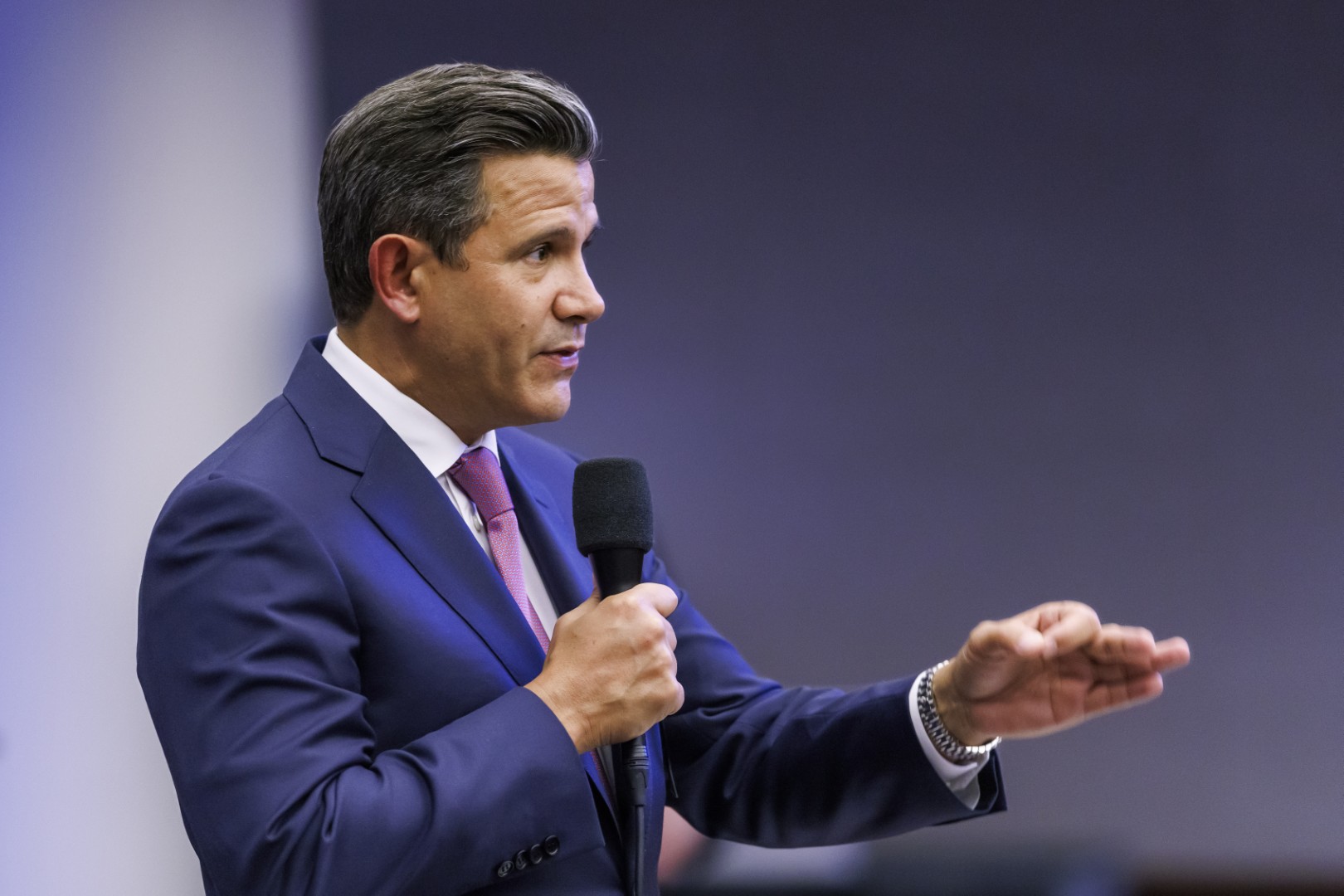
Legislation that would narrowly recategorize 911 dispatchers as first responders so they can receive workers’ compensation for work-related psychological injuries is one step closer to passing in the Legislature’s upper chamber.
Members of the Government Oversight and Accountability Committee voted unanimously to advance the bill (SB 774), which would eliminate a barrier that today denies aid to people who are often the first to respond to a crime.
The measure’s sponsor, Hollywood Sen. Jason Pizzo, noted that during his time as a prosecutor, playing a 911 call would often be the most effective thing to do to sway a jury.
“911, what’s your emergency? He’s going to kill me! He’s going to kill me! Now, imagine hearing that 12 times a day, 15 times a day,” he said.
“Two years ago, you all voted to require these 911 operators to be proficient in CPR so they could administer (it) over the phone. And they’re not considered first responders? They are first responders, and they’ve been grossly overlooked and screwed, and this brings some remedy.”
SB 774 would add 911 dispatchers to the group of “first responders” covered by Florida’s special workers’-compensation rules for employment-related mental or nervous injuries. It would apply the same framework to them as other first responders for mental health claims.
Essentially, if you’re a 911 dispatcher and develop post-traumatic stress disorder, anxiety or similar mental health injuries from traumatic calls, SB 774 would make it so you can get workers’ comp-covered treatment and that your claim is handled under the same special rules lawmakers already set for other first responders — without certain time-limit restrictions that typically apply to mental injury benefits.
Several dispatchers signaled or spoke in favor of the bill, as did representatives from the Florida Police Chiefs Association, Florida Sheriffs Association and Consolidated Dispatch Agency.
Jennifer Dana, a dispatcher with the Palm Beach Sheriff’s Office, noted that in a Senate analysis of SB 774, there’s a list of disturbing things first responders see and do on the job, from seeing dead children and witnessing murders to helping severely injured people, including those who commit suicide.
What it doesn’t include, she said, is that 911 dispatchers also witness those things.

“We’re seeing and hearing it,” she said. “We have the technology for people to livestream it now, so it’s a double-whammy for us, and we want to make sure we have the protections.”
Kim Powell, a licensed and clinical mental health counselor who oversees an employee behavioral health program at a 911 communications center in Leon County, detailed several examples of what dispatchers experience: a woman struggling to breathe while dying from a gunshot wound inflicted by her child’s father; an officer’s final words moments before his murder; the sound of a mother discovering her deceased infant; the 800 or so calls received in the wake of the Florida State University shooting last April.
“These are not isolated events; they are part of the job,” she said. “The trauma compounds over time with repeat exposure.”
St. Petersburg Republican Sen. Nick DiCeglie thanked Pizzo for carrying the bill and expressed gratitude to the “3,500 dispatchers” across Florida for their work.
“For me personally, (this) could be one of the most important bills that we have this Session because of the importance there is for your well-being and your quality of life,” he said.
Melbourne Republican Sen. Debbie Mayfield, who chairs the committee, echoed DiCeglie’s remarks.
Pizzo reminded the panel that four years ago, during COVID, a $280 million set-aside for payments to first responders and front-line workers did not extend to 911 dispatchers.
“They never stopped working,” he said, adding that Mayfield at the time acknowledged the oversight and pledged that the Legislature would get it right in the future. “So, it’s serendipitous that you were kind and gracious enough to put us on the agenda.”
SB 774 will next go to the Senate Appropriations Committee on Agriculture, Environment and General Government, after which it has one more stop before reaching a floor vote.
An identical bill (HB 451) by Republican Rep. Jeff Holcomb of Spring Hill awaits its first hearing in the House.

The Tampa Bay Rays’ search for a new home took a tangible step forward as the Hillsborough College Board of Trustees approved a nonbinding agreement that could ultimately shift the franchise away from St. Petersburg under its new ownership.
The Board voted to approve a memorandum of understanding (MOU) authorizing staff to negotiate with the Tampa Bay Rays over a potential stadium and mixed-use redevelopment at the college’s Dale Mabry Campus.
The agreement does not commit the college to the project and can be terminated by the Board at any time. Instead, it outlines key terms the parties would like to see in any future binding agreements, which would require separate Board approval at a later public meeting.
College officials characterized the MOU as the beginning of negotiations. Under the document, staff would begin drafting potential project agreements for Trustees to consider in the future, with an anticipated negotiation timeline of up to 180 days.
Rays CEO Ken Babby addressed Trustees during the meeting, calling the proposal an early milestone. He emphasized that the effort involves the college, the team, the state and local governments. Babby said the Rays are exploring a roughly 130-acre redevelopment anchored by a new stadium and an integrated college campus, alongside residential, commercial and entertainment uses.
“As we envision this development, together in cooperation and partnership with the community and the college, we’ve been calling the campus portion of this work ‘Innovation Edge’ featuring Hillsborough College,” Babby said.
“It’ll be neighbored by, of course, what we envision to be ‘Champions Corridor,’ which we hope will be the mentioned home of the Tampa Bay Rays. Of course, this will be a mixed-use with residential, with commercial, and, as we’ve said, billions of dollars of economic impact to the region. … This is an incredible moment for our community.”
Public input was split. Supporters recognized the economic impact the project could have, while critics worried about the effect on housing affordability, in particular for college students.
Following the vote, Trustees acknowledged uncertainty among students, faculty and staff, particularly those based at the Dale Mabry campus, but stressed that the approval did not determine final outcomes.
“This is a major decision, and I truly hope that it leads Hillsborough College towards growth and advancement,” Student Trustee Nicolas Castellanos said.

Trustee Michael Garcia echoed the sentiment.
“It’s a tremendous day for the future of Hillsborough College and for the future of Major League Baseball in the area and also for the future of the city of Tampa,” Garcia said.
Gov. Ron DeSantis publicly expressed support for the concept ahead of Tuesday’s meeting, saying it could benefit both the college and the region, while cautioning that details still need to be resolved.
“It could be very good for HCC, and I’ve met with the President about it. I think he’s excited about the possibility,” DeSantis said in Pinellas Park.
“Obviously, they’ve got to iron out details. But basically, we’re supportive of them pursuing that partnership because I think it could be good for them. I think it could be good for the state. But I definitely think it could be really good for this region.”
Also ahead of Tuesday’s meeting, Tampa Mayor Jane Castor told Florida Politics the city and Hillsborough County have been in ongoing discussions with the Tampa Bay Rays as the team explores long-term stadium options — including the potential Hillsborough College site. She emphasized that any future stadium proposal would require coordination among multiple governments and would be evaluated alongside existing contractual obligations related to other major sports facilities.
No timeline for construction, campus relocation or final land disposition was discussed Tuesday. College officials emphasized that any binding agreements would return to the Board of Trustees for approval at a future public meeting.
___
A.G. Gancarski and Janelle Irwin Taylor of Florida Politics contributed to this report.


Meghan Trainor and Daryl Sabara Welcome Baby Via Surrogate

Nike changes Greater China leadership in bid to recapture growth

Senate committee willing to test the waters on expanding swim lesson vouchers
-

 Politics8 years ago
Congress rolls out ‘Better Deal,’ new economic agenda
-
Entertainment9 years ago
New Season 8 Walking Dead trailer flashes forward in time
-
Politics9 years ago
Poll: Virginia governor’s race in dead heat
-
Politics8 years ago
Illinois’ financial crisis could bring the state to a halt
-
Entertainment8 years ago
The final 6 ‘Game of Thrones’ episodes might feel like a full season
-
Entertainment9 years ago
Meet Superman’s grandfather in new trailer for Krypton
-
Business9 years ago
6 Stunning new co-working spaces around the globe
-
Tech8 years ago
Hulu hires Google marketing veteran Kelly Campbell as CMO