Connect with us

Business

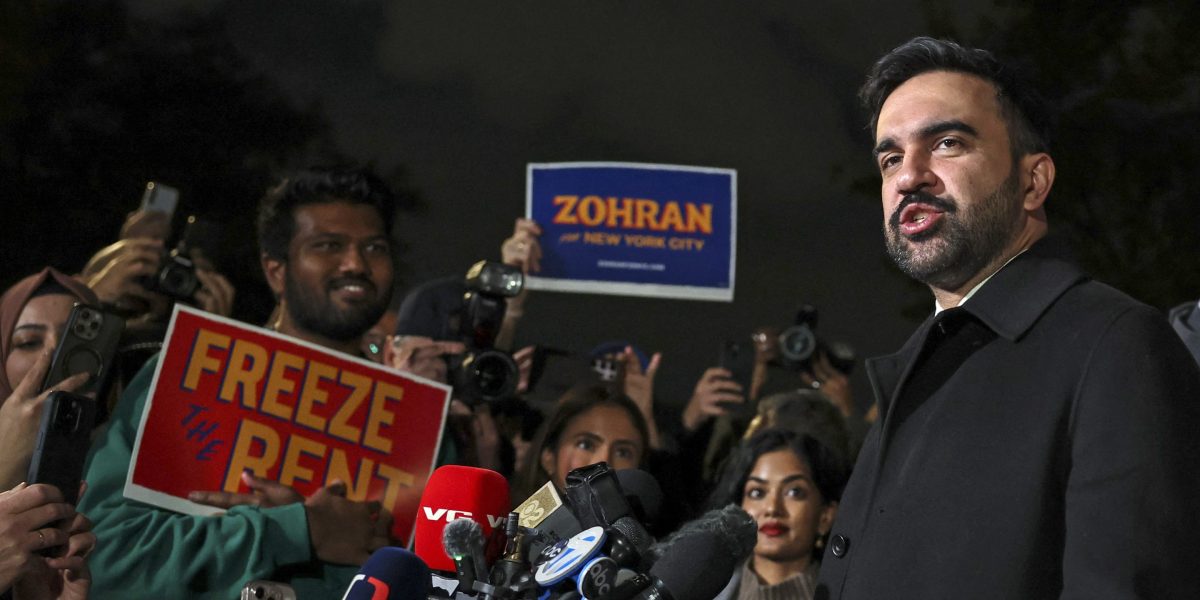
Some CEOs have vowed to revolt against a Zohran Mamdani win. Jamie Dimon says he’ll ‘offer my help’

Published

on


Good morning. It’s election day here in New York City. President Donald Trump has endorsed former New York Governor Andrew Cuomo for mayor, calling on New Yorkers to defeat “Communist” Zohran Mamdani in a post on Truth Social. But in my conversations with business leaders over the past few weeks, I’ve sensed a more nuanced stance on the 34-year-old Democratic Socialist who’s now leading in the polls. As one Wall Street executive pointed out to me in Miami: “He’s changed his mind on some things (such as defunding the police) and he needs to get support on others (such as raising state tax rates), so let’s see how he operates.”

Here are some issues on the radar for business:

Tax Hikes –  Mamdani has said he can raise $10 billion through a 2% income tax surcharge on salaries over $1 million, raising the state’s top corporate tax rate to 11.5%, transforming procurement and collecting almost $700 million that the city is owed. But Mamdani himself has admitted that the bulk of these moves require legislative action beyond his control.

Business Exodus – Dave Portnoy of Barstool Sports has threatened to move his New York City headquarters if Mamdani is elected. That would impact a little more than 300 people. But Jamie Dimon of JPMorgan, which has 24,000 employees in the city, recently told Fortune editor-in-chief Alyson Shontell that he’d help Mamdani or any mayor that wins the election. “You know, we survived [Mayor] Bill de Blasio,” he said. “New York will survive.”

City-run Stores – If you want to bet on the prospects for Mamdani’s plan to open a government-run grocery store in every borough, talk to one of my favorite people to interview: John Catsimatidis, who runs Gristedes and D’Agostino Supermarkets in New York. Opening a business with 2% margins in a city that already gets top scores for equitable access to groceries sounds like a losing proposition. Catsimatidis has threatened to close stores if Mamdani wins. Maybe he’ll go back to his earlier offer to give the mayor a store to run.

Real Estate – Mamdani’s promise of a rent freeze for 2 million New Yorkers in rent-stabilized apartments means a rent hike for everyone else. That, plus the prospect of tax hikes, is reviving interest in real estate in the city’s affluent suburbs. But affordability is a real issue as CEOs have told me it’s harder to attract talent to the city because of the cost of living, especially for startups and industries like fashion and advertising that can’t offer Wall Street salaries.

Gen Z –  Frustrated over housing costs, career opportunities and more, young New Yorkers want to change the status quo. That’s not unique to New York, of course, and CEOs are concerned that the next generation of leaders doesn’t trust that business or government is on their side. If Mamdani can ignite enthusiasm for civic engagement among Gen Z, that could be a boon for everyone. 

Just a reminder to join my colleagues Geoff Colvin and Sheryl Estrada for a conversation on “Optimizing for a Human–Machine Workforce,” next Thursday, Nov. 13, from 11:00 AM to 12:00 Noon ET. They’ll be joined by Deloitte’s Global AI Leader Nitin Mittal and INRIX CFO Thadd Stricker. You can register here.

More news below.

Contact CEO Daily via Diane Brady at diane.brady@fortune.com

Top news

OpenAI taps AWS

Amazon shares closed at a record high Monday after OpenAI agreed to buy $38 billion worth of AWS capacity in a fresh sign that the ChatGPT developer is no longer dependent on Microsoft. Amazon will eventually build new data centers to meet OpenAI’s demand.

Norway rejects Musk’s pay

Norway’s sovereign-wealth fund rejected Elon Musk’s proposed $1 trillion pay package due to concerns over “the total size of the award, dilution, and lack of mitigation of key person risk.” The $1.9 trillion fund is the first major Tesla investor to publicize its decision ahead of Thursday’s vote.

Starbucks offloads its China business

Starbucks is selling a 60% stake in its China business to Boyu Capital, a Chinese private equity firm. The U.S. coffee chain will continue to own and license its brand in the country. Starbucks has struggled in China, its second-largest market, due to sluggish consumer spending and new competition from domestic brands like Luckin Coffee. 

Kimberly-Clark’s Tylenol deal

Consumer goods company Kimberly-Clark will buy Tylenol parent Kenvue for $40 billion, part of CEO Mike Hsu’s decade-long effort to turn around the maker of Huggies and Kleenex. Kimberly-Clark investors appeared skeptical of the deal; Kenvue is at risk of personal-injury lawsuits over the Trump administration’s claims that Tylenol causes autism. 

Partial SNAP payments

Tens of millions of Americans will only get partial payments from the Supplemental Nutrition Assistance Program (SNAP) for November due to the government shutdown, the White House announced late on Monday. Around one in eight U.S. families receive SNAP benefits. 

Trump officials block Nvidia’s China hopes

Top U.S. officials like Secretary of State Marco Rubio convinced President Donald Trump not to discuss the sale of advanced Nvidia chips to China during last week’s summit with Xi Jinping, the Wall Street Journal reports. Trump had previously signaled openness to allowing Nvidia to sell its advanced Blackwell AI chip to China as part of his trade war truce with Beijing.

The markets

S&P 500 futures were down 0.95% this morning. The last session closed down 0.46%. STOXX Europe 600 was down 1.31% in early trading. The U.K.’s FTSE 100 was down 0.76% in early trading. Japan’s Nikkei 225 was down 1.74%. China’s CSI 300 was down 0.75%. The South Korea KOSPI was down 2.37%. India’s NIFTY 50 was down 0.47%. Bitcoin was down at $104K.

Around the watercooler

A ‘jobless profit boom’ has cemented a permanent loss in payrolls as AI displaces labor at a faster rate, strategist says by Jason Ma

Goldman Sachs CEO says AI-induced growth offers a ‘path out’ of America’s $38 trillion debt crisis by Eleanor Pringle

Walmart CEO said paying its star managers upwards of $620,000 yearly empowered them to ‘feel like owners’ by Emma Burleigh

Both subprime and super prime loans are on the rise, signs of a K-shaped economy that is a ‘prescription for real trouble’ by Sasha Rogelberg

MacKenzie Scott gifts $80 million to Howard University, marking one of the school’s largest donations in its 158-year history by Sydney Lake

CEO Daily was compiled and edited by Angelica Ang, Nick Gordon, and Claire Zillman.

This is the web version of CEO Daily, a newsletter of must-read global insights from CEOs and industry leaders. Sign up to get it delivered free to your inbox.


Source link

Continue Reading

Business

Gen Z’s nostalgia for ‘2016 vibes’ reveals something deeper: a protest against the world and economy they inherited

Published

on


Gen Z’s “2016 vibes” fixation is less about pastel Instagram filters and more about an economic and cultural shift: they are coming of age in a world where cheap Ubers, underpriced delivery, and a looser-feeling internet simply no longer exist. What looks like a lighthearted nostalgia trend is something more structural: a reaction to coming of age against the backdrop of a fully mature internet economy.

On TikTok and Instagram, “2016 vibes” has become a full-blown aesthetic, with POV clips, soundtracks of mid‑2010s hits, and filters that soften the present into a memory. Searches for “2016” on TikTok jumped more than 450% in the first week of January, and more than 1.6 million videos celebrating the year’s look and feel have been uploaded, according to creator‑economy newsletter After School by Casey Lewis. Lewis noted that only a few months ago, “millennial cringe” was rebranded as “millennial optimism,” with Gen Zers longing to experience a more carefree era. Lin-Manuel Miranda’s Hamilton, although it debuted in 2015, arguably has a 2016 vibe, for instance. Some millennial optimism is downright bewildering to Gen Z, such as what it calls the “stomp, clap, hey” genre of neo-folk pop music, recalling millennials’ own rediscovery (and new naming) of “yacht rock.”

Meanwhile, Google Trends reports that the search hit an all-time high in mid-January, with the top five trending “why is everyone…” searches all being related to 2016. The top two were “… posting 2016 pics” and “... talking about 2016.”

Creators caption posts “2026 is the new 2016” and stitch side‑by‑side footage of house parties, festivals, and mall hangs, inviting viewers to imagine a version of young adulthood that feels more spontaneous and frictionless.​ At the risk of being too self-referential, the difference can be tracked in Fortune covers, from the stampeding of the unicorns, the billion-dollar startup that defined the supposedly carefree days of 2016, to the bust a decade later and the dawn of the “unicorpse” era.

And while the comparison may feel ridiculous to anyone who actually lived through 2016 as an adult and can remember the stresses and anxieties of that particular time, there is something going on here, with economics at its core. In short, millennials were able to enjoy the peak of a particular Silicon Valley moment in 2016, but 10 years later, Gen Z is late to the party, finding the price of admission is just too high for them to get in the door.

Everyone used to love Silicon Valley

For millennials, 2016 marked a time when technology expanded opportunity rather than eliminating it. Venture capital was cheap, platforms were underpriced, and software functioned to your personal advantage, with aforementioned unicorns flush with cash and willing to offer millennials a crazy deal. The early iterations of the gig-economy ecosystem—Uber, Airbnb, TaskRabbit—were at their peak affordability, lowering the cost of living and making urban life feel frictionless. And at work, new digital tools helped young employees do more, faster, standing out from the pack.

For older millennials, 2016 evokes a very specific consumer reality: Ubers that were often cheaper than cabs and takeout that arrived in minutes for a few dollars in fees. Both were the product of what The New York Times‘ Kevin Roose labeled the “millennial lifestyle subsidy” in 2021, looking back on the era “from roughly 2012 through early 2020, when many of the daily activities of big-city 20- and 30-somethings were being quietly underwritten by Silicon Valley venture capitalists.” Because Uber and Seamless were not really turning a profit all those years while they gained market share, as on a grander scale Amazon and Netflix were underpriced for years before cornering the market on ecommerce and streaming, these subsidies “allowed us to live Balenciaga lifestyles on Banana Republic budgets,” as Roose put it.

Gen Z never really knew what it felt like to take a practically free late-night ride across town, or feast on $50 worth of Chinese takeout while paying half that. And they certainly never knew what it felt like to see unlimited movies in theaters each month, for the flat rate allowed by one MoviePass app. For the generation seeking the 2016 vibe, $40 surge‑priced trips and double‑digit delivery fees are standard, not a shocking new inconvenience, and the frictionless urban lifestyle of the millennial heyday, before they entered their 40s, had (a declining number of) kids, and fought their way into the suburban housing market amid the pandemic housing boom, reads more like historical fiction than a realistic blueprint.​

Tech and digital culture was also just fun. Gen-Z remembers the heyday of Pokemon Go, the only app that somehow forced the youth outside and interacting with each other. Viral trends felt collective rather than segmented by algorithmic feeds. Back then, Vine jokes, Harambe memes, and Snapchat filters could sweep through timelines in a way that made the internet feel weirdly communal, even as politics darkened the horizon.

That helps explain why The New York Times‘ Madison Malone Kircher recently framed the new 2016 nostalgia as part of a broader reexamination of millennial optimism on social media. Celebrities like Kylie Jenner, Selena Gomez, and Karlie Kloss have joined in, uploading 2016 throwbacks that signal a desire to rewind to an era when influencer culture felt less high‑stakes and more experimental.

The moment tech stopped being fun

Then, something shifted. The attitude towards tech companies as nerdy but general do-gooders who “move fast and break things” for the sake of the world faded into a “techlash.” The Cambridge Analytica scandal rocked what was then called Meta and fueled panic around data privacy. Former tech insiders like Tristan Harris started popularizing the idea that the algorithms were addictive.

Thus, when Silicon Valley entered another boom cycle after the release of ChatGPT in 2022—producing a new generation of young, ambitious entrepreneurs and icons like Sam Altman and Elon Musk with a new breed of unicorns to go along with them—the moment was met with skepticism from Gen Z. Where millennials once found a quite literal free lunch, Gen Z increasingly sees threat.

The entry-level work that once functioned as a professional apprenticeship—research, synthesis, junior coding, coordination—is now being handled by autonomous systems. Companies are no longer hiring large cohorts of juniors to train up, often citing AI as the reason. Economists describe this as a “jobless expansion,” with data showing that the share of early-career employees at major tech firms has nearly halved since 2023. The result is a generation of so-called “digital natives” left to wonder whether the very skills they were told would future-proof them have instead been commoditized out of their reach.

Instead of innovation making technology feel communal and fun, as it did in 2016, generative AI has flooded platforms with low-quality content—what users now call “slop”—while raising alarms about addictive chatbots dispensing confident but dangerous advice to children. The promise of technology hasn’t vanished, but its emotional valence has flipped from something people used to get ahead to something they increasingly feel subjected to.

Gen Z’s view from the present

Commentators stress that this is largely a millennial‑led nostalgia wave—but Gen Z is the audience making it go massively viral. Many were children or young teens in 2016, old enough to remember the music and memes but too young to fully participate in the nightlife and freedom the year now symbolizes. For those now juggling college debt, precarious work, and a cost‑of‑living crisis, the grainy clips of suburban parking lots, festival wristbands, and crowded Ubers feel like evidence of a slightly easier universe that just slipped out of reach.​

In that sense, “2016 vibes” is a way for Gen Z to process a basic unfairness: they inherited the platforms without the perks. Casey Lewis argues that, even if Gen Z may be driving this trend’s surge to prominence, even a new kind of monocultural moment, it’s by definition a “uniquely millennial trend,” part of an ongoing reexamination of what is emerging with time as a culture created by the millennial generation. Lewis argues that 2016 has an “economic” hold on the cultural imagination, representing “a version of modern life with many of today’s technological advancements but greater financial accessibility.”

Chris DeVille, managing editor of the (surviving millennial-era) music blog Stereogum, tracked a similar trajectory in his introspective cultural history of indie rock, released in August 2025. He documented, at times with lacerating self-criticism, how the underground musical genre grew out of Gen X’s alternative music scene of the 1990s and turned into something that openly embraced synthesizers, arena sing-alongs and countless sellouts to nationally broadcast car commercials.

And that may be what the “2016 vibes” trend represents more than anything: an acknowledgement that the internet is fully professionalized and corporatized now, and the search for something organic, indie, and authentic will have to take place somewhere else.

This story was originally featured on Fortune.com


Source link

Continue Reading

Business

Billionaire Marc Benioff challenges the AI sector: ‘What’s more important to us, growth or our kids?’

Published

on


Imagine it is 1996. You log on to your desktop computer (which took several minutes to start up), listening to the rhythmic screech and hiss of the modem connecting you to the World Wide Web. You navigate to a clunky message board—like AOL or Prodigy—to discuss your favorite hobbies, from Beanie Babies to the newest mixtapes.

At the time, a little-known law called Section 230 of the Communications Safety Act had just been passed. The law—then just a 26-word document—created the modern internet. It was intended to protect “good samaritans” who moderate websites from regulation, placing the responsibility for content on individual users rather than the host company.

Today, the law remains largely the same despite evolutionary leaps in internet technology and pushback from critics, now among them Salesforce CEO Marc Benioff. 

In a conversation at the World Economic Forum in Davos, Switzerland, on Tuesday, titled “Where Can New Growth Come From?” Benioff railed against Section 230, saying the law prevents tech giants from being held accountable for the dangers AI and social media pose.

“Things like Section 230 in the United States need to be reshaped because these tech companies will not be held responsible for the damage that they are basically doing to our families,” Benioff said in the panel conversation which also included Axa CEO Thomas Buberl, Alphabet President Ruth Porat, Emirati government official Khaldoon Khalifa Al Mubarak, and Bloomberg journalist Francine Lacqua.

As a growing number of children in the U.S. log onto AI and social media platforms, Benioff said the legislation threatens the safety of kids and families. The billionaire asked, “What’s more important to us, growth or our kids? What’s more important to us, growth or our families? Or, what’s more important, growth or the fundamental values of our society?”

Section 230 as a shield for tech firms

Tech companies have invoked Section 230 as a legal defense when dealing with issues of user harm, including in the 2019 case Force v. Facebook, where the court ruled the platform wasn’t liable for algorithms that connected members of Hamas after the terrorist organization used the platform to encourage murder in Israel. The law could shield tech companies from liability for harm AI platforms pose, including the production of deepfakes and AI-Generated sexual abuse material.

Benioff has been a vocal critic of Section 230 since 2019 and has repeatedly called for the legislation to be abolished. 

In recent years, Section 230 has come under increasing public scrutiny as both Democrats and Republicans have grown skeptical of the legislation. In 2019 the Department of Justice under President Donald Trump pursued a broad review of Section 230. In May 2020, President Trump signed an Executive Order limiting tech platforms’ immunity after Twitter added fact-checks to his tweets. And in 2023, the U.S. Supreme Court heard Gonzalez v. Google, though, decided it on other grounds, leaving Section 230 intact.

In an interview with Fortune in December 2025, Dartmouth business school professor Scott Anthony voiced concern over the “guardrails” that were—and weren’t—happening with AI. When cars were first invented, he pointed out, it took time for speed limits and driver’s licenses to follow. Now with AI, “we’ve got the technology, we’re figuring out the norms, but the idea of, ‘Hey, let’s just keep our hands off,’ I think it’s just really bad.”

The decision to exempt platforms from liability, Anthony added, “I just think that it’s not been good for the world. And I think we are, unfortunately, making the mistake again with AI.”

For Benioff, the fight to repeal Section 230 is more than a push to regulate tech companies, but a reallocation of priorities toward safety and away from unfettered growth. “In the era of this incredible growth, we’re drunk on the growth,” Benioff said. “Let’s make sure that we use this moment also to remember that we’re also about values as well.”


Source link

Continue Reading

Business

Palantir CEO says AI “will destroy” humanities jobs but there will be “more than enough jobs” for people with vocational training

Published

on


Some economists and experts say that critical thinking and creativity will be more important than ever in the age of artificial intelligence (AI), when a robot can do much of the heavy lifting on coding or research. Take Benjamin Shiller, the Brandeis economics professor who recently told Fortune that a “weirdness premium” will be valued in the labor market of the future. Alex Karp, the Palantir founder and CEO, isn’t one of these voices. 

“It will destroy humanities jobs,” Karp said when asked how AI will affect jobs in conversation with BlackRock CEO Larry Fink at the World Economic Forum annual meeting in Davos, Switzerland. “You went to an elite school and you studied philosophy — I’ll use myself as an example — hopefully you have some other skill, that one is going to be hard to market.”

Karp attended Haverford College, a small, elite liberal arts college outside his hometown of Philadelphia. He earned a J.D. from Stanford Law School and a Ph.D. in philosophy from Goethe University in Germany. He spoke about his own experience getting his first job. 

Karp told Fink that he remembered thinking about his own career, “I’m not sure who’s going to give me my first job.” 

The answer echoed past comments Karp has made about certain types of elite college graduates who lack specialized skills.

“If you are the kind of person that would’ve gone to Yale, classically high IQ, and you have generalized knowledge but it’s not specific, you’re effed,” Karp said in an interview with Axios in November. 

Not every CEO agrees with Karp’s assessment that humanities degrees are doomed. BlackRock COO Robert Goldstein told Fortune in 2024 that the company was recruiting graduates who studied “things that have nothing to do with finance or technology.” 

McKinsey CEO Bob Sternfels recently said in an interview with Harvard Business Review that the company is “looking more at liberal arts majors, whom we had deprioritized, as potential sources of creativity,” to break out of AI’s linear problem-solving. 

Karp has long been an advocate for vocational training over traditional college degrees. Last year, Palantir launched a Meritocracy Fellowship, offering high school students a paid internship with a chance to interview for a full-time position at the end of four months. 

The company criticized American universities for “indoctrinating” students and having “opaque” admissions that “displaced meritocracy and excellence,” in their announcement of the fellowship. 

“If you did not go to school, or you went to a school that’s not that great, or you went to Harvard or Princeton or Yale, once you come to Palantir, you’re a Palantirian—no one cares about the other stuff,” Karp said during a Q2 earnings call last year.

“I think we need different ways of testing aptitude,” Karp told Fink. He pointed to the former police officer who attended a junior college, who now manages the US Army’s MAVEN system, a Palantir-made AI tool that processes drone imagery and video.  

“In the past, the way we tested for aptitude would not have fully exposed how irreplaceable that person’s talents are,” he said. 

Karp also gave the example of technicians building batteries at a battery company, saying those workers are “very valuable if not irreplaceable because we can make them into something different than what they were very rapidly.”

He said what he does all day at Palantir is “figuring out what is someone’s outlier aptitude. Then, I’m putting them on that thing and trying to get them to stay on that thing and not on the five other things they think they’re great at.” 

Karp’s comments come as more employers report a gap between the skills applicants are offering and what employers are looking for in a tough labor market. The unemployment rate for young workers ages 16 to 24 hit 10.4% in December and is growing among college graduates. Karp isn’t too worried. 

“There will be more than enough jobs for the citizens of your nation, especially those with vocational training,” he said. 


Source link

Continue Reading

Trending

Copyright © Miami Select.