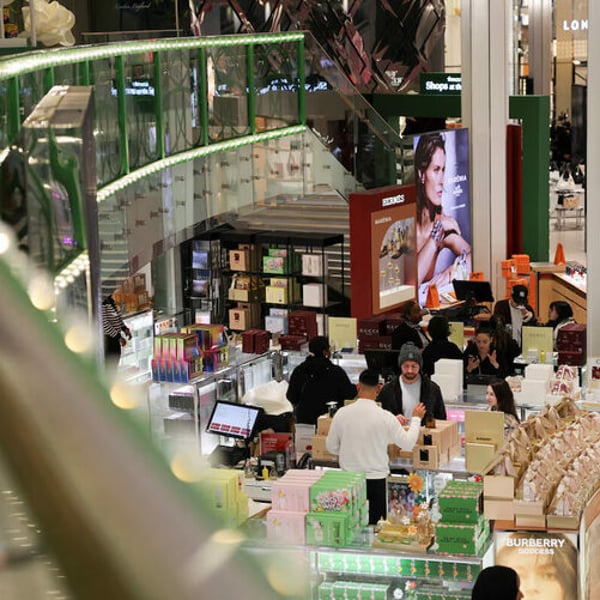
For Matt Hassett, founder of New York-based sleep wellness brand Loftie, the year-end holiday rush has always kept him on his toes.
Reuters
But this time, it has turned chaotic as import tariffs on China, from where Loftie sources its sunrise lamps and phone-free alarm clocks, disrupted supply chain.
“It’s been very difficult to prepare. We have sold down to extremely low stock levels – we probably have about 10% of the inventory we need,” he said earlier this week.
U.S. President Donald Trump‘s tariff flip-flop on goods from China, a lifeline for U.S. retailers, have forced small firms such as Loftie to choose between paying steep levies or finding new suppliers at even higher cost.
When Trump threatened tariffs as high as 180% on Chinese imports in mid-April, Hassett explored shifting production to Thailand, where duties were lower.
But when the rates on China was later cut to 20%, the alternative factories with 20% higher production costs proved to be costlier than the tariffs. In the end, Hassett stuck with his Chinese manufacturer. But the scramble delayed orders, leaving him dangerously short of stock ahead of the year’s busiest shopping season.
November and December typically account for a third of U.S. retailers’ annual profits.
Other small business owners are also struggling to balance inventory and changes to supplies, risking low stocks in warehouses and shelves during Black Friday.
Brooklyn-based Lo & Sons, which sells travel bags and accessories online, scouted up to eight factories between April and June in multiple countries, including India and Cambodia, before returning to its long-time supplier in China.
“On top of costing us a ton in tariff payments, the uncertainty prevented us from placing purchase orders,” CEO and co-founder Derek Lo said. “Now we’re sitting on lower-than-ideal inventory.”
Big-box retailers such as Walmart and Costco can soak in the supply jitters by leveraging scale more easily than smaller firms.
Operating margins for small retailers with total assets less than $50 million have plunged to negative 20.7%, according to business analytics provider RapidRatings, leaving 36% of them at a high risk of bankruptcy compared to 12% of large retailers.
“For the first time since the pandemic, average profit has dipped into negative territory… disproportionately impacting smaller companies that lack the scale and resources to absorb these pressures,” said James Gellert, executive chairman of RapidRatings.
Uncertainty from tariffs resulted in some businesses placing big holiday orders to get ahead of duties, but they risk getting stuck with unsold items due to an increasingly fragile consumer confidence.
More than a dozen small U.S. retailers that Reuters spoke to also flagged significant cost increases, resulting in some of them cutting jobs or trimming offerings to save cash.
The ripple effect of supply-chain disruptions can be seen across categories. Haus of Brilliance, a New York jewelry brand, shifted some production to Thailand and the U.S. to offset around 50% tariffs on India, its main hub.
The company has just completed its first production run in Thailand, which founder and CEO Monil Kothari is hoping will arrive in time for the holidays.
But “we will have shortages this holiday season and into next year”, he said. Loftie’s Hassett also has a shipment landing in time for Black Friday, but he has missed out on sales. “We could’ve made 50% more sales if we had enough inventory,” he said.
Monica Vinader has chosen English singer/songwriter Sienna Spiro as the face of the aspirational, ambitious premium jewellery brand.
Sienna Spiro
The “meaningful collaboration” links the jewellery brand “known for its design integrity and exceptional quality” to “one of music’s most compelling emerging voices… with her lyrics rooted in feeling and intention, qualities that closely align with Monica Vinader’s approach to design”, we’re told.
Throughout the campaign, Spiro wears the new Infinity collections as well as Monica Vinader pieces engraved with lyrics from her song ‘You Stole the Show’.
The engravings spotlight the brand’s personalisation services, “transforming jewellery into objects of meaning, from song lyrics and private messages to personal mantras”, the retailer said.
The brand, which has several stores in London, plus stores at Liverpool One, in Manchester and Edinburgh, appointed a new CEO in November. Sebastian Picardo now heads the previously family-run brand founded by siblings Monica (artistic director) and Gabriela (non-exec director) in 2008.
At the time of his appointment, the sisters said Picardo is “perfectly placed to guide our next phase of growth” and will work to accelerate the business’s global reach, “scaling innovation, inspiring existing and new audiences, and setting new standards for modern luxury jewellery”.
Scottish gymwear brand Dfyne has opening a 21,623 sq ft headquarters in Glasgow that “marks a major milestone in the company’s growth just four years after launch”, it said.
Dfyne
Designed in collaboration with workplace designer/builder Oktra, the new HQ provides a permanent base for Dfyne’s growing team and “reflects the brand’s ambition, identity, and people-first values.. as the business continues to grow”.
The opening marks ‘phase one’ of the project, with further phases planned to extend the workspace and complete the ground floor fit-out, it said.
The workplace is organised around a series of “clearly defined zones, balancing focused workspaces with informal collaboration areas and spaces to showcase Dfyne products”.
“Cultural storytelling” is also embedded within the design. Brown leather seating in the new meeting booths references a brown leather sofa from Dfyne’s original headquarters – a piece closely associated with the brand’s early days and formative moments.
“This detail symbolises [our] journey from a small founding team to a fast-growing international brand, while maintaining a strong connection to its roots”, it said.
CEO Oscar Ryndziewicz added: “In only four years, and thanks to our incredible community, we’ve grown to such a level that we can create a new, tailor-made space for our team that embodies our brand values. With the creation of unique workspaces, our new HQ is purposefully designed to enable everyone who supported the company’s growth to spark connections and inspire innovation.”
Puma is continuing its fruitful fashion-meets-sport collab with UK streetwear brand Represent, this time “rewriting the playbook of basketball-inspired staples”.
Puma x Represent
Fusing “Heritage Hoops Energy with Modern Streetwear”, it brings the two brands neatly together with a campaign fronted by German NBA star Dennis Schröder who “embodies the collection’s balanced fusion of court performance and off-court style”.
The “simple yet elevated collection” spans footwear and apparel that’s “highlighted by expressive and detailed cut-and-sew designs”, as well as a fresh interpretation of Puma’s All-Pro Nitro 2 sneaker.
Its “court-ready” Jersey and Shorts debut comes with a newly designed Puma x Represent graphic, featuring mesh construction and contrasting trim “that nods to retro game-day uniforms”.
The range is, of course, accompanied by “courtside essentials” including a Graphic T-Shirt and Hoodie, “pieces that bring bold visual detailing to the championship collaboration”.
A Coach Jacket and accompanying Pants also “comprise comfortable warm-up layers with everyday wearability”.
For footwear, Puma x Represent presents a re-envision All-Pro Nitro 2, a performance design underpinned by “explosive Nitro cushioning and a lightweight Ultraweave upper”. The black and white two-tone colourway is punctuated by subtle logo hits on the heel and tongue.
Complementing one of Puma’s “most modern examples of basketball performance technology”, the collection brings “a touch of ‘80s flair with the low-top Majesty”.