Connect with us

Business

Singapore voters seek stability as Trump roils global trade

Published

on


Any doubts about the People’s Action Party’s ability to continue dominating Singapore’s politics after six decades of rule were put to rest with Saturday’s election result.

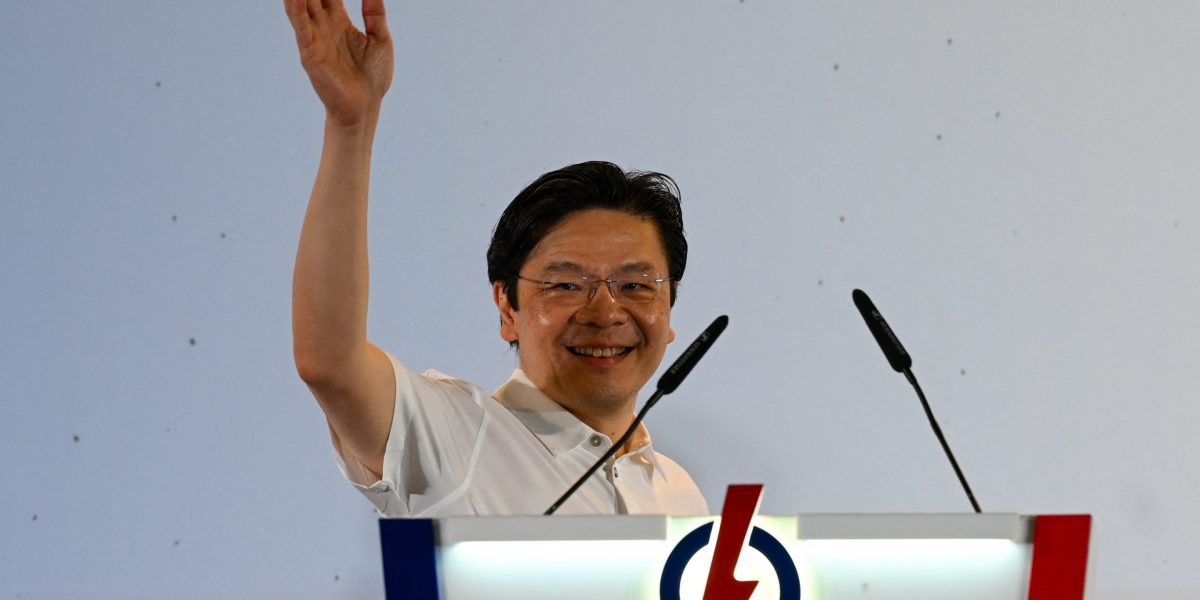
Led by Lawrence Wong in his first election as prime minster, the PAP took 87 of 97 seats in parliament, holding the opposition to the 10 it won during a breakout 2020 vote. The opposition had sought to extend those previous gains, but the mood changed as it became clear early on that voters flocked to safety amid the threat of global economic turmoil. 

The results are an endorsement of Wong’s strategy to deepen social aid in a bid to mitigate rising costs-of-living. They also echo the results of elections the past week in Australia and Canada, where voters backed incumbent parties as U.S. President Donald Trump’s policies roil global trade. 

The 52-year-old economist and his team have warned that inviting more opposition into government could create instability at just the wrong time for trade-dependent Singapore. 

“Lawrence Wong will be beaming like a Cheshire cat,” said Eugene Tan, associate professor of law at Singapore Management University. “He couldn’t have asked for a better result. This will let the PAP ride on for the next decade.”

The Straits Times Index was little changed on Monday, while the Singapore dollar edged higher against the greenback.

Beyond the parliamentary seats, Wong’s party did considerably better with the popular vote, garnering about 66% of the ballots cast, nearly 5 percentage points more than in 2020. 

That standing gives Wong all the backing he needs to complete a succession of new political leaders into his cabinet without much fuss from the opposition. The result also signals policy continuity to foreign companies that have helped make Singapore a global financial hub. 

‘Clear Signal’

It wasn’t all bad news for the opposition. Supporters of the Workers’ Party took some comfort in knowing they were able to hang onto the 10 seats they won in 2020, while boosting their share of the popular vote to almost 15%. That strengthens the WP’s claim as the primary voice for the opposition and, perhaps, a more potent force in the future. 

Yet Saturday’s election suggests a renewal of public trust in a political party that has been in charge since independence in 1965. Wong is the city-state’s fourth prime minister, and just the second not from Singapore founder Lee Kuan Yew’s family—Lee’s son Lee Hsien Loong held the top job from 2004-2024.

In the early hours of Sunday, Wong pledged to redouble efforts to tackle cost-of-living pressures facing Singaporeans. He also addressed the need to create more jobs and bolster support for healthcare, retirement, education and families.

“It’s a clear signal of trust, stability and confidence in your government,” he said early Sunday morning. “We will do our best to serve you and improve your lives.”

While a win was never in doubt, the margin of victory in Singapore can have a significant impact on public policy. 

In 2020 the PAP won 89% of the seats — its worst showing since independence, due in part to a backlash from younger voters. The party sought to lure them back ever since by, among other things, easing access to public housing and repealing a long-standing law barring sex between men. Half of the 32 new candidates the PAP floated in this election were under 40.

The transition to Wong marked a further shift in the PAP’s approach to addressing rising costs among some 3.6 million Singaporeans. That included first-time unemployment benefits and billions of dollars more in successive budgets to help pay for everything from meals to utilities and education support.

Trade War

Now Wong can focus on confronting economic headwinds that threaten to upend the city-state’s trade-reliant economy. The government last month revised its 2025 economic growth forecast down to 0-2% from a previous 1%-3%, and the prime minister has warned that a recession can’t be ruled out.

The strong result also provides a sigh of relief to companies, which were more likely to face higher taxes and restrictions on hiring foreign workers if the opposition had outperformed.

“For businesses, this means greater clarity and continuity in economic policy, including support for digital transformation, sustainability goals, and manpower policies,” said Nydia Ngiow, managing director at consultancy BowerGroupAsia. 

Companies will “find a more predictable regulatory environment in the near term, which would aid in investment planning and operational stability against the backdrop of the geopolitical tensions,” she said.

At the same time, Wong’s government will head into any trade negotiations with the U.S. more confident, with key ministers elected back into office. Wong had sought to convince voters on the campaign trail that Singapore would be in a stronger position to do just that if reelected.

The biggest tailwind for the PAP “was the heightened global uncertainty driven by the trade war unleashed by President Trump,” said Pushan Dutt, a professor of economics and political science at Insead in Singapore. “Voters were never going to take a gamble in the form of a protest vote.”

For the opposition, the result means that efforts to bring more balance and debate to parliament will have to wait. As the tallies came in Saturday evening, opposition candidates were despondent.

“We are shocked by the results,” said Leong Mun Wai, an opposition candidate from the Progress Singapore Party. “We may need to review our strategy and regroup ourselves to fight another day.”

Nonetheless, there was some consolation for them in the ability of the Workers’ Party to hold its ground in parliament. 

“Unlike other parties, the Workers’ Party was successful in staying competitive this time and now stand as the only real opposition force in Singapore,” according to polling firm Blackbox Research.  

This story was originally featured on Fortune.com


Source link

Continue Reading

Business

Not all CEOs favor Trump’s executive order to block state AI laws

Published

on

Good morning. What do companies in health care, insurance, utilities, construction, professional services, financial services, education, transportation, waste management, and alcohol/cannabis distribution, among others, have in common? They’re regulated at the state level. In certain areas (food safety, environmental standards and data privacy), a mix of state and federal mandates apply. Washington sets the baseline, and individual states layer on laws that aim to reflect the priorities of local voters. In the absence of a federal missive, like Roe v. Wade in legalizing abortion, state regulations apply.

So one might assume that CEOs would welcome Donald Trump’s executive order on AI last week that blocks state laws setting AI standards in favor of “a minimally burdensome national standard.” Silicon Valley types like OpenAI CEO Sam Altman, venture capitalist Marc Andreessen and, of course, AI czar David Sacks, praise the move as necessary for America to compete against the bête noire of China. But seven leaders I spoke with had more mixed views. (I spoke to them without attribution to encourage honest feedback.)

Nobody wants a growing patchwork of state laws that cause confusion, rising compliance costs, or what one person called “a race to be the Delaware of AI.” But neither do they want a vacuum when it comes to mitigating the risks or a situation where laws are set by the White House instead of Congress. Among the concerns:

The Executive Order is probably not legal. Everyone agreed that Trump can’t dismiss state rights with the stroke of a pen. As law firm Fisher Phillips notes, “all current and pending state and local AI laws will remain enforceable unless and until a court blocks them through an injunction, or Congress passes a federal law that preempts them.” The consensus: Congress should act—and fear-mongering doesn’t help. “I’m in a state with a lot of regulation and a lot of innovation,” said one California-based CEO. “What matters is resources, talent and technology.”

Businesses want clarity and protection. Tennessee’s ELVIS Act protects individuals from the unauthorized use of AI to mimic their voice and likeness; Texas prohibits its use for unlawful discrimination or sexually explicit content. Colorado requires companies to inform consumers when AI is used for high-stakes decisions from hiring to lending. Smaller businesses want the behemoths of tech kept in check. “Rules can level the playing field,” said one source, “and it’s more expensive to set standards in court.”

The U.S. needs to maintain its competitive edge. The EU Artificial Intelligence Act gives people the right to opt out of having their data used to train models, which stifles innovation. China has an AI Plus framework and President Xi Jinping has proposed creating a World Artificial Intelligence Cooperation Organization (WAICO) to promote a global governance system. The U.S. needs to, as one person put it, have a seat at the table with laws that protect copyright, patents, market access and consumer protections while driving regulation. “I’d rather have less regulation than more regulation,” an enterprise tech leader told me on Friday, “but I’d rather have some regulation than no regulation.”

Contact CEO Daily via Diane Brady at diane.brady@fortune.com

Top news

Weekend mass shootings

Australia Prime Minister Anthony Albanese has vowed action to tighten gun laws after a father and son, using legally licensed firearms, killed 15 people at a Hanukkah celebration at Bondi Beach. Meanwhile, Brown University has called off final exams and sent students home early after a gunman killed two and injured nine in an on-campus shooting. 

David Zaslav’s potential payday

Warner Bros. Discovery CEO David Zaslav is poised to collect as much as $1 billion from the sale of WBD if the bidding war between Netflix and Paramount continues to drive up the company’s stock price. His enormous payout will contrast starkly with the job cuts that are expected regardless of which deal goes through and the cost-cutting he’s already imposed at WBD. 

Volkswagen’s Germany closure

Volkswagen will cease production at a Dresden, Germany, plant on Tuesday, the first time it’s shuttered a production facility in Germany in 88 years. Europe’s largest automaker is contending with weak demand in China and Europe and the sting of U.S. tariffs. 

Private equity squeezes fire departments

Companies backed by private equity firms are quietly buying up the public safety systems needed to fight fires and increasing costs for budget-constrained U.S. fire departments, 85% of which are crewed by volunteers. 

Google’s SpaceX gain

Google parent Alphabet is poised to record another gain as the value of SpaceX nears $800 billion. Elon Musk’s rocket company completed a tender offer that priced shares at $421. Alphabet joined Fidelity Investments in a $1 billion funding round in 2015 in exchange for what was then a 10% stake in SpaceX. 

Christmas kitsch boom

Connecticut is cashing in on its role in sappy Christmas movies. Locations in the state are the settings for at least 22 Christmas movies by Hallmark, Lifetime and others, and it’s now promoting tours of the quaint towns and cities where the predictable—but hugely popular—movies are filmed.

The markets

S&P 500 futures are up 0.44% this morning. The last session closed down 1.07%. STOXX Europe 600 was up 0.75% in early trading. The U.K.’s FTSE 100 was up 0.88% in early trading. Japan’s Nikkei 225 was down 1.31%. China’s CSI 300 was down 0.63%. The South Korea KOSPI was down 1.84%. India’s NIFTY 50 was down 0.07%. Bitcoin went to $90K.

Around the watercooler

The Asian Infrastructure Investment Bank’s first president defends China’s role as ‘responsible stakeholder’ in a less multilateral world by Nicholas Gordon

Kevin Hassett says he’d be happy to talk to Trump everyday as Fed chair, but the president’s opinion would have ‘no weight’ on the FOMC by Jason Ma

Atlantic CEO Nick Thompson on how he learned to ‘just keep moving forward’ after his famous firing at 22 by Nick Lichtenberg

Everything the Trump administration is doing in Venezuela involves oil and regime change—even if the White House won’t admit it by Jordan Blum

CEO Daily is compiled and edited by Claire Zillman and Lee Clifford.


Source link

Continue Reading

Business

Rob Reiner, comedy legend who directed ‘When Harry Met Sally’ and ‘Spinal Tap,’ dead at 78

Published

on

Rob Reiner, the son of a comedy giant who went on to become one, himself, as one of the preeminent filmmakers of his generation with movies such as “The Princess Bride,” “When Harry Met Sally …” and “This Is Spinal Tap,” has died. He was 78.

Reiner and his wife, Michele Singer, were found dead Sunday at their home in the Brentwood neighborhood of Los Angeles. A law enforcement official briefed on the investigation confirmed that Reiner and Singer were the victims. The official could not publicly discuss details of the investigation and spoke to The Associated Press on condition of anonymity.

Authorities were investigating an “apparent homicide,” said Capt. Mike Bland with the Los Angeles Police Department. The Los Angeles Fire Department said it responded to a medical aid request shortly after 3:30 p.m.

Reiner grew up thinking his father, Carl Reiner, didn’t understand him or find him funny. But the younger Reiner would in many ways follow in his father’s footsteps, working both in front and behind the camera, in comedies that stretched from broad sketch work to accomplished dramedies.

“My father thought, ‘Oh, my God, this poor kid is worried about being in the shadow of a famous father,’” Reiner said, recalling the temptation to change his name to “60 Minutes” in October. “And he says, ‘What do you want to change your name to?’ And I said, ‘Carl.’ I just wanted to be like him.”

After starting out as a writer for “The Smothers Brothers Comedy Hour,” Reiner’s breakthrough came when he was, at age 23, cast in Norman Lear’s “All in the Family” as Archie Bunker’s liberal son-in-law, Michael “Meathead” Stivic. But by the 1980s, Reiner began as a feature film director, churning out some of the most beloved films of that, or any, era. His first film, the largely improvised 1984 cult classic “This Is Spinal Tap,” remains the urtext mockumentary.

After the 1985 John Cusack summer comedy, “The Sure Thing,” Reiner made “Stand By Me” (1986), “The Princess Bride” (1987) and “When Harry Met Sally …” (1989), a four-year stretch that resulted in a trio of American classics, all of them among the most often quoted movies of the 20th century.

A legacy on and off screen

For the next four decades, Reiner, a warm and gregarious presence on screen and an outspoken liberal advocate off it, remained a constant fixture in Hollywood. The production company he co-founded, Castle Rock Entertainment, launched an enviable string of hits, including “Seinfeld” and “The Shawshank Redemption.” By the turn of the century, its success rate had fallen considerably, but Reiner revived it earlier this decade. This fall, Reiner and Castle Rock released the long-in-coming sequel “Spinal Tap II: The End Continues.”

All the while, Reiner was one of the film industry’s most passionate Democrat activists, regularly hosting fundraisers and campaigning for liberal issues. He was co-founder of the American Foundation for Equal Rights, which challenged in court California’s ban on same-sex marriage, Proposition 8. He also chaired the campaign for Prop 10, a California initiative to fund early childhood development services with a tax on tobacco products. Reiner was also a critic of President Donald Trump.

That ran in the family, too. Reiner’s father opposed the Communist hunt of McCarthyism in the 1950s and his mother, Estelle Reiner, a singer and actor, protested the Vietnam War.

“If you’re a nepo baby, doors will open,” Reiner told the Guardian in 2024. “But you have to deliver. If you don’t deliver, the door will close just as fast as it opened.”

‘All in the Family’ to ‘Stand By Me’

Robert Reiner was born in the Bronx on March 6, 1947. As a young man, he quickly set out to follow his father into entertainment. He studied at the University of California, Los Angeles film school and, in the 1960s, began appearing in small parts in various television shows.

But when Lear saw Reiner as a key cast member in “All in the Family,” it came as a surprise to the elder Reiner.

“Norman says to my dad, ‘You know, this kid is really funny.’ And I think my dad said, ‘What? That kid? That kid? He’s sullen. He sits quiet. He doesn’t, you know, he’s not funny.’ He didn’t think I was anyway,” Reiner told “60 Minutes.”

On “All in the Family,” Reiner served as a pivotal foil to Carroll O’Connor’s bigoted, conservative Archie Bunker. Reiner was five times nominated for an Emmy for his performance on the show, winning in 1974 and 1978. In Lear, Reiner also found a mentor. He called him “a second father.”

“It wasn’t just that he hired me for ‘All in the Family,’” Reiner told “American Masters” in 2005. “It was that I saw, in how he conducted his life, that there was room to be an activist as well. That you could use your celebrity, your good fortune, to help make some change.”

Lear also helped launch Reiner as a filmmaker. He put $7.5 million of his own money to help finance “Stand By Me,” Reiner’s adaptation of the Stephen King novella “The Body.” The movie, about four boys who go looking for the dead body of a missing boy, became a coming-of-age classic, made breakthroughs of its young cast (particularly River Phoenix) and even earned the praise of King.

With his stock rising, Reiner devoted himself to adapting William Goldman’s 1973’s “The Princess Bride,” a book Reiner had loved since his father gave him a copy as a gift. Everyone from François Truffaut to Robert Redford had considered adapting Goldman’s book, but it ultimately fell to Reiner (from Goldman’s own script) to capture the unique comic tone of “The Princess Bride.” But only once he had Goldman’s blessing.

“At the door he greeted me and he said, ‘This is my baby. I want this on my tombstone. This is my favorite thing I’ve ever written in my life. What are you going to do with it?’” Reiner recalled in a Television Academy interview. “And we sat down with him and started going through what I thought should be done with the film.”

Though only a modest success in theaters, the movie — starring Cary Elwes, Mandy Patinkin, Wallace Shawn, André the Giant and Robin Wright — would grow in stature over the years, leading to countless impressions of Inigo Montoya’s vow of revenge and the risky nature of land wars in Asia.

‘When Harry Met Sally …”

Reiner was married to Penny Marshall, the actor and filmmaker, for 10 years beginning in 1971. Like Reiner, Marshall experienced sitcom fame, with “Laverne & Shirley,” but found a more lasting legacy behind the camera.

After their divorce, Reiner, at a lunch with Nora Ephron, suggested a comedy about dating. In writing what became “When Harry Met Sally …” Ephron and Reiner charted a relationship between a man and a woman (played in the film by Billy Crystal and Meg Ryan) over the course of 12 years.

Along the way, the movie’s ending changed, as did some of the film’s indelible moments. The famous line, “I’ll have what she’s having,” said after witnessing Ryan’s fake orgasm at Katz’s Delicatessen, was a suggestion by Crystal — delivered by none other than Reiner’s mother, Estelle.

The movie’s happy ending also had some real-life basis. Reiner met Singer, a photographer, on the set of “When Harry Met Sally …” In 1989, they were wed. They had three children together: Nick, Jake and Romy.

Reiner’s subsequent films included another King adaptation, “Misery” (1990) and a pair of Aaron Sorkin-penned dramas: the military courtroom tale “A Few Good Men” (1992) and 1995’s “The American President.”

By the late ’90s, Reiner’s films (1996’s “Ghosts of Mississippi,” 2007’s “The Bucket List”) no longer had the same success rate. But he remained a frequent actor, often memorably enlivening films like “Sleepless in Seattle” (1993) and “The Wolf of Wall Street” (2013). In 2023, he directed the documentary “Albert Brooks: Defending My Life.”

In an interview earlier this year with Seth Rogen, Reiner suggested everything in his career boiled down to one thing.

“All I’ve ever done is say, ‘Is this something that is an extension of me?’ For ‘Stand by Me,’ I didn’t know if it was going to be successful or not. All I thought was, ‘I like this because I know what it feels like.’”


Source link

Continue Reading

Business

Hero bystander who tackled Bondi gunman praised by Trump, Ackman

Published

on

A bystander who rushed and disarmed one of the Bondi Beach attackers has won praise from leaders around the world, including US President Donald Trump and hedge fund billionaire Bill Ackman, who announced a reward program for community heroes.

Extraordinary footage of the civilian’s actions began circulating on social media on Sunday, shortly after two men, later identified as a father and son, started shooting into a crowd gathered to celebrate the first day of Hanukkah. The massacre has left at least 16 people dead in the worst terrorist attack in Australia’s history. 

Read More: Sixteen People Killed in Bondi Beach Hanukkah Terror Attack 

In the mobile-phone video, which has not been verified by Bloomberg News, one of the attackers is standing near a tree and firing. A few meters away, a crouched man emerges from behind a parked car. He grabs the shooter from behind and wrestles the weapon from his hands. Local media named the bystander as Ahmed el Ahmed, a 43-year-old father-of-two from south Sydney. He was shot twice and is being treated in the hospital, according to reports.

He was also soon lauded for his feat. Trump said at the White House that Ahmed had saved many lives and expressed “great respect” for him. In Sydney, New South Wales Premier Chris Minns went further, describing Ahmed’s wrestle with the shooter as “the most unbelievable scene I’ve ever seen.”

“That man is a genuine hero and I’ve got no doubt there are many, many people alive tonight as a result of his bravery,” Minns said at a press conference late Sunday.

Australian Prime Minister Anthony Albanese also praised Ahmed, and other bystanders who helped treat victims in the immediate aftermath of the shooting. 

“People rushing towards danger to show the best of the Australian character,” Albanese told reporters Monday. “That’s who we are, people who stand up for our values.” 

Pershing Square Capital Management’s founder Ackman called Ahmed  “a brave hero” and said his hedge fund firm would establish a reward program for people who had carried out similar acts.

The top donor to a gofundme page set up for the “hero” who tackled the shooter is listed as William Ackman, who gave $99,999. More than $170,000 has been raised so far. 

Salesforce Inc. Founder and Chief Executive Officer Marc Benioff also expressed his gratitude for Ahmed in a post on X.


Source link

Continue Reading

Trending

Copyright © Miami Select.