Connect with us

Business

Silver pulls back after topping $80 in historic year-end rally

Published

on


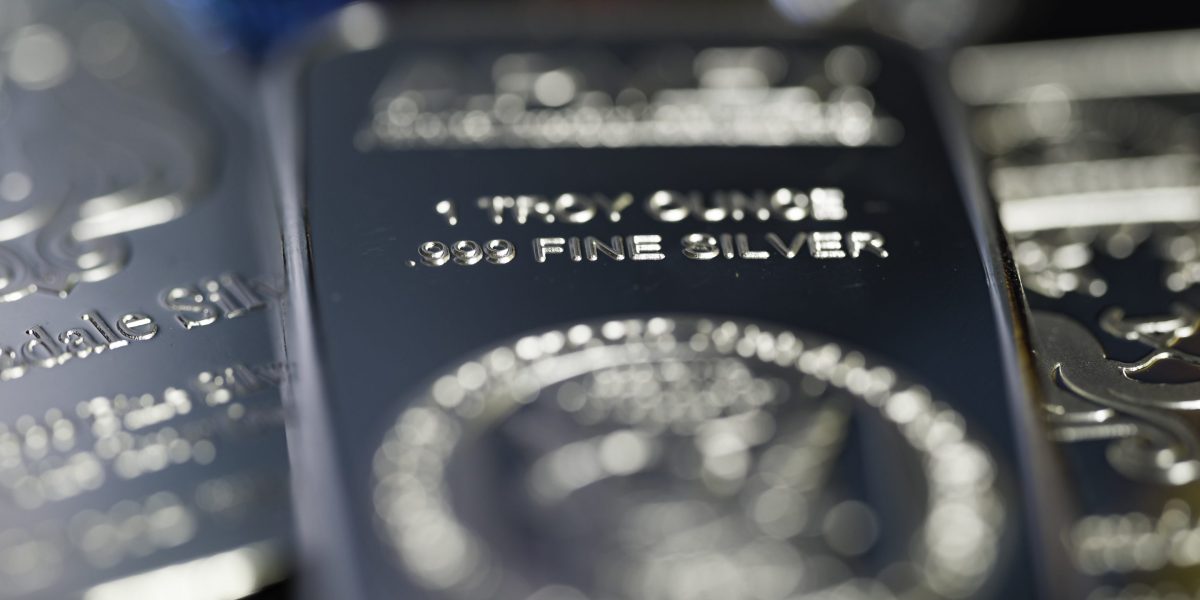
Silver retreated sharply after smashing through $80 an ounce for the first time, with traders taking profits from a record-breaking rally powered by a structural imbalance in supply and demand.

The white metal fell as much as 5% on Monday, after earlier spiking to a record $84 an ounce following five straight days of gains. A weaker dollar and escalating geopolitical tensions have added to the appeal of precious metals during an end-of-year jump to all-time highs for silver, gold and platinum. 

“Make no mistake: we are witnessing a generational bubble playing out in silver,” said Tony Sycamore, a market analyst at IG Australia.

Read More: Why Silver Has Been Surging Even More Than Gold

Silver’s rapid acceleration caps a yearlong rally for precious metals driven by elevated central-bank purchases, inflows to exchange-traded funds and three successive rate cuts by the US Federal Reserve. Lower borrowing costs are a tailwind for the commodities, which don’t pay interest, and traders are betting on more rate cuts in 2026.

In the last week, frictions in Venezuela — where the US has blockaded oil tankers — and strikes by Washington on Islamic State in Nigeria have added to the haven appeal of precious metals. The Bloomberg Dollar Spot Index, a key gauge of the US currency’s strength, fell 0.8% last week, its biggest weekly drop since June. A weaker dollar is generally supportive of gold and silver.

Silver is outshining gold for several reasons. For one, the market is thinner. Tighter inventories and liquidity that can evaporate quickly; while the London gold market is underpinned by around $700 billion of bullion that can be lent out in the event of a liquidity squeeze, no such reserve exists for silver. That historic supply squeeze happened in October.

Read More: Sold Out in India, Panic in London: How the Silver Market Broke

“The dominant driver of late has been a severe structural supply-demand imbalance in silver, sparking a scramble for physical metal,” said Sycamore. “Buyers are now paying a remarkable 7% premium for immediate delivery compared to waiting a year.”

Vaults in London have drawn sizable inflows since the October squeeze, but this has led to shortages elsewhere. In China, silver kept in warehouses linked to the Shanghai Futures Exchange last month hit the lowest level since 2015.

Added to that, much of the world’s readily available silver remains in New York as traders await the outcome of a US Commerce Department probe into whether imports of critical minerals pose a national security risk. The review could pave the way for tariffs or other trade curbs on the metal.

Read More: Precious Metals Craze Prompts China Fund to Turn Away Investors

Unlike gold, silver also has many useful real-world properties that make it a valuable component in a range of products like solar panels, AI data centers and electronics. With inventories near their lowest on record, there’s a risk of supply shortages that could impact multiple industries.

This prompted Elon Musk on Saturday to respond to a series of tweets on the supply shortage by saying on X: “This is not good. Silver is needed in many industrial processes.”

Technical indicators show the rally in silver may have run too hard, too fast. The metal’s 14-day relative strength index showed a reading of almost 80, far above the 70 that is considered to be overbought. 

Spot silver rose as much as 6% to a high of $84.00 an ounce before crashing 3.6% to trade at $76.47 as of 8:38 a.m. in Singapore. Gold fell 0.9% to $4,495.73 an ounce, below a record of $4,549.92 hit on Friday. Platinum and palladium both retreated after hitting records in the previous session.


Source link

Continue Reading

Business

Job market outlook 2026: ‘uncomfortably slow growth’ in the first half, then upward reversal later

Published

on


The labor market cooled during a rollercoaster year for the economy and financial markets, and 2026 should start off slow but then improve later in the year, according to JPMorgan.

In a forecast published earlier this month, economists at the bank attributed 2025’s loss of jobs momentum to business uncertainty created by President Donald Trump’s tariffs and trade policies.

“As a result both long-term and short-term business planning has remained difficult, and layoff and hiring rates have been low,” Michael Feroli, chief U.S. economist at JPMorgan, said in the report. “Businesses are hesitant to make sweeping changes to either grow or shrink their payrolls when they’re unsure what the next six months might hold.”

In addition, Trump’s immigration crackdown and deportation campaign have been more aggressive than expected, JPMorgan added.

This reduced supply of workers plus the relatively flat labor participation rate flat mean that the monthly job gains needed to keep unemployment steady could tumble to just 15,000 from 50,000. Despite the lower breakeven rate, unemployment will creep higher.

“The first half of 2026 will likely deliver uncomfortably slow growth in the labor market, with unemployment peaking at 4.5% in early 2026,” JPMorgan said, a week before the Labor Department released the delayed November jobs report that showed the rate climbing to a four-year high of 4.6%.

The bank blamed sluggish growth due to the labor supply shrinking from deportations, an aging population and fewer visas for workers and students.

Another factor in the early-2026 slump is artificial intelligence, which has spurred massive investment in equipment, software and data centers—but not so much job creation.

While there are still no signs yet of widespread job losses because of AI, some of the sectors most exposed to the technology have seen slower gains, JPMorgan pointed out.

But then the labor market will reverse course in the second half of the year, economists predicted, citing a more consistent tariff policy, tax cuts from Trump’s One Big Beautiful Bill Act, and additional rate cuts from the Federal Reserve.

“We believe supports are coming together that will arrest this labor market slowdown and revive activity growth later next year,” Feroli said. 

JPMorgan sees GDP growth in 2026 at 1.8%, with one-in-three odds of a recession, and inflation remaining sticky at 2.7%. 

Separately, Bank of America CEO Brian Moynihan expects Trump to de-escalate trade tensions next year, telling CBS News’ Face the Nation that an average tariff rate of 15% for a broad group of counties is “not a huge impact.”

Meanwhile, AI could be a wildcard that provides yet another boost next year.

“Usually, it takes several years for general purpose technologies like AI to boost productivity,” Feroli added. “A quicker realization of efficiency gains could lead to stronger GDP growth than expected.”

But that optimism contrasts with continued warnings from computer scientist and “godfather of AI” Geoffrey Hinton, who has said AI will replace more and more human workers.

During an interview on CNN’s State of the Union on Sunday, he was asked for his 2026 predictions after declaring 2025 a pivotal year for AI.

“I think we’re going to see AI get even better,” Hinton replied. “It’s already extremely good. We’re going to see it having the capabilities to replace many, many jobs. It’s already able to replace jobs in call centers, but it’s going to be able to replace many other jobs.”


Source link

Continue Reading

Business

North Korea’s Kim tests long-range cruise missiles over West Sea

Published

on


North Korea said it conducted a long-range strategic cruise missile launch drill over the West Sea on Sunday as it continues to showcase its weapons capabilities amid regional tensions.

Leader Kim Jong Un observed the drill, which was carried out to test the counterattack readiness and combat capabilities of long-range missile units, train missile operators in maneuvering and fire-mission procedures, and to verify the reliability of the strategic weapons system, Korean Central News Agency reported Monday.

The strategic cruise missiles flew along preset trajectories over waters off the country’s west coast for 10,199 seconds and 10,203 seconds — around 2 hours and 50 minutes each — before striking their targets, the state news agency said.

The results of the exercise provided a practical verification and a clear demonstration of the reliability and combat power of North Korea’s strategic counterattack capabilities, Kim said, expressing “great satisfaction” with the outcome, according to the report.

Read Also: North Korea’s Kim Seeks Arms Modernization Before Party Congress

He added that regularly testing the reliability and rapid response readiness of components of the country’s nuclear deterrent, and continuing to demonstrate their power, amounted to a responsible exercise of self-defense and a means of deterring war in the current security environment.

Kim stressed that the ruling party and government would continue to make all-out efforts to further strengthen and expand the country’s nuclear combat forces, KCNA reported.

Join us at the Fortune Workplace Innovation Summit May 19–20, 2026, in Atlanta. The next era of workplace innovation is here—and the old playbook is being rewritten. At this exclusive, high-energy event, the world’s most innovative leaders will convene to explore how AI, humanity, and strategy converge to redefine, again, the future of work. Register now.


Source link

Continue Reading

Business

Down Arrow Button Icon

Published

on


Brigitte Bardot, the French actress who set the standard for a generation of female sex symbols in the 1960s and devoted her later life to animal rights, has died. She was 91.

Her death was announced Sunday in a statement by her foundation, saying Bardot had chosen to abandon “her prestigious movie career to dedicate her life and energy” to defend animal welfare. It didn’t provide further details on her death.

The archetype of beauty to millions of men, Bardot spawned an era of curvy, pouting, insouciant actresses with her role as a self-assured small-town sexpot in And God Created Woman (1956). Throughout the 1970s, she was the model for “Marianne,” the female incarnation of the French republic whose profile adorns stamps and coins.

But Bardot quit making movies at age 39, and she courted controversy with comments about marginalized members of society. 

A Paris court fined her €5,000 (about $6,100 at the time) in 2004 for expressing “disgust” with France’s tolerance of Muslim immigrants in her 2003 autobiography, A Cry in the Silence. The book also referred to gay people as “freaks” and said the unemployed don’t want to work.

In a 2018 interview with Paris Match, she criticized the #MeToo movement against men who abuse positions of power, saying many actresses claiming sexual harassment had willingly offered their bodies to further their careers. Unlike Catherine Deneuve, who also spoke out against the movement, Bardot didn’t back down and apologize.

Her life was as tumultuous as those of women she portrayed. She was married four times and once said, “It’s better to be unfaithful than to be faithful and not want to be.”

Playboy magazine ranked her No. 4 on its 1999 list of the 20th century’s 100 sexiest stars, behind Raquel Welch, Jayne Mansfield and, at No. 1, Marilyn Monroe.

In 1986, she created a Paris-based foundation that supports animal refuges, sterilizes stray cats and dogs and funds projects including a horse-veterinarian center in Tunisia and a leper farm in India. The organization has also pushed for restrictions on bull fighting, whale hunting and the wearing of fur.

“I gave my youth and beauty to men,” she said in a 1999 interview. “I’m now giving my wisdom and experience to animals.”

Model at 13

Brigitte Anne-Marie Bardot was born on Sept. 28, 1934, in Paris and was already dancing and modeling at age 13. She was on the cover of Elle magazine at 15 and made her first film at 18.

The release of And God Created Woman established Bardot as an international star and Saint-Tropez as a major resort. While the film — about a woman torn between two brothers — didn’t have anything that would qualify as nudity today, its scenes of Bardot undressing and dancing barefoot to African music scandalized viewers in France and America. Bardot was married at the time to the film’s director, Roger Vadim.

Bardot went on to work with some of France’s top directors of her generation, including Henri-Georges Clouzot in La Verite (“The Truth”) in 1960, Louis Malle in Vie Privee (“A Very Private Affair”) in 1962, and Jean-Luc Godard in Mepris (“Contempt”) in 1963. She made her last film in 1973. She also released French pop songs in the 1960s and 1970s, including hits with the late singer and songwriter Serge Gainsbourg.

Bardot wanted to marry Vadim when she was 16, but her parents forced her to wait until she turned 18. They were together for five years before divorcing. He later married actress Jane Fonda.

Bardot’s second husband was actor Jacques Charrier, whom she married in 1959 after they met on the set of Babette Goes to War. They divorced after three years, during which they had Bardot’s only child, Nicolas-Jacques. A 1966 marriage to Gunter Sachs, a German photographer and art collector, lasted three years. Sachs committed suicide in 2011, seeking relief from an incurable degenerative disease, according to his family.

Her 1992 marriage to Bernard d’Ormale, a member of the anti-immigrant National Front party, linked her to the far-right in France.

Bardot said in interviews she wanted to be buried at her villa in Saint-Tropez on the French Riviera. She told Paris Match in 2018 that between the villa and a nearby farm, she owned about 50 dogs, cats, donkeys, pigs, sheep, goats, geese and turtles.

“Brigitte Bardot embodied a life of freedom,” French President Emmanuel Macron said in a post on X. “She touched us. We mourn a legend of the century.”


Source link

Continue Reading

Trending

Copyright © Miami Select.