Connect with us

Business

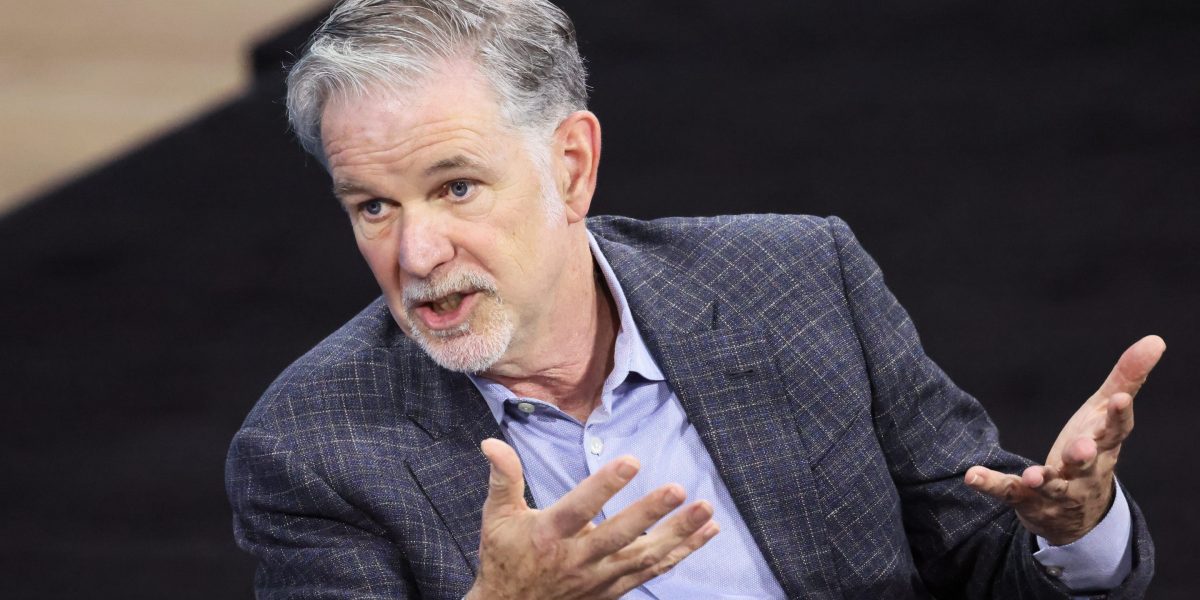
Silicon Valley Democrat Reed Hastings calls Trump’s $100K H-1B visa fee a ‘great solution’

Published

on


As tech leaders across Silicon Valley blasted President Donald Trump’s new $100,000 H-1B visa fee as a threat to innovation, Netflix cofounder Reed Hastings broke ranks, calling it “a great solution.”

In an X post on Sunday, Hastings said he has worked on H-1B politics for three decades and argued the steep cost would reserve visas for “very high-value jobs,” eliminating the lottery and giving employers more certainty.

Hastings’ support is surprising for a few reasons. For one, as one of the biggest Democratic ‘megadonors‘ who is heavily involved with party politics, he rarely endorses any of Trump’s actions and in fact has said the President “would destroy much of what is  great about America.”

Secondly, Hastings’ support cuts against the dominant mood in the tech industry, where most companies are alarmed about higher costs and the chilling effect on talent pipelines. Elon Musk, the on-again, off-again ally of the Trump White House, has fiercely criticized the potential changes to the program. 

Many local tech leaders have said that the six-figure fee could deal a serious blow to innovation and competitiveness in Silicon Valley. Venture capitalist Deedy Das, a former H-1B holder and partner at Menlo Ventures, warned that the policy undercuts America’s biggest advantage: Its ability to attract global talent. 

“If you stifle even that, it just makes it that much harder to compete on a global level,” he told CBS News

Smaller startups, Das added, could see their financial “runway” shortened by months if forced to absorb the new cost, while some founders say they’ll simply stop sponsoring foreign hires altogether. 

What the H-1B is—and what it has become

The H-1B program was created in 1990 to allow U.S. companies to hire foreign workers in “specialty occupations” that require highly technical or professional expertise. Theoretically, it’s meant to bring rare talent – think engineers, doctors, computer scientists and specialized researchers. Each year, Congress caps the number of new visas at 85,000, a number far below demand.

In practice, the program has evolved into something messier. Roughly 70% of visas go to Indian nationals, many not head-hunted by Silicon Valley firms but by outsourcing giants like Infosys, Wipro, and Tata Consultancy Services, many of whom work for some part of the IT sector. Those companies contract out employees to U.S. clients, leading critics—including President Donald Trump—to accuse them of undercutting American workers with lower-wage labor. 

Defenders argue the U.S. economy desperately needs these skills and that the visa holders often fill jobs that would otherwise go vacant. 

Elon Musk, CEO of Tesla and a one-time staunch supporter of Trump, famously had a Christmas-time bout with the MAGA base over his support for H-1B visas.

“There is a dire shortage of extremely talented and motivated engineers in America,” Musk posted on X. “If you force the world’s best talent to play for the other side, America will LOSE.”

He has said that he, like “many Americans,” is himself here due to the visa. 

Confusion, then clarification

Against that backdrop, Trump’s Friday proclamation requiring a $100,000 payment for each new petition sent shockwaves through the tech sector.

Commerce Secretary Howard Lutnick initially said the fee might be annual, fueling panic among employers. By Saturday, the White House clarified: it’s only a one-time payment applied to new petitions in future lotteries, not renewals or re-entries by existing visa holders. 

“This is NOT an annual fee,” spokesperson Karoline Leavitt wrote on X.

The clarification calmed some immediate fears, but not the broader unease. Many employers rushed to get their H-1b holders tickets to fly into the U.S. before the fee was enacted. Indian biotech professional Shubra Singh told CNBC that her Saturday dinner in Pittsburgh with H-1B friends was derailed by anxious news alerts that left many rushing to change travel plans.

Economic whiplash in India

The financial reverberations were immediate. Shares of major Indian IT outsourcing firms—including Infosys, Wipro, Tech Mahindra, HCL Technologies, and Tata Consultancy Services—fell between 1.7% and 4.2% on Indian stock exchanges during Monday trading.

Citi Research said in a note that the fee could shave about 100 basis points from margins and cut earnings per share across the IT sector by roughly 6% if companies continue staffing through H-1Bs. Analysts, including JP Morgan’s Toshi Jain, also predict fewer Indian students may choose U.S. universities if the post-graduation visa route now carries a six-figure price tag.

Yet some see opportunity. Accel partner Prashanth Prakash said the disruption could redirect top graduates toward India’s startup ecosystem.

“If Indian talent no longer heads to the U.S., it could be a boon for local entrepreneurship,” he argued.

SquadStack CEO Apurv Agrawal told the Economic Times of India the H-1B fee turmoil is pushing Indian professionals to see India itself—not the U.S.—as the ultimate destination for world-class talent.

“With the kind of AI-first companies and global-scale opportunities being built here today, we have a once-in-a-generation chance to retain and welcome back world-class talent,” Agrawal said.

Fortune Global Forum returns Oct. 26–27, 2025 in Riyadh. CEOs and global leaders will gather for a dynamic, invitation-only event shaping the future of business. Apply for an invitation.


Source link

Continue Reading

Business

Warner Bros. merger fight draws fire across U.S. political divide

Published

on


The battle for Warner Bros. Discovery Inc. has already lit a fire in Hollywood, with unions decrying the potential job losses, theaters sounding an alarm about the future of film releases and actors worrying about free speech. 

Now, the debate over which company will end up owning Warner Bros. — Netflix Inc. or Paramount Skydance Corp. — is carving up the country along political lines.

In Republican circles, it’s become fashionable to root against Netflix. Paramount is run by David Ellison, who has close ties to the White House and whose bid for Warner Bros. is backed by Jared Kushner, son-in-law of President Donald Trump. Some prominent Democrats, on the other hand, are voicing objections to the Paramount bid, crying foul over the $24 billion that’s coming from Middle East sources.

President Trump added drama on Wednesday when he said that any deal for Warner Bros. should include the sale of its CNN cable news network.

“It should be guaranteed that CNN is part of it or sold separately,” he said. The network is run by “a very dishonest group of people.”

Warner Bros. and Paramount declined to comment. Netflix didn’t respond to requests for comment.

Few mergers in recent memory have been as polarizing at the battle for Warner Bros., which combines the glamour of Hollywood, the influence of TV news, foreign intrigue tied to Middle Eastern funds and the specter of White House favoritism.

Trump’s comment triggered even more uncertainty. He had previously raised antitrust concerns about Netflix buying Warner Bros.

After a months-long auction, Warner Bros. agreed last week to sell its studios and streaming business, including HBO, to Netflix for $27.75 a share. Under the Netflix deal, Warner Bros. would move forward with its plan to spin off its cable networks, including CNN and TNT, into a separate company called Discovery Global.

Paramount, which kicked off the sale process by making several unsolicited offers for the company, responded on Dec. 8 by launching a $30-a-share hostile tender offer for all of Warner Bros., including the cable networks.

Paramount released a letter to shareholders on Wednesday reiterating that its offer is superior and more likely to win approval in Washington. 

Ellison has spoken publicly about having a good relationship with the Trump administration. His father Larry Ellison, the cofounder of Oracle Corp. and world’s second-richest person, is a Trump ally. 

Still, Trump hasn’t fully endorsed Paramount’s bid. He bashed the company on Monday over a 60 Minutes interview with Republican Congresswoman Marjorie Taylor Greene, who has become a vocal critic of the president. He also said that neither Netflix nor Paramount “are particularly great friends of mine.” 

Other politicians have been much clearer about who they’re rooting against in the bidding war.

In November, Republican Congressman Darrell Issa of California wrote a letter to Attorney General Pam Bondi asking whether a Netflix deal with Warner Bros. would give the streaming leader too much market power.

“Netflix is already the dominant streaming platform in the United States and permitting it to absorb a major competitor raises antitrust concerns that could result in a harm to consumers,” Issa wrote.

Democratic Representatives Sam Liccardo of California and Ayanna Pressley of Massachusetts sent a letter to Warner Bros. CEO David Zaslav on Wednesday raising concerns about the participation of foreign investors in Paramount’s bid, which includes backing from sovereign wealth funds in Saudi Arabia, Qatar and Abu Dhabi. 

“These investors, by virtue of their financial position or contractual rights, could obtain influence — direct or indirect — over business decisions that bear upon editorial independence, content moderation, distribution priorities, or the stewardship of Americans’ private data,” the lawmakers wrote. 

Like many in Hollywood, Democratic Senator Elizabeth Warren of Massachusetts would prefer no sale at all. She called Paramount’s offer a “five-alarm antitrust fire” on Monday after previously branding Netflix’s bid as an “anti-monopoly nightmare.”

Within the pro-Trump MAGA-verse, influencers and media commentators called on Trump to block a Netflix-Warner Bros. deal. Conservative commentator Laura Loomer zeroed in on Netflix’s ties to former President Barack Obama and his wife Michelle. They signed a deal with the company in 2018.

“If Netflix is allowed to buy Warner Bros. and Trump’s administration doesn’t kill off the merger, CNN will be transformed into the Obama News Network, featuring shows hosted by Michelle Obama @MichelleObama where she lectures Americans about how racist and sexist we are,” Loomer wrote on X

Right-wing podcaster Benny Johnson said combining Netflix with Warner Bros.’ streaming and studios asset would be “the most dangerous media consolidation in American history” and deliver “a monopoly on children’s entertainment” to “the Democrat super-donors that run Netflix.”

Former US Representative Matt Gaetz, who was previously nominated for attorney general by Trump before withdrawing, wrote “TRUMP MUST STOP THIS!” in a post on X shortly after the Netflix deal was announced.

“The most massive content distributor lashing to a massive content producer / catalog will create a homogenized, woke nightmare for the media landscape,” he wrote.

For Hollywood, much of the focus has been on how each deal would impact an industry already facing job losses, production cuts and the threat of artificial intelligence. 

With Netflix co-CEO Ted Sarandos previously deeming the experience of going to a movie theater to be “outdated,” some in the industry are concerned his company’s takeover of Warner Bros.’s streaming business would spell disaster for theater chains and film production. 

Michael O’Leary, CEO of movie theater trade group Cinema United, said in a statement last week that the Netflix deal “poses an unprecedented threat to the global exhibition business.”

“Netflix’s stated business model does not support theatrical exhibition,” he wrote. “In fact, it is the opposite.”

The Producer’s Guild of America urged protection for producers’ livelihoods and theatrical distribution. 

“Our legacy studios are more than content libraries – within their vaults are the character and culture of our nation,” the guild said.

Actress Jane Fonda spoke out against the Netflix deal last week calling it “an alarming escalation of the consolidation that threatens the entire entertainment industry, the democratic public it serves and the First Amendment itself.”

Other creatives commented on how the consolidation might affect consumers. In a skit from Morning Brew’s YouTube Channel Good Work, a movie viewer starts to stream a film at home, only to be barraged by a series of studio logos that include Netflix, Warner Bros., Paramount, HBO, Pixar and the Saudi Arabia Public Investment Fund. The viewer quickly gets bored before grabbing the remote.

“Let’s turn this off,” he says. 


Source link

Continue Reading

Business

Hinge’s founder and CEO is stepping down to start a new AI-first dating app

Published

on


After more than a decade as CEO of Hinge, Justin McLeod is stepping down to launch another dating app—with an AI twist.

McLeod started Hinge in 2011 and spent more than a decade at the helm, including after Match Group acquired the company in 2019. The company’s president and chief marketing officer, Jackie Jantos, will take over as CEO. 

McLeod’s new dating app, Overtone, plans to use “AI and voice tools to help people connect in a more thoughtful and personal way,” according to a press release. Yet, few further details are known about the venture. 

“We’re not going to talk a lot about [Overtone] quite yet,” McLeod told Fast Company, “except to say that there’s an opportunity to completely reimagine the dating experience and how technology can help facilitate people finding their partner—that breaks the mold of the way current dating apps are designed.”

Overtone started as a project within Hinge, but is now spinning off to operate independently. Still, it will continue to have ties to Match Group, which will lead the company’s first funding round in 2026 and plans to hold a “substantial ownership position.” Match CEO Spencer Rascoff will also sit on the board of directors, while McLeod serves as chairman of the board.

Match Group did not immediately respond to Fortune’s request for comment. 

The new venture comes as dating apps have struggled to maintain users. A 2024 study from Forbes found more than three quarters of dating-app users experienced some sort of “swipe fatigue,” and many said the burnout they experienced was linked to not being able to make genuine connections. 

Some data from the biggest market player, Tinder, dovetails with these sentiments. The app is down more than 1.5 million paying users from its peak in 2022, according to Fast Company. Match Group, which apart from Hinge also owns Tinder, Match.com, and OkCupid, reported a 2% year-over-year revenue increase in its latest quarter, yet Tinder’s paying customers dropped by 7%, according to the Wall Street Journal. To be sure, a bright spot in the company’s third quarter was Hinge, whose paying users increased 17%.

Amid potentially stagnating interest in dating apps, Match Group companies, as well as competitors Bumble and even Facebook Dating, have increasingly turned to AI to try to rekindle users’ interest. Earlier this year, Hinge launched a feature called “prompt feedback” that uses AI to help improve users improve the responses they give to public-facing prompts such as “my happy place.” 

Bumble and Tinder have also both added tools that use AI to analyze users’ photos and present the most appealing. Yet, it’s unclear if users are actually looking for more AI in their dating lives. In a study of 1,000 dating app users by Bloomberg Intelligence, nearly 50% of respondents said they didn’t have problems making a dating profile on their own, without AI.

While McLeod’s new project, Overtone, started within Match Group, he said it made more sense for the new dating app to be an independent company so it could move at the fastest possible pace. During his tenure, Hinge grew from less than $1 million in revenue in 2017 to roughly $400 million by 2023. He told Fast Company he was eager for a fresh challenge and to take the reins once more.

“I’m a founder and CEO at heart,” he said. “There’s a piece of me that wants to be out there on my own, ultimately steering the ship again.”


Source link

Continue Reading

Business

Jobs outlook 2026: ADP’s Nela Richardson doesn’t see Wall Street’s ‘rosy’ picture

Published

on


For all the volatility 2025 has endured, things have actually turned out relatively well: The S&P 500 is up by more than 17%, inflation hasn’t spiked despite an onslaught of tariffs, and the unemployment rate has stayed fairly steady.

Analysts and investors are generally feeling positive about 2026 as a result—after all, the U.S. economy’s performance has been above expectations since the pandemic, so why not take a bullish stance in the face of huge fiscal stimulus?

Well, beneath the relatively robust macroeconomic picture, cracks are beginning to show. Those tremors are already being felt; just look at the Fed’s decision to cut the base rate yesterday despite arguments that, under normal circumstances, there would be no particular reason to. Markets expected the cut based on the labor outlook, which is showing some signs of weakness in what Fed chairman Jerome Powell has called a “low-hire, low-fire” economy.

That weakness looks likely to become something of a fixture in 2026, according to ADP’s chief economist, Dr Nela Richardson. ADP’s take on the economy has grown in prominence this year, partly due to the government shutdown which meant public payroll data wasn’t published. In the void came data from ADP, which shares private payroll data insights.

Unlike her economist peers on Wall Street, Richardson tells Fortune: “We’re tracking changes in real time, it’s as high frequency as payroll data [can] get and we have not seen this rosy picture for 2026 in the data. I think [when people] point to an improved labor market next year, they’re highlighting a couple of things in the macro economy, while we’re looking at this very granular data set of private employment.

“They’re highlighting maybe a couple of rate cuts, they’re highlighting some tax advantages on the fiscal side, and they’re probably highlighting some AI and investment paying off—and certainly they’re probably adding some clarity in terms of trade policy and resolving some of the macro [questions]. All fantastic attributes, but it takes longer for those to trickle to mom and pop.”

Richardson points to the latest jobs reporting from her company: U.S. private employment dropped by 32,000 roles in November, lead by weakness from smaller businesses. Companies with between one and 19 employees axed 46,000 roles, while those with 20 to 49 employees cut 74,000. Conversely, companies with 500-plus employees added 39,000 employees.

“Tiny firms are a big chunk of employment, but the tiny firms are making tiny moves, and they’re moving all in the same direction,” Richardson added. “It could be as small as not hiring two teenagers at the bakery or foregoing that delivery driver over a certain season, it doesn’t mean it’s a big, huge layoff, it’s not replacing a worker here or there, and those changes add up. 

“If you’re making those micro moves, micro decisions for mom and pop [businesses], these macro drivers are less likely to influence your patterns.”

A rapidly evolving picture

Once upon a time, a sound work ethic and perseverance were enough to get you a foot on the career ladder. In 2025, that’s no longer the case—just ask the business leaders at the top of some of America’s largest corporations.

And while it’s true Gen Z are facing an entirely different job market to their parents, the rules of engagement are evolving so rapidly that market entrants one year to the next are facing a different set of hoops to jump through—making the picture for 2026 all the more complex.

These shifts have not happened in a vacuum, says Richardson, but are more a culmination of trends over the past five years. The so-called “Great Resignation” and the advancement of hybrid work are chief among them. Hybrid work, for example, means the pool of competition has expanded rapidly with hiring managers no longer constrained to a certain geography.

Likewise, “the Great Resignation meant people were able to demand their own terms,” Richardson added. “That meant hybrid work, that meant higher salaries and bonuses, all kinds of promotions happened during that time. Why leave?”

These factors mean the goalposts are constantly changing for market entrants: “It’s not even generation to generation,” Richardson says. “It’s your older brother and sister who graduated three or four years ago, it’s not even their job market anymore.”


Source link

Continue Reading

Trending

Copyright © Miami Select.