
Politics
Sheila Cherfilus-McCormick counsel pushes back on allegations of siphoning money to campaign
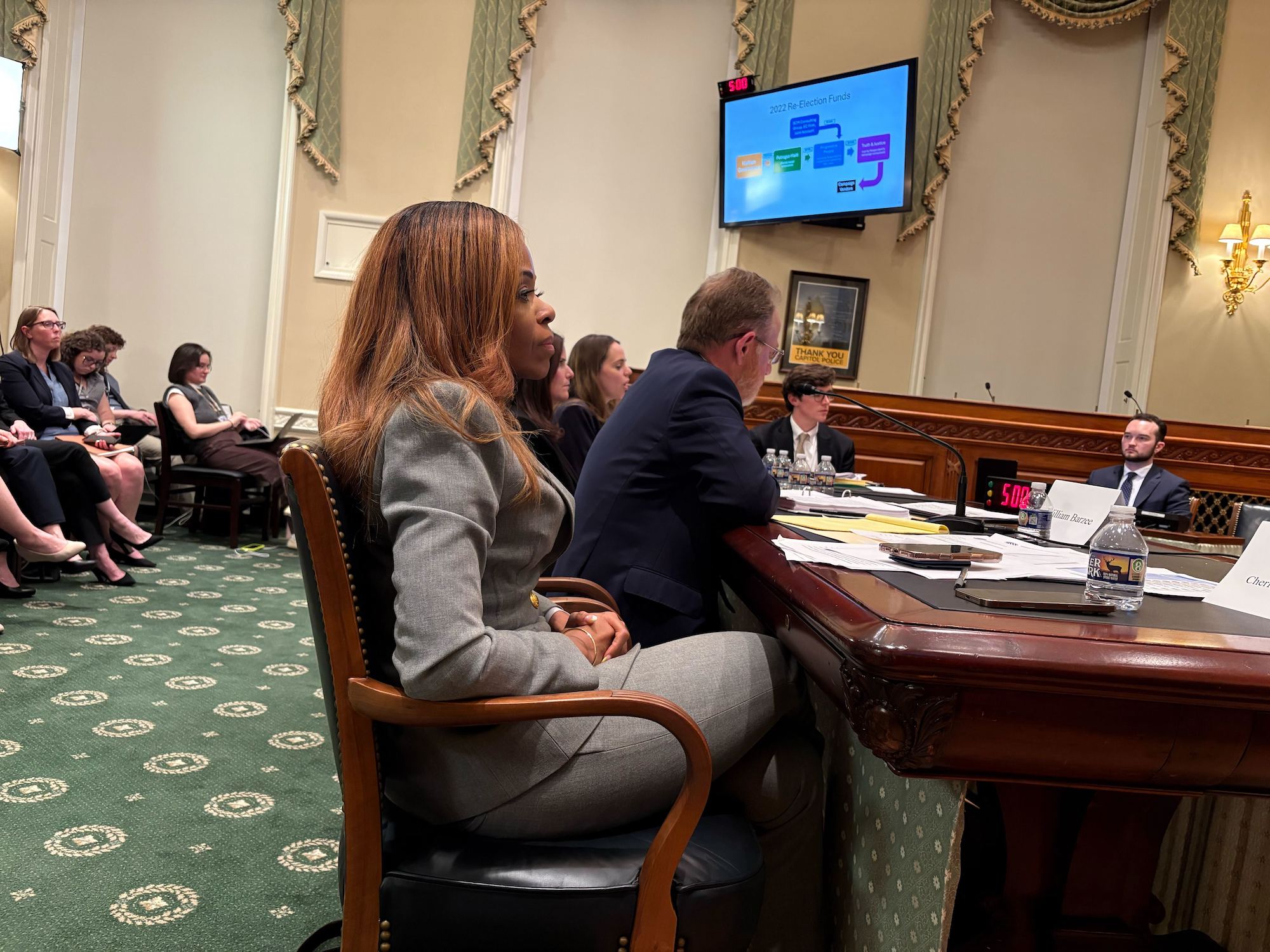
In a House Ethics trial, U.S. Rep. Sheila Cherfilus-McCormick’s counsel called a company handling multi-million-dollar contracts a family business.
Attorney William Barzee also classified an unsigned chart as a legal profit-sharing agreement. And he asserted a hearing on 27 ethical allegations threatened her 5th Amendment right to remain silent while under criminal investigation.
But House investigations staff said those claims are incredulous as the Congresswoman stands accused of 27 ethical violations, most related to the siphoning of more than $5 million dollars from an overpaid state contract into her congressional campaign.
Members of the House Ethics Committee from both political parties voiced skepticism over a hearing in Washington, D.C. that lasted into the evening.
“If I was looking at a financial statement in a family business, I would notice $5 million. I sure would notice if it went the other way,” said Rep. Mark DeSaulnier, ranking Democrat on the House Ethics Committee.
“If I had this kind of money and I was running for Congress, on the FEC, I would have hired someone to comply on stuff.”
House Ethics investigators say Cherfilus-McCormick did not properly report sources of income or the source of spending. But the most explosive charges, which are also at the center of a criminal case brought against the Miramar Democrat.
In the Ethics Trial, the flow of money detailed some $14 million in state funding paid to Trinity Health Care Services, a business she helped found. That money ended up being directed to a series of contractors run by Cherfilus-McCormick and her family members. That included $4.4 million sent to SCM Consulting, a business also run by Cherfilus-McCormick and bearing her initials in the name. But hundreds of thousands were also sent to companies founded by her brother, sister and a close family friend.
Each of those companies and several other accounts ultimately donated money to Cherfilus-McCormick’s 2021 Special Election campaign for Congress, sometimes exceeding campaign finance limits.
That alone could be a problem, but she ended up the subject of a federal criminal investigation because the state payments, part of an effort to deliver COVID-19 vaccines in underserved communities, were actually being overpaid. In the most serious case, a missing decimal point led to a payment of more than $50,000, resulting in a $5 million check.

Barzee, though, said the evidence was presented in a way that wrongly painted the collection of money as a crime. Individuals can make loans to their own campaign, he said, and nearly all of the money sent to the campaign was funding she was entitled to as payment from her business.
“We all agree that Florida sending Trinity a check is not evidence of money laundering?” he said.
He said that term, contained among 27 charges, implied money was gained from an illicit source.
“You’ve got to remember, this is happening during COVID,” Barzee said. Cherfilus-McCormick, he said, was “driving around the state of Florida, trying to get unrepresented communities vaccinated from the COVID virus. That’s what she was doing.”
As for the money landing in her own account, he said there was a profit-sharing agreement between Cherfilus-McCormick and Trinity. He provided an unsigned chart that showed how profits would be divided.
“That money was earned,” Barzee said. “That work was done.”
U.S. Rep. Nathaniel Moran, a Texas Republican, scoffed at both the amount spent for the work — “Wish I had a job like that,” he said — but also in the notion that an informal write-up should be seen as a legally binding contract about profit sharing.
The hearing also touched on allegations that Cherfilus-McCormick also benefited from a scheme by the Haitian government to siphon money through Petrogaz-Haiti into multiple political committees, some closely tied to the Congresswoman’s husband. Barzee said Cherfilus-McCormick had no idea any scheme was at work, and that she shouldn’t be held accountable for a plan of which she had no knowledge.
But most fundamentally, Barzee argued that the House ethics Committee shouldn’t exist at all. The pending criminal investigation created an inherent conflict because anything Cherfilus-McCormick said or provided at the Ethics trial could be used against her in a court of law. He asked the adjudicatory Committee overseeing the trial to postpone the hearing until after the federal case is resolved, likely in late Summer or Fall.
But the Committee in executive session declined to delay the case.
Britney Pescatore, director of investigations for the House Ethics Committee, also addressed the question of how culpable Cherfilus-McCormick may be for the movement of money and whether she had any knowledge of wrongdoing as it happened.
That included a Jan. 2, 2021, email where McCormick wrote: “I will be running for Congress again, and need to roll out my nonprofit.” She had previously challenged longtime U.S. Rep. Alcee Hastings in a Democratic Primary, but at that time, he was dying of cancer. He died on April 6 of the same year, prompting the election for his successor.