Connect with us

Politics

Senate passes Donald Trump’s big tax breaks and spending cuts bill as JD Vance breaks 50-50 tie
Published

on


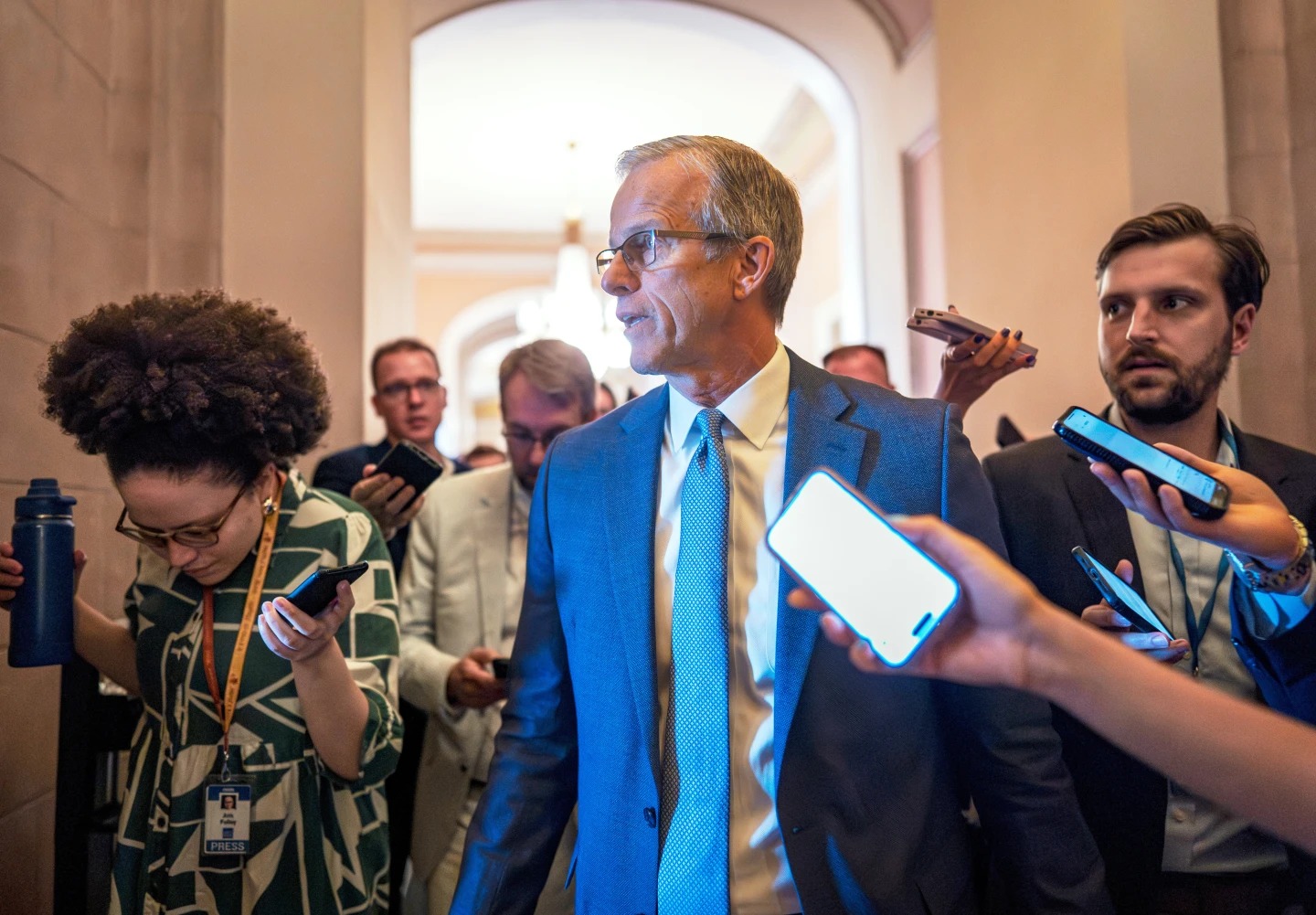
Senate Republicans hauled President Donald Trump’s big tax breaks and spending cuts bill to passage Tuesday on the narrowest of votes, pushing past opposition from Democrats and their own GOP ranks after a turbulent overnight session.

The outcome capped an unusually tense weekend of work at the Capitol, the President’s signature legislative priority teetering on the edge of approval or collapse. In the end that tally was 50-50, with Vice President JD Vance casting the tie-breaking vote.

Three Republican Senators — Thom Tillis of North Carolina, Susan Collins of Maine and Rand Paul of Kentucky — joined all Democrats in voting against it.

“The big not so beautiful bill has passed,” Paul said after the vote.

The difficulty it took for Republicans, who have the majority hold in Congress, to wrestle the bill to this point is not expected to let up. The package now goes back to the House, where Speaker Mike Johnson had warned Senators not to deviate too far from what his chamber had already approved. But the Senate did make changes, particularly to Medicaid, risking more problems as they race to finish by Trump’s Fourth of July deadline.

The outcome is a pivotal moment for President and his party, which have been consumed by the 940-page One Big Beautiful Bill Act,” as it’s formally titled, and invested their political capital in delivering on the GOP’s sweep of power in Washington.

Trump acknowledged it’s “very complicated stuff,” as he departed the White House for Florida.

“I don’t want to go too crazy with cuts,” he said. “I don’t like cuts.”

What started as a routine but laborious day of amendment voting, in a process called vote-a-rama, spiraled into a round-the-clock slog as Republican leaders were buying time to shore up support.

The droning roll calls in the chamber belied the frenzied action to steady the bill. Grim-faced scenes played out on and off the Senate floor, amid exhaustion.

Senate Majority Leader John Thune of South Dakota was desperately reaching for last-minute agreements between those in his party worried the bill’s reductions to Medicaid will leave millions without care, and his most conservative flank, which wants even steeper cuts to hold down deficits ballooning with the tax cuts.

The GOP leaders had no room to spare, with narrow majorities. Thune could lose no more than three Republican Senators, and two — Tillis, who warned that millions of people will lose access to Medicaid health care, and Paul, who opposes raising the debt limit by $5 trillion — indicated opposition ahead of the vote.

Attention quickly turned to two key Senators, Lisa Murkowski of Alaska and Collins, who also raised concerns about health care cuts, as well as a loose coalition of four conservative GOP Senators pushing for even steeper reductions.

Murkowski in particular became the subject of the GOP leadership’s attention, as they sat beside her for talks. She was huddled intensely for more than an hour in the back of the chamber with others, scribbling notes on papers.

Then all eyes were on Paul after he returned from a visit to Thune’s office with a stunning offer that could win his vote. He had suggested substantially lowering the bill’s increase in the debt ceiling, according to two people familiar with the private meeting and granted anonymity to discuss it.

Senate Democratic Leader Chuck Schumer of New York said “Republicans are in shambles because they know the bill is so unpopular.”

An analysis from the nonpartisan Congressional Budget Office (CBO) found 11.8 million more Americans would become uninsured by 2034 if the bill became law. The CBO said the package would increase the deficit by nearly $3.3 trillion over the decade.

And on social media, billionaire Elon Musk was again lashing out at Republicans as “the PORKY PIG PARTY!!” for including the $5 trillion debt ceiling in the package, which is needed to allow continued borrowing to pay the bills.

Senators insist on changes

Few Republicans appeared fully satisfied as the final package emerges, in either the House or Senate.

Collins had proposed bolstering the $25 billion proposed rural hospital fund to $50 billion, offset with a higher tax rate on those earning more than $25 million a year, but her amendment failed.

And Murkowski was trying to secure provisions to spare people in her state from some food stamp cuts, which appeared to be accepted, while she was also working to beef up federal reimbursements to hospitals in Alaska and others states, that did not comply with parliamentary rules.

“Radio silence,” Murkowski said when asked how she would vote.

The conservative Senators demanding a vote on their steeper health care cuts, including Rick Scott of Florida, Mike Lee of Utah, Ron Johnson of Wisconsin and Cynthia Lummis of Wyoming, filed into Thune’s office near-midnight.

What’s in the big bill

All told, the Senate bill includes $4.5 trillion in tax cuts, according to the latest CBO analysis, making permanent Trump’s 2017 rates, which would expire at the end of the year if Congress fails to act, while adding the new ones he campaigned on, including no taxes on tips.

The Senate package would roll back billions of dollars in green energy tax credits, which Democrats warn will wipe out wind and solar investments nationwide. It would impose $1.2 trillion in cuts, largely to Medicaid and food stamps, by imposing work requirements on able-bodied people, including some parents and older Americans, making sign-up eligibility more stringent and changing federal reimbursements to states.

Additionally, the bill would provide a $350 billion infusion for border and national security, including for deportations, some of it paid for with new fees charged to immigrants.

Democrats fighting all day and night

Unable to stop the march toward passage, the Democrats tried to drag out the process, including with a weekend reading of the full bill.

A few of the Democratic amendments won support from a few Republicans, though almost none were passing. More were considered in one of the longer such sessions in modern times.

One amendment overwhelmingly approved stripped a provision barring states from regulating artificial intelligence if they receive certain federal funding.

U.S. Sen. Patty Murray of Washington, the ranking Democrat on the Appropriations Committee, raised particular concern about the accounting method being used by the Republicans, which says the tax breaks from Trump’s first term are now “current policy” and the cost of extending them should not be counted toward deficits.

She said that kind of “magic math” won’t fly with Americans trying to balance their own household books.

___

Republished with permission of The Associated Press.


Post Views: 0


Source link

Continue Reading

Politics

Kevin Steele seeks insight from conservative leaders at Rick Scott-led summit

Published

on


State Rep. Kevin Steele’s campaign for Chief Financial Officer already enjoys political support from U.S. Sen. Rick Scott. The Dade City Republican attended a summit headlined by the Senator to also gain some policy insight and mentoring.

Steele was among the attendees for the Rescuing the American Dream summit held on Thursday in Washington, D.C. He said it was a quest for knowledge that drew him to Capitol Hill to hear the discussion.

“The way you do things better in the future is by learning from people who have already accomplished something,” Steele told Florida Politics at the event.

Scott gave a shoutout to Steele from the stage. The Governor already endorsed Steele, who is challenging the appointed Chief Financial Officer Blaise Ingoglia in 2026. At the summit, Scott both promoted conservative successes in the first year of President Donald Trump’s second term and laid out visions on issues from health care reform to cryptocurrency.

Steele called the panel discussions “amazing” and instructive on tackling affordability issues in Florida.

“If we don’t start addressing those things head first, we’re going to fall behind,” Steele said. “I think we’ve lost several million jobs in the state of Florida over the past six or seven years. Learning from Rick Scott and how to bring jobs back to the state is a good thing. And I think that we need to start tackling some of the big, big things that we need to attack.”

That includes addressing property insurance premiums head on and evaluating the property tax situation.

While he will be challenging a Republican incumbent in a Primary, Steele voiced caution at comparing his philosophy too directly with Ingoglia, a former Republican Party of Florida Chair with a history of animus with Scott.

But he did suggest Ingoglia’s recent scrutinizing of local governments may be starting at the wrong place when it comes to cutting spending.

“We need to start focusing on state down, instead of going to a county and pointing out flaws there,” Steele said. “There’s a lot of issues at the state level that we can address, some of which we are, some of which I’ve submitted different bills to address. I think that there’s a lot of waste and abuse at the state level that we can focus on.”


Source link

Continue Reading

Politics

Darren Soto refuses to call for Sheila Cherfilus-McCormick’s resignation

Published

on


U.S. Rep. Darren Soto is refusing to say whether indicted U.S. Rep. Sheila Cherfilus-McCormick should vacate her seat in Congress.

Video obtained by Florida Politics shows Soto being confronted on Capitol Hill. “Will you call on Sheila Cherfilus-McCormick to resign?” the videographer asks.

Initially, Soto remains silent, but the questioner suggests that silence shows “support” for someone who “stole $5 million in health care funds for the most vulnerable.” The Kissimmee Democrat then responds but continues walking away from the camera. He then conflates a censure motion against U.S. Rep. Cory Mills, a New Smyrna Beach Republican, and Cherfilus-McCormick, a Miramar Democrat.

“Both Mills and Cherfilus-McCormick, both will have due process. Thank you,” Soto said.

Both Cherfilus-McCormick and Mills remain the subjects of ongoing House Ethics Committee investigations. But only Cherfilus-McCormick now faces criminal prosecution for alleged financial crimes.

A grand jury in November indicted Cherfilus-McCormick on charges she stole $5 million in disaster relief funds to finance her 2021 congressional campaign.

The indictment alleges that Cherfilus-McCormick and her brother, Edwin Cherfilus, secured funding intended for a COVID vaccine distribution program, but when overpayments were made, she routed the spending through several accounts that later donated the funds as campaign contributions.

Minority Leader Hakeem Jeffries said pursuant to House rules that Cherfilus-McCormick had to give up her ranking status on the Subcommittee on the Middle East and North Africa. Local Democrats have started to issue calls for the Miramar Democrat’s resignation. But there have been no calls from Democratic members of Congress.

U.S. Rep. Greg Steube, a Sarasota Republican, has said if she won’t resign, he will move for her expulsion.

The National Republican Congressional Committee (NRCC), which lists Soto as a target in 2026, slammed Soto’s unwillingness to criticize a fellow Democrat.

“Darren Soto’s refusal to call on Sheila Cherfilus-McCormick to resign is unacceptable,” said NRCC spokesperson Maureen O’Toole. “Floridians deserve a representative who fights for them, not his taxpayer-thieving colleague.”


Source link

Continue Reading

Politics

Lawmakers propose tough penalties for adults who involve minors in animal cruelty

Published

on


Bipartisan legislation filed this week would expand Florida’s criminal penalties for adults who involve children in acts of animal cruelty or expose them to violent offenses against animals.

Democratic Sen. Kristen Arrington and Republican Rep. Linda Chaney filed the legislation (SB 676, HB 559). The bills would add new crimes to state law that make it a third-degree felony for an adult to entice a minor to commit animal cruelty, or for an adult to commit animal cruelty in the presence of a minor. 

The lawmakers cite studies that show children who witness acts of animal cruelty experience an increase in mental health issues, along with an increased likelihood of engaging in violence themselves. By addressing the cycle of abuse early on, they say children can be shielded from additional trauma caused by witnessing violence.

The proposal would also create offenses for adults who involve minors in animal fighting or baiting, and for sexual activities with animals, while also ranking the new crimes on the state’s offense severity chart and increasing penalties for certain felony offenses. If approved, the act would take effect Oct. 1, 2026.

Arrington, of Kissimmee, said the goal is to strengthen protections for both children and animals.

“Exposing children to acts of animal cruelty not only harms animals but has a profound negative impact on children’s emotional development and wellbeing” Arrington said in a statement. “This bill is meant to protect both our youth and our animals, ensuring that those who would involve minors in such heinous acts face strict consequences.”

Chaney, of St. Pete Beach, said animal crimes committed in front of children are closely linked with other forms of family violence.

“Committing animal crimes in front of minors is a serious issue that often co-occurs with other forms of family violence and can have severe, long-term traumatic effects on the children involved” Chaney said. “We must do all we can to break generational cycles of violence. This bill can do that.”

Democratic Rep. Johanna López of Orlando signed on as a prime co-sponsor.

“I’m honored to join Senator Arrington and Representative Chaney in advancing reforms that protect the safety and mental health of our minors and ensure that those who abuse our children or our pets are held accountable,” López said.


Source link

Continue Reading

Trending

Copyright © Miami Select.