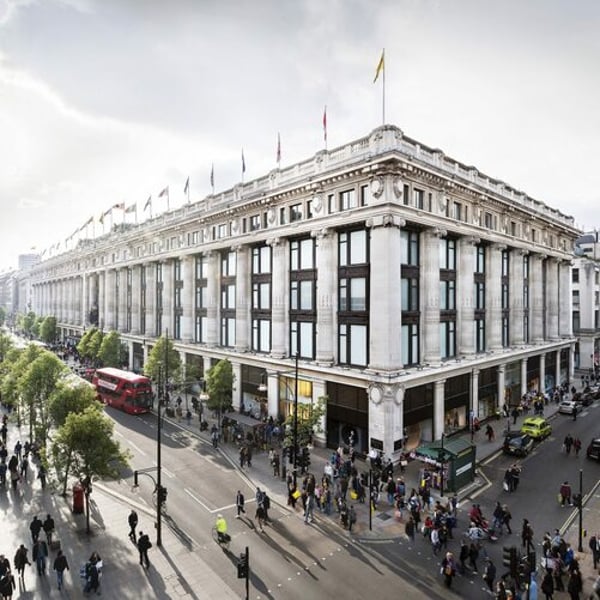
Selfridges Retail has filed its accounts for the 48 weeks to early January 2025 and said that profitability improved, although revenue was technically down.
Selfridges
The company said that revenue fell to £774.6 million from £834.9 million, although key here is that the previous period was a 53-week one that ended in February 2024. And if we make an over-simplistic calculation by dividing the latest figure by 48 weeks and the earlier one by 53 weeks, it would actually show a better revenue result per week in the most recent almost-year.
But as well as the revenue falling because of the shorter financial year, the company said it dipped due to a focus on more profitable sales, particularly from the digital retail business. And this focus on higher margins, combined with effective cost controls, led to an increase in its operating profit.
So with that in mind, operating profit rising to £42.2 million from £27.7 million looks even more impressive than the headline numbers suggest. And although it still made a loss before income tax of £15.9 million this time, that was compared to a £41.9 million deficit a year earlier. It had an income tax credit in both years, although in the previous year it was £28.1 million and this time it was only £17.7 million. The end result was that the profit for the latest financial period was £1.8 million compared to a loss of £13.8 million last time.
The company said that its trade and turnover continued to “feel impacts from various economic factors”, including the reduced numbers of international visitors coming to the UK and shopping in it stores (an obvious reference to the lack of tax-free shopping for tourists in the UK). But it also suffered from disruption to some supply chains due to worldwide conflicts and shipping route delays, as well as inflation and exchange rate fluctuations, price increases across luxury brands, and the overall higher cost of living.
During the shorter year in question, the company had seen a partial change of ownership with Austria-based Signa Retail bowing out as minority owner and the public investment fund (PIF) of Saudi Arabia taking over the holding.Thailand’s Central Group retains its majority shareholding with PIF now its minority partner.
Analyst view
So what do analysts think of the company’s results in what was clearly a turbulent year for it? Ashley Adeyemi, retail analyst at GlobalData, said that while it’s reduced its losses, “it has yet to break free from the drag of a weakening luxury market”.
But she highlighted that it’s doing plenty to reverse its losses: “The department store’s strategy continues to centre on experiential retail, using events, services and in-store destinations to drive loyalty and repeat visits as a way of creating greater resilience in a tougher luxury market. Its Selfridges Unlocked membership scheme has been further embedded, with expansion in 2025 to reward customers for time spent across its destinations, from restaurants and cinemas to beauty services.”
Selfridges was a key destination for brand activations during the year
However, she has issues with this: “While innovative, this approach raises questions about conversion, with the retailer acknowledging it is possible to reach the top ‘Very Selfridges Person’ tier without making a purchase. Without clearer disclosure on whether increased engagement is translating into spend, the commercial impact of this strategy remains uncertain.”
She had more praise for other initiatives that “demonstrate stronger evidence of traction”. Beauty saw “robust results” following the refurbishment of its London beauty hall, with sales up 10%, appointments up 22% and beauty concierge bookings ahead by 135%. The ReSelfridges circularity programme “also resonated with customers” (especially younger ones), with pre-owned bag sales up 56% and watches up 90%.
And its pop-up Corner Shop space hosted 32 immersive brand experiences, attracting more than 60,000 visitors, “helping to reinforce Selfridges’ positioning as a cultural as well as retail destination”.
The demerger of Unilever‘s ice cream division, to be named ‘The Magnum Ice Cream Company,’ which had been delayed in recent months by the US government shutdown, will finally go ahead on Saturday, the British group announced.
Reuters
Unilever said in a statement on Friday that the admission of the new entity’s shares to listing and trading in Amsterdam, London, and New York, as well as the commencement of trading… is expected to take place on Monday, December 8.
The longest federal government shutdown in US history, from October 1 to November 12, fully or partially affected many parts of the federal government, including the securities regulator, after weeks without an agreement between Donald Trump‘s Republicans and the Democratic opposition.
Unilever, which had previously aimed to complete the demerger by mid-November, warned in October that the US securities regulator (SEC) was “not in a position to declare effective” the registration of the new company’s shares. However, the group said it was “determined to implement in 2025” the separation of a division that also includes the Ben & Jerry’s and Cornetto brands, and which will have its primary listing in Amsterdam.
“The registration statement” for the shares in the US “became effective on Thursday, December 4,” Unilever said in its statement. Known for Dove soaps, Axe deodorants and Knorr soups, the group reported a slight decline in third-quarter sales at the end of October, but beat market expectations.
Under pressure from investors, including the activist fund Trian of US billionaire Nelson Peltz, to improve performance, the group last year unveiled a strategic plan to focus on 30 power brands. It then announced the demerger of its ice cream division and, to boost margins, launched a cost-saving plan involving 7,500 job cuts, nearly 6% of the workforce. Unilever’s shares on the London Stock Exchange were steady on Friday shortly after the market opened, at 4,429 pence.
This article is an automatic translation. Click here to read the original article.
Burberry has named a new chief operating and supply chain officer as well as a new chief customer officer. They’re both key roles at the recovering luxury giant and both are being promoted from within.
Matteo Calonaci becomes chief operating and supply chain officer, moving from his role as senior vice-president of strategy and transformation at the firm.
In his new role, he’ll be oversee supply chain and planning, strategy and transformation, and data and analytics. He succeeds Klaus Bierbrauer, who’s currently Burberry supply chain and industrial officer. Bierbrauer will be leaving the company following its winter show and a transition period.
Matteo Calonaci – Burberry
Meanwhile, Johnattan Leon steps up as chief customer officer. He’s currently currently Burberry’s senior vice-president of commercial and chief of staff. In his new role he’ll be leading Burberry’s customer, client engagement, customer service and retail excellence teams, while also overseeing its digital, outlet and commercial operations.
Both Calonaci and Leon will join the executive committee, reporting to Company CEO Joshua Schulman.
JohnattanLeon – Burberry
Schulman said of the two execs that the appointments “reflect the exceptional talent and leadership we have at Burberry. Both Matteo and Johnattan have been instrumental in strengthening our focus on executional excellence and elevating our customer experience. Their deep understanding of our business, our people, and our customers gives me full confidence that their leadership will help drive [our strategy] Burberry Forward”.
Traditional and occasion wear designer Puneet Gupta has stepped into the world of fine jewellery with the launch of ‘Deco Luméaura,’ a collection designed to blend heritage and contemporary aesthetics while taking inspiration from the dramatic landscapes of Ladakh.
Hints of Ladakh’s heritage can be seen in this sculptural evening bag – Puneet Gupta
“For me, Deco Luméaura is an exploration of transformation- of material, of story, of self,” said Puneet Gupta in a press release. “True luxury isn’t perfect; it is intentional. Every piece is crafted to be lived with and passed on.”
The jewellery collection features cocktail rings, bangles, chokers, necklaces, and statement evening bags made in recycled brass and finished with 24 carat gold. The stones used have been kept natural to highlight their imperfect and unique forms and each piece in the collection has been hammered, polished, and engraved by hand.
An eclectic mix of jewels from the collection – Puneet Gupta
Designed to function as wearable art pieces, the colourful jewellery echoes the geometry of Art Deco while incorporating distinctly South Asian imagery such as camels, butterflies, and tassels. Gupta divides his time between his stores in Hyderabad and Delhi and aims to bring Indian artistry to a global audience while crafting a dialogue between designer and artisan.