Connect with us

Business

Search for 27 missing girls plows forward after flash flood kills at least 51 people in Texas

Published

on


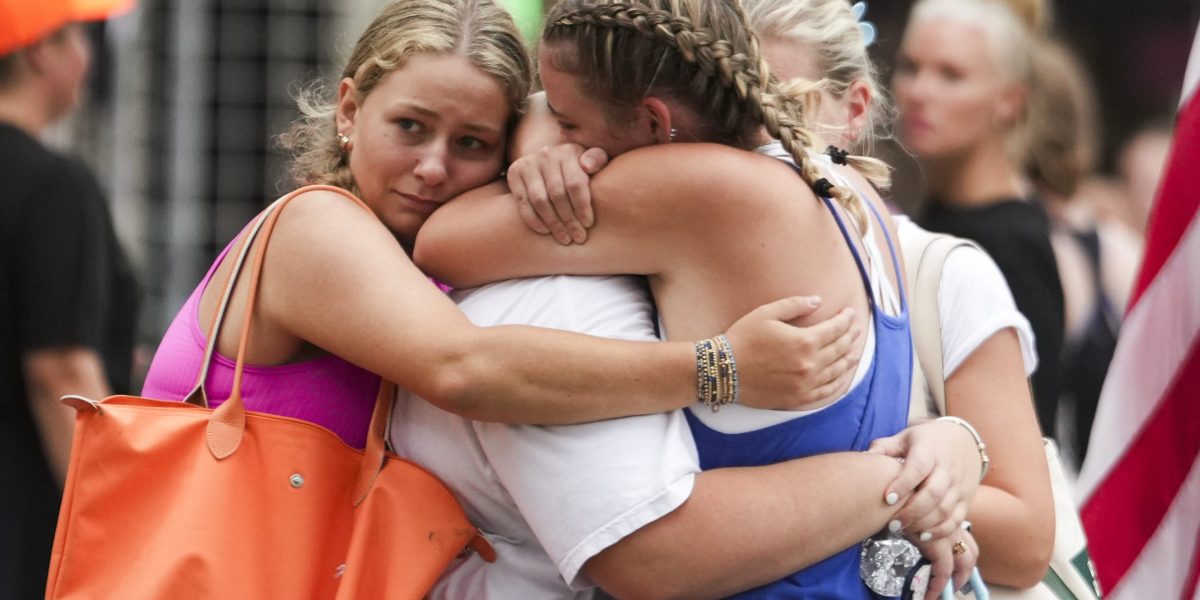
The grueling, desperate search for 27 missing girls stretched into a third day on Sunday after raging floodwaters surged into a summer camp as rescuers maneuvered through challenging terrain, while Texans were asked to pray that any survivors would be found.

At least 51 people, including 15 children, were killed, with most of the deaths coming in Kerr County in the state’s Hill Country. Besides the 43 dead in Kerr County, four deaths were reported in Travis, three in Burnet and 1 in Kendall.

Rescuers dealt with broken trees, overturned cars and muck-filled debris in a difficult task to find survivors. Authorities still have not said how many people were missing beyond the children from Camp Mystic, a Christian summer camp along the Guadalupe River in Kerr County where most of the dead were recovered.

The destructive, fast-moving waters rose 26 feet (8 meters) on the river in only 45 minutes before daybreak Friday, washing away homes and vehicles. The danger was not over as at least one flash flood warning remained in effect in central Texas on Sunday.

Searchers used helicopters, boats and drones to look for victims and to rescue people stranded in trees and from camps isolated by washed-out roads.

Gov. Greg Abbott vowed that authorities will work around the clock and said new areas were being searched as the water receded. He declared Sunday a day of prayer for the state.

“I urge every Texan to join me in prayer this Sunday — for the lives lost, for those still missing, for the recovery of our communities, and for the safety of those on the front lines,” he said in a statement.

Pope Leo XIV offered special prayers for those touched by the disaster. History’s first American pope spoke in English at the end of his Sunday noon blessing, “I would like to express sincere condolences to all the families who have lost loved ones, in particular their daughters who were in summer camp, in the disaster caused by the flooding of the Guadalupe River in Texas in the United States. We pray for them.”

Authorities were coming under scrutiny over whether the camps and residents in places long vulnerable to flooding received proper warning and whether enough preparations were made.

The hills along the Guadalupe River are dotted with century-old youth camps and campgrounds where generations of families have come to swim and enjoy the outdoors. The area is especially popular around the Independence Day holiday, making it more difficult to know how many are missing.

“We don’t even want to begin to estimate at this time,” Kerrville City Manager Dalton Rice said earlier.

Raging storm hit the camp in the middle of the night

“The camp was completely destroyed,” said Elinor Lester, 13, one of hundreds of campers. “A helicopter landed and started taking people away. It was really scary.”

The raging storm, fueled by massive amounts of moisture, woke up her cabin just after midnight Friday. When rescuers arrived, they tied a rope for the girls to hold as they walked across a bridge with water whipping around their legs, she said.

Frantic parents and families posted photos of missing loved ones and pleas for information.

Among those confirmed dead were an 8-year-old girl from Mountain Brook, Alabama, who was at Camp Mystic, and the director of another camp up the road.

The flooding in the middle of the night caught many residents, campers and officials by surprise.

AccuWeather said the private forecasting company and the National Weather Service sent warnings about potential flash flooding hours beforehand.

“These warnings should have provided officials with ample time to evacuate camps such as Camp Mystic and get people to safety,” AccuWeather said in a statement. It called the Hill Country one of the most flash-flood-prone areas of the U.S. because of its terrain and many water crossings.

At the Mo-Ranch Camp in the community of Hunt, officials had been monitoring the weather and opted to move several hundred campers and attendees at a church youth conference to higher ground. At nearby Camps Rio Vista and Sierra Vista, organizers also had mentioned on social media that they were watching the weather the day before ending their second summer session Thursday.

Authorities and elected officials have said they did not expect such an intense downpour, the equivalent of months’ worth of rain for the area.

U.S. Rep. Chip Roy, whose district includes the ravaged area, called it a once-in-a-century flood and acknowledged that there would be second-guessing and finger-pointing as people look for someone to blame.

Helicopters and drones used in frantic search

Search crews faced harsh conditions while “looking in every possible location,” Rice said.

Officials said more than 850 people were rescued in the last 36 hours, with heroic efforts at the camps to save children.

Homeland Security Secretary Kristi Noem arrived and pledged that the Trump administration would use all available resources. Coast Guard helicopters and planes were assisting to ensure operations continued even in darkness.

One reunification center at an elementary school was mostly quiet after taking in hundreds of evacuees the day before.

“We still have people coming here looking for their loved ones. We’ve had a little success, but not much,” said Bobby Templeton, superintendent of Ingram Independent School District.

People clung to trees and fled to attics

In Ingram, Erin Burgess awoke to thunder and rain in the middle of the night. Only 20 minutes later, water poured into her home, she said, describing an agonizing hour clinging to a tree with her teen son.

“My son and I floated to a tree where we hung onto it, and my boyfriend and my dog floated away. He was lost for a while, but we found them,” she said.

Barry Adelman said water pushed everyone in his three-story house into the attic, including his 94-year-old grandmother and 9-year-old grandson.

“I was having to look at my grandson in the face and tell him everything was going to be OK, but inside I was scared to death,” he said.

Locals know the area as “flash flood alley.”

“When it rains, water doesn’t soak into the soil,” said Austin Dickson, CEO of the Community Foundation of the Texas Hill Country, which was collecting donations. “It rushes down the hill.”

‘Nobody saw this coming’

The weekend forecast had called for rain, with a flood watch upgraded to a warning overnight Friday for at least 30,000 people.

“We know we get rains. We know the river rises. But nobody saw this coming,” said Kerr County Judge Rob Kelly, the county’s chief elected official.

The county had considered a flood warning system on the river similar to a tornado warning siren about six or seven years ago, but Kelly said the idea never got off the ground and the cost would have been an issue.

Kelly said he was heartbroken seeing body bags at the funeral home and the devastation on the ground during a helicopter tour.

“The rescue has gone as well as can be expected. It’s getting time now for the recovery,” he said. “And that’s going to be a long, toilsome task for us.”


Source link

Continue Reading

Business

Attacker who killed US troops in Syria was a recent recruit to security forces

Published

on


A man who carried out an attack in Syria that killed three U.S. citizens had joined Syria’s internal security forces as a base security guard two months earlier and was recently reassigned amid suspicions that he might be affiliated with the Islamic State group, a Syrian official told The Associated Press Sunday.

The attack Saturday in the Syrian desert near the historic city of Palmyra killed two U.S. service members and one American civilian and wounded three others. It also wounded three members of the Syrian security forces who clashed with the gunman, interior ministry spokesperson Nour al-Din al-Baba said.

Al-Baba said that Syria’s new authorities had faced shortages in security personnel and had to recruit rapidly after the unexpected success of a rebel offensive last year that intended to capture the northern city of Aleppo but ended up overthrowing the government of former President Bashar Assad.

“We were shocked that in 11 days we took all of Syria and that put a huge responsibility in front of us from the security and administration sides,” he said.

The attacker was among 5,000 members who recently joined a new division in the internal security forces formed in the desert region known as the Badiya, one of the places where remnants of the Islamic State extremist group have remained active.

Attacker had raised suspicions

Al-Baba said the internal security forces’ leadership had recently become suspicious that there was an infiltrator leaking information to IS and began evaluating all members in the Badiya area.

The probe raised suspicions last week about the man who later carried out the attack, but officials decided to continue monitoring him for a few days to try to determine if he was an active member of IS and to identify the network he was communicating with if so, al-Baba said. He did not name the attacker.

At the same time, as a “precautionary measure,” he said, the man was reassigned to guard equipment at the base at a location where he would be farther from the leadership and from any patrols by U.S.-led coalition forces.

On Saturday, the man stormed a meeting between U.S. and Syrian security officials who were having lunch together and opened fire after clashing with Syrian guards, al-Baba said. The attacker was shot and killed at the scene.

Al-Baba acknowledged that the incident was “a major security breach” but said that in the year since Assad’s fall “there have been many more successes than failures” by security forces.

In the wake of the shooting, he said, the Syrian army and internal security forces “launched wide-ranging sweeps of the Badiya region” and broke up a number of alleged IS cells. The interior ministry said in a statement later that five suspects were arrested in the city of Palmyra.

A delicate partnership

The incident comes at a delicate time as the U.S. military is expanding its cooperation with Syrian security forces.

The U.S. has had forces on the ground in Syria for over a decade, with a stated mission of fighting IS, with about 900 troops present there today.

Before Assad’s ouster, Washington had no diplomatic relations with Damascus and the U.S. military did not work directly with the Syrian army. Its main partner at the time was the Kurdish-led Syrian Democratic Forces in the country’s northeast.

That has changed over the past year. Ties have warmed between the administrations of U.S. President Donald Trump and Syrian interim President Ahmad al-Sharaa, the former leader of an Islamist insurgent group Hayat Tahrir al-Sham that used to be listed by Washington as a terrorist organization.

In November, al-Sharaa became the first Syrian president to visit Washington since the country’s independence in 1946. During his visit, Syria announced its entry into the global coalition against the Islamic State, joining 89 other countries that have committed to combating the group.

U.S. officials have vowed retaliation against IS for the attack but have not publicly commented on the fact that the shooter was a member of the Syrian security forces.

Critics of the new Syrian authorities have pointed to Saturday’s attack as evidence that the security forces are deeply infiltrated by IS and are an unreliable partner.

Mouaz Moustafa, executive director of the Syrian Emergency Task Force, an advocacy group that seeks to build closer relations between Washington and Damascus, said that is unfair.

Despite both having Islamist roots, HTS and IS were enemies and often clashed over the past decade.

Among former members of HTS and allied groups, Moustafa, said, “It’s a fact that even those who carry the most fundamentalist of beliefs, the most conservative within the fighters, have a vehement hatred of ISIS.”

“The coalition between the United States and Syria is the most important partnership in the global fight against ISIS because only Syria has the expertise and experience to deal with this,” he said.

Later Sunday, Syria’s state-run news agency SANA reported that four members of the internal security forces were killed and a fifth was wounded after gunmen opened fire on them in the city of Maarat al-Numan in Idlib province.

It was not immediately clear who the gunmen were or whether the attack was linked to the Saturday’s shooting.


Source link

Continue Reading

Business

AIIB’s first president defends China as ‘responsible stakeholder’ in less multilateral world

Published

on


When China wanted to set up its answer to the World Bank, it picked Jin Liqun—a veteran financier with experience at the World Bank, the Asian Development Bank, China’s ministry of finance and the China Investment Corporation, the country’s sovereign wealth fund—to design it. Since 2014, Jin has been the force behind the Asian Infrastructure Investment Bank, including a decade as its first president, starting in 2016. 

Jin’s decade-long tenure comes to an end on January 16, when he will hand over the president’s chair to Zou Jiayi, a former vice minister of finance. When Jin took over the AIIB ten years ago, the world was still mostly on a path to further globalization and economic integration, and the U.S. and China were competitors, not rivals. The world is different now: Protectionism is back, countries are ditching multilateralism, and the U.S. and China are at loggerheads. 

The AIIB has largely managed to keep its over-100 members, which includes many countries that are either close allies to the U.S.—like Germany, France and the U.K.—or have longstanding tensions with Beijing, like India and the Philippines.

But can the AIIB—which boasts China as its largest shareholder, and is closely tied to Beijing’s drive to be seen as a “responsible stakeholder”—remain neutral in a more polarized international environment? And can multilateralism survive with an “America First” administration in Washington?

After his decades working for multilateral organizations—the World Bank, the ADB, and now the AIIB—Jin remains a fan of multilateralism and is bullish on the prospects for global governance.

“I find it very hard to understand that you can go alone,” Jin tells Fortune in an interview. “If one of those countries is going to work with China, and then China would have negotiations with this country on trade, cross-border investment, and so on—how can they negotiate something without understanding the basics, without following the generally accepted rules?”

“Multilateralism is something you could never escape.”

Why did China set up the AIIB?

Beijing set up the Asian Infrastructure Investment Bank almost a decade ago, on Jan. 16, 2016. The bank grew from the aftermath of the Global Financial Crisis, when Chinese officials considered how best to use the country’s growing foreign exchange reserves. Beijing was also grumbling about its perceived lack of influence in major global economic institutions, like the International Monetary Fund and the World Bank, despite becoming one of the world’s most important economies.

With $66 billion in assets (according to its most recent financial statements), the Asian Infrastructure Investment Bank is smaller than its U.S.-led peers, the World Bank (with $411 billion in assets) and the Asian Development Bank (with $130 billion). But the AIIB was designed to be China’s first to design its own institutions for global governance and mark its name as a leader in development finance.

Negotiations to establish the bank started in earnest in 2014, as several Asian economies like India and Indonesia chose to join the new institution as members. Then, in early 2015, the U.K. made the shocking decision to join the AIIB as well; several other Western countries, like France, Germany, Australia, and Canada, followed suit.

Two major economies stood out in abstaining. The U.S., then under the Obama administration, chose not to join the AIIB, citing concerns about its ability to meet “high standards” around governance and environmental safeguards. Japan, the U.S.’s closest security ally in East Asia, also declined, ostensibly due to concerns about human rights, environmental protection, and debt.

“They chose not to join, but we don’t mind.” Jin says. “We still keep a very close working relationship with U.S. financial institutions and regulatory bodies, as well as Japanese companies.” He sees this relationship as proof of the AIIB’s neutral and apolitical nature.

Still, Beijing set up the AIIB after years of being lobbied by U.S. officials to become a “responsible stakeholder,” when then-U.S. Secretary of State Robert Zoellick defined in 2005 as countries that “recognize that the international system sustains their peaceful prosperity, so they work to sustain that system.”

Two decades later, U.S. officials see China’s presence in global governance as a threat, fearing that Beijing is now trying to twist international institutions to suit its own interests. 

Jin shrugs off these criticisms. “China is now, I think, the No. 2 contributor to the United Nations, and one of the biggest contributors to the World Bank and the Asian Development Bank” (ADB), Jin says. “Yet the per capita GDP for China is still quite lower than a number of countries. That, in my view, is an indication of its assumption of responsibility.”

And now, with several countries withdrawing from global governance, Jin thinks those lecturing China on being responsible are being hypocritical. “When anybody tells someone else ‘you should be a responsible member’, you should ask yourself whether I am, myself, a responsible man. You can’t say, ‘you’ve got to be a good guy.’ Do you think you are a good guy yourself?” he says, chuckling.

Why does China care about infrastructure?

From its inception, Beijing tried to differentiate the AIIB from the World Bank and the ADB through its focus on infrastructure. Jin credits infrastructure investment for laying part of the groundwork for China’s later economic boom.

“In 1980, China didn’t have any expressways, no electrified railways, no modern airports, nothing in terms of so-called modern infrastructure,” Jin says. “Yet by 1995, China’s economy started to take off. From 1995, other sectors—manufacturing, processing—mushroomed because of basic infrastructure.”

Still, Jin doesn’t see the AIIB as a competitor to the World Bank and the ADB, saying he’s “deeply attached” to both banks due to his time serving in both. “Those two institutions have been tremendous for Asian countries and many others around the world. But time moves forward, and we need something new to deal with new challenges, do projects more cost-effectively, and be more responsive.”

Jin is particularly eager to defend one particular institutional choice: the AIIB’s decision to have a non-resident board, with directors who don’t reside in the bank’s headquarters of Beijing. (Commentators, at the time of the bank’s inception, were concerned that a non-resident board would reduce transparency, and limit the ability of board directors to stay informed.)

“In order for management to be held accountable, in order for the board to have the real authoritative power to supervise and guide the management, the board should be hands-off. If the board makes decisions on policies and approves specific projects, the management will have no responsibility,” he says.

Jin says it was a lesson learned from the private sector. “The real owners, the board members, understand they should not interfere with the routine management of the institution, because only in so doing can they hold management responsible.”

“If the CEO is doing a good job, they can go on. If they are not doing a good job, kick them out.”

What does Jin Liqun plan to do next?

Jin Liqun was born in 1949, just a few months before the official establishment of the People’s Republic of China. He was sent to the countryside during the Cultural Revolution, and spent a decade first as a farmer, and eventually a teacher. He returned to higher education in 1978, getting a master’s in English Literature from Beijing Foreign Studies University.

From there, he made his way through an array of Chinese and international financial institutions: the World Bank, the Asian Development Bank, China’s Ministry of Finance, the China International Capital Corporation, and, eventually, the China Investment Corporation, the country’s sovereign wealth fund.

In 2014, Jin was put in charge of the body set up to create the AIIB. Then, in 2016, he was elected the AIIB’s first-ever president.

“Geopolitical tensions are just like the wind or the waves on the ocean. They’ll push you a little bit here and there,” Jin says. “But we have to navigate this rough and tumble in a way where we wouldn’t deviate from our neutrality and apolitical nature.” 

He admits “the sea was never calm” in his decade in office. U.S. President Donald Trump’s election in 2016 intensified U.S.-China competition, with Washington now seeing China’s involvement in global governance as a threat to U.S. power. 

Other countries have also rethought their membership in the AIIB: Canada suspended its membership in 2023 after a former Canadian AIIB director raised allegations of Chinese Communist Party influence among leadership. (The AIIB called the accusations “baseless and disappointing”). China is also the AIIB’s largest shareholder, holding around 26% of voting shares; by comparison, the U.S. holds about 16% of the World Bank’s voting shares.

Still, several countries that have tense relations with China, like India and the Philippines, have maintained their ties with the AIIB. “We managed to overcome a lot of difficulty which arose from disputes between some of our members, and we managed to overcome some difficulty arising from conflicts around the world,” he said.

“Staff of different nationalities did not become enemies because their governments were having problems with each other. We never had this kind of problem.”


Source link

Continue Reading

Business

JetBlue flight near Venezuela avoids midair collision with U.S. Air Force tanker

Published

on


A JetBlue flight from the small Caribbean nation of Curaçao halted its ascent to avoid colliding with a U.S. Air Force refueling tanker on Friday, and the pilot blamed the military plane for crossing his path.

“We almost had a midair collision up here,” the JetBlue pilot said, according to a recording of his conversation with air traffic control. “They passed directly in our flight path. … They don’t have their transponder turned on, it’s outrageous.”

The incident involved JetBlue Flight 1112 from Curaçao, which is just off the coast of Venezuela, en route to New York City’s JFK airport. It comes as the U.S. military has stepped up its drug interdiction activities in the Caribbean and is also seeking to increase pressure on Venezuela’s government.

“We just had traffic pass directly in front of us within 5 miles of us — maybe 2 or 3 miles — but it was an air-to air-refueler from the United States Air Force and he was at our altitude,” the pilot said. “We had to stop our climb.” The pilot said the Air Force plane then headed into Venezuelan air space.

Derek Dombrowski, a spokesman for JetBlue, said Sunday: “We have reported this incident to federal authorities and will participate in any investigation.” He added, “Our crewmembers are trained on proper procedures for various flight situations, and we appreciate our crew for promptly reporting this situation to our leadership team.”

The Pentagon referred The Associated Press to the Air Force for comment. The Air Force didn’t immediately respond to a request for comment.

The Federal Aviation Administration last month issued a warning to U.S. aircraft urging them to “exercise caution” when in Venezuelan airspace, “due to the worsening security situation and heightened military activity in or around Venezuela.”

According to the air traffic recording, the controller responded to the pilot, “It has been outrageous with the unidentified aircraft within our air.”

Join us at the Fortune Workplace Innovation Summit May 19–20, 2026, in Atlanta. The next era of workplace innovation is here—and the old playbook is being rewritten. At this exclusive, high-energy event, the world’s most innovative leaders will convene to explore how AI, humanity, and strategy converge to redefine, again, the future of work. Register now.


Source link

Continue Reading

Trending

Copyright © Miami Select.