Connect with us

Business

Scott Bessent says stay tuned for ‘substantial support for our farmers, especially the soybean farmers’

Published

on


President Donald Trump is planning a significant aid package to U.S. soybean farmers to help them survive China’s boycott of American beans in response to his trade war even as the president says he is still seeking a soybean deal with Beijing.

But farmers are worried that time is quickly running out to reach a deal in time to sell any of this year’s crop to their biggest customer.

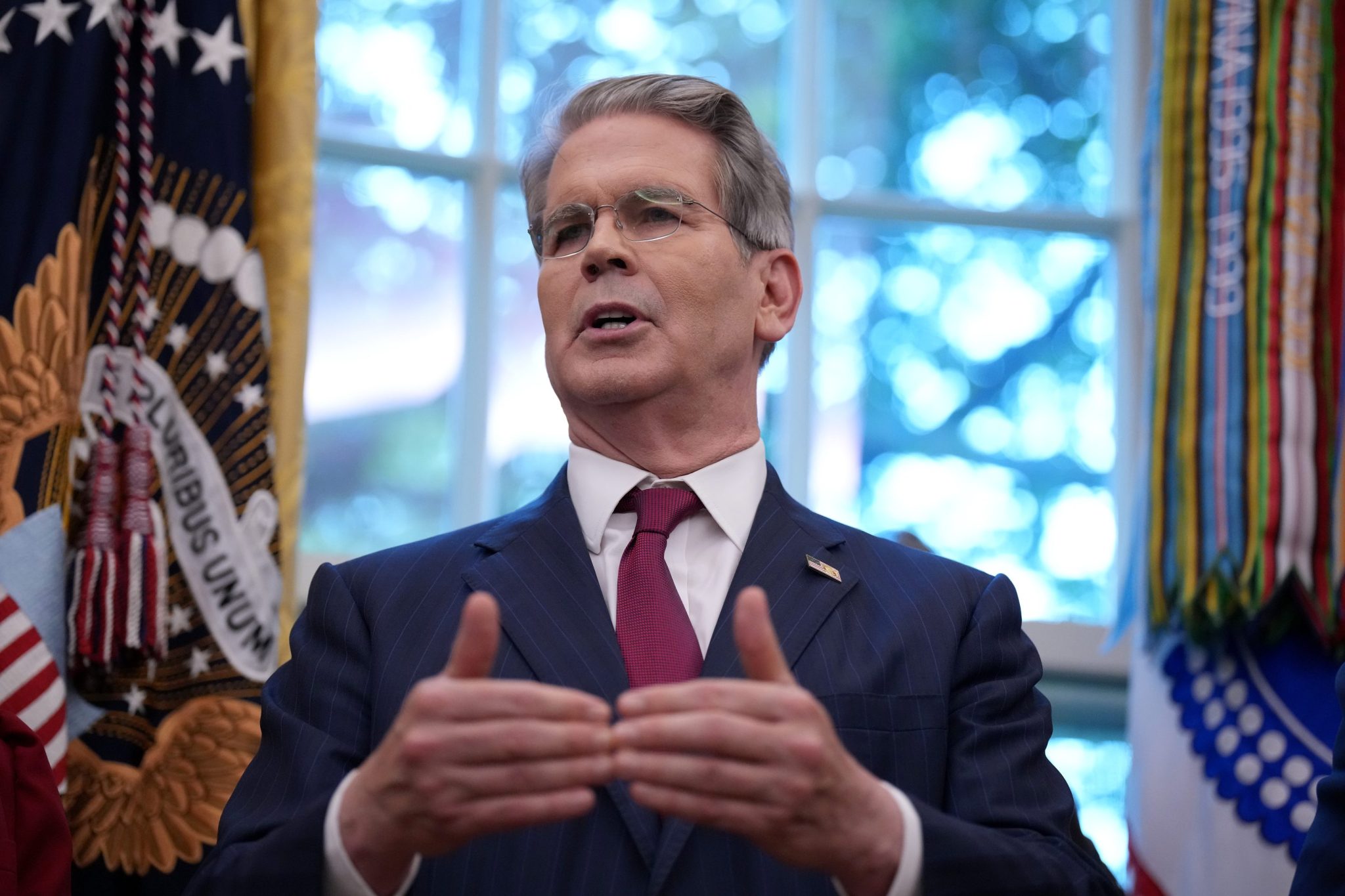
Treasury Secretary Scott Bessent on Thursday said on CNBC that the public could expect news of “substantial support for our farmers, especially the soybean farmers” as soon as Tuesday.

Details of the aid package are unknown, but it would come as the world’s two largest economies have been unable to reach a trade deal and China has halted purchases of U.S. beans. China, the biggest foreign buyer of American soybeans for many years, last bought American beans in May and has not bought any for this harvest season, which began in September.

“The Soybean Farmers of our Country are being hurt because China is, for ‘negotiating’ reasons only, not buying,” Trump wrote in a Truth Social post on Wednesday. “We’ve made so much money on Tariffs, that we are going to take a small portion of that money, and help our Farmers.”

“I’ll be meeting with President Xi, of China, in four weeks, and Soybeans will be a major topic of discussion,” Trump wrote.

The soybeans that China imports largely for oil extraction and animal feed are an important crop for U.S. agriculture because they are the top U.S. food export, accounting for about 14% of all farm goods sent overseas and China has been buying 25% of all American soybeans in recent years.

U.S. farmers grew $60.7 billion worth of soybeans, or nearly 4.3 billion bushels, in the 2022-2023 marketing year, according to the American Soybean Association. Just over half were exported. Illinois is the top soybean growing state, but Iowa, Nebraska and Minnesota are also large producers.

Trump and Chinese President Xi Jinping are expected to meet on the sidelines of the annual summit of the Asia Pacific Economic Cooperation grouping, to be held at the end of October in South Korea.

In Trump’s first trade war with China, he gave American farmers more than $22 billion in aid payments in 2019 and nearly $46 billion in 2020, though the latter also included aid related to the COVID pandemic.

Time is running out

Caleb Ragland, a Kentucky farmer who serves as president of the American Soybean Association, welcomed Trump acknowledging the difficulties faced by farmers. He said actions are needed to prevent many farmers from going out of business.

Before the trade war, farmers were already pinched by high costs and low crop prices, he said. Then, their biggest customer vanished.

“It’s just unfortunate that we’re being used as a bargaining chip in this trade war that’s not of our own doing,” Ragland said.

He said time is running low for the two governments to strike a deal, because China has already ordered soybeans from countries such as Brazil and Argentina for deliveries through December and, if there’s no soybean deal soon, China could skip the U.S. entirely.

“If they get another couple months, they’re into new crop soybeans in Brazil and Argentina. And they’re going to bypass us altogether if we’re not careful,” Ragland said.

Deal is still likely

China has slapped 20% tariffs on U.S. soybeans since Trump announced his tariffs on the world in the spring, making U.S. beans uncompetitive in price.

The retaliatory tariffs are in response to Trump’s new import taxes on Chinese goods over allegations that Beijing has failed to stem the flow of chemicals used to make fentanyl as well as Trump’s across-the-board “Liberation Day” tariffs, which have been reduced to the 10% baseline rate.

Observers say China could ease tariffs on U.S. farm goods should the White House walk back on fentanyl-related tariffs. That has yet to happen.

The White House “has not prioritized fentanyl” since this spring, said Sun Yun, director of the China program at the Washington-based think tank Stimson Center. She said Wang Xiaohong, China’s public security minister, showed up in Geneva in May but met no counterpart from the U.S. to negotiate with.

But it is not time yet to write off a soybean deal, she said. “China still needs to have something to show for at the leadership meeting in South Korea,” Sun said.

Gabriel Wildau, managing director of the consultancy Teneo, said a soybean deal is “the lowest-hanging fruit” for both governments.

“China needs beans, and the U.S. has them to sell. It costs China basically nothing to shift towards U.S. beans and away from Brazil and Argentina,” Wildau said. “If Washington and Beijing can’t reach a deal on soybeans, then they don’t have much hope of reaching a deal on thornier issues like export controls.”

Argentina is a sore subject for U.S. farmers right now because on September 24, Beijing took advantage of a tax holiday in Argentina and ordered nearly 2 million tons of Argentine soybean and soy products. The tax holiday came after the U.S. signaled it would provide a $20 billion support package to help stabilize the Latin American country’s economy.

“That situation was angering to many farmers,” Ragland said. “And while I don’t think the specific intent was just to give a big chunk, give $20 billion to Argentina so that they could send China soybeans. That was the result. And the optics of it look absolutely terrible.”

Farmers prefer trade over aid

Government aid might be necessary to help farmers get through this year if they cannot sell to China, but farmers say they would rather sell their crops on the market.

“All farmers are proud of what they do and they don’t like handouts. We’d rather make it with our own two hands than have it handed to us,” Iowa farmer Robb Ewoldt said.

Meanwhile, farmers like Ryan Mackenthun, a fifth-generation farmer in south-central Minnesota, say they will do everything they can to survive.

“It’s definitely tighten the belt, to look at the inputs, look at the previous investments I made in fertilizer and see if I can stretch another year or two out of them to reduce costs but maintain the same yield projections, run equipment longer,” Mackenthun said.


Source link

Continue Reading

Business

Hegseth likens strikes on alleged drug boats to post-9/11 war on terror

Published

on


Defense Secretary Pete Hegseth defended strikes on alleged drug cartel boats during remarks Saturday at the Ronald Reagan Presidential Library, saying President Donald Trump has the power to take military action “as he sees fit” to defend the nation.

Hegseth dismissed criticism of the strikes, which have killed more than 80 people and now face intense scrutiny over concerns that they violated international law. Saying the strikes are justified to protect Americans, Hegseth likened the fight to the war on terror following the Sept. 11, 2001 attacks.

“If you’re working for a designated terrorist organization and you bring drugs to this country in a boat, we will find you and we will sink you. Let there be no doubt about it,” Hegseth said during his keynote address at the Reagan National Defense Forum. “President Trump can and will take decisive military action as he sees fit to defend our nation’s interests. Let no country on earth doubt that for a moment.”

The most recent strike brings the death toll of the campaign to at least 87 people. Lawmakers have sought more answers about the attacks and their legal justification, and whether U.S. forces were ordered to launch a follow-up strike following a September attack even after the Pentagon knew of survivors.

Though Hegseth compared the alleged drug smugglers to Al-Qaida terrorists, experts have noted significant differences between the two foes and the efforts to combat them.

Hegseth’s remarks came after the Trump administration released its new national security strategy, one that paints European allies as weak and aims to reassert America’s dominance in the Western Hemisphere.

During the speech, Hegseth also discussed the need to check China’s rise through strength instead of conflict. He repeated Trump’s vow to resume nuclear testing on an equal basis as China and Russia — a goal that has alarmed many nuclear arms experts. China and Russia haven’t conducted explosive tests in decades, though the Kremlin said it would follow the U.S. if Trump restarted tests.

The speech was delivered at the Reagan National Defense Forum at the Ronald Reagan Presidential Foundation and Institute in California, an event which brings together top national security experts from around the country. Hegseth used the visit to argue that Trump is Reagan’s “true and rightful heir” when it comes to muscular foreign policy.

By contrast, Hegseth criticized Republican leaders in the years since Reagan for supporting wars in the Middle East and democracy-building efforts that didn’t work. He also blasted those who have argued that climate change poses serious challenges to military readiness.

“The war department will not be distracted by democracy building, interventionism, undefined wars, regime change, climate change, woke moralizing and feckless nation building,” he said.


Source link

Continue Reading

Business

US debt crisis: Most likely fix is severe austerity triggered by a fiscal calamity

Published

on


One way or another, U.S. debt will stop expanding unsustainably, but the most likely outcome is also among the most painful, according to Jeffrey Frankel, a Harvard professor and former member of President Bill Clinton’s Council of Economic Advisers.

Publicly held debt is already at 99% of GDP and is on track to hit 107% by 2029, breaking the record set after the end of World War II. Debt service alone is more than $11 billion a week, or 15% of federal spending in the current fiscal year.

In a Project Syndicate op-ed last week, Frankel went down the list of possible debt solutions: faster economic growth, lower interest rates, default, inflation, financial repression, and fiscal austerity. 

While faster growth is the most appealing option, it’s not coming to the rescue due to the shrinking labor force, he said. AI will boost productivity, but not as much as would be needed to rein in U.S. debt.

Frankel also said the previous era of low rates was a historic anomaly that’s not coming back, and default isn’t plausible given already-growing doubts about Treasury bonds as a safe asset, especially after President Donald Trump’s “Liberation Day” tariff shocker.

Relying on inflation to shrink the real value of U.S. debt would be just as bad as a default, and financial repression would require the federal government to essentially force banks to buy bonds with artificially low yields, he explained.

“There is one possibility left: severe fiscal austerity,” Frankel added.

How severe? A sustainable U.S. debt trajectory would entail elimination of nearly all defense spending or almost all non-defense discretionary outlays, he estimated.

For the foreseeable future, Democrats are unlikely to slash top programs, while Republicans are likely to use any fiscal breathing room to push for more tax cuts, Frankel said.

“Eventually, in the unforeseeable future, austerity may be the most likely of the six possible outcomes,” he warned. “Unfortunately, it will probably come only after a severe fiscal crisis. The longer it takes for that reckoning to arrive, the more radical the adjustment will need to be.”

The austerity forecast echoes an earlier note from Oxford Economics, which said the expected insolvency of the Social Security and Medicare trust funds by 2034 will serve as a catalyst for fiscal reform.

In Oxford’s view, lawmakers will seek to prevent a fiscal crisis in the form of a precipitous drop in demand for Treasury bonds, sending rates soaring.

But that’s only after lawmakers try to take the more politically expedient path by allowing Social Security and Medicare to tap general revenue that funds other parts of the federal government.

“However, unfavorable fiscal news of this sort could trigger a negative reaction in the US bond market, which would view this as a capitulation on one of the last major political openings for reforms,” Bernard Yaros, lead U.S. economist at Oxford Economics, wrote. “A sharp upward repricing of the term premium for longer-dated bonds could force Congress back into a reform mindset.”


Source link

Continue Reading

Business

The $124 trillion Great Wealth Transfer is intensifying as inheritance jumps to a new record

Published

on


Nearly $300 billion was inherited this year as the Great Wealth Transfer picks up speed, showering family members with immense windfalls.

According to the latest UBS Billionaire Ambitions Report, 91 heirs inherited a record-high $297.8 billion in 2025, up 36% from a year ago despite fewer inheritors.

“These heirs are proof of a multi-year wealth transfer that’s intensifying,” Benjamin Cavalli, head of Strategic Clients & Global Connectivity at UBS Global Wealth Management, said in the report.

Western Europe led the way with 48 individuals inheriting $149.5 billion. That includes 15 members of two “German pharmaceutical families,” with the youngest just 19 years old and the oldest at 94.

Meanwhile, 18 heirs in North America got $86.5 billion, and 11 in South East Asia received $24.7 billion, UBS said.

This year’s wealth transfer lifted the number of multi-generational billionaires to 860, who have total assets of $4.7 trillion, up from 805 with $4.2 trillion in 2024.

Wealth management firm Cerulli Associates estimated last year that $124 trillion worldwide will be handed over through 2048, dubbing it the Great Wealth Transfer. More than half of that amount will come from high-net-worth and ultra-high-net-worth people.

Among billionaires, UBS expects they will likely transfer about $6.9 trillion by 2040, with at least $5.9 trillion of that being passed to children, either directly or indirectly.

While the Great Wealth Transfer appears to be accelerating, it may not turn into a sudden flood. Tim Gerend, CEO of financial planning giant Northwestern Mutual, told Fortune’s Amanda Gerut recently that it will unfold more gradually and with greater complexity

“I think the wealth transfer isn’t going to be just a big bang,” he said. “It’s not like, we just passed peak age 65 and now all the money is going to move.”

Of course, millennials and Gen Zers with rich relatives aren’t the only ones who sat to reap billions. More entrepreneurs also joined the ranks of the super rich.

In 2025, 196 self-made billionaires were newly minted with total wealth of $386.5 billion. That trails only the record year of 2021 and is up from last year, which saw 161 self-made individuals with assets of $305.6 billion.

But despite the hype over the AI boom and startups with astronomical valuations, some of the new U.S. billionaires come from a range of industries.

UBS highlighted Ben Lamm, cofounder of genetics and bioscience company Colossal; Michael Dorrell, cofounder and CEO of infrastructure investment firm Stonepeak; as well as Bob Pender and Mike Sabel, cofounders of LNG exporter Venture Global.

“A fresh generation of billionaires is steadily emerging,” UBS said. “In a highly uncertain time for geopolitics and economics, entrepreneurs are innovating at scale across a range of sectors and markets.”


Source link

Continue Reading

Trending

Copyright © Miami Select.