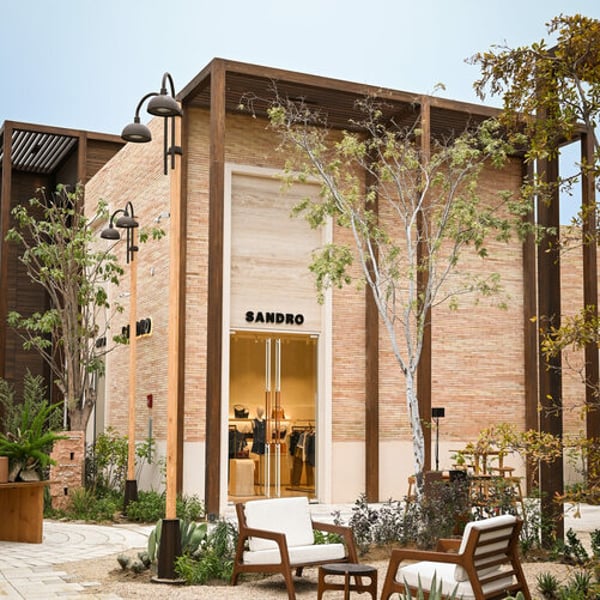
Sandro announces two new openings in Latin America, with the launch of a boutique in Los Cabos, Mexico, and its first store in Santiago, Chile. These openings form part of the Paris-based brand’s international growth strategy, strengthening its presence in high-potential markets through partnerships with local players.
Sandro boutique in Santiago, Chile – DR
Founded in 1984 in Paris by Evelyne Chetrite, Sandro has established itself as a premium ready-to-wear brand with a contemporary positioning. The brand is now owned by the SMCP Group, alongside Maje, Claudie Pierlot, and Fursac. SMCP is majority controlled by the Chinese group Shandong Ruyi and has an international presence structured around a network of directly operated stores and franchise partners.
The first opening is in Mexico, with a new boutique at Ánima Village in Los Cabos. This new commercial and cultural district is developing into one of the country’s leading luxury hubs, bringing together more than 80 international brands, dining destinations and galleries, with architecture that blends into the natural landscape. Opened in early December, the Sandro boutique spans 159 square metres and offers the full womenswear and menswear collections. The interior follows the brand concept, defined by contemporary lines, high-quality materials, and a pared-back ambience. Developed in partnership with Retail Fashion Group, this opening brings the number of Sandro points of sale in Mexico to 21.
The second opening marks Sandro’s entry into the Chilean market. The brand is unveiling its first boutique in Santiago, within the Parque Arauco shopping centre, in its dedicated luxury district, considered one of the most prestigious in the Chilean capital. Covering 142 square metres, the boutique also offers the womenswear and menswear collections and reflects the house’s elegant, modern world. This opening, delivered in partnership with Leuru Group, represents a key milestone in Sandro’s regional development.
With these two new locations, Sandro continues its expansion in Latin America, strengthening its proximity to local and international clientele. This momentum follows the opening, in October 2025, of the brand’s first boutique in Argentina, in Buenos Aires. Globally, Sandro relies on a network of more than 750 points of sale across the key markets of Europe, North America, Asia, and the Middle East, and plans further openings in Latin America, notably in Paraguay and Uruguay. In France, the brand has 143 points of sale, including 64 corners.
This development strategy aligns with the SMCP Group’s overall performance, which in 2024 recorded revenue of €1.21 billion, around half of which was generated by Sandro.
This article is an automatic translation. Click here to read the original article.
From 2026, Umbro’s France business will be managed by the Drôme-based group Textiss. The company, led by Sylvain Caire and specialising in men’s underwear, notably develops its Freegun brand, as well as licensed products for Pierre Cardin and Von Dutch. Textiss is taking over Umbro’s footwear and textile licence in France, which had been held by the Royer Group for 10 years.
Textiss takes over Umbro’s footwear and textile licence for the French market – Umbro
“As owner of the Umbro brand, the Iconix Group has decided to entrust the Textiss Group with the textile and footwear licence in France from 2026, a natural evolution that continues the historic relationship between Iconix, Royer, and Textiss,” the group explained in a press release on December 19, adding that Textiss has been Umbro’s underwear and socks licensee in France for a decade.
“In agreement with the Royer Group, the licence will be subject to an organised and carefully managed transition,” said the group. “From January 2026, Textiss will manage orders for the second half of 2026, ensuring a smooth operational handover for all customers and partners.”
The American Iconix Group, a specialist in the licensed brand development model, was seeking a solution for the licence covering the key products of the British sporting goods brand it acquired from Nike in 2012. The Royer Group held the licence after taking it over in 2016.
With the French specialist in the development of footwear and sportswear brands facing difficulties, Iconix ultimately opted for the Châteauneuf-du-Rhône-based group to take on the brand’s key categories. Umbro currently outfits the Le Havre football club, HAC.
Neither the value of the deal nor details of the organisation concerning the teams that have worked or will work on the licence have been disclosed.
This article is an automatic translation. Click here to read the original article.
Under Armour Inc. has laid off two employees who worked on Stephen Curry’s shoe and apparel brand and moved others to new jobs as the athletic company winds down its partnership with the basketball star.
Stephen Curry collaborated with Under Armour on branded goods – Curry
The company is disbanding the team that worked on the brand despite plans to sell new Curry merchandise through October, according to a person familiar with the matter who wasn’t authorised to speak publicly.
A spokeswoman for Under Armour said the company doesn’t comment on personnel-related decisions. Representatives for Curry didn’t immediately respond to messages seeking comment.
Last month Under Armour and Curry announced their surprise separation, ending a yearslong relationship that had helped boost sales and draw attention to the brand. Under Armour still plans to release the Curry 13 sneaker in February and says additional colorways and apparel collections will be available through October.
The end of the tie-up adds to growing pressure at Under Armour, whose shares have fallen 45% this year. The company has been trying to stem two years of sales declines by increasing marketing and prioritising core products.
The split came after Curry and his advisers became frustrated with what they considered to be a lack of investment in the brand and sales of the division hadn’t met their expectations or the company’s, Bloomberg News has previously reported.
Under Armour has said it will incur an additional $95 million in restructuring costs in part tied to the separation.
Originally slated for 2025, the commissioning of Carbios’ first biorecycling plant in France’s Longlaville (Meurthe-et-Moselle) has been pushed back again. Amid a challenging economic climate that is complicating financing, the French biotech announced on December 18 a further delay to its timetable.
Carbios
While the company has reaffirmed its determination to see the project through, it has now given itself until the end of the first quarter of 2026 to secure the final tranche of private funding needed to start construction. As a result, the plant is not expected to be operational until the first half of 2028, three years later than initially planned.
The stakes are high for the French company: the future Longlaville plant is intended to scale up Carbios’s technology for the enzymatic depolymerisation of PET (polyethylene terephthalate) plastics to industrial level. Once operational, the site is designed to process the equivalent of 300 million T-shirts (at least 90% made from synthetic materials) or two billion coloured bottles into virgin-quality PET.
The project enjoys strong backing, with €42.5 million in public funding secured and pre-commercialisation contracts already covering nearly 50% of future production capacity. However, a ‘small portion’ of private funding is still needed to get the project off the ground, a step hampered by the current market’s caution towards ‘First-of-a-Kind’ industrial infrastructure.
L’Oréal, On, Patagonia, Puma, PVH Corp, and Salomon are among the companies in the consortium supporting the Carbios project, whether to use its recycled materials for bottles or for fibres. Following an initial postponement announced at the end of 2024, the company nevertheless announced spending reductions in spring 2025.
Three additional plants planned internationally
While its in-house project in France is stalling, Carbios is accelerating its ‘asset-light’ deployment model: selling licences abroad. The company is no longer relying solely on its Lorraine site to demonstrate its technology, but is counting on industrial partners capable of financing their own plants.
After signing a major agreement with Wankai Group in early December for a plant in China, Carbios is now aiming to establish its technology in three other strategic regions: Europe, North America, and South America.
In 2024, Carbios announced, in succession, an initial project replicating its industrial site model in China with the Chinese group Zhink, then in Turkey with partner Sasa, and finally in the UK with the British company FCC Environment UK.
This article is an automatic translation. Click here to read the original article.