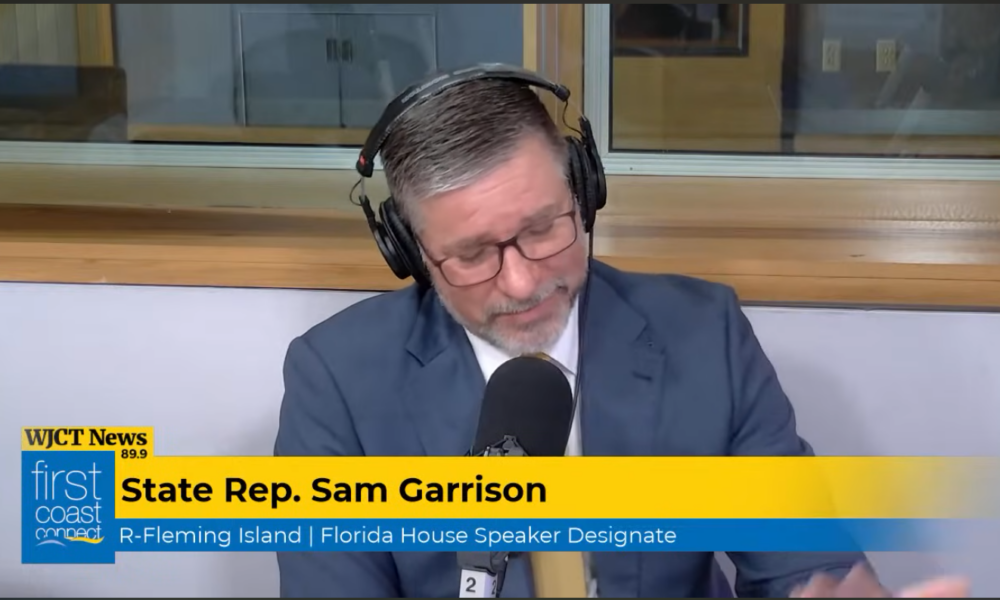
House Speaker-designate Sam Garrison believes artificial intelligence will dominate next year’s Legislative Session, spurring unusual coalitions amid Gov. Ron DeSantis’ call for regulation.
“I think this year, outside of property tax, I think AI policy is going to be probably the biggest area of tension that we’re going to see because it doesn’t fall on traditional partisan lines. You can have very conservative Republicans and very liberal Democrats who might find common cause,” the Clay County Republican said on “First Coast Connect.”
DeSantis has proposed a “far-reaching artificial intelligence bill of rights” during next year’s Legislative Session. That’s an effort to counter what he says could be an “age of darkness and deceit” without action against deepfakes, subversion of parental controls, malign foreign influence, data security, insurance companies’ reliance on the technology, and regulating data centers.
Garrison agreed that some checks are needed on data centers while acknowledging the importance of private property rights.
“If you’re going to have a data center, it has got to be extraordinarily regulated to make sure that you’re not adversely impacting the quality of life for Floridians,” Garrison said.
“I’m not a big proponent of telling people what they can and can’t do on their land. So if … Amazon wants to come to town and say we want to build a data center, sure, go for it. But you’re going to have to be regulated like heck to make sure that nothing on that property is going to adversely affect the residents of a community — whether it’s from electrical use, whether it’s from water, things of that nature.”
Florida’s policy considerations are moving forward despite President Donald Trump pleading for national uniformity in AI guidance. DeSantis has said he’s not worried about a recent Trump executive order as it “doesn’t/can’t preempt state legislative action.”
A bill from Republican Sen. Tom Leek (SB 482) would ban governmental agencies from contracting with AI companies controlled, owned or governed by countries of concern.
Leek’s legislation would also ban children from communicating with chatbots without parental authorization. Chatbots would also have to disclose being artificial intelligence, and programmers would have to ensure that adult materials are not accessed by children.
The measure would confer other rights, including warning people when they are communicating with AI chatbots rather than human beings, and whether identifying data or biometric data is being exposed.
Additionally, the proposal would ban using AI to appropriate name, image and likeness of nonconsenting people for commercial purposes, as well as for fraud, identity theft and cyberbullying.
While Leek’s bill seems to satisfy the Governor’s requirements, a House companion has yet to manifest.