Connect with us

Business

Sam Altman’s AI paradox: Warning of a bubble while raising trillions
Published

on


Welcome to Eye on AI! AI reporter Sharon Goldman here, filling in for Jeremy Kahn. In this edition… Sam Altman’s AI paradox…AI has quietly become a fixture of advertising…Silicon Valley’s AI deals are creating zombie startupssources say Nvidia working on new AI chip for China that outperforms the H20.

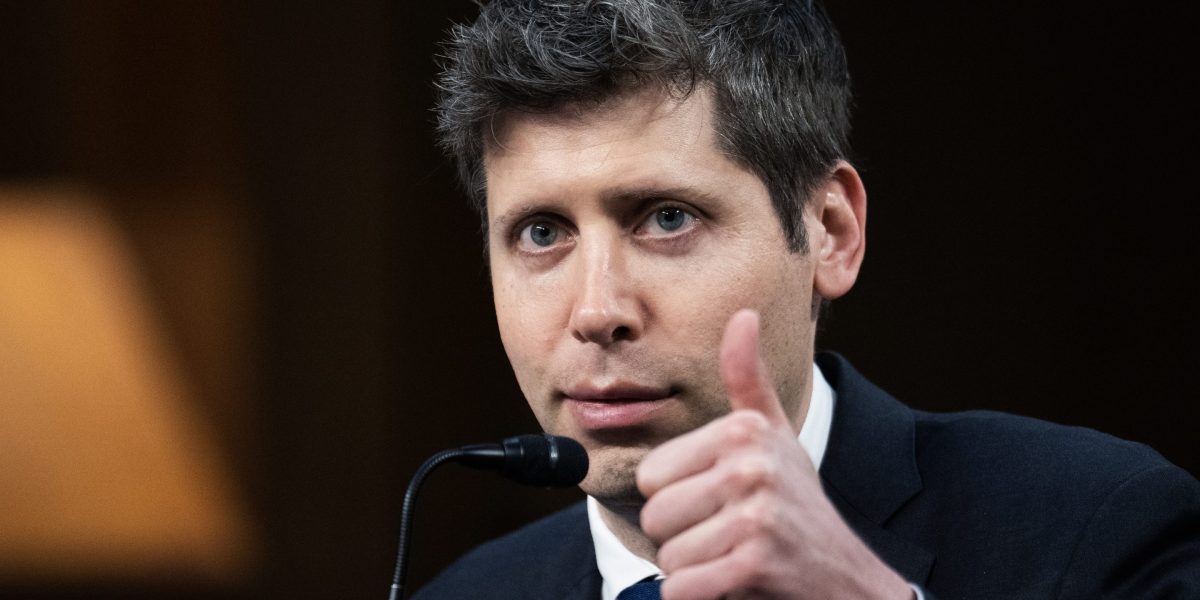
I was not invited to Sam Altman’s cozy dinner with reporters in San Francisco last week (whomp whomp), but maybe that’s for the best. I have trouble suppressing exasperated eye rolls when I hear peak Silicon Valley–ironic statements.

I am not sure I could have controlled myself when the OpenAI CEO said that he believes AI could be in a “bubble,” with market conditions similar to the 1990s dotcom boom. Yes, he reportedly said, “investors as a whole are overexcited about AI.” 

Yet, over the same meal, Altman also apparently said he expects OpenAI to spend trillions of dollars on its data center buildout in the “not very distant future,” adding that “you should expect a bunch of economists wringing their hands, saying, ‘This is so crazy, it’s so reckless,’ and we’ll just be like, ‘You know what? Let us do our thing.’”

Ummm…what could be more frothy than pitching a multi-trillion-dollar expansion in an industry you’ve just called a bubble? Cue an eye roll reaching the top of my head. Sure, Altman may have been referring to smaller AI startups with sky-high valuations and little to no revenue, but still, the irony is rich. It’s particularly notable given the weak GPT-5 rollout earlier this month, which was supposed to mark a leap forward but instead left many disappointed with its routing system and lack of breakthrough progress.

In addition, even as Altman speaks of bubbles, OpenAI itself is raising record sums. In early August, OpenAI secured a whopping $8.3 billion in new funding at a $300 billion valuation—part of its plan to raise $40 billion this year. That figure was five times oversubscribed. On top of that, employees are now poised to sell about $6 billion in shares to investors like SoftBank, Dragoneer, and Thrive, pushing the company’s valuation potentially up to $500 billion.

OpenAI is hardly an outlier in its infrastructure binge. Tech giants are pouring unprecedented sums into AI buildouts in 2025: Microsoft alone plans to spend $80 billion on AI data centers this fiscal year, while Meta is projecting up to $72 billion in AI and infrastructure investments. And on the fundraising front, OpenAI has company too — rivals like Anthropic are chasing multibillion-dollar rounds of their own. 

Wall Street’s biggest bulls, like Wedbush’s Dan Ives, seem unconcerned. Ives said Monday on CNBC’s “Closing Bell” that demand for AI infrastructure has grown 30% to 40% in the last months, calling the capex surge a validation moment for the sector. While he acknowledged “some froth” in parts of the market, he said the AI revolution with autonomous systems is only starting to play out and we are in the “second inning of a nine-inning game.” 

And while a bubble implies an eventual bursting, and all the damage that results, the underlying phenomenon causing a bubble often has real value. The advent of the web in the ’90s was revolutionary; The bubble was a reflection of the massive opportunities opening up.

Still, I’d be curious if anyone pressed Altman on the AI paradox—warning of a bubble while simultaneously bragging about OpenAI’s massive fundraising and spending. Perhaps over a glass of bubbly and a sugary sweet dessert? I’d also love to know if he fielded tougher questions on the other big issues looming over the company: its shift to a public benefit corporation (and what that means for the nonprofit), the current state of its Microsoft partnership, and whether its mission of “AGI to benefit all of humanity” still holds now that Altman himself has said AGI “is not a super-useful term.”

In any case, I’m game for a follow-up chat with Altman & Co (call me!). I’ll bring the bubbly, pop the questions, and do my best to keep the eye rolls at bay.

Also: In just a few weeks, I will be headed to Park City, Utah, to participate in our annual Brainstorm Tech conference at the Montage Deer Valley! Space is limited, so if you’re interested in joining me, register here. I highly recommend: There’s a fantastic lineup of speakers, including Ashley Kramer, chief revenue officer of OpenAI; John Furner, president and CEO of Walmart U.S.; Tony Xu, founder and CEO of DoorDash; and many, many more!

With that, here’s more AI news.

Sharon Goldman
sharon.goldman@fortune.com
@sharongoldman

FORTUNE ON AI

Wall Street isn’t worried about an AI bubble. Sam Altman is – by Beatrice Nolan

MIT report: 95% of generative AI pilots at companies are failing – by Sheryl Estrada

Silicon Valley talent keeps getting recycled, so this CEO uses a ‘moneyball’ approach for uncovering hidden AI geniuses in the new era – by Sydney Lake

Waymo experimenting with generative AI, but exec says LiDAR and radar sensors important to self-driving safety ‘under all conditions’ – by Jessica Matthews

AI IN THE NEWS

More shakeups for Meta AI. The New York Times reported today that Meta is expected to announce that it will split its A.I. division — which is known as Meta Superintelligence Labs — into four groups. One will focus on AI research; one on  “superintelligence”; another on products; and one on infrastructure such as data centers. According to the article’s anonymous sources, the reorganization “is likely to be the final one for some time,” with moves “aimed at better organizing Meta so it can get to its goal of superintelligence and develop AI products more quickly to compete with others.” The news comes less than two months after CEO Mark Zuckerberg overhauled Meta’s entire AI organization, including bringing on Scale AI CEO Alexandr Wang as chief AI officer. 

Madison Avenue is starting to love AI. According to the New York Times, artificial intelligence has quietly become a fixture of advertising. What felt novel when Coca-Cola released an AI-generated holiday ad last year is now mainstream: nearly 90% of big-budget marketers are already using—or planning to use—generative AI in video ads. From hyper-realistic backdrops to synthetic voice-overs, the technology is slashing costs and production times, opening TV spots to smaller businesses for the first time. Companies like Shuttlerock and ITV are helping brands replace weeks of work with hours, while tech giants like Meta and TikTok push their own AI ad tools. The shift raises ethical questions about displacing creatives and fooling viewers, but industry leaders say the genie is out of the bottle: AI isn’t just streamlining ad production—it’s reshaping the entire commercial playbook.

Silicon Valley’s AI deals are creating zombie startups: ‘You hollowed out the organization.’ According to CNBCSilicon Valley’s AI startup scene is being hollowed out as Big Tech sidesteps antitrust rules with a new playbook: licensing deals and talent raids that gut promising young companies. Windsurf, once in talks to be acquired by OpenAI, collapsed into turmoil after its founders bolted to Google in a $2.4 billion licensing pact; interim CEO Jeff Wang described tearful all-hands meetings as employees realized they’d been left with “nothing.” Similar moves have seen Meta sink $14.3 billion into Scale AI, Microsoft scoop up Inflection’s founders, and Amazon strip talent from Adept and Covariant—leaving behind so-called “zombie companies” with little future. While founders and top researchers cash out, investors and rank-and-file staff are often left stranded, sparking growing concern that these quasi-acquisitions not only skirt regulators but also threaten to choke off AI innovation at its source.

Nvidia working on new AI chip for China that outperforms the H20, sources say. According to ReutersNvidia is developing a new China-specific AI chip, codenamed B30A, based on its cutting-edge Blackwell architecture. The chip, which could be delivered to Chinese clients for testing as soon as next month, would be more powerful than the current H20 but still fall below U.S. export thresholds—using a single-die design with about half the raw computing power of Nvidia’s flagship B300. The move comes after President Trump signaled possible approval for scaled-down chip sales to China, though regulatory approval is uncertain amid bipartisan concerns in Washington over giving Beijing access to advanced AI hardware. Nvidia argues that retaining Chinese buyers is crucial to prevent defections to domestic rivals like Huawei, even as Chinese regulators cast suspicion on the company’s products.

EYE ON AI RESEARCH

Study finds AI-led interviews improved outcomes. A new study looked at what happens when job interviews are run by AI voice agents instead of human recruiters. In a large experiment with 70,000 applicants, people were randomly assigned to be interviewed by a person, by an AI, or given the choice. Surprisingly, AI-led interviews actually improved outcomes: applicants interviewed by AI were 12% more likely to get job offers, 18% more likely to start jobs, and 17% more likely to still be employed after 30 days. Most applicants didn’t mind the change—78% even chose the AI when given the option, especially those with lower test scores. The AI also pulled out more useful information from candidates, leading recruiters to rate those interviews higher. Overall, the study shows that AI interviewers can perform just as well as, or even better than, human recruiters—without hurting applicant satisfaction.

AI CALENDAR

Sept. 8-10: Fortune Brainstorm Tech, Park City, Utah. Apply to attend here.

Oct. 6-10: World AI Week, Amsterdam

Oct. 21-22: TedAI San Francisco. Apply to attend here.

Dec. 2-7: NeurIPS, San Diego

Dec. 8-9: Fortune Brainstorm AI San Francisco. Apply to attend here.

BRAIN FOOD

Do AI chatbots need to be protected from harm? 

AI lab Anthropic has introduced a new safety measure in its latest Claude models, which empowers the AI to terminate conversations in extreme cases of harmful or abusive interaction. The feature activates only after repeated redirections fail—typically for content requests involving sexual exploitation of minors or facilitation of large-scale violence. The company is notably framing this as a safeguard not principally for users, but for the model’s own “AI welfare,” reflecting an exploratory stance on the machine’s potential moral status.

Unsurprisingly, the idea of granting AI moral status is contentious. Jonathan Birch, a philosophy professor at the London School of Economics, told The Guardian he welcomed Anthropic’s move for sparking a public debate about AI sentience—a topic he said many in the industry would rather suppress. At the same time, he warned that the decision risks misleading users into believing the chatbot is more real than it is.

Others argue that focusing on AI welfare distracts from urgent human concerns. For example, while Claude is designed to end only the most extreme abusive conversations, it will not intervene in cases of imminent self-harm—even though a New York Times opinion piece yesterday urged such safeguards, written by a mother who discovered her daughter’s ChatGPT conversations only after her daughter’s suicide.


Source link

Continue Reading

Business

Databricks CEO Ali Ghodsi says company will be worth $1 trillion by doing these three things

Published

on


Ali Ghodsi, the CEO and cofounder of data intelligence company Databricks, is betting his privately held startup can be the latest addition to the trillion-dollar valuation club.

In August, Ghodsi told the Wall Street Journalthat he believed Databricks, which is reportedly in talks toraise funding at a $134 billion valuation, had “a shot to be a trillion-dollar company.” At Fortune’s Brainstorm AI conference in San Francisco on Tuesday, he explained how it would happen, laying out a “trifecta” of growth areas to ignite the company’s next leg of growth.

The first is entering the transactional database market, the traditional territory of large enterprise players like Oracle, which Ghodsi said has remained largely “the same for 40 years.” Earlier this year, Databricks launched a link-based offering called Lakehouse, which aims to combine the capabilities of traditional databases with modern data lake storage, in an attempt to capture some of this market.

The company is also seeing growth driven by the rise of AI-powered coding. “Over 80% of the databases that are being launched on Databricks are not being launched by humans, but by AI agents,” Ghodsi said. As developers use AI tools for “vibe coding”—rapidly building software with natural language commands—those applications automatically need databases, and Ghodsi they’re defaulting to Databricks’ platform.

“That’s just a huge growth factor for us. I think if we just did that, we could maybe get all the way to a trillion,” he said.

The second growth area is Agentbricks, Databricks’ platform for building AI agents that work with proprietary enterprise data.

“It’s a commodity now to have AI that has general knowledge,” Ghodsi said, but “it’s very elusive to get AI that really works and understands that proprietary data that’s inside enterprise.” He pointed to the Royal Bank of Canada, which built AI agents for equity research analysts, as an example. Ghodsi said these agents were able to automatically gather earnings calls and company information to assemble research reports, reducing “many days’ worth of work down to minutes.”

And finally, the third piece to Ghodsi’s puzzle involves building applications on top of this infrastructure, with developers using AI tools to quickly build applications that run on Lakehouse and which are then powered by AI agents. “To get the trifecta is also to have apps on top of this. Now you have apps that are vibe coded with the database, Lakehouse, and with agents,” Ghodsi said. “Those are three new vectors for us.”

Ghodsi did not provide a timeframe for attaining the trillion-dollar goal. Currently, only a handful of companies have achieved the milestone, all of them as publicly traded companies. In the tech industry, only big tech giants like Apple, Microsoft, Nvidia, Alphabet, Amazon, and Meta have managed to cross the trillion-dollar threshold.

To reach this level would require Databricks, which is widely expected to go public sometime in early 2026, to grow its valuation roughly sevenfold from its current reported level. Part of this journey will likely also include the expected IPO, Ghodsi said.

“There are huge advantages and pros and cons. That’s why we’re not super religious about it,” Ghodsi said when asked about a potential IPO. “We will go public at some point. But to us, it’s not a really big deal.”

Could the company IPO next year? Maybe, replied Ghodsi.


Source link

Continue Reading

Business

New contract shows Palantir working on tech platform for another federal agency that works with ICE

Published

on


Palantir, the artificial intelligence and data analytics company, has quietly started working on a tech platform for a federal immigration agency that has referred dozens of individuals to U.S. Immigration and Customs Enforcement for potential enforcement since September.

The U.S. Citizenship and Immigration Services agency—which handles services including citizenship applications, family immigration, adoptions, and work permits for non-citizens—started the contract with Palantir at the end of October, and is paying the data analytics company to implement “Phase 0” of a “vetting of wedding-based schemes,” or “VOWS” platform, according to the federal contract, which was posted to the U.S. government website and reviewed by Fortune.

The contract is small—less than $100,000—and details of what exactly the new platform entails are thin. The contract itself offers few details, apart from the general description of the platform (“vetting of wedding-based schemes”) and an estimate that the completion of the contract would be Dec. 9.Palantir declined to comment on the contract or nature of the work, and USCIS did not respond to requests for comment for this story.

But the contract is notable, nonetheless, as it marks the beginning of a new relationship between USCIS and Palantir, which has had longstanding contracts with ICE, another agency of the Department of Homeland Security, since at least 2011. The description of the contract suggests that the “VOWS” platform may very well be focused on marriage fraud and related to USCIS’ recent stated effort to drill down on duplicity in applications for marriage and family-based petitions, employment authorizations, and parole-related requests.

USCIS has been outspoken about its recent collaboration with ICE. Over nine days in September, USCIS announced that it worked with ICE and the Federal Bureau of Investigation to conduct what it called “Operation Twin Shield” in the Minneapolis-St. Paul area, where immigration officials investigated potential cases of fraud in immigration benefit applications the agency had received. The agency reported that its officers referred 42 cases to ICE over the period. In a statement published to the USCIS website shortly after the operation, USCIS director Joseph Edlow said his agency was “declaring an all-out war on immigration fraud” and that it would “relentlessly pursue everyone involved in undermining the integrity of our immigration system and laws.” 

“Under President Trump, we will leave no stone unturned,” he said.

Earlier this year, USCIS rolled out updates to its policy requirements for marriage-based green cards, which have included more details of relationship evidence and stricter interview requirements.

While Palantir has always been a controversial company—and one that tends to lean into that reputation no less—the new contract with USCIS is likely to lead to more public scrutiny. Backlash over Palantir’s contracts with ICE have intensified this year amid the Trump Administration’s crackdown on immigration and aggressive tactics used by ICE to detain immigrants that have gone viral on social media. Not to mention, Palantir inked a $30 million contract with ICE earlier this year to pilot a system that will track individuals who have elected to self-deport and help ICE with targeting and enforcement prioritization. There has been pushback from current and former employees of the company alike over contracts the company has with ICE and Israel.

In a recent interview at the New York Times DealBook Summit, Karp was asked on stage about Palantir’s work with ICE and later what Karp thought, from a moral standpoint, about families getting separated by ICE. “Of course I don’t like that, right? No one likes that. No American. This is the fairest, least bigoted, most open-minded culture in the world,” Karp said. But he said he cared about two issues politically: immigration and “re-establishing the deterrent capacity of America without being a colonialist neocon view. On those two issues, this president has performed.”


Source link

Continue Reading

Business

CoreWeave CEO: Despite see-sawing stock, IPO was ‘incredibly successful’ amid challenges of tariff timing

Published

on


CoreWeave has been rocked by dizzying stock swings—with its stock currently trading 52% below its post-IPO high—and a frequent target of market commentators, but CEO Michael Intrator says the company’s move to the public markets has been “incredibly successful. And he takes the public’s mixed reaction in stride, given the novelty of CoreWeave’s “neocloud” business which competes with established cloud providers like Amazon AWS and Google Cloud.

“When you introduce new models, introduce a new way of doing business, disrupt what has been a static environment, it’s going to take some people some time,” Intrator said Tuesday at Fortune’s Brainstorm AI conference in San Francisco. But, he added, more people are beginning to understand the CoreWeave’s business model.

“We came out into one of the most challenging environments,” Intrator said of CoreWeave’s March IPO, which occurred very close to President Trump’s “Liberation Day” tariffs in April. “In spite of the incredible headwinds, we’re able to launch a successful IPO.”

CoreWeave, which priced its IPO at $40 per share, has experienced frequent severe up-and-down price swings in the eight months since its public market debut. At its closing price of $90.66 on Tuesday, the stock remains well above its IPO price.

As Fortune reported last month, CoreWeave’s rapid rise has been fueled by an aggressive, debt-heavy strategy to stand up data centers at unprecedented speed for AI customers. And for now, the bet is still paying off. In its third-quarter results released in November, the company said its revenue backlog nearly doubled in a single quarter—to $55.6 billion from $30 billion—reflecting long-term commitments from marquee clients including Meta, OpenAI, and French AI startup Poolside. Both earnings and revenue came in ahead of Wall Street expectations.

But the numbers were not all celebratory. CoreWeave disclosed a further increase in the debt it has taken on to finance its expansion, and it revised its full-year revenue outlook downward—suggesting that, even with historic demand in the pipeline.

With media headlines calling CoreWeave a “ticking time bomb,” with critics calling out insider stock sales, circular financing accusations and an overreliance on Nvidia, Intrator was asked whether he felt CoreWeave was misunderstood.

“Look, we built a company that is challenging one of the most stable businesses that exist—that cloud business, these three massive players,” he said, referring to AWS, Microsoft Azure and Google Cloud.  I feel like it’s incumbent on CoreWeave to introduce a new business model on how the cloud is going to be built and run. And that’s what we’re doing.” 

He repeatedly framed CoreWeave not as a GPU reseller or traditional data-center operator but as a company purpose-built from scratch to deliver high-performance, parallelized computing for AI workloads. That focus, he said, means designing proprietary software that orchestrates GPUs, building and colocating its own infrastructure, and moving “up the stack” through acquisitions such as Weights & Biases and OpenPipe.

Intrator also defended the company’s debt strategy, saying CoreWeave is effectively inventing a new financing model for AI infrastructure. He pointed to the company’s ability to repurpose power sources, rapidly deploy capacity, and finance large-scale clusters as proof it is solving problems incumbents never had to face.

“When I look back at history of the company, it took us a year with with a company investor like Fidelity, before they were like, ‘Oh, I get it,’” he said. “So look, we’ve been public for eight months. I couldn’t be prouder of what the company has accomplished.” 


Source link

Continue Reading

Trending

Copyright © Miami Select.