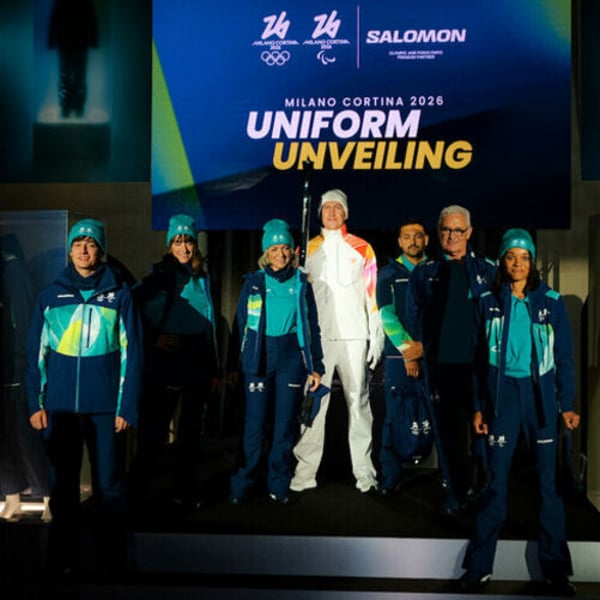
On November 12, the Milano Cortina 2026 Foundation unveiled the official uniforms that will be worn by more than 18,000 volunteers and Organising Committee staff during the Milano Cortina 2026 Olympic and Paralympic Winter Games. In total, more than 25,000 people will wear garments born of the creative collaboration between the Foundation and Salomon, a premium partner of the event. FashionNetwork.com discussed the project (and much more) with Raffaella Panié, brand image and look director of Milano Cortina 2026, and Guillaume Meyzenq, president & CEO of Salomon.
Salomon and Milano Cortina 2026 present the official uniforms of the Olympic and Paralympic Games
“Our project with Salomon began two years ago, when much was still to be defined. We realised the visual impact of so many people would be extremely powerful, so we devoted great care to the uniforms, which represent both a key communication and branding opportunity and a strong message of belonging,” Panié told us. “Milano Cortina 2026 is an event that will put all of Italy in the spotlight. With Salomon we found a partner to work hand in hand with to convey the vibrant Italian spirit through the uniforms, carrying out extensive testing and refinements. The result is a highly technical, high-performance product; in addition to the uniforms, the company is the licensee of a line of garments bearing the Milano Cortina 2026 logo that can be purchased by end consumers.”
Developed over 18 months by the Milano Cortina 2026 Foundation team and Salomon’s Annecy Design Centre, the project involved more than 50 experts, designers, engineers, and technicians to create 17 interconnected elements suited to every role and weather condition. In total, more than 400,000 pieces were produced, marrying technical performance with visual identity. Each volunteer will receive a complete kit, designed to ensure maximum functionality in every operational context, from mountain slopes to city arenas.
The kit includes an outdoor jacket, which provides thermal insulation and protection from the elements; garments referred to as “mid-layers”, ideal for indoor environments or mild climates; trousers in two versions, one insulated for more extreme conditions and one lighter for everyday activities; accessories such as hats and gloves; a Trailblazer 20 backpack; and, for footwear, Salomon’s X Ultra 360 Mid Gore-Tex hiking boots.
“Salomon is a brand that continues to grow: we have evolved from a winter sports brand to an outdoor brand, and now we are a global sports label,” CEO Guillaume Meyzenq explained. “We have a strong Alpine community – in France, Italy, and Switzerland – and throughout our history we have worked with many Olympic athletes; so the collaboration with Milano Cortina 2026 was a natural one. The main challenge was to create uniforms that would meet the needs of staff and volunteers, both in the mountains and in the city. Beyond the Olympic partnership, we will celebrate the event with collaborations with Italian brands and, in particular, Milan-based ones; there will be surprises even before February.”
Regarding the brand’s performance: “Today we have about 500 Salomon-branded stores worldwide, including directly operated and partner-run locations. Europe is growing at double-digit rates and we are seeing very strong growth in Asia, particularly in China; in general, all the countries where we already had some brand awareness are accelerating significantly,” the executive adds. “What is worth emphasising is that we are moving beyond the mountains, for which people have historically known us: today we are able to offer products and experiences for the city as well. In particular, in 2024 footwear surpassed $1 billion in turnover.”
Part of the Amer Sports Group, which is listed on the New York Stock Exchange, Salomon does not release financial data, “but what I can say is that Amer Sports’ Outdoor Performance segment, which includes Salomon, grew by 30%. We are experiencing great momentum,” Meyzenq points out.
Future plans for the brand, which until now in its domestic market had only the Annecy location, include the opening of new offices in Paris by the end of the year. “This will be a 1,500-square-metre, multi-storey space on Boulevard Magenta, which will also house two large showrooms,” the manager concludes. “We realised that an office in the capital will give us the opportunity to be closer to our customers, our partners and our clientele, which is becoming younger, as well as to recruit a broader range of talent to support the development of the brand.”
This article is an automatic translation. Click here to read the original article.
The demerger of Unilever‘s ice cream division, to be named ‘The Magnum Ice Cream Company,’ which had been delayed in recent months by the US government shutdown, will finally go ahead on Saturday, the British group announced.
Reuters
Unilever said in a statement on Friday that the admission of the new entity’s shares to listing and trading in Amsterdam, London, and New York, as well as the commencement of trading… is expected to take place on Monday, December 8.
The longest federal government shutdown in US history, from October 1 to November 12, fully or partially affected many parts of the federal government, including the securities regulator, after weeks without an agreement between Donald Trump‘s Republicans and the Democratic opposition.
Unilever, which had previously aimed to complete the demerger by mid-November, warned in October that the US securities regulator (SEC) was “not in a position to declare effective” the registration of the new company’s shares. However, the group said it was “determined to implement in 2025” the separation of a division that also includes the Ben & Jerry’s and Cornetto brands, and which will have its primary listing in Amsterdam.
“The registration statement” for the shares in the US “became effective on Thursday, December 4,” Unilever said in its statement. Known for Dove soaps, Axe deodorants and Knorr soups, the group reported a slight decline in third-quarter sales at the end of October, but beat market expectations.
Under pressure from investors, including the activist fund Trian of US billionaire Nelson Peltz, to improve performance, the group last year unveiled a strategic plan to focus on 30 power brands. It then announced the demerger of its ice cream division and, to boost margins, launched a cost-saving plan involving 7,500 job cuts, nearly 6% of the workforce. Unilever’s shares on the London Stock Exchange were steady on Friday shortly after the market opened, at 4,429 pence.
This article is an automatic translation. Click here to read the original article.
Burberry has named a new chief operating and supply chain officer as well as a new chief customer officer. They’re both key roles at the recovering luxury giant and both are being promoted from within.
Matteo Calonaci becomes chief operating and supply chain officer, moving from his role as senior vice-president of strategy and transformation at the firm.
In his new role, he’ll be oversee supply chain and planning, strategy and transformation, and data and analytics. He succeeds Klaus Bierbrauer, who’s currently Burberry supply chain and industrial officer. Bierbrauer will be leaving the company following its winter show and a transition period.
Matteo Calonaci – Burberry
Meanwhile, Johnattan Leon steps up as chief customer officer. He’s currently currently Burberry’s senior vice-president of commercial and chief of staff. In his new role he’ll be leading Burberry’s customer, client engagement, customer service and retail excellence teams, while also overseeing its digital, outlet and commercial operations.
Both Calonaci and Leon will join the executive committee, reporting to Company CEO Joshua Schulman.
JohnattanLeon – Burberry
Schulman said of the two execs that the appointments “reflect the exceptional talent and leadership we have at Burberry. Both Matteo and Johnattan have been instrumental in strengthening our focus on executional excellence and elevating our customer experience. Their deep understanding of our business, our people, and our customers gives me full confidence that their leadership will help drive [our strategy] Burberry Forward”.
Traditional and occasion wear designer Puneet Gupta has stepped into the world of fine jewellery with the launch of ‘Deco Luméaura,’ a collection designed to blend heritage and contemporary aesthetics while taking inspiration from the dramatic landscapes of Ladakh.
Hints of Ladakh’s heritage can be seen in this sculptural evening bag – Puneet Gupta
“For me, Deco Luméaura is an exploration of transformation- of material, of story, of self,” said Puneet Gupta in a press release. “True luxury isn’t perfect; it is intentional. Every piece is crafted to be lived with and passed on.”
The jewellery collection features cocktail rings, bangles, chokers, necklaces, and statement evening bags made in recycled brass and finished with 24 carat gold. The stones used have been kept natural to highlight their imperfect and unique forms and each piece in the collection has been hammered, polished, and engraved by hand.
An eclectic mix of jewels from the collection – Puneet Gupta
Designed to function as wearable art pieces, the colourful jewellery echoes the geometry of Art Deco while incorporating distinctly South Asian imagery such as camels, butterflies, and tassels. Gupta divides his time between his stores in Hyderabad and Delhi and aims to bring Indian artistry to a global audience while crafting a dialogue between designer and artisan.