Connect with us

Business

Salesforce revamps its ‘Agentforce’ offerings to try to pull customers across the gap between AI capabilities and AI adoption

Published

on


Hello and welcome to Eye on AI. In this editionA breakdown of the AI news from Salesforce’s Dreamforce…OpenAI debuts its browser…Google makes a cancer research breakthrough…and backlash against the data-center boom builds.

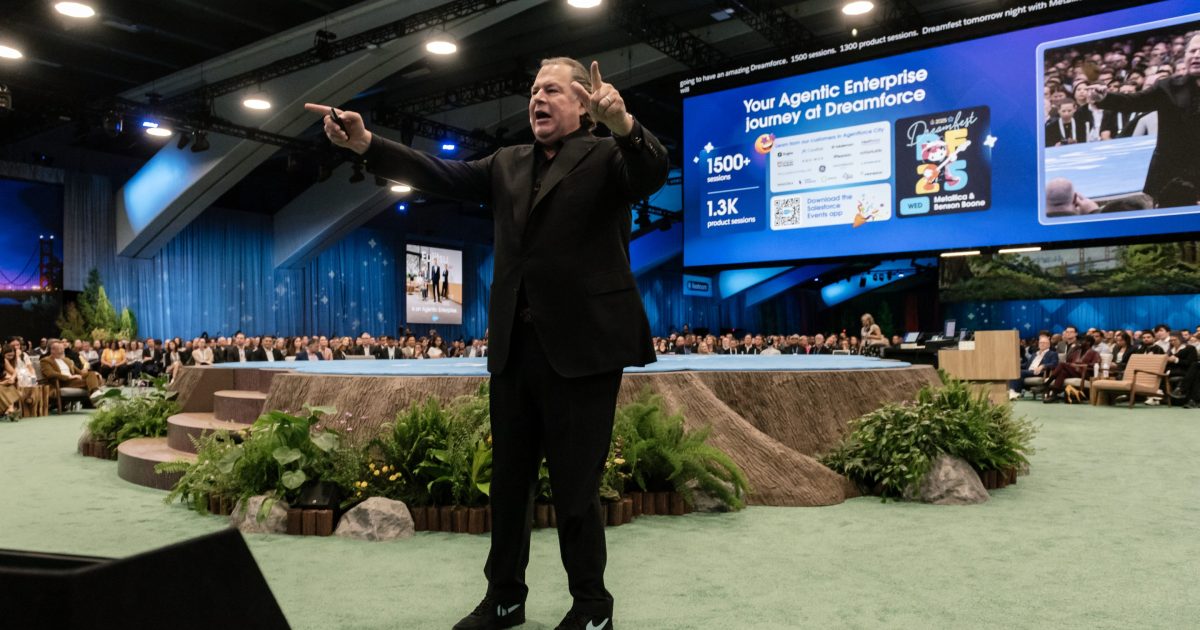
I spent last week on a reporting assignment in San Francisco. While there, I dropped by Salesforce’s huge Dreamforce conference. Salesforce founder and CEO Marc Benioff made lots of headlines—but probably not for the reason he wanted.

En route to the conference, Benioff had given an interview to the New York Times in which he’d been complimentary of President Trump and said he would welcome the National Guard being deployed to San Francisco. By the end of the week, Benioff had apologized for that stance—saying he had spoken out of an abundance of concern about the safety of those attending his conference—after being sharply criticized by famed Silicon Valley investor and advisor Ron Conway, who resigned from the board of Benioff’s charitable foundation in protest, as well as Lauren Powell Jobs, Steve Jobs’ widow and president of the Emerson Collective, who lambasted Benioff’s position in an op-ed in the Wall Street Journal.

All of this was a distraction from what was actually taking place at Dreamforce, where Salesforce announced a slew of new tools to make it easier for its customers to build and deploy AI agents. Few tech company CEOs have staked as much on the promise of “agentic AI” as Benioff. How is that bet going? Well, to judge from Dreamforce, the answer is—like so much that is happening in AI right now—something of a mixed picture.

On the one hand, Salesforce says that its “Agentforce” features have seen the fastest adoption of any product the company has ever released. But, on the other hand, not counting agents in Slack—which I’ll cover further in a moment—the company has only about 12,500 customers (or just over 8% of its customer base) having adopted Agentforce in the past year, and only 6,000 of those are paid engagements. (Salesforce allows customers to experiment with Agentforce for free, up until a certain usage threshold.) Those relatively low numbers—which helped explain Salesforce’s rather tepid recent revenue growth—had been weighing on Salesforce’s stock.

But at the conference, Salesforce also issued improved guidance for its future revenues, saying that, thanks to Agentforce, organic sales growth would accelerate to above 10% year over year in 2026 and continue that way. The company now forecasts $60 billion in annual sales by 2030, ahead of analysts’ consensus view. That projection sent Salesforce’s stock up 5% on the day, and shares have continued to climb over the past week. So what’s really happening here?

Innovation out-stripping adoption

In his keynote at Dreamforce Benioff, acknowledged that there was currently a “bifurcation” between rapid consumer adoption of AI chatbots, such as OpenAI’s ChatGPT, and relatively slower enterprise adoption of AI. And during a press conference afterwards, he went further, saying, “This is the moment where this technology innovation [is] out-stripping customer adoption. Our job is to get those customers into adoption mode. The way to do it is by showing them customers who are front-runners in this, so when you look at these customers, they are making it happen.” Salesforce is also doing this by creating more “forward-deployed engineers” to work directly with its customers, helping them build AI agents. The company seems to have realized in the past year that enterprises will need Salesforce to hold their hand more than was true with its traditional SaaS products.

I toured a section of the convention hall branded “Agentforce City” to look at some of those early adopters and their AI agents. A few, like Williams & Sonoma’s AI agent that offers customers recipe advice—and by the way, also suggests cookware they might need to make that roast or pie—seemed a bit gimmicky. That recipe agent might give the company more touchpoints with a customer, but it wasn’t clear it would directly translate into higher sales. More interesting was PepsiCo’s AI agent that allows it to provide better customer service to the many small Mom-and-Pop shopkeepers and bodega owners who stock Pepsi products but who don’t necessarily get a lot of attention and advice from Pepsi’s sales reps. More promising still is Dell’s use of Salesforce’s AI agents to automate parts of its supply chain, including onboarding new suppliers, which has cut its average onboarding time from months to days.

But Salesforce executives universally acknowledged that it would take time for more companies to follow the lead of Dell or PepsiCo. Adam Evans, Salesforce’s executive vice president and general manager of Salesforce AI, told me that he has spent most of the past year trying to show customers how to move beyond experimentation with AI agents. “What’s hard is to create agents that scale, that do things consistently, that you can work into an enterprise process to create value,” he said.

Slack as the interface to all of Salesforce’s software

To help customers with that, Salesforce unveiled several new Agentforce features at Dreamforce. There’s an Agent Builderthat allows a user to simply describe what it wants an agent to do; the system then automatically sets it up, with much less manual tinkering that was needed previously. There’s a new voice interface for AI agents, powered in part through OpenAI’s voice models, that improves interaction with agents. There’s an Agent Script tool that lets businesses establish rule-based processes for part of a given process and use the less predictable, but potentially powerful, reasoning of a large language model (LLM) for other parts of the process. It also introduced a new vibe-coding tool called Agentforce Vibes, which is aimed at developers already skilled at building Salesforce applications, but allows them to create these apps, including more sophisticated agentic workflows, using natural language.

Perhaps the biggest news is that Salesforce is hoping to position Slack—which Salesforce bought in 2020 for $27.7 billion—as the main “conversational gateway” to all of Salesforce’s software, including its Agentforce offerings. Denise Dresser, Slack’s CEO, told me that the idea is that instead of having to learn to configure and run processes in Salesforce’s Marketing Cloud or its Service Cloud, a Slack user could simply message an AI agent within Slack that will run these processes for them using Salesforce’s software in the background.

Slack has also created “knowledge agents” that can surface information from a particular Slack channel and perform certain actions—helping them onboard a new hire for, instance, or install software on a new laptop, directly from Slack. Dresser also told me that she thinks Slack is the ideal interface because it can incorporate both person-to-person and team interactions on the same channel in which you can have individuals and teams interacting with AI agents, whereas some AI companies are only optimizing their products for human-to-AI collaboration.

Dresser certainly may have a point about chat as the new interface to software. It’s a vision that AI companies like OpenAI and Anthropic are also pursuing. And some of these AI companies are projecting the idea even further, envisioning a future where AI agents use their coding abilities spin up bespoke software on the fly to handle many of the tasks that now require enterprise software, like, um, Salesforce. But whether that vision will come to fruition or whether traditional SaaS products will continue to exist, just with AI front-ends, remains to be seen. One thing that is clear from Salesforce’s experience in the past year since it started rolling out AI agents is that enterprise adoption will probably run behind over-hyped market expectations.

With that, here’s more AI news.

Jeremy Kahn
jeremy.kahn@fortune.com
@jeremyakahn

If you want to learn more about how AI can help your company to succeed and hear from industry leaders on where this technology is heading, I hope you’ll consider joining me at Fortune Brainstorm AI San Francisco on Dec. 8–9. Among those confirmed to appear so far include Google Cloud chief Thomas Kurian, Intuit CEO Sasan Goodarzi, Databricks CEO Ali Ghodsi, Glean CEO Arvind Jain, Amazon’s Panos Panay, and many more. Register now.

FORTUNE ON AI

Marketing leaders say AI is rewriting how brands reach Gen Z and millennials: ‘Forget what you know; learn this’—by Jessica Coacci

Exclusive: Early AI darling LangChain is now a unicorn with a fresh $125 million in funding—by Sharon Goldman

Sam Altman wants to ‘treat adults like adults’—but can OpenAI keep ChatGPT safe after opening the door to erotica?—by Beatrice Nolan

Empathy is the most under-hyped factor of the AI transformation era, American Express exec says—by Sydney Lake

EYE ON AI NEWS

OpenAI launches its long-awaited AI-powered web browser. The company debuted ChatGPT Atlas, a web browser with a built-in conversational assistant designed to act as a “companion” while users navigate the internet. Available globally on macOS (with Windows, iOS, and Android versions coming soon), Atlas includes an agent mode for Plus and Pro subscribers that allows ChatGPT to take real-world actions like booking reservations, editing documents, or managing emails. The release marks OpenAI’s most direct challenge yet to Google and Perplexity, both of which have already released their AI-capable browsers. The shares of Google-parent Alphabet fell sharply on the news. You can read more from Fortunehere.

Walmart partners with OpenAI on commerce. Within the next few months, U.S. ChatGPT users will be able to buy most Walmart products directly in the chatbot using its new Instant Checkout feature, the two companies announced. The move is a sign of what may be a new paradigm of “conversational shopping”—and it means Walmart will share purchase data from ChatGPT transactions with OpenAI, a notable concession given retailers’ usual grip on such data. You can read more from the Wall Street Journalhere.

Study finds AI copilots could save U.K. health service 43 minutes per staffer per day. That’s the result of a study that looked at the deployment of Microsoft’s 365 Copilot across 90 different organizations that are part of Britain’s National Health Service. That could translate to millions of hours per year if rolled out across the entire health service. You can read more from The Telegraphhere.

Anthropic pushes back after criticism from White House ‘AI czar.’ Anthropic CEO Dario Amodei wrote a blog post rebutting social media attacks from David Sacks, the White House’s crypto and AI czar. Sacks accused the company of pursuing a strategy of “regulatory capture”—trying to raise fears of existential risk from AI in order to lobby for AI regulation at the state and federal level that would favor its own products over those of rivals. Amodei argued that Anthropic aligns with the Trump administration on key AI priorities—citing praise for competitiveness-focused executive orders and a July meeting where he spoke with President Trump—while still opposing a proposed 10-year state-level moratorium on new AI laws. He also defended Anthropic’s support for California’s recently enacted AI law, which requires AI companies building powerful AI systems to report the results of their in-house safety-testing and provides additional whistleblower-protection to employees of those companies. Amodei said the company had hired both Republicans and Democrats to policy positions and that its models were less politically-biased than some rivals’. You can read more from my Fortune colleague Beatrice Nolan here.

OpenAI researcher retracts announcement of math breakthrough. OpenAI researchers, including Sebastien Bubeck, claimed that their model GPT‑5 had solved 10 difficult math problems that had been initially proposed by mathematician Paul Erdős (who died in 1996) and had remained unsolved to date, and that it had made significant progress on 11 others. But Thomas Bloom, who maintains the online list of “Erdős problems” quickly debunked this, showing that GPT-5 had merely found obscure published solutions that had not previously been brought to his attention, rather than producing new proofs. The incident sparked sharp industry criticism—Google DeepMind CEO Demis Hassabis called the situation “embarrassing”—and highlighted concerns about whether the mathematical and scientific reasoning capabilities of many AI models is overhyped. You can read more from TechCrunch here.

AI researcher Andrej Karpathy says AGI is still at least a decade away. Andrej Karpathy, a prominent AI researcher who was part of the founding group at OpenAI and headed AI at Tesla for a number of years, appeared on the Dwarkesh Podcast and said that artificial general intelligence (AGI) is likely still about a decade away. His position contradicts claims by a number of AI researchers at companies such as OpenAI and Anthropic that human-level AI is imminent. Karpathy argued that today’s AI agents “just don’t work,” describing them as unreliable, unintelligent, and incapable of handling complex, continuous tasks, and said AGI will emerge gradually rather than through a sudden breakthrough. Karpathy added that progress should be viewed through the lens of steady economic and technological growth rather than hype about machines replacing humans anytime soon. You can listen and watch the podcast episode here

EYE ON AI RESEARCH

Google researchers use AI to help spot genetic drivers of cancer. Researchers at the tech giant created DeepSomatic, a new open-source AI model that helps scientists analyze cancer genomes more quickly and accurately. The tool—which is based on a convolutional neural network, an older form of AI architecture that is particularly good at analyzing visual data—is able to distinguish between genetic mutations a person is born with and those that develop in cancer cells. In early tests, it outperformed existing methods of detecting these cancer-related genetic changes, making it especially useful for studying hard-to-analyze cancers like childhood leukemia and brain tumors. Google is open-sourcing both the AI model and the training data set it used to create it. You can read Google’s blog post on the research here.

AI CALENDAR

Oct. 21-22: TedAI San Francisco

Nov. 10-13: Web Summit, Lisbon 

Nov. 26-27: World AI Congress, London

Dec. 2-7: NeurIPS, San Diego

Dec. 8-9: Fortune Brainstorm AI San Francisco. Apply to attend here.

BRAIN FOOD

The backlash against the AI-driven data center boom is growing worldwide. The New York Times examined how local communities from Chile to Ireland are increasingly opposed to data center construction in their backyards due to the negative environmental impacts and energy demands these warehouses stuffed with computer chips bring. The comprehensively reported story is definitely worth reading. Nearly 60% of the world’s largest data centers are now located outside the U.S., often in places where electricity and water systems are already fragile, the paper reported. Residents in affected regions report worsening blackouts and water shortages, while governments—eager for investment and AI infrastructure—have offered tax breaks and cheap land, often with little regulation or transparency. Tech companies say the projects bring jobs and investment and claim they are minimizing environmental impact, but critics argue they are depleting vital resources and hiding their true footprint through subsidiaries and nondisclosure agreements.

The data center build-out is sparking a growing backlash, led by environmental activists. Whether this backlash will slow the data center boom, blacken the reputation of AI companies and their products with users, or hasten the roll-out of AI regulation globally remains to be seen. But it is definitely a trend to watch. It’s unclear if the backlash will spur AI researchers to find alternative AI methods that are less environmentally-costly—or if AI itself will lead to clean energy breakthroughs, in say fusion power, that might compensate or negate the environmental damage the technology is causing currently. But one can hope. 


Source link

Continue Reading

Business

Inside the Fortune 500 CEO pressure cooker: Surviving harder than ever and requires an ‘odd combination’

Published

on


Thompson, chairman of the Chief Executive Alliance and previously ranked as the world’s top CEO coach, and Loflin, Nasdaq’s Global Head of Board Advisory, joined forces to provide a 360-view of this loaded moment for leadership, from the C-suite and board perspectives, respectively. In a wide-ranging conversation with Fortune, they talked about the Shakespearean themes of leadership and turmoil and the feeling that “heavy is the head that wears the crown.”

For those aspiring to reach the top, Thompson shared the conventional wisdom he’d learned from his mentor, Marshall Goldsmith: “What got you here got you halfway there.” (Goldsmith had a New York Times bestseller in 2007 with What Got You Here Won’t Get You There.)

The transition from being a high-performing executive in a “swim lane” to having the “aperture of having a full enterprise” requires substantial new learning and skill development, Thompson argued, because no matter how great an executive you are or how prepared you think you might be, the stakes are existentially high. The risk that a CEO might “lose his or her head within the next year or so” is “easily like 20% or at the big brands It feels like it’s twice that,” said Thompson, who recently penned an essay on the subject of CEO “decapitation” for Fortune.

Adding to this pressure, Thompson and Loflin added, is the radical shift in board member expectations. Board members, who once might have been “golf buddies,” are now “really under the gun to perform.” They are “less patient” and expected to “actually deliver,” based on their subject matter expertise.

This environment demands nearly every candidate be ready to serve as a “peacetime in a wartime CEO,” Thompson said, capable of harvesting the best aspects of the company culture while also being “disrupting and breaking new ground.” An executive promoted from a functional role, such as a CFO, may possess the “gravitas of understanding the street and the shareholders,” but often lacks the breadth to “light hearts and minds” across the workforce, or do “ride-alongs with customers.”

The loneliness of the tower, and ‘relationology’

Fortune has been tracking this tenuous moment for leaders throughout 2025. Top recruitment firm Challenger, Gray & Christmas found 1,235 CEOs had left (or lost) their jobs through the first half of 2025, a stunning 12% increase from 2024 and the highest year-to-date total since Challenger began tracking CEO turnover in 2002.

Jim Rossman, Barclays’ global head of shareholder advisory, who’s been closely tracking shareholder activism for decades, similarly found record activist-linked turnover at the top for 2025. “It feels like what activists have done is basically [to hold] public companies to the standards of private equity,” Rossman told Fortune in a previous interview, as they have come to view the CEO “more as an operator, not somebody who’s risen through the ranks.” In other words: Results matter.

The intense environment contributes to feelings of isolation. As CEOs often note, being the boss is a lonely job where leaders are caught in the middle, with information they cannot share with reports but must share with the board, creating a huge information asymmetry, as Microsoft CEO Satya Nadella previously told McKinsey.

Carolyn Dewar, the co-leader and founder of McKinsey’s CEO Practice, previously told Fortune that “No one else in your organization or above you, like your board or your investors, see all the pieces you see.” She advocated for leaders to surround themselves with trusted advisors—“a kitchen cabinet” of sorts.

Similarly, Loflin told Fortune he’s fond of the concept of “relationology,” which he describes as “sort of a study of relationships.” He suggested leaders must develop a “portfolio of relationships of intimacy” that are “very context-relevant.” A leader’s effectiveness hinges on having fluency, for instance, when speaking to a CFO about analyst days, or working with a compliance team to keep the business safe or connecting authentically with union executives. Loflin said he’s often seen it being a “big surprise” to accomplished leaders that they have, say, seven different groups they need to engage and maybe as many as six new skills to really flesh out before they’re ready to take the enterprise to the next level.

This need for deep, context-aware connection also applies to personal life, Loflin added. The idea that a personal life and professional life can be entirely separate “undermines leadership and undermines the fabric of a company.” Critically, Loflin said, the chair must really know his CEO “at a deep level, like a Shakespearean level,” requiring a transparency that ensures appropriate accountability. After all, Loflin noted as one example, boards have to be mindful that a personal relationship that violates company policy can jeopardize corporate governance at the drop of a hat. The board really needs to know who their CEO is, maybe better than the CEO knows themselves.

The power and the privilege, the hubris and the humility

Loflin, who admitted to Fortune that he’s a bit of a Shakespeare nerd, noted the difference between a tragedy and a comedy is determined by “the vulnerability and the self-awareness of the protagonist,” and a tragic outcome results from a feeling he likened to “never recognizing whether I needed to grow or change.”

Thompson added that surviving as a CEO requires an “odd combination” of traits you might read in a Greek tragedy: hubris and humility.

The CEO must possess the hubris, or excessive pride, to believe they can be the best in their field, but also the profound humility that acknowledges they can’t do it alone.

The professional mandate is relentless, Thompson added, citing a key interview for the book from Qualcomm CEO Cristiano Amon: if you were the “same guy you were a year ago, you don’t deserve to be promoted.” Thompson said he thinks of hubris of being at “the edge of your competence, so rather than retreating, you actually should lean into that” to acquire the skills and help you need to keep growing as a professional.

For top leaders, Thompson said, the top job is not a prize to be won, but a “privilege to do this role.” Just as Olympic athletes must constantly improve, he added, leaders must recognize that breaking a record only attracts more competition.

Loflin urged boards and executives alike to move beyond a Wolf of Wall Street mindset and into “what it means to authentically care for and build the confidence and foster appropriate accountability.” He said that for many executives, admitting you have areas to improve on and get better at is a “special vulnerability.” He argued boards need more genuine, interpersonal affection—sometimes of the tough love variety—is needed to prevent a truly Shakespearean tragedy on their watch.

Loflin said he’d just had breakfast with a board director for a $30 billion company and the subject of love arose: “Do you love your management team?” The director said yes, definitely, almost like relatives. After all, they had been with the company over a decade and come to have deep relationships with other directors and their C-suite. Loflin argued that over decades of advising boards on corporate governance, he wishes more would adopt this sort of attitude.

“I don’t think it’s going to hurt anything in business because a good father has to talk to a troubled son, hopefully he’s mentoring when [the son is] getting himself in trouble.” After all, Loflin continued, “bad stuff happens, and I think some of these metaphors are important.” In other words, it shouldn’t be the Wolf of Wall Street, but the wolf—or the activist—is always at the door.


Source link

Continue Reading

Business

So much of crypto is not even real—but that’s starting to change

Published

on


We spend a lot of time on the road meeting with LPs, fellow investors, and founders. No matter where the conversation starts – whether it’s in Singapore, Abu Dhabi, London, or anywhere else – it often drifts to a simple, sometimes rhetorical question: Is any of this real?

It’s a fair question. Crypto has become a strange reflection of our economy and society more broadly: part financial spectacle, part social experiment, part collective delusion. For every breakthrough in cryptography or blockchain infrastructure, there are ten new ways to speculate. The mood across the ecosystem has shifted. It’s not outrage or denial anymore…it’s fatigue.

Over the past few years, crypto has rotated through one speculative narrative after another: Layer 1 blockchains that quickly traded to huge valuations; NFTs that promised culture and delivered cash grabs; Metaverse real estate in the clouds; “Play-to-earn” games that collapsed before they even shipped. The most recent cycle brought us a flood of memecoins, which grew the universe of tokens from 20,000 in 2022 to over 27 million today, and now represent as much as 60%+ of daily application revenue on Solana. Then there are perpetual futures platforms that offer 100X leverage to largely retail traders.

Each cycle creates a new form of entertainment and a new way for speculative capital to churn. To date, the current era’s three most successful crypto retail applications – Pump.fun, Hyperliquid and Polymarket – have all fed this speculative bubble. One reality has become perfectly clear. The casino always finds a new table.

And yet, buried under all the speculative noise, something real is taking shape.

The most obvious sign is stablecoins bursting into the mainstream with a host of real-world use cases. Already, stablecoin circulation has reached more than $280 billion, and led financial incumbents to scramble for a response. The stablecoin boom reflects how institutional investors and asset managers are becoming less focused on the speculative nature of crypto and toward what can actually be built now that the pipes actually work and the advantages of faster, cheaper, and more secure rails are becoming clear.

AI, meanwhile, is accelerating the cognitive part of the equation. Where blockchain builds verifiable systems of record, AI introduces adaptability, reasoning, and speed. These two technologies complement each other in powerful ways: verifiable and immutable data for intelligent models, intelligent models for decentralized networks. Together, they create the architecture for products that address real-world use cases that couldn’t exist before – autonomous systems that transact, coordinate, and learn in real time.

This convergence is where the next chapter begins. Founders with deep domain expertise are building in financial infrastructure, global payments, AI compute networks, media, telecom, and beyond – massive sectors where the combination of trustless systems and intelligent automation can unlock entirely new markets. These aren’t speculative casino plays; they are fundamental rewrites of how value and data move through the economy.

The question has never been about available capital or interest. It has been about why investors should feel enough conviction to allocate to an industry with a history of prioritizing the casino. The consensus has been that despite blockchain’s potential, too many projects are chasing the same users, while too many teams are designing for each other instead of the broader market. The result has been a landscape full of potential energy waiting for its moment of release – a release that institutional investors finally realize is coming soon.

So, is any of this real?

The truth is that most of it still isn’t, but it is becoming more real everyday. For the first time in our 10+ years in the digital asset space, institutional investors are now acknowledging that this technology has the potential to touch industries far beyond crypto in ways that can reshape finance, trade, media, data, and beyond. And much of this potential is not far off.

That’s why we believe 2026 will mark the most meaningful shift we’ve seen in this space. The casino might still churn, but the builders who survive it will drive lasting innovation.

We’re betting on them and we’re more bullish on the future of this technology than ever.

Pete Najarian is Managing Partner of Raptor Digital who operates in both the digital asset space and traditional finance. Joe Bruzzesi is a General Partner at Raptor Digital and serves on the boards of Titan Content and Nirvana Labs.Their views do not necessarily reflect those of Fortune.


Source link

Continue Reading

Business

Paul Newman and Yvon Chouinard’s footsteps: More ways for CEOs to give it away in ‘Great Boomer Fire Sale’

Published

on


The most radical act in capitalism today isn’t launching a unicorn startup or orchestrating a multi-billion-dollar IPO – it’s giving your company away in service of good.

While some business leaders are focused on how to make their fortunes in AI or crypto, others are choosing to walk away with nothing except what matters most: a philanthropic annuity to cement their legacy. As the President and CEO of one of the most famous brands that gives 100% of its profits away, I am hearing from more and more CEOs and business owners who want to follow in Paul Newman or Yvon Chouinard’s footsteps. These leaders spent decades building profitable enterprises and are now working to transfer ownership of their companies, not to the highest bidder, but to foundations, nonprofits, purpose-driven trusts, or to their employees.

An estimated 2.9 million private U.S. businesses are owned by those over 55. Over the next 20 years, the Great Wealth Transfer and “The Great Boomer Fire Sale” is a unique opportunity to reimagine business exits as an act of generosity. 

Why give away your business? A generosity exit allows you to maximize your giving through an engine that will keep generating profits every year, creating a philanthropic annuity, while preserving the company, its employees, and the culture built over decades. Besides, conventional exit options may not be a great fit for your values if you’ve spent decades investing in your employees and your community. Selling to private equity or another business could mean layoffs and a decimated culture. Not all owners have family heirs who want or can take over. Going public is only available to the biggest businesses and subjects your life’s work to quarterly earnings pressures and the short-term thinking that comes along with it. Purpose and legacy can be more important than a big check at the end of your life, especially if you already made good money throughout your life’s work. 

As the baby boomer generation looks to the legacy they want to leave behind, Millennials and Gen Z look ahead to the legacies they want to build, with some founding successful companies where giving 100% of their profits away is baked in from the beginning. Entrepreneurs like John and Hank Green of The Good Store, and Adam McCurdie and Joshua Ross of Humanitix, are challenging the critics of the ‘business for good’ model by showing that you can grow a successful business while simultaneously giving away all profits.

The good news for those interested in giving away their business? There are now more governance models available than ever before. 

Choosing the Right Structure for Your Exit

Through the passage of the Philanthropic Enterprise Act in 2018, foundations can now own 100% for-profit companies in the US. Newman’s Own Foundation is an example of this. As a result, one hundred percent of profits and royalties from sales of Newman’s Own products go to the Foundation in service of its mission: to nourish and transform the lives of children who face adversity. 

Patagonia uses a perpetual purpose trust, a type of steward-owned ownership which is more common in Europe. Since 2022, the trust holds 100% of the company’s voting stock to ensure its environmental mission and values are preserved indefinitely, while profits are funnelled to a 501c(4), Holdfast Collective to give away to climate causes. These models create what economists call “lock-in effects” allowing owners to keep mission front and center, even when they’re gone.

Over 6,500 U.S. companies are now fully or part-owned by their workers, using Employee Stock Ownership Plans (ESOPs), including Bob’s Red Mill and King Arthur Baking Company. These models support business continuity and create thousands of employee-owners who are invested in the company’s long-term success. While in many cases, these exits are financed through loans, there’s nothing stopping an owner from giving the business to their workers.

You can also look at hybrid models. For example, Organic Grown Company uses a perpetual purpose trust to ensure profits are split between equity investors, employees, growers, and nonprofits.

And while a business owner may decide to establish their own foundation, why reinvent the wheel? There are plenty of existing foundations and non-profits who could be worthy recipients if you want to give your company away. Back in 2011, Amar Bose gave the majority of the stock of the sound system company Bose corporation to his alma mater, the Massachusetts Institute of Technology in the form of non-voting shares.

What’s Next? 

This holiday season is upon us, and whether you own a business or not, it’s a good time to reflect on what matters most: What are your values? How much money is enough for yourself and your family? What does legacy mean to you?

For CEOs and owners considering a generosity exit, the first step is to assemble the right team: attorneys experienced in foundation-ownership, purpose trusts, or ESOPs, financial advisors who understand tax implications of these unique paths, independent directors or trustees who share your vision. Organizations like 100% for Purpose, Purpose Trust Ownership Network, and Purpose Foundation can provide resources and case studies.

Start mapping out your plan, and be patient as a transition could take years, not months. Yvon Chouinard spent two years structuring Patagonia’s transition. While Paul Newman decided from the beginning to give all of the food company’s profits away back when it began in 1982, the first few years were just him writing checks at the end of the year. A foundation was initially established in 1998, and became Newman’s Own Foundation before Paul’s death, at which point the food company was gifted to the Foundation. The complexity isn’t just legal—it’s emotional, relational, and cultural, but ideally, the transition can happen while you’re still actively involved, can steward the shift, and can see the rewards of your hard labor pay dividends for good. 

In this day and age of robots and artificial intelligence, it’s good to remember Paul Newman’s wise words: “Corporations are not inhuman money machines. They must accept that they exist inside a community. They have a moral responsibility to be involved. They can’t just sit there without acknowledging that there’s stuff going on around them.”

Building a profitable company is hard but what’s truly meaningful is to let them go in service of good. In doing so, we allow our work to live on in ways that matter far beyond the balance sheet.

The opinions expressed in Fortune.com commentary pieces are solely the views of their authors and do not necessarily reflect the opinions and beliefs of Fortune.


Source link

Continue Reading

Trending

Copyright © Miami Select.