Saks woes cloud cashmere king Cucinelli’s department store bet
By
Reuters
Published
January 9, 2026
Italian luxury brand Brunello Cucinelli, known for its $3,000 cashmere sweaters, bet big on department stores, a strategy now in the spotlight as iconic US High Street retailer Saks struggles to pay back debts.
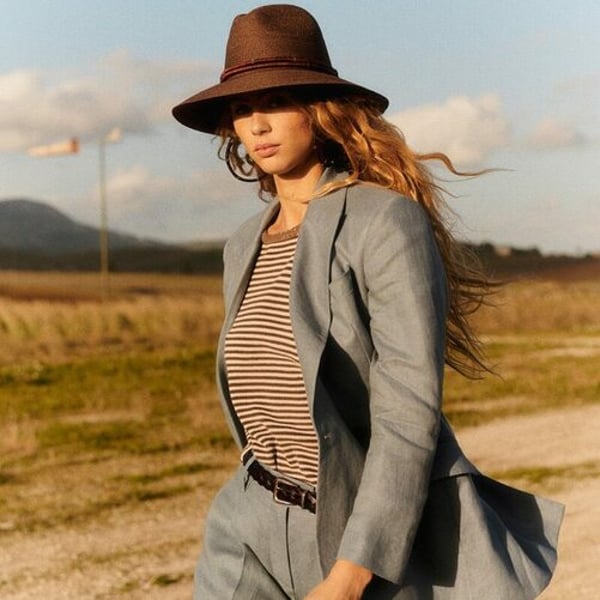
A look by Brunello Cucinelli – Brunello Cucinelli
Saks Global, created after Saks Fifth Avenue parent Hudson’s Bay Company bought rival Neiman Marcus, saw its CEO depart this month, amid reports it was preparing for bankruptcy after missing an over $100 million interest payment. That’s put a harsh spotlight on the strategy of firms like Cucinelli that have bet heavily on high-end department stores, whose future is more uncertain in a weak global luxury market where many brands have shifted towards their own outlets.
The firm, however, is doubling down. Brunello Cucinelli, founder and chairman of his namesake firm, told Reuters that the company was sticking with its strategy, which gives a strong emphasis to the wholesale channel.
He said that so far it had only faced a one-month delay in payments from Saks Global, and at the operational level had not had any issues with the retailer. “We don’t foresee any economic risks, except for extremely limited ones,” Cucinelli told Reuters by phone. “And bear in mind, they would be the first (losses) in 45 years of business. Every year, we lose 0.1% from our multi-brands, which is practically nothing.”
Cucinelli is, however, more exposed than most. Co-CEO Luca Lisandroni in December lauded the cashmere king’s ties with Saks and heralded some of its “best results ever” in its stores around the US, “demonstrating the great centrality of this client in the global luxury landscape.” The Italian firm makes some 36% of its revenues from the wholesale channel and around 64% from its own retail outlets, relying more heavily on multi-brand distribution than some key luxury peers, according to data compiled by Reuters.
Over the past decade, luxury groups have shifted toward their own retail networks, giving them more control over pricing, inventory, and margins. Retail now accounts for some 90% of sales by Prada, 81% at Moncler, 87% at Zegna, and 75% at Gucci-owner Kering.
Cucinelli, which targets some of the highest-end wealthy customers, has proved to be among the most resilient brands in the industry hit by lower demand. Sales in both the wholesale and retail channel grew in the first nine months of 2025 and the brand raised its full-year revenue growth forecast to 11–12% in December.
Morningstar analyst Svetlana Menshchikova said that a possible Saks bankruptcy or restructuring could lead to “delayed payments, limited bad-debt exposure and maybe some lost sales if the department stores would fail to replenish their stock.”
“The company has consistently highlighted the US wholesalers as key clients and an integral part of its brand image and business model,” she said. “Although we do not expect a severe impact on the company given Cucinelli’s global footprint and strong balance sheet.”
Saks Global’s financial troubles reflect wider challenges in the $417 billion global luxury market, which is battling to emerge from years of stalling sales. The US luxury retailer, which operates Saks Fifth Avenue, Neiman Marcus, and Bergdorf Goodman, missed an interest payment due at the end of December and it is preparing to file for bankruptcy, the Wall Street Journal reported last month. Founder Cucinelli credited department stores in part for that and said he had faith in Saks and the 400 multi-brand stores he said the brand worked with worldwide.
“We do 40% of our business with multi-brands and I’m absolutely delighted,” he said, calling department stores the “true custodians of the brand.”
“To make it even clearer how much we believe in multi-brand (stores), hypothetically speaking, I would buy Saks Global tomorrow if I were an interested investor.”