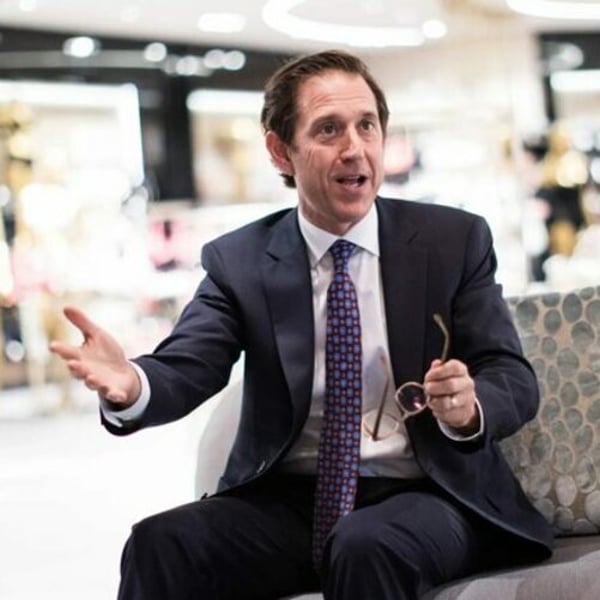
Saks Global Enterprises’ chief executive officer Richard Baker is departing less than two weeks after taking over the top job as the beleaguered luxury conglomerate he created prepares to restructure under bankruptcy court protection.
Bloomberg
Baker, who has been CEO and also executive chairman of the department store chain, had been finalizing his exit over the past few days, according to people familiar with the situation who asked not to be identified because the move hasn’t been announced yet.
Geoffroy van Raemdonck, currently a board member of Moncler SpA, is currently negotiating for a role at the company, according to people familiar with the matter.
Founded more than 150 years ago, Saks is close to filing for Chapter 11 bankruptcy protection, according to the people, to address mounting losses and a substantial debt load.
Saks, Baker and van Raemdonck didn’t immediately respond to requests for comment.
Van Raemdonck was CEO of Neiman Marcus Group from 2018 until 2024. He saw the luxury retailer through a pandemic-era bankruptcy and then its emergence and subsequent recovery. He stepped down when Saks acquired it.
Saks’ debt has weighed on the company, which operates its flagship Saks Fifth Avenue stores as well as Bergdorf Goodman and Neiman Marcus.
Baker, a longtime real estate investor, was announced as the company’s new CEO on Jan. 2, succeeding Marc Metrick.
Baker was chairman of Hudson’s Bay Co. when it bought Saks Fifth Avenue in 2013 and was the key architect of Saks’ acquisition of rival Neiman Marcus Group for $2.65 billion in 2024, creating Saks Global.
One brand, and designer, enjoying a renaissance at Pitti Uomo is Rag & Bone, where newly installed creative director Swaim Hutson showed his debut collection for the house.
Swaim Hutson – Courtesy
After several years where the brand seemed to stand still, there was plenty of fresh momentum at its stand inside Pitti. From fabric choices and color, to proportion and attitude.
“I don’t want to obviously steer away from the DNA of what Rag & Bone has stood for over the years and what Marcus and David started. It’s about keeping the DNA – starting with workwear, denim obviously and then tailoring,” said Hutson, referring to the brand’s two UK founders and cohort, Marcus Wainright and David Neville.
So, Hutson took those three categories “and just put them in a blender and mashed them up,” for fall 2026.
“That’s the way the modern man dresses, and definitely the way guys in New York are dressing now,” underlined Hutson, pointing to a smart blazer worn with rugby jersey and track pants.
Rag & Bone fall/winter 2026 – Courtesy
Much of Rag & Bone’s suiting is made in Portugal, like an increasing number of brands. Hutson comes from a more tailoring background, but was “determined not to be stuffy,” so he mixes lots of suiting separates with sportswear.
Asked what brief did he get when you got the job, he deadpans: “What did Mr. Andrew Rosen tell me? He told me a lot. Nothing major, just more of the history of the brand and that there were no restrictions,” said Swain referring to the famed New York fashion entrepreneur and brand’s de facto CEO.
Rag & Bone began life back in 2002 with a pair of raw denim jeans, and Hutson has gone back to a rawer denim aesthetic, with R&B Raw, proprietary to the brand. A new treatment where you wash jeans 20 times without destroying the raw aesthetic, while keeping the fabric soft and supple.
“So, it doesn’t feel like wearing sandpaper. It’s raw denim, but modernized for today’s work,” said Hutson.
Rag & Bone fall/winter 2026 – Courtesy
Swaim brings nearly two decades of experience in international menswear to the role. He first won attention by founding Obedient Sons in New York- going on to become a CFDA/Vogue Fashion Fund finalist. He then held creative director roles at 3.1 Phillip Lim, Club Monaco, and Generra. Before later launching The Academy New York, a label that has established itself within the fashion, art, and music communities.
His plan for mixing suiting, denim and outerwear at Rag & Bone led to pairing a denim shirt under a suit jacket, as opposed to wearing an Oxford shirt. The subtle change of style comes as Rag & Bone is upping its efforts in Europe. Today, Rag & Bone is controlled by the WHP Global group, which also includes Vera Wang, Isaac Mizrahi, G-Star and Joseph Abboud.
Hutson was born in North Carolina, making him, as they say, a Tarheeler, but now resides in the Brooklyn Navy Yard district.
This year, the brand will open a new boutique in Dubai, following on from a fresh store in Amsterdam, adding to one in Germany, and two in London, for a chain of some 30 boutiques. The brand remains primarily a wholesale business though, with over 700 doors and annual revenues hover around $300 million.
Rag & Bone fall/winter 2026 collection – Courtesy
Rag & Bone originally began as men’s brand, but today women’s wear accounts for 60% revenues, with menswear at 40%.
The brand’s other big focus is a project called “Miramar”, a fresh denim aesthetic that is very soft, almost like terry cloth, with lots of looks ideal for travel.
“We’ve opened a couple of small Miramar stores. One is about 600 square-foot inside Moynihan Train Hall, opposite Penn Station which is beautiful. And it’s done tremendous business,” he enthuses about the new Manhattan retail hub.
In Pitti, Hutson also showed some strong new colors with bold reds and plaids. Plus, he impressed with more probable proportions – from short, plaid shirt jackets to some really cool faded blue chalk stripe looks. Seen in deconstructed jackets and a natty urban redingote, finished with neat RB logo buttons.
Next up, one suspects is a return to the catwalk for Rag & Bone after a hiatus of several years.
“We’re talking about it. It wouldn’t hurt. It’s just about the leadership being confident in what designs we put out. I would love to do a show. I think New York deserves it, and we’re a New York brand, you know,” he concludes.
Beleaguered luxury retailer Saks Global is close to finalizing $1.75 billion in financing with creditors that would allow its iconic Saks Fifth Avenue, Bergdorf Goodman and Neiman Marcus stores to remain open, two people familiar with the negotiations said.
The department store conglomerate wants to reorganize its debt and operations in Chapter 11 bankruptcy, which it could file “imminently.” – REUTERS/Angelina Katsanis
The department store conglomerate wants to reorganize its debt and operations in Chapter 11 bankruptcy, which it could file “imminently”, the people said.
The financing would provide an immediate cash infusion of $1 billion through a debtor-in-possession loan from an investor group led by Pentwater Capital Management in Naples, Florida, and Boston-based Bracebridge Capital, the people said.
The company’s banks would also provide an additional $250 million in financing through an asset-backed loan, the people said, asking not to be identified because the discussions are private.
A DIP loan helps companies pay salaries, vendors and other ongoing expenses while a company goes through Chapter 11 bankruptcy, allowing it to continue operating while reorganizing its business. DIP financing gives investors priority repayment if the company isn’t successful and has to liquidate, so a bankruptcy judge will have to sign off on it.
Saks Global, which controls stores and brands that have helped shape America’s taste for high fashion over the last century, would have access to another $500 million of financing from the investor group once it successfully exits bankruptcy protection, the sources added.
The negotiations are still fluid and the exact terms of the lending package could change, they cautioned. The financing plan would also need approval from a bankruptcy judge before it is finalized. The filing could come as soon as Tuesday, the people said.
The DIP finance package would allow Saks Global to repay its vendors and restock depleted inventory, one of the people said, while a Chapter 11 reorganization allows it to continue operating as it restructures its finances and renegotiates lease agreements and other contracts.
The so-called DIP loan could eventually be converted into equity or another type of asset, instead of repaid, if Saks successfully emerges from bankruptcy, one of the people said.
PJT Partners, which is advising Saks on its restructuring, declined to comment. Saks did not immediately return a request for comment.
Driven by the vision of real estate investor Richard Baker, Canada-based conglomerate Hudson’s Bay Co, which had owned Saks since 2013, bought rival Neiman Marcus in 2024 for $2.65 billion and spun off its U.S. luxury assets to create Saks Global.
The plan was to more easily take on competitors like Bloomingdale’s and Nordstrom by bringing together two of America’s best-known department store chains. Big names such as Amazon and Salesforce backed the Saks Global deal by becoming equity investors.
While the marriage gave the newly formed luxury conglomerate more leverage to negotiate discounts with vendors, it also left it saddled with debt. Saks Global took on about $2.2 billion in fresh debt as part of the deal, targeting $600 million in annual cost savings, according to media reports citing the company’s investor call in October.
But demand for luxury goods didn’t rebound as hoped for in 2025 and the servicing costs on that debt significantly ate into its cash flow, making it late in paying vendors and investors, according to interviews with former vendors, investors and analysts.
Saks Global had to tap investors for another $600 million in June and missed a crucial bond payment last month. Some of Saks’ bonds are trading at as little as a penny on the dollar. Its first lien bonds, which have the most protection in bankruptcy, are trading at 25 cents to 30 cents, one bond investor told Reuters.
The new cash injection should give Saks enough breathing room, and liquidity, to eventually recover, one investor said. It wasn’t clear whether the restructuring plan will include additional changes to the company’s management team or its storied real estate holdings, which include its flagship Saks Fifth Avenue store in New York City.
The company abruptly replaced its chief executive – veteran retail executive Marc Metrick – earlier this month, elevating Baker to CEO.
There’s a new executive at the helm of North Sails Apparel. Frenchman Cédric Georges has been appointed CEO of the Italian sportswear brand inspired by the world of sailing. It’s an additional top executive role for Georges, formerly the boss of outdoor apparel brand Odlo, who joined North Technology Group in 2024 and is currently also the CEO of Netherlands-based North Actionsports Group, a leader in kiteboarding, windsurfing and wakeboarding equipment.
North Sails’s ready-to-wear division has appointed a new CEO – North Sails
Georges has already moved to Milan to take up his new role. He replaced Victor Duran (formerly with McKinsey, Amer Sports and Intersport), who left the company in December 2025 after a two-year tenure.
“I am honoured to step into my new role as president and CEO of North Sails Apparel and North Actionsports Group,” Georges recently posted on his LinkedIn account. “Leading two companies of the North Technology Group, based in two different countries and operating in two distinct industries, will certainly be challenging – and that’s exactly what makes this journey so motivating. On a more personal note, we’ve recently relocated to Milan with my family, embracing this new chapter both professionally and personally. I am grateful for the trust placed in me and truly excited to work alongside our amazing teams to build what’s coming next,” he added.
It’s a crucial challenge for North Sails Apparel, which is distributed via several hundred stores, with Italy as its main market, and is active within as embattled a segment as ready-to-wear. Georges has the opportunity to rebuild on shared principles the two divisions he is in charge of, which together generate a revenue of nearly €150 million.
Their results were consolidated in H1 2025, and they are both subsidiaries of sailmaking giant North Sails, a company founded in California in 1957 by Lowell North. North Sails launched into the ready-to-wear business in 1989, signing a licence deal in Italy. US investment firm Oakley Capital Investments (OCI) bought North Sails in 2014, and subsequently took over the whole North Technology Group business, which in 2022 bought the apparel division operated by Italian sailing specialist Tomasoni Topsail. OCI has indicated that the revenue of the North Sails group grew by 7% in H1 2025, with EBITDA up 11%.