Connect with us

Business

Sagrada Familia, Barcelona’s famously incomplete church, will finally erect its central tower

Published

on


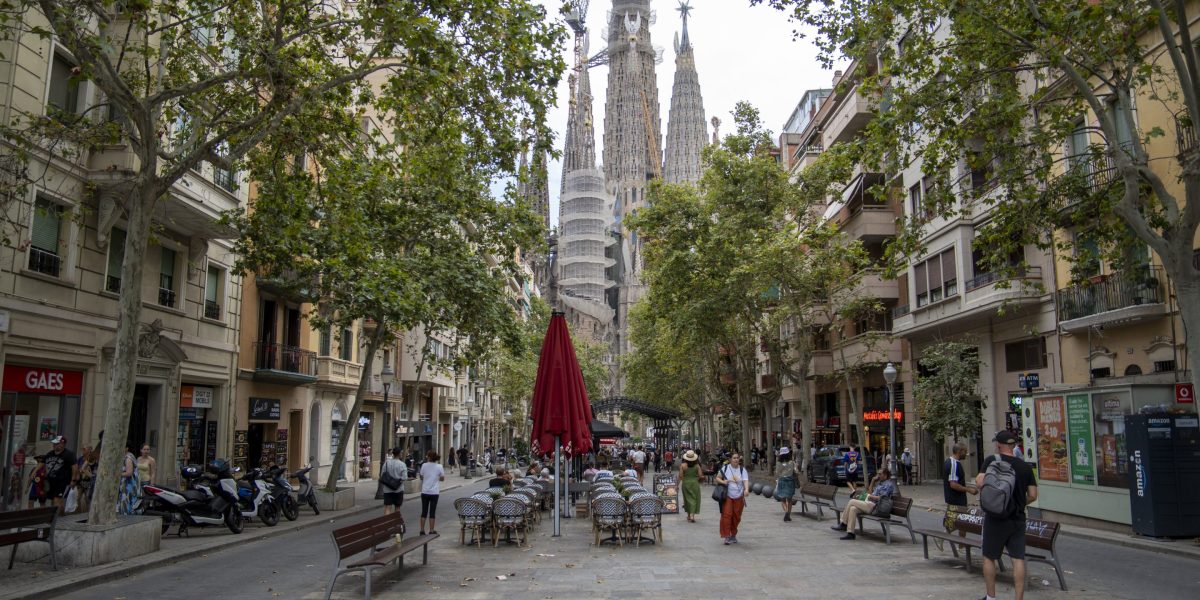
After well over a century under construction, Barcelona’s Sagrada Familia basilica is ready to raise its immense central tower and become the tallest Christian church in Europe.

The basilica’s General Director Xavier Martínez said Thursday that “the tower will be finished at the end of this year or the beginning of 2026.”

“This is an important moment in the history of the building of the Sagrada Familia because it will reach its maximum height,” Martínez told The Associated Press. “We are used to seeing skyscrapers like those in the United States (go up), but it is remarkable that in the 21st century we are building a cathedral.”

Once the gigantic Tower of Jesus Christ is up, the masterpiece of architect Antoni Gaudí will rise to 172 meters (564 feet). That will make it taller than the Ulmer Münster church in southern Germany, which tops out at 162 meters (531.5 feet).

The first pieces are already in place and the rest will be added in phases over the coming months. Once complete, the structure will be crowned by a cross and tightly surrounded by five other towers, one dedicated to Mary and four slightly shorter ones for the four evangelists.

Work on the facades and interior will continue for several years, the church’s head of construction Esteve Camps said, but the goal is to finish building work in approximately a decade from now.

100th anniversary of Gaudí’s death

Next year will be the 100th anniversary of the death of Gaudí. The church will hold several events to celebrate his legacy, which includes several stunning buildings in Barcelona and other places in Spain.

Pope Leo XIV has been invited for a solemn Mass to be held in Gaudí’s memory on June 10, the day he died when struck by a streetcar in 1926. Sagrada Familia officials said that they hope to have a response from the Vatican in the coming weeks.

Pope Benedict XVI consecrated the Sagrada Familia (Holy Family in Spanish) and designated it a minor basilica in 2010.

The first stone of the Sagrada Familia was placed in 1882. Gaudí never expected it to be completed in his lifetime. Only one of its multiple towers was finished when he died.

A fervent Catholic, Gaudi incorporated both Christian symbolism and organic forms into his unique aesthetic.

Work has sped up over recent decades as the basilica became a major international tourist attraction. The money from entrance fees is used to fund the ongoing construction. Last year, 4.9 million people paid to visit it, with 15% of those tourists coming from the United States.

Fortune Global Forum returns Oct. 26–27, 2025 in Riyadh. CEOs and global leaders will gather for a dynamic, invitation-only event shaping the future of business. Apply for an invitation.


Source link

Continue Reading

Business

‘I had to take 60 meetings’: Jeff Bezos says ‘the hardest thing I’ve ever done’ was raising the first million dollars of seed capital for Amazon

Published

on


Today, Amazon’s market cap is hovering around $2.38 trillion, and founder Jeff Bezos is one of the world’s richest men, worth $236.1 billion. But three decades ago, in 1995, getting the first million dollars in seed capital for Amazon was more grueling than any challenge that would follow. One year ago, at New York’s Dealbook Summit, Bezos told Andrew Ross Sorkin those early fundraising efforts were an absolute slog, with dozens of meetings with angel investors—the vast majority of which were “hard-earned no’s.”

“I had to take 60 meetings,” Bezos said, in reference to the effort required to convince angel investors to sink tens of thousands of dollars into his company. “It was the hardest thing I’ve ever done, basically.”

The structure was straightforward: Bezos said he offered 20% of Amazon for a $5 million valuation. He eventually got around 20 investors to each invest around $50,000. But out of those 60 meetings he took around that time, 40 investors said no—and those 40 “no’s” were particularly soul-crushing because before getting an answer, each back-and-forth required “multiple meetings” and substantial effort.

Bezos said he had a hard time convincing investors selling books over the internet was a good idea. “The first question was what’s the internet? Everybody wanted to know what the internet was,” Bezos recalled. Few investors had heard of the World Wide Web, let alone grasped its commercial potential.

That said, Bezos admitted brutal honesty with his potential investors may have played a role in getting so many rejections.

“I would always tell people I thought there was a 70% chance they would lose their investment,” he said. “In retrospect, I think that might have been a little naive. But I think it was true. In fact, if anything, I think I was giving myself better odds than the real odds.”

Bezos said getting those investors on board in the mid-90s was absolutely critical. “The whole enterprise could have been extinguished then,” he said.

You can watch Bezos’ full interview with Andrew Ross Sorkin below. He starts talking about this interview gauntlet for seed capital around the 33-minute mark.

This story was originally featured on Fortune.com


Source link

Continue Reading

Business

Google cofounder Sergey Brin said he was ‘spiraling’ before returning to work on Gemini

Published

on


Google cofounder Sergey Brin thought retiring from Google in 2019 would mean quietly studying physics for days on end in cafés. 

But when COVID hit soon after, he realized he may have made a mistake.

“That didn’t work because there were no more cafés,” he told students at Stanford University’s School of Engineering centennial celebration last week, Business Insider reported.

The transition from president of Google parent company Alphabet to a 40-something retiree ended up not being as smooth as he imagined, and soon after he said he was “spiraling” and “kind of not being sharp” as he stepped away from busy corporate life.

Therefore, when Google began allowing small numbers of employees back into the office, Brin tagged along and put his efforts into what would become Google’s AI model, Gemini. Despite being the world’s fourth-richest man with a net worth of $247 billion, retirement wasn’t for him, he said.

“To be able to have that technical creative outlet, I think that’s very rewarding,” Brin said. “If I’d stayed retired, I think that would’ve been a big mistake.”

By 2023, Brin was back to work in a big way, visiting the company’s office three to four times a week, the Wall Street Journalreported, working with researchers and holding weekly discussions with Google employees about new AI research. He also reportedly had a hand in some personnel decisions, like hiring. 

Skip forward to 2025 and Brin’s plans for a peaceful retirement of quiet study are out the window. In February, he made waves for an internal memo in which, despite Google’s three-day in-office policy, he recommended Google employees go into the company’s Mountain View, Calif. offices at least every weekday, and that 60 hours a week was the “sweet spot” of productivity.

Brin’s newfound efforts at work may have been necessary as OpenAI’s release of ChatGPT in 2022 caught the tech giant off guard, after it had led the field of AI research with DeepMind and Google Brain for years.

To be sure, Google for its part has been rising in the AI race. Analysts raved last month about Gemini 3, the company’s latest update to its LLM, and Google’s stock is up about 8% since its release. Meanwhile, OpenAI earlier this month declared a “code red,” its highest alert level, to improve ChatGPT. 

Brin added in the talk at Stanford that Google has an advantage in the AI arms race precisely because of the foundation it laid over years through its neural network research, its custom AI chips, and its data center infrastructure.

“Very few have that scale,” he said.


Source link

Continue Reading

Business

Gen Z grads are now being given ‘resilience’ training at PwC U.K. to toughen up for the job

Published

on


Gen Z is often branded a “lazy” generation of workers with no ambition to climb the corporate ladder. But PwC U.K. says the real challenge isn’t motivation—it’s resilience. These young professionals are eager to succeed in their own way, but the pandemic may have left them with gaps in essential skills. So the “Big Four” consulting firm is taking matters into its own hands with “resilience” training for fresh-faced hires. 

“Quite often we are struck that the graduates [who] join us—who are meeting all the cognitive tests we’ve set—they don’t always have the resilience,” Phillippa O’Connor, chief people officer at PwC U.K., recently toldThe Sunday Times. “They don’t always have the human skills that we want to deploy onto the client work we pass them towards.”

“We’ve really doubled down, particularly [with] this year’s graduates,” O’Connor continued. “We’re doing a whole load of separate training in their first six months with us, really about resilience, really about some of those communication skills.”

The executive described resilience as the ability to handle day-to-day work dynamics—especially pressure, criticism, or sticky situations. That skill, she said, is particularly crucial in a deal-making environment, where managing challenges is a “core” part of the job.

According to O’Connor, many younger workers simply didn’t get the chance to build that muscle during the pandemic, when lockdowns disrupted education and early workplace experiences that would normally help develop it.

But by offering this special training, PwC is ensuring the talent that fills its 1,300 open U.K. graduate jobs this year—which received around 47,000 applications—are well-equipped to succeed. 

Fortune reached out to PwC for comment. 

Companies are offering Gen Z special training 

PwC’s “resilience” training is just one example of how employers have been stepping up to ensure Gen Z is primed to succeed in the workforce. 

In 2023, fellow “Big Four” consulting giant KPMGsupplied extra instruction to its Gen Z hires. The business provided training for its graduate talent, out of concern they were struggling to adapt to professional life—particualry when it came to “soft skills,” how to give presentations, work in a team, and manage projects. 

The chief people officer of $1.5 billion data protection start-up Cohesity, Rebecca Adams, has also pushed for inter-generational cohesiveness. 

Earlier this year the executive led the charge to skill bosses in managing the young professionals, citing that Gen Z responds to feedback differently: “They want to know why, how—they want constant feedback.” On the flipside, she described having to teach “basic things” to young staffers that would mind-boggle their Gen X counterparts. 

“How do I manage my calendar? You actually have to accept the meeting request,” Adams explained toFortune in September. “You can’t just walk out of the meeting that you’re in because you have another one while it’s still going on.”

Charitable organizations are also stepping up to solve Gen Z’s professional pitfalls. Radical Hope is a nonprofit helping equip college students with essential skills including communication, interpersonal dexterity, and emotional intelligence. It began as a pilot program at New York University back in 2020, after experts noted “elevated anxiety, stress, and depression” among students within the previous years—and has spread to 75 college campuses so far.  

Liz Feld, the CEO of Radical Hope, hopes the Gen Z trainees will become adept in the skills “we all got growing up at the kitchen table.” Even the little things, like small talk, can be a challenge for the young hopefuls striving to one day succeed in the workplace. 

“They won’t ask someone, ‘Do you want to go to the dining hall and grab dinner, you want to go grab a beer, you want to go for a walk, you want to get a coffee?’” Feld told Fortune, adding that if someone says “no,” their confidence is crushed. “They internalize the whole thing. The face-to-face rejection is what they’re afraid of.”


Source link

Continue Reading

Trending

Copyright © Miami Select.