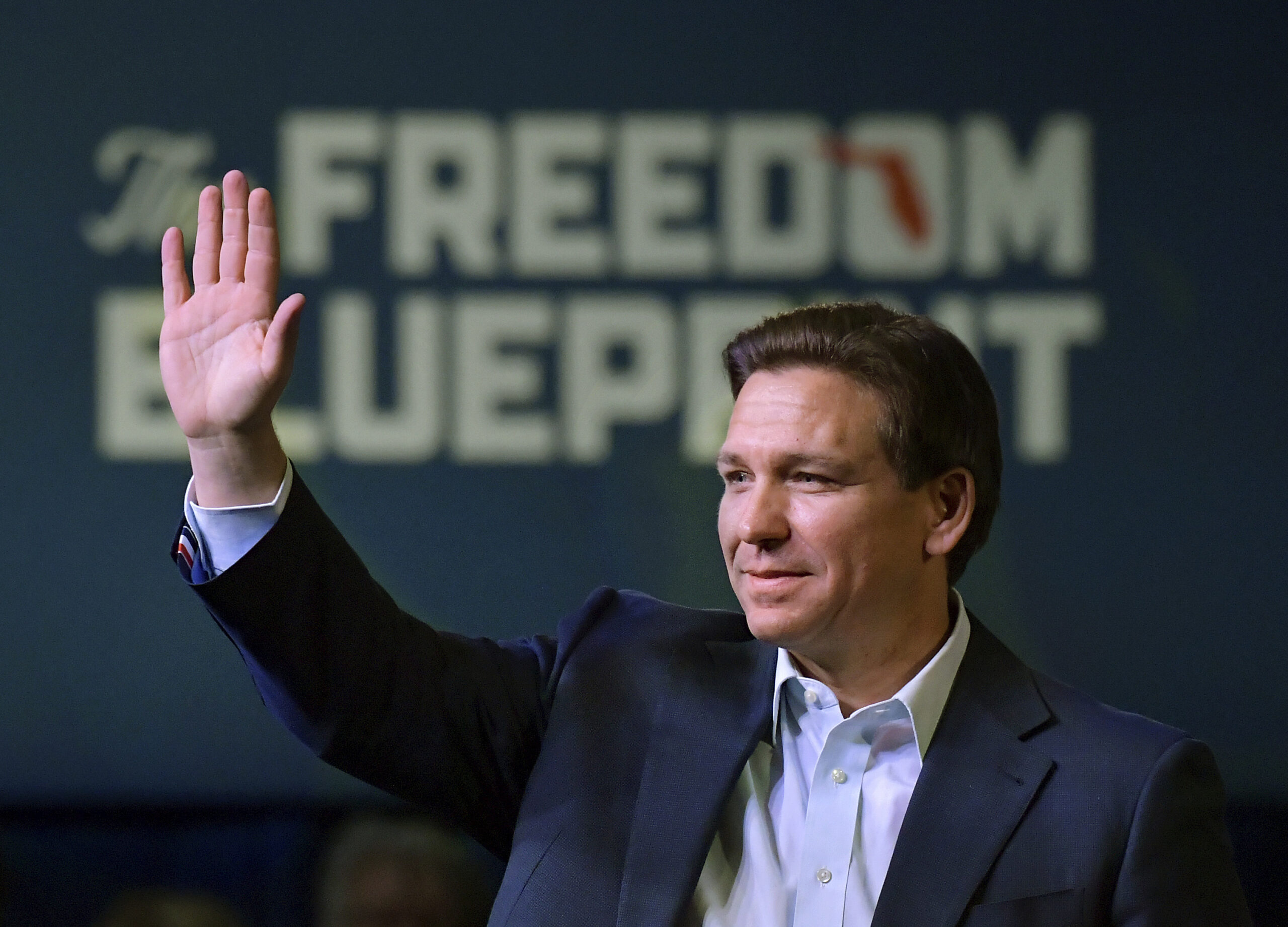
Gov. Ron DeSantis may be able to make a mark in 2028 after all, with yet another poll showing him above single digits.
A new survey from Overton Insights shows the Florida Governor and 2024 presidential candidate with 11% support, good for third place and marginally ahead of fellow Florida man Marco Rubio. The Secretary of State has 9% support.
Both men are far behind the leaders.
Vice President JD Vance has 32% support, while Donald Trump Jr. garners 24%.
DeSantis does best with conservative voters and people who voted for Donald Trump in 2024, with 13% and 12% with those groups, respectively. Among moderate voters, he has 6% support. Liberal Republicans don’t rate him at all.
Rubio has 10% support among conservatives and 9% among Trump voters. He actually leads DeSantis with moderates, with 7% support. Like the Governor, no liberals support him.
A couple of polls have shown Rubio ahead, meanwhile, so the usual caution about surveys being a snapshot in time holds here.
As mentioned above, a co/efficient poll last month also showed DeSantis in double digits. While he’s nowhere close to leading the pack, support for him seems to be sticky.
Overton Insights polled 444 Republicans between June 23 and June 26.
While Gov. Ron DeSantis twiddles his thumbs rather than call a Special Election for House District 113, one candidate for the post is urging his opponents to join him in planning policy.
Republican businessman Tony Diaz, one of five candidates seeking HD 113 seat Vicki Lopez vacated two months ago for a spot on the Miami-Dade Commission, believes brainstorming future legislation now will ultimately benefit voters, who are without House representation this Session.
“I propose we meet twice a month to discuss the laws we would propose, the matters we believe need fixing,” he said, adding that any actionable ideas could be sent to sitting lawmakers “who lend an ear.”
“I believe our district will be grateful and the winner of the November election will be in a better position.”
Diaz, for now, faces two Republican Primary foes: former Miami-Dade Commissioner Bruno Barreiro and real estate broker Frank Lago, both of whom have significantly outraised him in the contest so far.
Two Democrats — consultant Gloria Romero Roses and Miami-Dade Young Democrats President Justin Mendoza Routt — are also running.
In a statement Monday, Diaz lamented how the DeSantis administration and leaders in the Legislature “have forsaken” him and the four other candidates by failing to fill the empty HD 113 seat in a timely fashion.
As a “modest bandage for this amputated limb,” Diaz said he will also be establishing a “District 113 Provisional Representation Office” at 2264 SW 22nd Ave.— a property in the county’s Silver Bluff neighborhood he owns, according to the Miami-Dade Property Appraiser’s Office — for constituents to “bring a concern about our district or Florida to the attention of the State Government.”
It’ll be open 9 a.m. to 2 p.m. daily, Monday through Friday, Diaz said, but added that calling him ahead of time at 786-774-2125 “would be appreciated.”
“I will cover the expenses, field the office, and host a-political meetings here,” he said. “All information submitted by residents will be forwarded to the Dade Delegation, Speaker (Daniel) Perez, Governor DeSantis and appropriate committee chairs.”
Diaz carries endorsements from former Surfside Mayor Dan Gielchinsky, gubernatorial candidate James Fishback and Key Biscayne community activist H. Frances Reaves, according to his campaign.
Welcome back to Diagnosis, a vertical focused on the intersection of health care policy and politics.
— First-tier priority —
Florida lawmakers are entering the 2026 Legislative Session with renewed urgency around behavioral health, and Rep. Sam Garrison has made clear that the issue will remain one of his top priorities.
Speaking at the Florida Chamber’s Legislative Fly-In, the Fleming Island Republican framed mental health and substance use disorders as among the most pressing challenges facing Florida, asserting it is a “first-tier” priority.
Sam Garrison outlines health priorities during the Florida Chamber Legislative Fly-In ahead of the 2026 Legislative Session.
“This is, to my mind, one of the biggest challenges facing not just Florida, but America, the world, you name it,” said Garrison, who is in line to become House Speaker after November’s elections.
Garrison said behavioral health in 2026 is not a siloed issue, but something that cuts across demographic lines. He pointed to technology and social media as accelerants, particularly for younger generations.
“Phones, technology, and all the things that come with it that you and I and everybody else in this room — unless you’re really successful and vicious young executive — never had to deal with growing up,” he said to an audience of business leaders. “This is the reality of the world that we’re in right now.”
Despite the Legislature’s reputation for partisan clashes, Garrison said mental health is a rare area of broad bipartisan agreement. He credited both House and Senate leaders for engaging on the issue and vowed that it will continue through the end of his speakership in 2028, if not beyond.
“We have a model, a structure, how we handle the government side of the shop that was created in the 1970s and 1980s, and it’s a little bit different than it was back then,” he said,
“ … You’re going to see — especially in the Florida House, but I think the Senate will be there, too — a real focus on, ‘Do we have the right structure set up so that we as a government can do our part to make sure that mental health services, behavioral health services, are being provided in a manner that’s effective and with a 2026 model, not a 1976 model.’”
Recalling his time as a prosecutor, Garrison said mental health or substance use issues were present in the vast majority of serious criminal cases he handled.
“If I had to give you a guess, it may not have been 100%, but it was pretty damn close,” he said, adding that he’s also seen firsthand through his wife’s work as a high school teacher that even students from well-off families are struggling.
“These kids, they lack for very little in life. But even among those kids whose folks love, whose parents are like everybody in this room — parents who have been successful — they’ve got resources. They have mom and dad, mom or dad, or some generation that cares,” he continued.
“Even with those kids, pretty darn close to 100% of them in some form or fashion — because of those phones, because of technology, because of the world we live in — have challenges related to mental health. And if those kids are struggling … extrapolate that out with the kids who are who may not have parental involvement at home, don’t have that oversight, don’t have the resources.”
Garrison said Florida spends billions annually on health care, directly or indirectly tied to behavioral health, yet the state still lacks a cohesive long-term strategy. And even in a year where leadership has signaled budget cuts are coming, he warned that relying on hospitals to provide behavioral health services as “loss leaders” or expecting providers to accept unsustainable reimbursement rates is not a viable path forward.
“We have a lot of tactics for how to attack this, but we don’t necessarily have it as a strategy. There’s a difference between tactics and strategy,” he said, adding that even though “Florida is light-years — I mean light-years — ahead of basically everyone else in the rest of the nation,” the Legislature needs to be “aggressive” and “forward thinking” on the issue.
“If you’re requiring providers to come in and do this job and lose money, that’s not a long-term strategy. The answer to all your questions isn’t always money, but in this case, a lot of it is,” he said.
Moffitt Cancer Center. Image via Moffitt Cancer Center.
— Savings for whom? —
A priority health care bill scheduled for its first Committee stop this week includes a prescription drug pricing proposal that is reviving a long-running policy debate over prescription affordability, access, and the role of international markets in setting prices.
HB 697, sponsored by Rep. Jennifer Kincart Johnsson and part of House Speaker Daniel Perez’s broader “Florida’s New Frontier” health care initiative, would establish an international reference pricing framework for certain outpatient prescription drugs.
Jennifer Kincart Johnsson, Daniel Perez discuss international drug pricing proposal ahead of first Committee hearing.
Often described as a “most favored nation” model, the approach would cap reimbursement rates in Florida based on prices paid in a select group of foreign countries. Under the proposal, drug manufacturers would be required to report international pricing data to the state, and the Agency for Health Care Administration would set a benchmark price based on the lowest price paid in comparable, market-based countries, excluding single-payer systems.
Supporters argue that tying prices to international benchmarks could rein in costs in a system where U.S. consumers routinely pay more for prescription drugs than patients abroad. Critics, however, say that may not be the case because the legislation does not require insurers or pharmacy benefit managers to pass along any savings to patients.
Florida has explored similar concepts before. During the 2024 Session, House committees examined international reference pricing proposals. They heard testimony from national policy experts, prompting bipartisan concerns about relying on foreign health systems that often limit or delay access to new medicines.
Critics, including some lawmakers, also questioned whether such models would discourage investment in pharmaceutical research and development. This industry directly employs about 43,000 Floridians and indirectly supports another 250,000 jobs in the state.
Nationally, the debate remains unsettled. Countries that use centralized price-setting models typically achieve lower prices by restricting coverage or delaying approval of new treatments. At the same time, research consistently shows that U.S. patients gain access to new medicines earlier and at higher rates.
— The doctor is in —
Legislation clarifying when nurse practitioners may use the title “doctor” in clinical settings advanced during the first week of Session.
HB 237, sponsored by Rep. Michelle Salzman, cleared its first hurdle Wednesday with unanimous approval from the House Health Professions & Programs Subcommittee. The measure would allow NPs who have earned doctoral degrees to use the title “doctor” so long as they also clearly disclose that they are nurse practitioners.
Michelle Salzman advances bill clarifying nurse practitioners’ use of doctor title during early 2026 Session.
“If you’ve earned a doctorate in the medical field, you deserve to say so, just like in any other profession,” said Salzman, a Pensacola Republican. “This bill ensures patients understand the training behind their care while offering fairness and recognition to our nurse practitioners.”
Salzman and the bill’s supporters said the proposal would align Florida with other states where doctoral-level health professionals, such as pharmacists, physical therapists, audiologists and psychologists, may use the title with a similar guardrail. They also say the change could help with recruitment and retention as Florida grapples with an ongoing shortage of health care professionals.
The bill now heads to the Health & Human Services Committee. If ultimately approved by the Legislature, the measure would take effect July 1.
— TGH-LRH partnership —
Tampa General Hospital and Lakeland Regional Hospital announced an agreement linking TGH’s nationally recognized academic health system with the Hollis Cancer Center at LRH.
The two Central Florida hospitals said the agreement will result in expanded subspecialized cancer care across the region, creating new pathways for patients to access advanced cancer research, clinical trials and clinical expertise.
Tampa General Hospital and Lakeland Regional Hospital partner to expand cancer care, research and trials.
“I am impressed by the innovation and the dedication to the community that I’ve witnessed at Lakeland Regional Health,” said John Couris, president and CEO of Florida Health Sciences Center and Tampa General. “When health care professionals work together to advance research and improve outcomes for cancer patients, everybody wins.”
Through the partnership, cancer patients at the Hollis Cancer Center will gain access to TGH’s subspecialized oncology experts, cutting-edge research and advanced clinical trials, while receiving care in their own community.
“We are very excited to collaborate with the TGH Cancer Institute, which is widely recognized as a national leader in cancer care and research,” said Danielle Drummond, president and CEO of Lakeland Regional Health. “Our goal is always to provide the highest level of care to our patients close to home, and we are confident that combining our resources and expertise will offer tremendous benefits for our patients.”
The TGH Cancer Institute is one of Florida’s few cancer centers backed by academic medicine. The Institute has been ranked among the Top 10% in the nation for cancer care by U.S. News & World Report for 2025-2026. The Hollis Cancer Center has also earned national accolades for excellence in cancer care, including Gold Status Accreditation from the American College of Surgeons’ Commission on Cancer.
The collaboration builds on existing initiatives between Tampa General and Lakeland Regional, including their joint neurosciences program and the innovative Hospital at Home model, which allows patients to receive hospital-level care from the comfort of their homes.
— ROSTER —
Gov. Ron DeSantis appointed Gary Kompothecras and reappointed Howard Baum to the Board of Chiropractic Medicine earlier this month.
Kompothecras is the Manager of Physicians Group, LLC and is a member of the Sarasota Military Academy Foundation Board of Directors. He previously served on the Sarasota Manatee Airport Authority and the Space Florida Board of Directors.
Gary Kompothecras and Howard Baum were appointed to the Board of Chiropractic Medicine by Gov. Ron DeSantis.
Kompothecras earned his bachelor’s degree in marketing from the University of South Florida and his Doctor of Chiropractic Medicine from Life University.
Baum is a self-employed Licensed Mental Health Counselor and U.S. Army veteran, retiring with the rank of Colonel. He serves as a counseling clinician for the Tampa Bay Regional Critical Incident Team, is a counseling team member for Hope Justice Ministry, and a member of the Association of Former Intelligence Officers.
Baum earned his bachelor’s degree in psychology from Texas Tech University, his master’s degree in systems management from the University of Southern California, and his master’s degree in clinical mental health counseling from Argosy University.
— ICYMI —
“Thousands in Florida to lose coverage for HIV meds because of state cuts” via Ana Goñi-Lessan of USA Today Network — For thousands in Florida who rely on the AIDS Drug Assistance Program (ADAP), the Florida Department of Health is about to change up their medication plans or even get rid of covering them altogether, citing federal cuts as the culprit. Public health advocates warned legislators at the Capitol on Wednesday, Jan. 14, that cutting funds would push people off their meds and separate them from their doctors, causing lower adherence rates. When lifesaving HIV medication isn’t taken daily, viral loads go up, making the virus transmissible again and putting people at risk for opportunistic infections.
Florida advocates warn cuts disrupt HIV medication coverage for thousands relying on Drug Assistance Program.
“Medical malpractice, doulas, dental care: Health care nitty-gritty in the 2026 Session” via Christine Sexton of the Florida Phoenix — Florida leads the nation in Affordable Care Act enrollment, and, if the enhanced premium tax subsidies people rely on to help purchase the health insurance aren’t extended, the state could see the ranks of the uncovered rise exponentially. What, if anything, the Legislature does in the next two months to make health care more affordable and accessible to Florida residents remains to be seen. Florida legislators are expected to once again look at killing a medical malpractice law that bars adult children of single parents and parents of childless adult children from pursuing negligence lawsuits if a family member has died.
“Trump releases health policy outline” via Cheyenne Haslett of POLITICO — Trump released a health care framework that calls on Congress to codify his efforts to reduce prescription drug prices, send money to Health Savings Accounts instead of insurers via Affordable Care Act subsidies, and force more price transparency from insurance companies, hospitals and physicians. “We’re calling it the Great Health Care Plan. Instead of putting the needs of big corporations and special interests first, our plan finally puts you first and puts more money in your pocket,” Trump said in a video published by the White House on Thursday with little advance notice.
“Trump administration reinstates drug, mental health programs it cut days earlier” via Ryan Gillespie of the Orlando Sentinel — The Trump administration reinstated about $2 billion in mental health and substance abuse funding — two days after it canceled those grants and left Central Florida agencies worried about how they would manage significant cuts to the region’s limited resources. Central Florida’s largest mental health and substance abuse provider had nearly $1.2 million in payments canceled overnight on Tuesday, but by Thursday morning, it learned it would receive its funds. Both notices arrived via email from the federal Department of Health and Human Services, which oversees the Substance Abuse and Mental Health Services Administration. A Kissimmee clinic, Pan-American Behavioral Health Services, also lost funding and had it reinstated within those two days, its CEO, Brendan Ramirez, said.
“Darryl Rouson, Debra Tendrich propose sweeping expansion of youth mental health screenings” via Jesse Scheckner of Florida Politics — St. Petersburg Sen. Rouson and Rep. Tendrich filed companion bills (SB 1302, HB 1133) to require mental and behavioral health screenings for minors and young adults enrolled in Medicaid. The goal is to confront what they describe as a statewide youth mental health emergency. Tendrich told Florida Politics her push for reform was galvanized by personal tragedy. In 2023, her friend, Brian Hiltebeitel, was brutally killed on a Palm Beach County golf course by a 26-year-old man later deemed incompetent for trial due to mental illness and substance abuse concerns.
— RULES —
The Board of Orthotists and Prosthetists’ final rule regarding citations for disciplinary action goes into effect Jan. 26. More here.
The Board of Pharmacy’s final rule regarding the responsibilities of supervising pharmacists and supervision of more than one registered pharmacy technician went into effect on Sunday. More here.
— PENCIL IT IN —
Jan. 20
9:30 a.m. — The Senate Children, Families and Elder Affairs Committee meets to consider legislation affecting child welfare and related health policy. Room 301, Senate Office Building.
10:30 a.m. — The House Health Care Budget Subcommittee meets, including a Department of Children and Families presentation on changes to the Supplemental Nutrition Assistance Program. Room 314, House Office Building.
2 p.m. — The House Human Services Subcommittee meets to consider legislation affecting medical assistance eligibility and foster care records. Room 314, House Office Building.
3:30 p.m. — The Senate Health Policy Committee meets for an OPPAGA review of health care practitioner regulation in Florida and other states. Room 412, Knott Building.
Health policy advocates pencil in Committee meetings and advocacy days across late January at the Capitol.
Jan. 21
8 a.m. — The House Health and Human Services Committee meets to consider bills related to nursing practice, social work licensure, and swimming lesson vouchers. Room 17, House Office Building.
10 a.m. — The House Health Professions and Programs Subcommittee meets to consider legislation affecting occupational therapy and nursing education. Room 102, House Office Building.
4 p.m. — The House Health Care Facilities and Systems Subcommittee meets to consider legislation related to drug prices and insurance coverage. Room 404, House Office Building.
Jan. 27
8 a.m. — Florida Dental Association Dentists’ Day on the Hill brings dental professionals to the Capitol to advocate oral health policy. Capitol Complex.
12:30 p.m. — Florida Hospital Association Hospital Days begin with a Board of Trustees meeting and legislative reception focused on hospital and health system priorities. Tallahassee.
1 p.m. — The Senate Children, Families and Elder Affairs Committee meets to consider health and human services legislation. Room 301, Senate Office Building.
Jan. 28
7 a.m. — Florida Hospital Association Hospital Days continue with legislative briefings and member visits focused on hospital policy priorities. Capitol Complex.
8 a.m. — Moffitt Day at the Capitol highlights cancer research and treatment advocacy. Capitol Complex.
1 p.m. — The Senate Appropriations Committee on Health and Human Services meets to consider health-related budget items. Room 412, Knott Building.
Universal and SeaWorld have announced the details on one of the best theme park deals of the year: concerts that are included in regular park admission during their annual food festivals.
Disney World also welcomes well-known artists and nostalgic favorites to play for theme park guests. But the Mouse has not officially released the 2026 schedule for the Garden Rocks concerts at the Epcot International Flower & Garden Festival. The festival runs March 4 to June 1.
Universal’s Mardi Gras concerts kick off Feb. 7 through March 28 on select nights. This year’s lineup features Grammy-winning DJ and producer Zedd, Bebe Rexha, and The All-American Rejects, who are returning for the second year in a row as the concert series’ finale.
The nightly concerts take place following Universal’s Mardi Gras parade featuring elaborate floats and plenty of bead throwing.
At SeaWorld, the music includes KISS rocker Gene Simmons, the Beach Boys, Flo Rida, Fitz and the Tantrums, the Fray and Boyz II Men during the concert series running on select nights from Jan. 31 to May 17.
“This is the biggest and most diverse concert lineup we’ve ever presented as part of Seven Seas Food Festival,” said SeaWorld Orlando Park President Jon Peterson in a statement. “With chart-topping artists, throwback favorites, and every concert included with park admission, we’re delivering one of the best entertainment values in Central Florida.”
The majority of the dates have been announced, although SeaWorld said a few additional acts will be announced later in the year.
Orlando has deep ties to boy band history, which you’ll find at the theme parks’ festival concerts.
You won’t see Justin Timberlake anytime soon playing behind a backdrop of roller coasters. But Chris Kirkpatrick of NSYNC performs Feb 22 at the Pop 2000 Tour night at SeaWorld. Meanwhile, Kirkpatrick’s former bandmate Joey Fatone teams up with the Backstreet Boys’ AJ McLean at Universal Orlando Feb. 21.