Connect with us

Business

Rob Reiner, comedy legend who directed ‘When Harry Met Sally’ and ‘Spinal Tap,’ dead at 78

Published

on


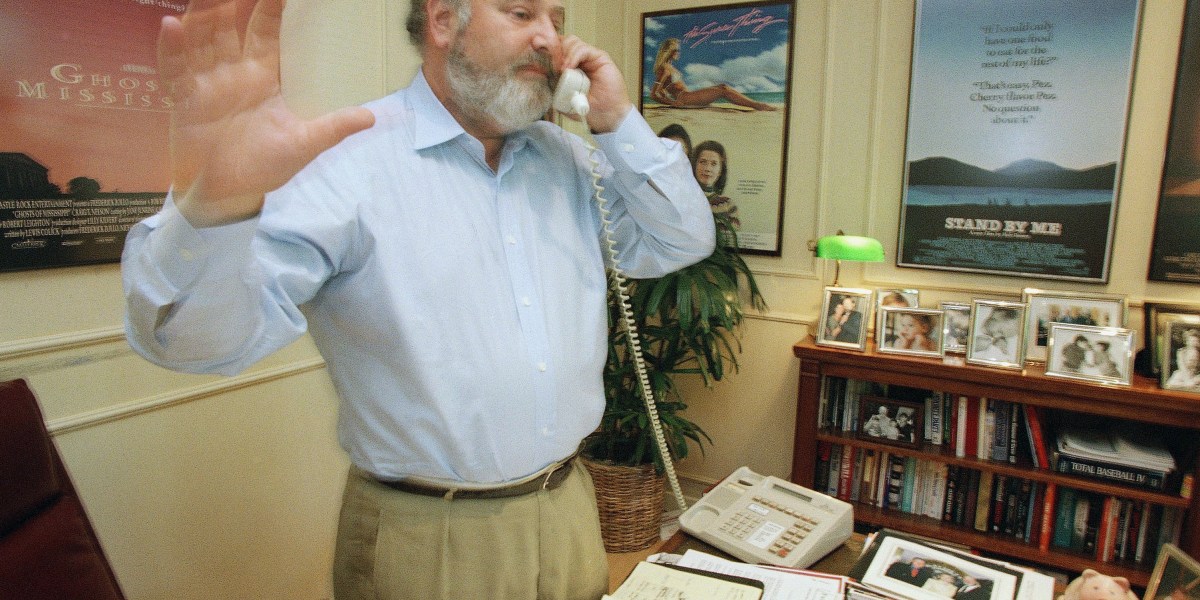
Rob Reiner, the son of a comedy giant who went on to become one, himself, as one of the preeminent filmmakers of his generation with movies such as “The Princess Bride,” “When Harry Met Sally …” and “This Is Spinal Tap,” has died. He was 78.

Reiner and his wife, Michele Singer, were found dead Sunday at their home in the Brentwood neighborhood of Los Angeles. A law enforcement official briefed on the investigation confirmed that Reiner and Singer were the victims. The official could not publicly discuss details of the investigation and spoke to The Associated Press on condition of anonymity.

Authorities were investigating an “apparent homicide,” said Capt. Mike Bland with the Los Angeles Police Department. The Los Angeles Fire Department said it responded to a medical aid request shortly after 3:30 p.m.

Reiner grew up thinking his father, Carl Reiner, didn’t understand him or find him funny. But the younger Reiner would in many ways follow in his father’s footsteps, working both in front and behind the camera, in comedies that stretched from broad sketch work to accomplished dramedies.

“My father thought, ‘Oh, my God, this poor kid is worried about being in the shadow of a famous father,’” Reiner said, recalling the temptation to change his name to “60 Minutes” in October. “And he says, ‘What do you want to change your name to?’ And I said, ‘Carl.’ I just wanted to be like him.”

After starting out as a writer for “The Smothers Brothers Comedy Hour,” Reiner’s breakthrough came when he was, at age 23, cast in Norman Lear’s “All in the Family” as Archie Bunker’s liberal son-in-law, Michael “Meathead” Stivic. But by the 1980s, Reiner began as a feature film director, churning out some of the most beloved films of that, or any, era. His first film, the largely improvised 1984 cult classic “This Is Spinal Tap,” remains the urtext mockumentary.

After the 1985 John Cusack summer comedy, “The Sure Thing,” Reiner made “Stand By Me” (1986), “The Princess Bride” (1987) and “When Harry Met Sally …” (1989), a four-year stretch that resulted in a trio of American classics, all of them among the most often quoted movies of the 20th century.

A legacy on and off screen

For the next four decades, Reiner, a warm and gregarious presence on screen and an outspoken liberal advocate off it, remained a constant fixture in Hollywood. The production company he co-founded, Castle Rock Entertainment, launched an enviable string of hits, including “Seinfeld” and “The Shawshank Redemption.” By the turn of the century, its success rate had fallen considerably, but Reiner revived it earlier this decade. This fall, Reiner and Castle Rock released the long-in-coming sequel “Spinal Tap II: The End Continues.”

All the while, Reiner was one of the film industry’s most passionate Democrat activists, regularly hosting fundraisers and campaigning for liberal issues. He was co-founder of the American Foundation for Equal Rights, which challenged in court California’s ban on same-sex marriage, Proposition 8. He also chaired the campaign for Prop 10, a California initiative to fund early childhood development services with a tax on tobacco products. Reiner was also a critic of President Donald Trump.

That ran in the family, too. Reiner’s father opposed the Communist hunt of McCarthyism in the 1950s and his mother, Estelle Reiner, a singer and actor, protested the Vietnam War.

“If you’re a nepo baby, doors will open,” Reiner told the Guardian in 2024. “But you have to deliver. If you don’t deliver, the door will close just as fast as it opened.”

‘All in the Family’ to ‘Stand By Me’

Robert Reiner was born in the Bronx on March 6, 1947. As a young man, he quickly set out to follow his father into entertainment. He studied at the University of California, Los Angeles film school and, in the 1960s, began appearing in small parts in various television shows.

But when Lear saw Reiner as a key cast member in “All in the Family,” it came as a surprise to the elder Reiner.

“Norman says to my dad, ‘You know, this kid is really funny.’ And I think my dad said, ‘What? That kid? That kid? He’s sullen. He sits quiet. He doesn’t, you know, he’s not funny.’ He didn’t think I was anyway,” Reiner told “60 Minutes.”

On “All in the Family,” Reiner served as a pivotal foil to Carroll O’Connor’s bigoted, conservative Archie Bunker. Reiner was five times nominated for an Emmy for his performance on the show, winning in 1974 and 1978. In Lear, Reiner also found a mentor. He called him “a second father.”

“It wasn’t just that he hired me for ‘All in the Family,’” Reiner told “American Masters” in 2005. “It was that I saw, in how he conducted his life, that there was room to be an activist as well. That you could use your celebrity, your good fortune, to help make some change.”

Lear also helped launch Reiner as a filmmaker. He put $7.5 million of his own money to help finance “Stand By Me,” Reiner’s adaptation of the Stephen King novella “The Body.” The movie, about four boys who go looking for the dead body of a missing boy, became a coming-of-age classic, made breakthroughs of its young cast (particularly River Phoenix) and even earned the praise of King.

With his stock rising, Reiner devoted himself to adapting William Goldman’s 1973’s “The Princess Bride,” a book Reiner had loved since his father gave him a copy as a gift. Everyone from François Truffaut to Robert Redford had considered adapting Goldman’s book, but it ultimately fell to Reiner (from Goldman’s own script) to capture the unique comic tone of “The Princess Bride.” But only once he had Goldman’s blessing.

“At the door he greeted me and he said, ‘This is my baby. I want this on my tombstone. This is my favorite thing I’ve ever written in my life. What are you going to do with it?’” Reiner recalled in a Television Academy interview. “And we sat down with him and started going through what I thought should be done with the film.”

Though only a modest success in theaters, the movie — starring Cary Elwes, Mandy Patinkin, Wallace Shawn, André the Giant and Robin Wright — would grow in stature over the years, leading to countless impressions of Inigo Montoya’s vow of revenge and the risky nature of land wars in Asia.

‘When Harry Met Sally …”

Reiner was married to Penny Marshall, the actor and filmmaker, for 10 years beginning in 1971. Like Reiner, Marshall experienced sitcom fame, with “Laverne & Shirley,” but found a more lasting legacy behind the camera.

After their divorce, Reiner, at a lunch with Nora Ephron, suggested a comedy about dating. In writing what became “When Harry Met Sally …” Ephron and Reiner charted a relationship between a man and a woman (played in the film by Billy Crystal and Meg Ryan) over the course of 12 years.

Along the way, the movie’s ending changed, as did some of the film’s indelible moments. The famous line, “I’ll have what she’s having,” said after witnessing Ryan’s fake orgasm at Katz’s Delicatessen, was a suggestion by Crystal — delivered by none other than Reiner’s mother, Estelle.

The movie’s happy ending also had some real-life basis. Reiner met Singer, a photographer, on the set of “When Harry Met Sally …” In 1989, they were wed. They had three children together: Nick, Jake and Romy.

Reiner’s subsequent films included another King adaptation, “Misery” (1990) and a pair of Aaron Sorkin-penned dramas: the military courtroom tale “A Few Good Men” (1992) and 1995’s “The American President.”

By the late ’90s, Reiner’s films (1996’s “Ghosts of Mississippi,” 2007’s “The Bucket List”) no longer had the same success rate. But he remained a frequent actor, often memorably enlivening films like “Sleepless in Seattle” (1993) and “The Wolf of Wall Street” (2013). In 2023, he directed the documentary “Albert Brooks: Defending My Life.”

In an interview earlier this year with Seth Rogen, Reiner suggested everything in his career boiled down to one thing.

“All I’ve ever done is say, ‘Is this something that is an extension of me?’ For ‘Stand by Me,’ I didn’t know if it was going to be successful or not. All I thought was, ‘I like this because I know what it feels like.’”


Source link

Continue Reading

Business

Unlimited vacation policies can work—it just depends on where employees are based

Published

on


For years, the prevailing theory amongst workers about “unlimited vacation” is that it actually encourages workers to take less time off. Without the entitlement to a set number of days, employees can feel awkward requesting days off, or worried that doing so will make them look less committed to work. 

But a new study from payroll and HR platform Deel finds it’s less about specific PTO policies than about culture. It all depends on where you live, says Lauren Thomas, the startup’s economist. 

On average, European employees with unlimited vacation policies took four more days off than their counterparts with fixed time off this year27 vs. 23. But in North America, there was hardly a difference, as both those with unlimited and fixed vacation policies averaged about 17.

“Americans and Canadians are definitely getting less time off, even when you only look at fixed time, than Europeans are,” Thomas said. “That is a combination of policy and culture.” 

In fact, Canadian workers are taking less time off than those in the U.S. Thomas said this is because 77% of U.S. workers have access to paid vacation, while just 73% of Canadians do, based on U.S. Bureau of Labor Statistics and Statistics Canada data.

But Americans and Canadians who work for companies that span the Atlantic do take more time off than their counterparts working for companies that do not have hires in Europe, Thomas said.

“I think companies need to think really carefully about how much productivity they’re really getting when they’re requiring so much [working] time from their employees,” she said. “At the end of the day, we know that time off is important for productivity, it’s important for making a good company, it’s also really important for attracting talent.” 

Which cities are best at encouraging workers to take time off to rest and recharge? Stockholm, Berlin or Paris, where Thomas found employees took 25 or more days off this year. 

Kristin Stoller
Editorial Director, Fortune Live Media
kristin.stoller@fortune.com

Around the Table

A round-up of the most important HR headlines.

The Society for Human Resource Management, or SHRM, was hit with a $11.5 million verdict after a former employee accused the trade group of racial discrimination and retaliation. Business Insider

As jobs get more niche, it has become harder for workers to explain exactly what they do to family and friends. Wall Street Journal

OpenAI says its tools save workers roughly 40 to 60 minutes per day, and has helped improve either the speed or quality of their work. Bloomberg

Watercooler

Everything you need to know from Fortune.

Leaning out. For the first time in a decade, fewer women than men are interested in getting a promotion at work. —Sasha Rogelberg

Interview test. Gagan Biyani, CEO of the education platform Maven, says he gives candidates live feedback during job interviews to see how they react. —Orianna Rosa Royle

Manager shake-up. As AI agents are automating busy work, some managerial drudgery can be avoided—but human interaction is still essential. —Beatrice Nolan


Source link

Continue Reading

Business

Crypto wallets now feel a lot more like Venmo

Published

on


Crypto wallets are having a moment. The latest example is Kalshi announcing an integration with Phantom to offer event contracts to the wallet’s 15 million users. While the prediction market angle is intriguing (these markets are a HUGE story right now), the news also highlights the light-speed advancements taking place in the wallet realm.

Consider how, just three years ago, the only thing you could do with Phantom was access the Solana blockchain. MetaMask, meanwhile, was limited to Ethereum. Sure, alternatives like Coinbase Wallet offered access to more assets but, like other wallets of the time, it suffered from a ghastly interface that required users to run a gauntlet of sub-nets, confusing gas fees, and more. The experience was miserable for crypto natives. For everyone else, it was nigh impossible.

Then something changed. After years of promises, developers finally succeeded in pushing the clunky technical elements to the background, while adding a host of practical features. The result has been an uptick in useful real-world applications, including Phantom’s Kalshi offering, and also in souped-up new offerings like Coinbase’s rebranded Base as well as Robinhood Wallet.

This new generation of wallets offers the best aspects of decentralized crypto by making the customers the ultimate custodians of their assets. At the same time, they offer interfaces that are starting to feel like Venmo or online banking apps—which should be table stakes for any of these products looking to break into the mainstream. The question now is where these wallets will fit in day-to-day life. Will they become the successor to web browsers, as Coinbase CEO Brian Armstrong and others have predicted, or will they be something else entirely?

JP Richardson is the founder and CEO of Exodus, another leading wallet that recently added a suite of stablecoin payment tools. He told me the browser analogy doesn’t really fit, arguing wallets are better seen as a superior type of banking app—one that will be able to bridge disparate financial services. “We believe it should not be three apps, it should be one app. Why can’t you take your brokerage app, and tap and buy groceries?” he asked.

Trevor Traina, the founder of a wallet called Kresus, whose customers include Sotheby’s auction house, has another take. He believes the tools will have a much broader footprint. He sees a world where wallets are not just for managing our assets, but also become repositories for vital documents such as a will, insurance, or a law license. 

The technology is certainly there to support Traina’s vision. That includes blockchains, which can supply a permanent and tamper-proof ledger, but also newer privacy tools like zero-knowledge proofs. Together, this tech provides a way to safeguard all of one’s personal data, while also being able to meet the constant need to show identification that modern life demands. All of this could get more interesting still if wallets like Sam Altman’s World App, which includes an anti-bot biometric layer, get more traction.

Now for the cold water: Just because you build it doesn’t mean they will come—or come anytime soon at least. I spoke with analyst James Wester, one of the shrewder observers of the crypto and fintech scene, and he pointed out that the idea of an “everything app” has been around for years but shows few signs of getting adopted. A big reason for this is inertia.

Right now, our existing apps and payment tools work pretty well, so it’s unlikely we’ll see mass wallet adoption anytime soon without some sort of external nudge. Wester points out that Apple Pay and Google Pay have been around for a decade, yet a huge number of people keep paying with physical cards—because they can. This will change as younger people who are well versed in tech and crypto make up a greater portion of the economy. But until then, wallet makers may have to find a way to make their suddenly attractive products downright irresistible.

Jeff John Roberts
jeff.roberts@fortune.com
@jeffjohnroberts

DECENTRALIZED NEWS

Stablecoins at YouTube: In a landmark moment for crypto in mainstream commerce, YouTube is now giving U.S. creators on the platform the option to receive payment in the form of PayPal’s stablecoin PYUSD. (Fortune)

Circle’s new privacy coin: Stablecoin giant Circle is working with an upstart blockchain called Aleo to issue a spin-off of its flagship token called USDCx, which will let banking clients obscure private transaction histories. (Fortune)

Charters for all: The OCC issued national trust bank charters to Circle, Ripple, BitGo, Paxos and Fidelity Digital Assets. The move comes amid a broader move by the agency to issue more such charters, which do not allow taking customer deposits or accessing FDIC insurance. (Axios)

Tokenization tipping point? The SEC issued a no-action letter to the DTCC, which will let the country’s main clearing house custody stocks on the blockchain. The permission applies only to 1,000 of the most liquid stocks, but is a key first step for what is likely to be a wholesale shift toward putting custody and record keeping on-chain. (Bloomberg)

Think I’ll buy me a football team: Tether, whose CEO is Italian and a lifetime fan of Juventus, made a bid to buy the storied football club. Its board rebuffed the offer even as the publicly-traded club struggles to keep up with financial dominance of Premier League teams and Real Madrid. (Reuters

MAIN CHARACTER OF THE WEEK

Do Kwon in Podgorica, Montenegro, in 2024—before he was extradited to the U.S.

Filip Filipovic—Getty Images

Do Kwon is arguably the second most notorious fraudster in crypto history. Now, the Terra Luna founder, known for his “steady lads” rallying cry, will get to test how steady he is after a U.S. judge sentenced him to 15 years in prison. If it’s any consolation, this earns him Fortune Crypto’s weekly Main Character designation.

MEME O’ THE MOMENT

Satoshi Nakamoto wanted to reinvent finance. Now, he’s at the New York Stock Exchange.

@NYSE

The cult of Satoshi keeps spreading as the New York Stock Exchange becomes the latest venue to install a physical statue of the Bitcoin creator. 


Source link

Continue Reading

Business

Magnificent 7 isn’t that magnificent: 5 stocks have underperformed the market this year

Published

on


S&P 500 futures were up 0.44%  this morning after the index lost 1.07% on Friday, a day after setting a new all-time high on Dec.11.

The index is still up 16% year-to-date—an above-average performance for U.S. stocks. Analysts have long complained that the index is dominated by the “Magnificent 7” tech stocks. Between October 2022 and November 2025 roughly 75% of gains in the S&P 500 came from this handful of companies.

But as we draw near to the close of the year, only two of those stocks—Alphabet and Nvidia—have beaten the market as a whole, year to date:

What appears to be happening is that investors are picking between winners and losers in tech, as opposed to just herding into the index or tech stocks as a whole. That’s probably healthy if you are worried that AI spending is creating a bubble in tech stocks.

The best example of this is Oracle, which is up a respectable 14% year to date but has declined 42% from its high in September. Investors have not liked the extra debt that Oracle has taken on, at increasingly wider interest spreads above the risk-free benchmarks, to fund its AI buildout. 

Wall Street is not yet ready to declare the AI gold rush a bubble. “If this is a bubble, it is still in its early stages,” Deutsche Bank analysts Adrian Cox and Stefan Abrudan said in a recent deep-dive research note on AI.

Thus far, the capital expenditure and the revenue is real: it’s hitting the top and bottom lines of Alphabet and Nvidia, and that’s why valuations for those companies are so healthy. “The charge is led by well-established Big Tech companies with multiple revenue streams, who are paying for their investment in data centers mostly out of free cash flow and from which they are generating immediate returns from enterprise customers,” Cox and Abrudan wrote.

“We think that reports of a bubble are exaggerated (for now),” they said.

Elsewhere: Asian markets were down today but markets in Europe largely rose in early trading. The STOXX Europe 600 was up 0.63% at the time of writing; The U.K.’s FTSE 100 was up 0.74%.

Here’s a snapshot of the markets ahead of the opening bell in New York this morning:

  • S&P 500 futures were up 0.44%  this morning. The last session closed down 1.07%. 
  • STOXX Europe 600 was up 0.63% in early trading. 
  • The U.K.’s FTSE 100 was up 0.74% in early trading. 
  • Japan’s Nikkei 225 was down 1.31%. 
  • China’s CSI 300 was down 0.63%. 
  • The South Korea KOSPI was down 1.84%. 
  • India’s NIFTY 50 was down 0.12%. 
  • Bitcoin was at $89K.
Join us at the Fortune Workplace Innovation Summit May 19–20, 2026, in Atlanta. The next era of workplace innovation is here—and the old playbook is being rewritten. At this exclusive, high-energy event, the world’s most innovative leaders will convene to explore how AI, humanity, and strategy converge to redefine, again, the future of work. Register now.


Source link

Continue Reading

Trending

Copyright © Miami Select.