Connect with us

Business

Rivian CEO says midprice EV sales are still 50% Tesla: ‘That’s not a reflection of a healthy market’

Published

on


It’s not that Americans don’t want electric vehicles, according to the chief executive of American EV-maker Rivian. It’s just that they don’t have many good options.

At the Fortune Brainstorm AI conference in San Francisco earlier this month, Rivian CEO RJ Scaringe pointed to the scant choices consumers have in picking a midprice EV, noting that Tesla has continued to dominate sales, making up about 50% of the market share, with few other competitors making an impression.

“That’s not a reflection of a healthy market with lots of choice,” Scaringe said. “If you think of it as a consumer, you have 300 different internal combustion engine choices at that price or lower, and you have maybe one highly compelling EV choice.”

EV demand in the U.S. has continued to lag behind other parts of the world, making up just about 5% of new car sales, according to November data from Edmunds. In China, meanwhile, EVs make up more than 50% of the auto market share, China Association of Automobile Manufacturers data shows. Battery-electric cars make up about 16% of the EU market share, per the European Automobile Manufacturers’ Association.

U.S. automakers are feeling the squeeze from middling demand, with Ford pivoting away from heavy EV investment, citing lackluster American interest. It announced this week it would take a $19.5 billion charge and refocus on gas- and hybrid-powered vehicles, discontinuing some larger EV models.

Sparking American’s EV curiosity

Scaringe hopes his automaker’s own focus on more affordable EVs can rev up demand in the sector. Rivian’s R1, a seven-seat premium SUV, starts at about $70,000 and can run up to about $120,000. The R2, expected to launch in the first half of next year, will have a $45,000 price tag.

“We see, with R2, an opportunity to really bring a whole host of new customers that haven’t had a choice that’s electric that really appealed to them yet,” Scaringe said.

Price appears to be at the forefront of the CEO’s mind. While automakers like Ford said the end of the $7,500 EV tax credit tempered demand for new cars, Scaringe reportedly took a different perspective. In a memo to employees, reported by the Wall Street Journal, Scaringe said the end of the incentive puts pressure on EV companies, including Rivian, to lower prices.

But increased competition has not always been greeted so fondly. Canada imposed a 100% tariff on Chinese EVs in 2024, hoping to protect the burgeoning domestic market of electric cars.  Scaringe, however, sees room for his rivals in the U.S.

“I really think the constraint isn’t the demand side. I think it’s the supply side,” Scaringe said. “I do think that the existence of choice will help drive more penetration, and it actually creates a unique opportunity in the United States.” 

This story was originally featured on Fortune.com


Source link

Continue Reading

Business

AI governance becomes a board mandate as operational reality lags

Published

on


Good morning. At Fortune 500 companies, AI governance has become a top priority for boards, yet many are still working to deploy AI at scale.

Sedgwick, a global risk and claims administration partner, published its 2026 forecasting report identifying key AI trends across sectors. The results contend that 70% of Fortune 500 executives surveyed say their companies have AI risk committees, 67% report progress on AI infrastructure, and 41% have a dedicated AI governance team. Yet only 14% say they are fully ready for AI deployment, underscoring a growing gap between formal governance structures and real-world AI readiness.

Executives have clearly moved fast to formalize oversight. Many organizations now have AI councils, risk committees, and policies on paper. But the foundations needed to operationalize those frameworks—processes, controls, tooling, and skills embedded in day-to-day work—have not kept pace. The findings are based on a survey of 300 senior leaders at Fortune 500 companies, including C-suite executives (CEO, COO, CFO, CHRO, CRO) as well as EVPs, SVPs, VPs, and directors.

Sedgwick’s report finds that the leading implementation challenge is the rapid pace of AI change, followed by difficulties in executing governance and managing data privacy. Regulatory uncertainty and change management also rank as major hurdles. These barriers are mostly organizational and process-oriented rather than purely technical, suggesting that companies will succeed only if they align people, policy, and technology at the same time, according to the report.

‘AI has become a board-level mandate’

Those themes were front and center at the recent Fortune Brainstorm AI event in San Francisco last week, where a panel on the next phase of AI governance translated the numbers into lived experience. Navrina Singh, founder and CEO of Credo AI, an AI governance platform, outlined the three biggest gaps she sees with clients.

The first is visibility. Many organizations still lack a comprehensive view of where AI is being used across their business, Singh explained. Shadow AI and unsanctioned tools proliferate, while sanctioned projects are not always cataloged in a central inventory. Without this map of AI systems and use cases, governance bodies are effectively trying to manage risk they cannot fully see.

The second gap is conceptual. “There’s a myth that governance is the same as regulation,” Singh said. “Unfortunately, it’s not.” Governance, she argued, is much broader: It includes understanding and mitigating risk, but also proving out product quality, reliability, and alignment with organizational values. Treating governance as a compliance checkbox leaves major gaps in how AI actually behaves in production.

The final one is AI literacy. “You can’t govern something you don’t use or understand,” Singh said. If only a small AI team truly grasps the technology while the rest of the organization is buying or deploying AI-enabled tools, governance frameworks will not translate into responsible decisions on the ground.

Singh also highlighted how the AI landscape is evolving—from predictive models to generative AI and now to agentic systems that can act autonomously across workflows. AI has become a board-level mandate,” she said. “If you’re not using AI as a company, you are going to be pretty irrelevant in the next, I would say, 18 to 24 months.”

What good governance looks like, Singh argued, is highly contextual. Organizations need to anchor governance in what they care about most. She offered the example of one of her clients, PepsiCo, which cares deeply about reputation and invests heavily in responsible AI. For the company, any AI system that interacts with customers—whether in customer service or via a chatbot—must be reliable, fair, and reflective of its brand values, she explained.

For other organizations, good governance may mean prioritizing auditability, bias mitigation, or resilience. The common thread, Singh said, is moving beyond structures on paper to operational practices that make AI safe, trustworthy, and fit for purpose.

Sheryl Estrada
sheryl.estrada@fortune.com

Leaderboard

 Matthew Dunnigan was appointed CFO of 7 Brew, a drive-thru coffee chain. Dunnigan joins 7 Brew from Restaurant Brands International (NYSE: QSR), where he served as CFO for more than six years and with the company for about 10 years. 

Mark E. Patten was appointed CFO of Sun Communities, Inc. (NYSE: SUI), a real estate investment trust, effective Jan. 5, 2026. Patten will succeed Fernando Castro-Caratini. Patten joins the company from Essential Properties Realty Trust, Inc., where he serves as EVP, CFO, and treasurer. He has held senior finance leadership roles across the real estate investment trust and professional services sectors, including CFO of CTO Realty Growth, Inc.

Big Deal

KKR has released its 2026 Global Macro Outlook, titled “High Grading,” led by Henry McVey, CIO of KKR’s Balance Sheet and head of global macro and asset allocation. The report forecasts better‑than‑expected GDP and earnings growth across most major regions in 2026, but argues that now is the time to “high grade” portfolios given a more mature cycle and the relatively low cost of upgrading portfolio quality.

McVey and his team also contend that we are in the midst of a multi‑year productivity renaissance, though more of that upside is now being priced into markets. The implied 10‑year forward CAGR embedded in the S&P 500’s current valuation is now close to 16%, versus roughly 8% for much of the prior decade, which, in their view, further underscores the case for high grading. Key investment themes highlighted in the outlook include corporate reform stories, worker retraining and productivity gains, and “security of everything” driving demand for critical inputs.

Going deeper

In a recent episode of Fortune’s Leadership Next podcast, cohosts Diane Brady, executive editorial director of the Fortune CEO Initiative and Fortune Live Media, and Kristin Stoller, editorial director of Fortune Live Media, talk with Circle CEO Jeremy Allaire. They discuss the crypto company’s IPO over the summer; the future of the blockchain; and Allaire’s entrepreneurial history.

Overheard

“Let humans focus on strategy and judgment. Let agents handle pattern recognition, coordination, and routine interventions.”

—Norbert Jung, CEO of Bosch Connected Industry, writes in a Fortune opinion piece titled, “Factory 2030 runs on more than code. As a CEO, I see the power of agentic AI—and the trust gap that we must close.”


Source link

Continue Reading

Business

CellVoyant debuts AI platform that could slash the cost of CAR-T and other cell-based treatments
Published

on


CellVoyant, a U.K.-based startup, has launched an AI platform that allows scientists to predict the future health and performance of human cells based on their appearance in microscope images—a breakthrough that could sharply reduce the cost of cell-based medical therapies.

A growing number of treatments for diseases ranging from cancer to Parkinson’s to diabetes depend on modified human cells as the core component of the treatment. These include CAR-T, where a patient’s own immune cells are extracted, genetically reprogrammed outside the body so that they can recognize and destroy cancer cells, and then reinjected into the patient. The category also includes various stem cell-based therapies.

Currently, these cell-based therapies are among the most expensive medications available. CAR-T treatments, for example, often cost hundreds of thousands of dollars per dose.

Part of the reason they are so costly is due to the labor-intensive, highly sensitive, and relatively wasteful process that is required to produce them. Scientists have to culture a lot more cells than they need, because some of the cells will not be healthy enough or exhibit the right properties to make a good treatment dose. Although it is possible to determine some aspects of cell health simply by “eyeballing” the living cells under a microscope, scientists usually cannot gauge which cells are best without performing tests on samples, usually killing those cells being tested in the process. Then they have to hope that the cells they tested are actually representative of the other cells in the culture, which is not always the case. And while tests assess a cell’s current condition, they can’t predict how the cell will develop in the future. Sometimes entire cell lines fail to perform and have to be discarded. Sometimes an entire treatment dose winds up being ineffective. All of this adds to the cost of the treatments.

CellVoyant’s new product, a platform called FateView, aims to significantly reduce the waste in this process by using AI models it has trained to classify cells by their current qualities and, critically, predict which cells will possess the right qualities in the future, simply by analyzing microscope-based imagery of the cells that use regular, white light. Currently the platform can do this for 10 different cell types—including stem cells, T-cells, cardiac cells, and blood cells—and the company is planning on training its models to work with more in the future.

Predicting cells’ behavior

The company’s platform can, according to CellVoyant, instantly identify which cells are currently exhibiting certain biomarkers, predict how well individual cells will express certain genes in the future, and forecast how well stem cells will differentiate into specific cell types—all from white light microscope images, without having to perform chemical tests that are time-consuming and can destroy cells in the process.

“We can see, understand and predict how cells behave without having to destroy them,” Rafael Carazo Salas, CellVoyant’s founder and CEO, said. He said FateView could predict a cell’s quality hours, days, or even weeks out from its present state. That should allow scientists and the companies producing cell lines for therapy to be much more selective in deciding which cells should progress, eliminating waste, improving the chances of success, and ultimately, lowering costs.

Carazo Salas gives the example of scientists who produce specific cell-types from stem cells—which has the potential to revolutionize the treatment of everything from Type 1 Diabetes to heart disease. This complex process can take weeks and the yields of usable cells tend to be low, he said. But he said CellVoyant had been able to reduce the costs of what’s called cell derivation—making those specific cell types from stem cells—by up to 80% simply by better predicting at each stage of the process which cells are most likely to progress well. Because some of these cell therapies currently have price tags approaching $1 million, that cost savings is game-changing, meaning that many more people (or their insurance companies) will be able to pay for these treatments, he said.

Photo courtesy of CellVoyant

And it’s not just cell-based therapies that depend on healthy cells. The challenge of predicting cell health is also relevant for many “biologic” drugs, which are usually proteins produced by bacteria or other kinds of cells that are then harvested, and even in the case of cells needed to test the effects of the small molecules that make up the majority of pharmaceuticals. “Whether using cells to discover drugs, as a measuring device, or using cells as a factory to produce biologics, or cells as a drug, as in case of cell therapy, the unit economics is defined by cells,” Carazo Salas told Fortune. “The cost is defined by cells, batch to batch. Variation is what accounts for a lot of the cost in the industry.”

CellVoyant is making its FateView system available through a simple online interface that lets scientists upload microscope images of cells to be analyzed, as well as through an API (application programming interface) for companies that need to analyze high volumes of samples, possibly as part of a robotic laboratory workflow. Academic users will be able to access the platform for a nominal fee, while biotech and pharmaceutical companies are charged  an annual subscription, which gives them the right to store their data securely, as well as a relatively low per-use charge. 

Carazo Salas, who is also a professor of cellular and molecular medicine at the University of Bristol, in England, said CellVoyant was able to train AI models to characterize cells and predict their behavior because it had access to a large database of microscope images of the same cells taken over time, as well as the results of traditional chemical assays on cells taken at different stages of development. This time-series data allows the models to learn how the shape and visual characteristics of a cell at any point relate to its current function, as well as how it relates to its future appearance and function. The company trains a specific model for each cell type it works on—for instance, a separate model for cardiac cells and one for metabolic cells—although it is possible that in the future a single foundation model might be able to learn how to make predictions about any cell type, Carazo Salas said.

CellVoyant, whose name is a portmanteau derived from the words “cell” and “clairvoyant,” was spun out of the University of Bristol in 2021. In 2023, it received £7.6 million ($10.1 million) in seed funding from Octopus Ventures, Horizon Ventures, Verve Ventures, and Air Street Capital. 

FateView marks CellVoyant’s first major commercial product release. Previously, the company has worked with specific biotech and pharma partners, only some of which it can name, Carazo Salas said.

One of its early customers is Rinri Therapeutics, a biotech company in Sheffield, England, that is working on a cell-based regenerative therapy for hearing loss. Terri Gaskell, the chief technology officer at Rinri Therapeutics, said in a statement that CellVoyant’s platform had enabled it to predict “cell behavior in ways that haven’t been possible before.” Gaskell said that with help from CellVoyant, the company “hope[s] it will be possible to scale production [of cells] more efficiently and make it significantly more cost effective, [and] ultimately bring restorative cell therapies closer to those with hearing loss that need them most.”


Source link

Continue Reading

Business

Stocks: ‘Big Short’ investor Michael Burry piles misery onto tech stocks

Published

on


The S&P 500 closed down 1.16% yesterday, marking four straight losing sessions for the index, which is now off 2.6%% from the all-time high it hit on Dec. 11. The decline was led, as usual, by technology stocks. Oracle was down 5.4% and its AI data center rival CoreWeave lost more than 7%.

Two things pummeled the tech sector:

First, “Big Short” investor Michael Burry published a chart from Wells Fargo on X showing that stocks now composed a greater portion of U.S. household wealth than real estate. That has happened only twice before in history, once in the 1960s and then again immediately before the dot com crash of 2000. “The last two times the ensuing bear market lasted years,” Burry said.

“Reasons for this are many but certainly include the gamification of stock trading, the nation’s gambling problem due to its own gamification, and a new ‘AI’ paradigm backed by trillions [of dollars] of ongoing planned capital investment backed by our richest companies and the political establishment. What could go wrong?” Burry argued.

Of course, Burry has a conflict of interest in the form of a $1.1 billion short bet against AI stocks Palantir and Nvidia. So take his doom-mongering with a pinch of salt.

Second, Oracle failed to close a deal for $10 billion in debt-based funding from Blue Owl Capital for a new AI data center in Michigan, according to the Financial Times. The company admitted it would not partner with Blue Owl but told the FT it was pressing ahead with the plan on schedule.

Wall Street is increasingly unimpressed with Oracle’s debt. “With over $100 billion in outstanding debt, investors continue to grow more concerned about the company’s borrowing to fund its AI ambitions,” Bespoke Investment Group told clients in an email this morning. 

Jim Reid and his colleagues at Deutsche Bank noted that the spread on Oracle’s credit default swaps—the yield premium that investors demand for the risk of buying them—which was already notably wider than comparable companies, got even wider.

“That FT report … heightened concerns around a potential AI bubble, and meant that Oracle’s five-year credit default swaps climbed to 156 basis points, their highest since the GFC [Great Financial Crisis],” they said. “So tech stocks led yesterday’s declines, with the [Magnificent Seven tech stocks] (-2.12%) having its worst day in over a month, led by a -3.81% slump for Nvidia.”

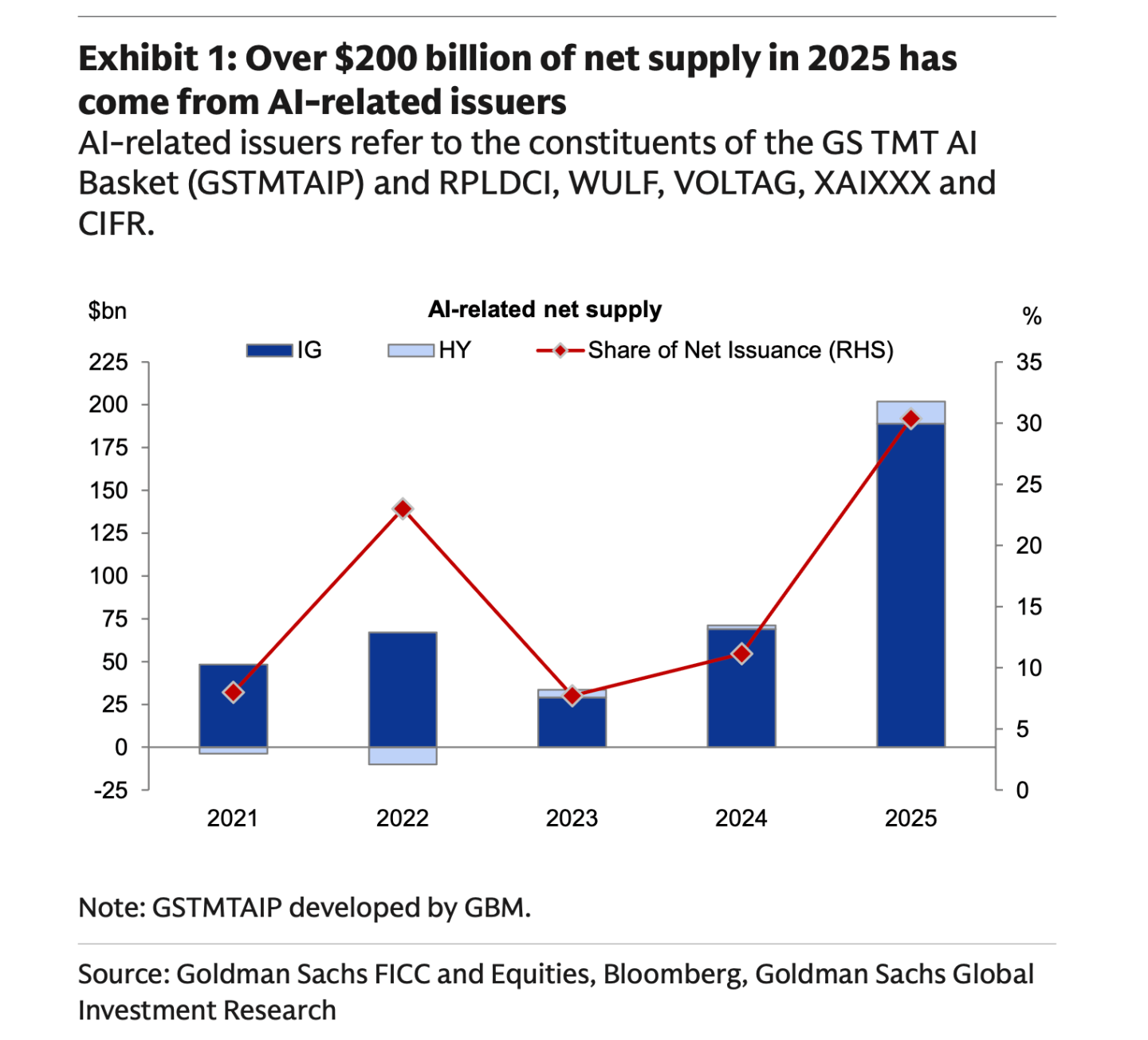
The net new supply of AI-related debt from all tech companies doubled this year to $200 billion, according to research by Goldman Sachs, and now accounts for 30% of all corporate debt issuance.
KKR published its 2026 “outlook” yesterday and it was notably sceptical about AI data center construction. In a section titled “Speculative Data Center Projects with Uncompetitive Cost Structures,” the private equity company wrote: “We see some excess exuberance in data centers … estimates point to almost $7 trillion in global data center infrastructure capital expenditures by 2030, an amount roughly equal to the combined GDP of Japan and Germany. As always, unit economics are key. Developers who focus on return on invested capital after power, capital and maintenance capex costs will do well, while those who focus on theoretical total addressable markets and lose sight of unit economics are likely to suffer.”

Economist Ed Yardeni told clients that “The Mag-7 may be undergoing a correction.”

“In recent weeks, investors have started to fret that the spending is depleting the Mag-7s’ cash flows and slowing profits growth. Before AI, the Mag-7 had lots of cash flow because their spending on labor and capital was relatively low. That changed once AI forced them to spend much more on both,” he said.

“We aren’t ruling out a Santa Claus rally over the remainder of the year. However, that is unlikely to happen if the S&P 500 continues to rotate away from the Magnificent-7 toward the Impressive-493, as we expect.”

The “the Impressive-493” is a reference to all the other stocks in the S&P 500 outside the Magnificent Seven which have done pretty well this year.

Here’s a snapshot of the markets ahead of the opening bell in New York this morning:

  • S&P 500 futures were up 0.39%  this morning. The last session closed down 1.16%. 
  • STOXX Europe 600 was up 0.21% in early trading. 
  • The U.K.’s FTSE 100 was up 0.29% in early trading. 
  • Japan’s Nikkei 225 was down 1.03%. 
  • China’s CSI 300 was down 0.59%. 
  • The South Korea KOSPI was down 1.53%. 
  • India’s NIFTY 50 was flat. 
  • Bitcoin was at $87K.
Join us at the Fortune Workplace Innovation Summit May 19–20, 2026, in Atlanta. The next era of workplace innovation is here—and the old playbook is being rewritten. At this exclusive, high-energy event, the world’s most innovative leaders will convene to explore how AI, humanity, and strategy converge to redefine, again, the future of work. Register now.


Source link

Continue Reading

Trending

Copyright © Miami Select.