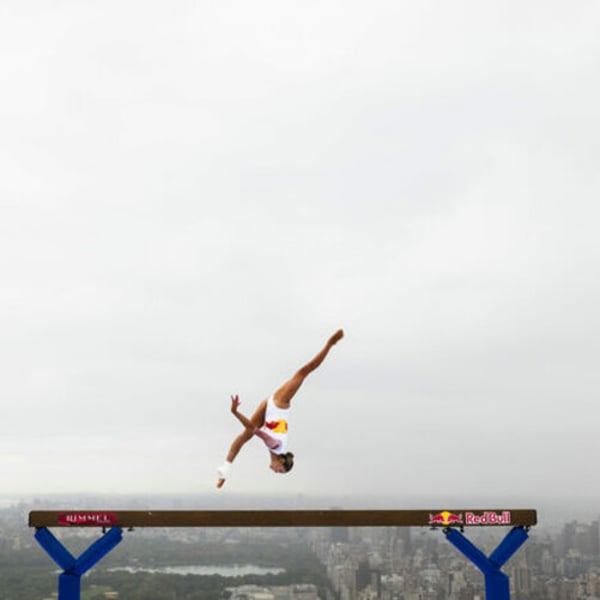
Rimmel London has teamed up with Red Bull to tap gymnast Lily Smith as the face of the launch of Rimmel’s new Thrill Seeker Mega Lift Mascara.
Rimmel taps gymnast Lily Smith for Thrill Seeker mascara launch. – Rimmel London
As part of the partnership, the five-time national All-American gymnast performed a daring 90-second balance beam routine 52 stories above street level. The routine, developed independently by Smith, featured challenging maneuvers including a front-toss-pike on a beam that extended 9.5 feet above the rooftop—twice the height of a standard competition balance beam.
“Partnering with Red Bull on this adrenaline-fueled project, 52 stories above the ground, is an incredible moment for Rimmel,” said Janine Fernandes, vice president of global marketing for Rimmel London.
“Lily’s extraordinary achievement and fearless ambition, mirrors our own 190-year heritage of empowering bold self-expression. Bringing these two powerhouse brands together for the launch of our new Thrill Seeker Mega Lift mascara was a natural fit, and we’re excited to keep pushing the limits, in beauty and beyond.”
Smith will appear across Rimmel’s global campaign for the Thrill Seeker Mega Lift Mascara across social media and digital platforms starting January 2026.
“Performing this routine in such a unique and unusual setting, ahead of my college season, was a total thrill for me and I’m so excited to have had the opportunity, thanks to Rimmel London and Red Bull. This challenge reflects what I strive for in my sport – pushing limits, embracing creativity, and expressing my own style,” said Smith.
The successor to C&A at 126, rue de Rivoli has finally been revealed. After more than two years of work to rehabilitate the historic building, which for many years housed the flagship of the Dutch fashion chain, Redevco announced on January 16 that another international fashion player will open its French flagship within the BPM project by late 2026.
Rendering of the building at 126, rue de Rivoli after renovation – Redevco
With a planned footprint of 2,700 square metres, Muji shows that Uniqlo is not the only ambitious Japanese brand in France and Europe. The Japanese advocate of the “no brand” concept (Mujirushi Ryohin) has set its sights on one of the capital’s busiest thoroughfares. The store will be among the largest in Europe, eclipsing the already generous format at Forum des Halles.
It marks a milestone for Muji, whose Paris story began in 1998, when the brand quietly took its first steps on Rue Saint‑Sulpice, attracting a Left Bank clientele of insiders. In nearly thirty years, the brand has spread to the Marais, Saint‑Lazare and Bastille, with six stores. But the forthcoming Rivoli location, with its XXL format over three levels, signals a shift in approach on a thoroughfare that sees nearly 15 million visitors a year.
Muji to expand its range in Europe
“The future store will offer 2,500 square metres of sales space across three levels (basement, ground floor and first floor). For the brand, it’s a genuine relaunch in Paris and then in London, before rolling this proposition out across Europe,” Uriel Karsenti, the brand’s Europe director, told FashionNetwork.com.
“Our strategy is to align Muji’s image at a global level. The aim is to expand the sales area to present a much more comprehensive range.”
Today, Muji offers barely half the range available in its stores in Japan. In its new flagship, the brand will be able to present around 85% of the Japanese range, including the childrenswear collection, as well as skincare, and a much stronger selection of accessories, homeware and electronics.
In its future flagship, Muji will broaden the number of product categories on show to bring it closer to its Japanese concept – Muji
“This will be our largest store in Europe, after our Finnish location, which is unique in having a restaurant. We are currently looking for a site in London, in the Oxford Street area, where we already have a store,” explained the executive, who hopes for a major opening in the English capital in 2027.
“The flagship is important for the group’s management, as it is a showcase project that will test Muji’s potential for international expansion, a significant growth driver for the Japanese leadership.”
The store, whose concept has been entrusted to Atelier Tsuyoshi Tane Architects (At‑ta), is due to open in October in a building completely refurbished by the owner.
The location is significant, and C&A attracted generations of customers here before closing in 2023. The owner, Redevco, has initiated a complete overhaul of the building to breathe new life into the 13,000 square metre complex. Dubbed “BPM” (for “Beats Per Minute”), the project, entrusted to architect Franklin Azzi, goes beyond a simple façade renovation. The future Muji flagship will be spread over three levels, but it will not be the only new feature: the building will also house a 57‑room Radisson Collection hotel, upmarket offices (the LVMH group is reportedly in the running for part of the space) and, more surprisingly, an urban logistics hub in the basement. Redevco says it was also keen to preserve the soul of the site by maintaining a listed 13th‑century crypt and opening a landscaped rooftop accessible to the public, offering a bird’s‑eye view over the rooftops of Paris.
With another fashion brand yet to be unveiled, Muji—whose parent company, Ryohin Keikaku, closed its 2024‑25 financial year at the end of August with global sales of 785 billion yen (around €4.3 billion) from some 1,450 stores worldwide—is bringing its full hybrid fashion‑and‑home concept to a Parisian thoroughfare that is reinventing itself.
Muji’s management, for whom the North American and European markets account for 5% of activity, intends to build on its positive momentum, having reported double‑digit growth in Europe in the first quarter of 2025‑26, supported by around 30 stores across nine markets.
The expanded range will also be progressively rolled out on its website next season. This is a major development and could prompt Muji to review its current French network, comprising five stores in Paris and one in Lyon. Following the opening of its flagship, Muji may look for new, larger spaces in the years to come.
This article is an automatic translation. Click here to read the original article.
In a busy, but chilly 24 hours, Milano Moda Uomo ranged from the mountain party animal style at Dsquared2 or fisherman’s inspired moods at Setchu, to Paul Smith’s archive revival and Corneliani’s AI-influenced display.
Dsquared2: Rocky Mountain ravers
Dsquared2’s invitation this season was a ski pass, though one imagined that it mainly gained guests entry into an après-ski bar or an after-hours club and not an actual mountain slope.
The backdrop was a wild snow-capped Canadian Rockies, the show’s star was “Heated Rivalry” star Hudson Williams, pouting as he walked down the snow-white runway in a denim jacket with frayed seams, black faded jeans and the first of a great series of new futuristic cowboy boots finished with ski bindings.
Designers Dean and Dan Caten blended slopes and sex with high-shine latex bodystockings worn with faux-fur trapper coats or studded corsets. In a cunning love, the Dsquared2 duo frosted denim jeans, loon pants, jackets or huge Klondike coats. Along with a great series of humungous glistening puffers – ideal to wear for a party to celebrate a gold medal winner in next month’s Milan Cortina Winter Olympic Games.
No wonder they entitled this fall 2026 collection, “Game On”.
Many models donning retro-futurist goggles and winter shades in a collab’ with Carrera, often completed with a Dsquared2 x Carrera elastic band.
Despite the chilly theme, the model sizzled – especially two young shirtless beef cakes with pneumatic drill tummies, who were later called on to carry Dean and Dan on their shoulders as they took their ovation at the noisy finale. The Canadian twins looked like they were in heaven.
Setchu: From Greenland to Normandy One of the most fertile designers in fashion today is Satoshi Kuwata, whose staged his third-ever runway show in his new home, a revamped atelier on Via Privata Rezia, in northwest Milan.
For next season, Kuwata again sought inspiration in his favorite hobby – fishing. For the uninitiated, he’s maintaining a rich tradition among distinguished designers – seeing as Oscar de la Renta and John Rocha share a similar rod casting obsession.
And, thanks to winning the 2023 LVMH Prize, this Japan-born and Milan-based designer was able to indulge a life-long dream – flying to Greenland to fish the world’s best cod fish.
“I know Greenland is very in the news now, but I went there before this current trendy boom began,” he cautioned in a pre-show briefing
Noted for his fabric innovations, Satoshi dreamed up a remarkable silk and wool jacquard that looked uncannily like sealskin. Seen on a fall-away blouse and skirt in this co-ed show.
An indie Anglo-classic-with-a-twist collection by the designer, who personally opened the show with a witty monologue, talking into the microphone from the top floor of the thee-floor showroom.
“Fashion is getting more and more mass produced. Can you believe it, hmmmm,” lamented Sir Paul, in opening megaphone-like remarks, noting that his design team was inspired by his company archive of over 6,000 looks. Their ideas, in turn, inspire him.
Twisting classics so much so that several blazers were made literally inside out, showing exposed stitching and shoulder pads. A collection whose tailoring was very much in sync with the wider silhouettes that are dominating the current season. Cutting jackets so they hung away from the body and trousers flat front and very wide.
Plus, in a season of iridescence, the cast donned shiny trousers and corporal’s military shirts made in active sport nylon. However, when the wind blows down from the Alps as it did today, the cast could wrap up in the fabric of the season Donegal tweed-style flecked woollens – made into flap pocket weekend jackets and soft-collared coats. Several models matching mini tricorne hats.
Backed up by Ryuichi Sakamoto’s “Riot in Lagos”, it made for a jolly moment. Winning Sir Paul an extended applause as he descended two floors in a long tour of the twisting catwalk.
Corneliani: AI meets Milan
Using AI, Corneliani’s creative director Stefano Gaudioso Tramonte commissioned a novel film that played on iconic cinematic moments. Its title: “The Gentleman“.
Corneliani fall/winter 2026/2027 – Courtesy
Presented inside a Renaissance courtyard, it made for a great backdrop to his latest collection for the house – a neat blend of debonair with practical style. Presented on a dozen models, before a select group of editors, sat on 1930s cinema seats.
Amid all the drizzle of chilly Saturday, the windowpane, patch pocket trench coats looked ideal, as did the mohair-mix overcoats with peak collars.
Made in a color mix of mauve, mud, pale gray, chocolate and more mauve.
“We have staged our last shows with music and with dance in the past two seasons. This season, we used AI to express those magic moment in cinema, and fashion’s special relationship with the silver screen,” he explained.
Inside the palazzo, one was also impressed by a very now sheepskin matelassé jerking, worn with a high roll neck merino wool sweater. Or a precise brushed suede mud-hued blazer worn with a Nehru-collar shirt in faded bronze.
But in the end, the heart of Corneliani will always be its classy suiting. Made more attractive by Stefano’s relaxed interpretation of masculine style. Call it ‘Modern Gentleman’.
Dolce & Gabbana entitled their latest menswear collection “The Portrait of Man”. Maybe they should have named it portraits of many, many men so wide-ranging and rambling was the result.
Presented on Saturday in their show space on Viale Piave in Milan, the collection certainly had plenty of great clothes. What it lacked was focus.
Even down to the order of show, where models suddenly leapt up from the audience, wandered about the set before finally cruising down the catwalk. Made of mock marble Formica even the runway jarred visually.
It didn’t help that the mood entering was sullen, as the thousands of fans that often crowd the sidewalks outside Dolce & Gabbana shows were absent due to the leaden sky and steady rain.
All that said, Domenico Dolce and Stefano Gabbana remain great tailors, and there were some sensational sartorial statements. Above all in the fabric of the moment, speckled Donegal tweed, made of blends of wool and cashmere. An opening pale stony gray suit with gangster silhouette jacket done with wickedly large lapels and wide pants was perfect. As was a three piece version, where the jacket was replaced by a black mohair sweater.
But then, just when we were in the middle of daywear, an oily haired lothario model beside me hopped onto the runway – attired in matelassé black smoking jacket paired with pajama pants and slippers. Shifting the portraits from gentlemanly chic to patrician dandy.
For colder nights, Domenico and Stefano whipped up all sorts of dramatic shearling coats for posh hippie dudes. While at home, the duo want guys to wear faux leopard skin dressing gowns – just perfect for the Mediterranean sensualist.
Add in military great coats, piped velvet jackets and the coolest of hussar’ jacket and there was something for everyone in this collection. Even a sporting moment – football jerseys reading Soccer Club or 84, the year the boys opened their brand.
“Each man is seen as self-contained universe of a passions, memories and inattentions. The runway becomes a contemporary gallery of a living portraits, where every look functions as a psychological and sartorial self-portrait,” intoned a British-accented announcer pre-show as a video showed scores of models in their looks.
It certainly made for a commercial collection, but perhaps not a great show. One could not help thinking of fellow Sicilian Luigi Pirandello’s classic play “Six Characters in Search of an Author”. This show felt likes scores of models in search of a common.