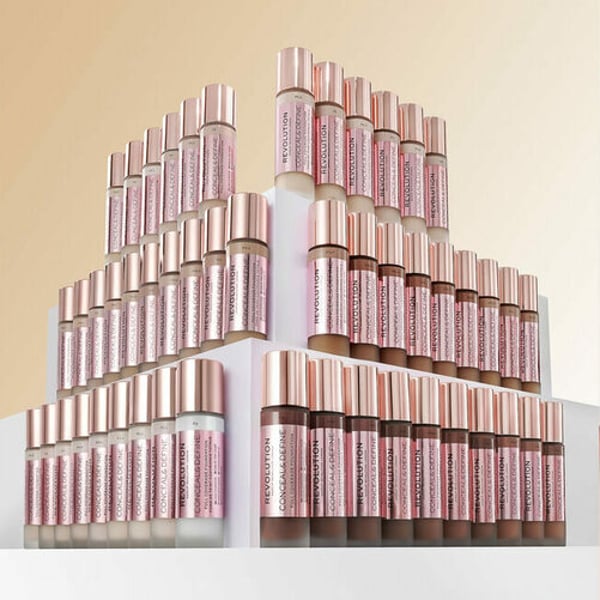
Revolution Beauty Group’s half-year results showed continuing declines on Thursday with the six months to late August clearly a tough time for the business.
Revolution Beauty
The multi-channel mass beauty brand said revenue fell 31.8% to £49.4 million while gross profit was down by a similar percentage at £15.9 million.
The gross margin increased, but only marginally, to 32.2% from 32% and operating costs edged down by almost 4%.
But that was the only good news with adjusted EBITDA being a loss of £12.5 million, almost double the £6.3 million loss in the previous year.
The operating loss at the company also widened considerably from £9.8 million last time to £16.7 million this time and the loss before tax increased from £10.9 million to £18.4 million. Net debt at the company also grew by almost £5 million to over £30 million.
So what were the drivers behind these numbers? The company said the revenue drop was primarily driven by disruption carried over from prior-year strategic and operational issues.
Transitional challenges also weighed on the net sales performance, most notably the shift from Relove to Revolution at Walmart, “which contributed to short-term softness in sales and operational efficiency during the period”.
And the very minimal increase in the gross margin was blamed on “clearance sales undertaken to generate cash under the previous management team prior to the refinancing”.
That refinancing saw the business also undertaking an equity raise, “strengthening the balance sheet and restoring financial stability”, subsequent to the results reported here.
As for “previous management”, a few days before the end of the period covered, the company announced the proposed return of the founders to the business, Tom Allsworth as CEO and Adam Minto in a consultancy role. This “was a key aspect of the success of the debt and equity refinancing”.
So what of the future? Revolution said that “following the period end, the founders have brought renewed energy, clear leadership and strategy to the business”. And the return of the founders “has been well received by our wholesale partners and there are encouraging early signs of a stabilisation of sales”.
In September and October, following the early action taken on costs, the group moved back to generating positive EBITDA.
The new management team is focused on “restoring sales momentum, improving financial discipline, and rebuilding confidence”. Its operational priorities include “rebuilding our ranges, pricing and speed to market to restore what made Revolution Beauty a success in the first place. Early progress has been made to identify a number of exciting NPD opportunities for launch in spring 2026”.
A “significant headcount reduction”, from 205 (excluding production staff) as of 1 March to 123 currently, has been implemented, “right-sizing the organisation to match the current scale of operations and ensure the group can move forward with agility”.
Management has also “successfully negotiated price adjustments with US retailers, to mitigate tariffs costs, which will benefit the next financial year”.
But the business also issued a profit warning, This came as it said “the performance achieved under the previous management for the first half was worse than expected”. So “full-year sales and adjusted EBITDA will not match the guidance given on 22 August”.
That said, “with the actions taken by the new management to right-size the cost base, set realistic budgets and manage stock carefully, the business has already returned to generating EBITDA profitability. Consequently, with these actions taken and with new foundations and strategy, the company expects to have established an Adjusted EBITDA run rate by the end of FY26 in line with previous guidance of £8 million-£10 million with an Adjusted EBITDA outturn for the second half of FY26 in the region of £4 million.
CEO Tom Allsworth said of all this: “Although I was not part of the business during the six-month reporting period, it is clear that the group faced a number of significant challenges. I recognise the impact this has had on our people, our partners and our performance. However, with the actions taken since the period end, we have laid the foundations for a more disciplined, focused and resilient business.”
The demerger of Unilever‘s ice cream division, to be named ‘The Magnum Ice Cream Company,’ which had been delayed in recent months by the US government shutdown, will finally go ahead on Saturday, the British group announced.
Reuters
Unilever said in a statement on Friday that the admission of the new entity’s shares to listing and trading in Amsterdam, London, and New York, as well as the commencement of trading… is expected to take place on Monday, December 8.
The longest federal government shutdown in US history, from October 1 to November 12, fully or partially affected many parts of the federal government, including the securities regulator, after weeks without an agreement between Donald Trump‘s Republicans and the Democratic opposition.
Unilever, which had previously aimed to complete the demerger by mid-November, warned in October that the US securities regulator (SEC) was “not in a position to declare effective” the registration of the new company’s shares. However, the group said it was “determined to implement in 2025” the separation of a division that also includes the Ben & Jerry’s and Cornetto brands, and which will have its primary listing in Amsterdam.
“The registration statement” for the shares in the US “became effective on Thursday, December 4,” Unilever said in its statement. Known for Dove soaps, Axe deodorants and Knorr soups, the group reported a slight decline in third-quarter sales at the end of October, but beat market expectations.
Under pressure from investors, including the activist fund Trian of US billionaire Nelson Peltz, to improve performance, the group last year unveiled a strategic plan to focus on 30 power brands. It then announced the demerger of its ice cream division and, to boost margins, launched a cost-saving plan involving 7,500 job cuts, nearly 6% of the workforce. Unilever’s shares on the London Stock Exchange were steady on Friday shortly after the market opened, at 4,429 pence.
This article is an automatic translation. Click here to read the original article.
Burberry has named a new chief operating and supply chain officer as well as a new chief customer officer. They’re both key roles at the recovering luxury giant and both are being promoted from within.
Matteo Calonaci becomes chief operating and supply chain officer, moving from his role as senior vice-president of strategy and transformation at the firm.
In his new role, he’ll be oversee supply chain and planning, strategy and transformation, and data and analytics. He succeeds Klaus Bierbrauer, who’s currently Burberry supply chain and industrial officer. Bierbrauer will be leaving the company following its winter show and a transition period.
Matteo Calonaci – Burberry
Meanwhile, Johnattan Leon steps up as chief customer officer. He’s currently currently Burberry’s senior vice-president of commercial and chief of staff. In his new role he’ll be leading Burberry’s customer, client engagement, customer service and retail excellence teams, while also overseeing its digital, outlet and commercial operations.
Both Calonaci and Leon will join the executive committee, reporting to Company CEO Joshua Schulman.
JohnattanLeon – Burberry
Schulman said of the two execs that the appointments “reflect the exceptional talent and leadership we have at Burberry. Both Matteo and Johnattan have been instrumental in strengthening our focus on executional excellence and elevating our customer experience. Their deep understanding of our business, our people, and our customers gives me full confidence that their leadership will help drive [our strategy] Burberry Forward”.
Traditional and occasion wear designer Puneet Gupta has stepped into the world of fine jewellery with the launch of ‘Deco Luméaura,’ a collection designed to blend heritage and contemporary aesthetics while taking inspiration from the dramatic landscapes of Ladakh.
Hints of Ladakh’s heritage can be seen in this sculptural evening bag – Puneet Gupta
“For me, Deco Luméaura is an exploration of transformation- of material, of story, of self,” said Puneet Gupta in a press release. “True luxury isn’t perfect; it is intentional. Every piece is crafted to be lived with and passed on.”
The jewellery collection features cocktail rings, bangles, chokers, necklaces, and statement evening bags made in recycled brass and finished with 24 carat gold. The stones used have been kept natural to highlight their imperfect and unique forms and each piece in the collection has been hammered, polished, and engraved by hand.
An eclectic mix of jewels from the collection – Puneet Gupta
Designed to function as wearable art pieces, the colourful jewellery echoes the geometry of Art Deco while incorporating distinctly South Asian imagery such as camels, butterflies, and tassels. Gupta divides his time between his stores in Hyderabad and Delhi and aims to bring Indian artistry to a global audience while crafting a dialogue between designer and artisan.