
Fashion
Retailers lose online momentum as Shein, Temu and Vinted rise

Translated by
Nazia BIBI KEENOO
Published
September 15, 2025
As the price gap widens between the mid-market and entry-level segments, fashion retailers have seen their online sales decline since the start of the year, according to the retailer panel and consumer barometer published by the Institut Français de la Mode, which coincides with the release of France’s mid-year e-commerce figures.
Fashion retail contracted by 0.9% over the first seven months of the year, with a 1.4% decline in physical retail not offset by 0.8% growth in online sales. This contrasts with 2024, when online fashion sales increased by 1.7% and physical sales declined by 0.7%, resulting in overall clothing retail growth of just 0.1%.
From the second half of 2021 to the first half of 2024, online clothing sales posted declines, which Fevad (the e-commerce federation) described as a “reflux” following the sharp accelerations of 2020 and 2021. Even so, between January and July 2025, online clothing sales were 9% higher than in the same period of 2019.
In 2025, IFM introduced a barometer that surveys 1,250 consumers representative of the French population each month. While this new tool cannot yet track changes in purchasing behavior, it provides a snapshot of the leading platforms as of the first half of 2025.
In volume terms, the French spent the most on Vinted (in-store or online) when buying clothing. The Lithuanian site ranks ahead of Kiabi, Amazon, Decathlon and Shein. It is followed by H&M, Galeries Lafayette, Bershka, Adidas, Carrefour, Intersport, E.Leclerc, Zara, Auchan and Temu.
“We can therefore see that sport, ultra-fast fashion and the major platforms are strongly represented in this ranking,” said Gildas Minvielle, director of IFM’s Economic Observatory. “This is also true of hypermarkets and supermarkets, which remain important even though their share of clothing sales is lower than it was twenty years ago.”
Widening price gap between players
The ranking is accompanied by average purchase price levels per platform, as reported by the consumers surveyed. Shein and Temu each average 9 euros, not far from Kiabi (13 euros), Vinted (14 euros) or hypermarkets such as Carrefour (16 euros) and E.Leclerc (17 euros).

Data from the retailer panel also show that mass-market chains (Kiabi, Gémo) proved more resilient in the first half (+0.6% and +10.7% online) than specialist chains such as H&M, Zara, Celio and others (-1% and -0.6% online).
“The gap between the mid-market and the entry level is widening,” summarized Gildas Minvielle. “And some long-established players are finding it very difficult to position themselves against an entry-level segment where prices are lower than before because of ultra-fast fashion and, in part, second-hand.”
IFM estimates that Shein and Temu now generate 16% of online fashion purchase volumes. The two Chinese ultra-low-price players also capture 5% of fashion purchases across all channels.
E-commerce, second-hand and promotions
When it comes to buying clothes, 30.7% of spending now takes place online. That level is close to the 34.9% spent during sales and promotional periods. In addition, 11.9% of fashion purchases are now made on second-hand sites.

These three purchasing modes nonetheless reveal in detail the marked disparities between generations. The share of online sales rises to 34.7% among 18-to 34-year-olds, compared with 22.5% among those aged 55 and older. Second-hand accounts for 17.8% of purchases by 18-24-year-olds, compared with 4.8% among those aged 55 and above.
And while the latter make 35.8% of their purchases during sales and promotions, that share falls to 31.9% among those aged 18-34. They are now more likely to spend online than to buy during discount periods. This trend may be further amplified by new players whose prices are already very low.
Most targeted site types
IFM figures also show that, for online fashion purchases alone, multibrand platforms such as Amazon and Zalando take 47% of the market. Brand and retailer sites are not far behind, capturing 35% of sales, compared with 18% for specialist second-hand platforms such as Vinted and Vestiaire Collective.

While men and women buy in equal proportion on multibrand platforms, the consumer survey shows that 21% of women’s purchases are made on second-hand platforms, compared with 15% for men, who direct 38% of their spending straight to brand and retailer sites. This suggests that female consumers are more comfortable with second-hand, but also that there is still potential in the men’s second-hand segment.
This article is an automatic translation.
Click here to read the original article.
Copyright © 2025 FashionNetwork.com All rights reserved.
Published
December 11, 2025
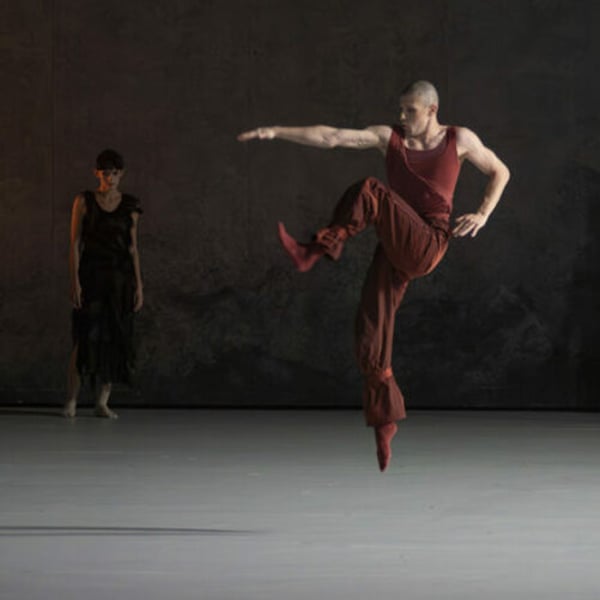
On the occasion of the Contrastes programme, presented from December 1 to 31, 2025 at the Opéra national de Paris, Alainpaul unveils its first collaboration with choreographers Imre and Marne van Opstal. Their new piece, Drift Wood, offers an ideal canvas for exploring the relationship between body, material, and narrative, a space where costumes become integral to movement.
Inspired by the image of driftwood, shaped by time and carried by the currents, Alainpaul’s costumes give physical form to the tension at the heart of the piece: that which both opposes and binds conscious humanity to instinctive nature. Poised between fragility and resistance, the silhouettes move like a second skin, moulding to the dancers’ movements. This focus on texture and construction renders, in visual terms, the contradictions that course through Drift Wood, where bodies oscillate between self-control and impulse.
“A moment of fulfilment”
Conceived as a poetic diorama, the piece unfolds within a landscape shaped by the elements: sound, image, and movement interweave to explore vulnerability, connection, and ambiguity. In this floating world, the costumes play a central role. Rooted in Alainpaul’s signature sculptural clarity and fluidity, they amplify the emotional language imagined by the Van Opstal duo. For the house, this collaboration marks a powerful return to the stage, where clothing reconnects with its primary origin: gesture.

“Collaborating with Imre and Marne, as well as with the Opéra national de Paris’s exceptional atelier, was an immense honour,” said Alain Paul, the house’s founder. “These are the first Alainpaul costumes created for a contemporary ballet, and we are deeply grateful for the trust placed in us for Drift Wood. We have forged a genuine dialogue between movement and the construction of the costumes. Having grown up in the world of dance, this project represents a moment of fulfilment and a profound way of uniting my two worlds.”
Alainpaul, a brand inspired by choreography
This creation forms part of Contrastes, a programme that brings together three choreographic worlds: two major works by Trisha Brown, the entry into the repertoire of David Dawson’s Anima Animus, and Drift Wood, the Van Opstals’ first piece for the Paris Opera. Together, these works explore the tensions and oppositions running through dance today, from minimalist radicalism to sculptural power.

Founded on a choreographic approach to clothing, the house Alainpaul has, from the outset, drawn on the vocabulary of choreographers such as Pina Bausch and Merce Cunningham. Its pieces, with their experimental lines and sculptural silhouettes, reinterpret the dancer’s wardrobe within a timeless, urban aesthetic. With Drift Wood, this ambition takes on a new dimension: that of a garment fully animated by movement.
This article is an automatic translation.
Click here to read the original article.
Copyright © 2025 FashionNetwork.com All rights reserved.
Fashion
Hybrid retail takes over Christmas as most shoppers go for in-store/online mix – CACI report




Andy Dick’s Crack Smoking Helped Him Avoid Fentanyl Death, DEA Sources Say

Alainpaul and its costumes take to the stage with Drift Wood at the Paris Opera

Emily Gregory lands new endorsements, tops $80K in HD 87 Special Election as vote-by-mail begins
-

 Politics8 years ago
Congress rolls out ‘Better Deal,’ new economic agenda
-
Entertainment8 years ago
New Season 8 Walking Dead trailer flashes forward in time
-
Politics8 years ago
Poll: Virginia governor’s race in dead heat
-
Entertainment8 years ago
The final 6 ‘Game of Thrones’ episodes might feel like a full season
-
Entertainment8 years ago
Meet Superman’s grandfather in new trailer for Krypton
-
Politics8 years ago
Illinois’ financial crisis could bring the state to a halt
-
Business8 years ago
6 Stunning new co-working spaces around the globe
-
Tech8 years ago
Hulu hires Google marketing veteran Kelly Campbell as CMO